Sooho.io utilized a compact 9-slide deck to secure a $4.5M Series A round in 2024, as reported by Business Insider. The deck functions more as a technical partnership proposal than a traditional narrative-driven investor presentation, emphasizing the company's pedigree and automated security tools. By highlighting a total value protected of over $2.9 billion as of October 2021 (Slide 4) and backing from industry titan ConsenSys (Slide 2), Sooho.io establishes immediate credibility in the high-stakes blockchain security sector. The presentation leans heavily on technical workflows and vulnerab…
Key takeaways
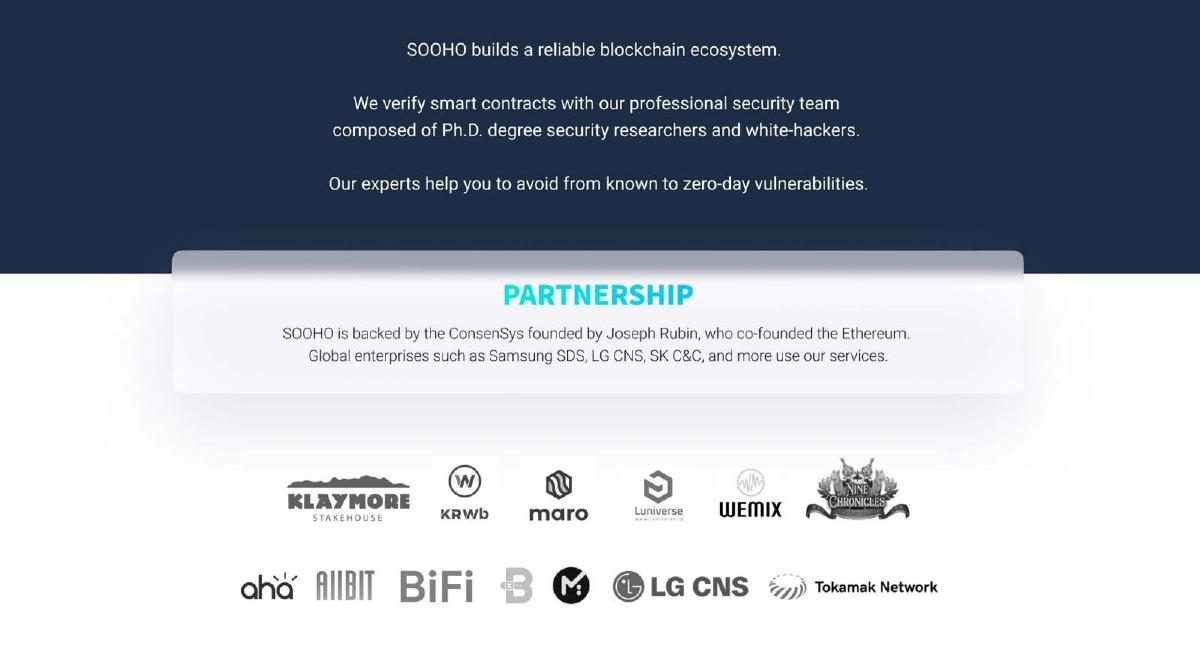
- The deck highlights significant institutional backing, specifically mentioning being backed by ConsenSys and its founder Joseph Lubin on Slide 2.
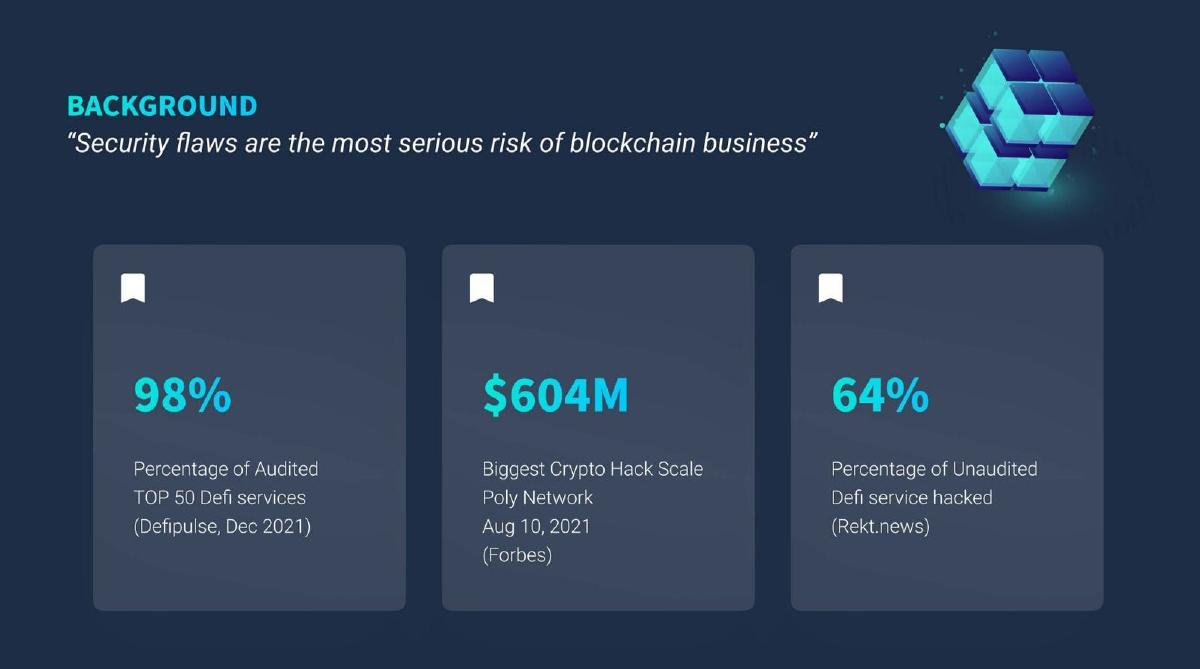
- Sooho.io uses high-impact industry statistics to frame the problem, citing that 64% of unaudited DeFi services have been hacked on Slide 3.
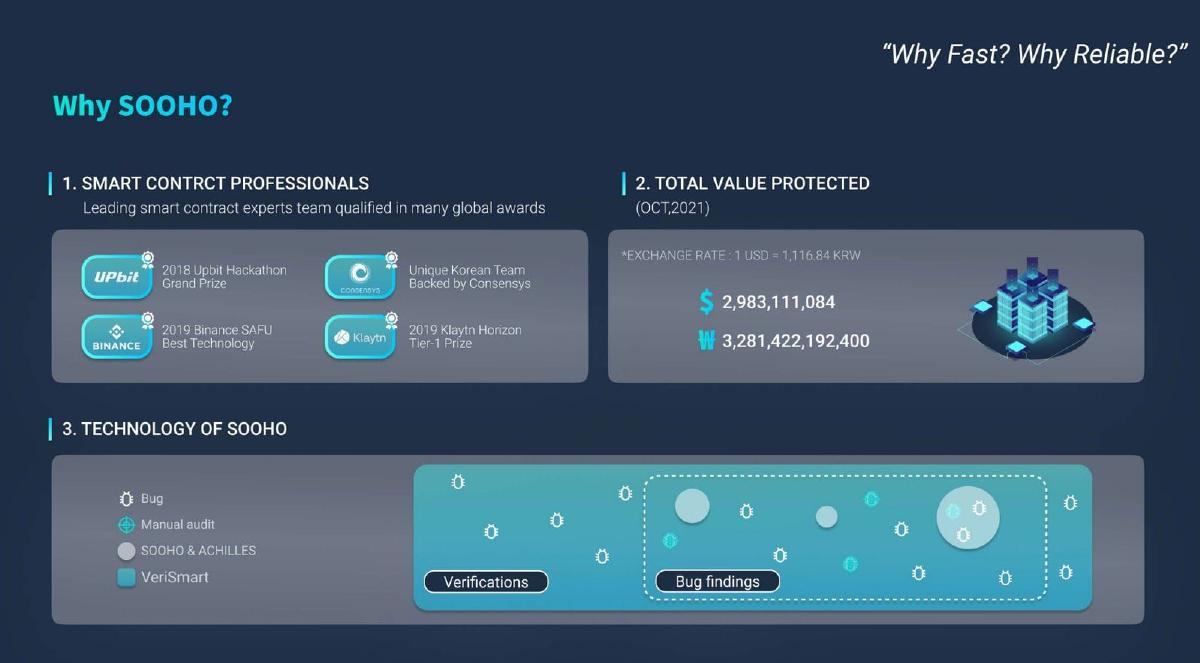
- The company demonstrates scale by reporting $2,983,111,084 in total value protected as of October 2021 on Slide 4.
- Technical validation is provided through a list of awards, including the 2018 Upbit Hackathon Grand Prize and the 2019 Binance SAFU Best Technology award on Slide 4.
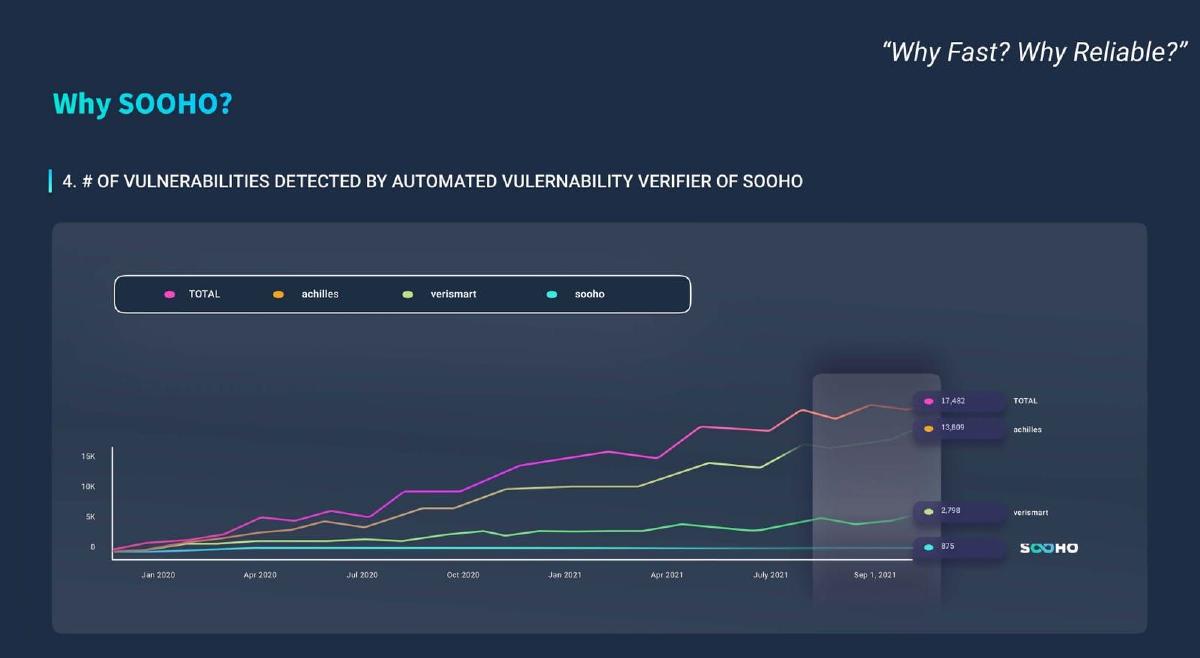
- The deck showcases a proprietary automated vulnerability verifier that detected 17,482 total vulnerabilities by September 2021, as shown on Slide 5.
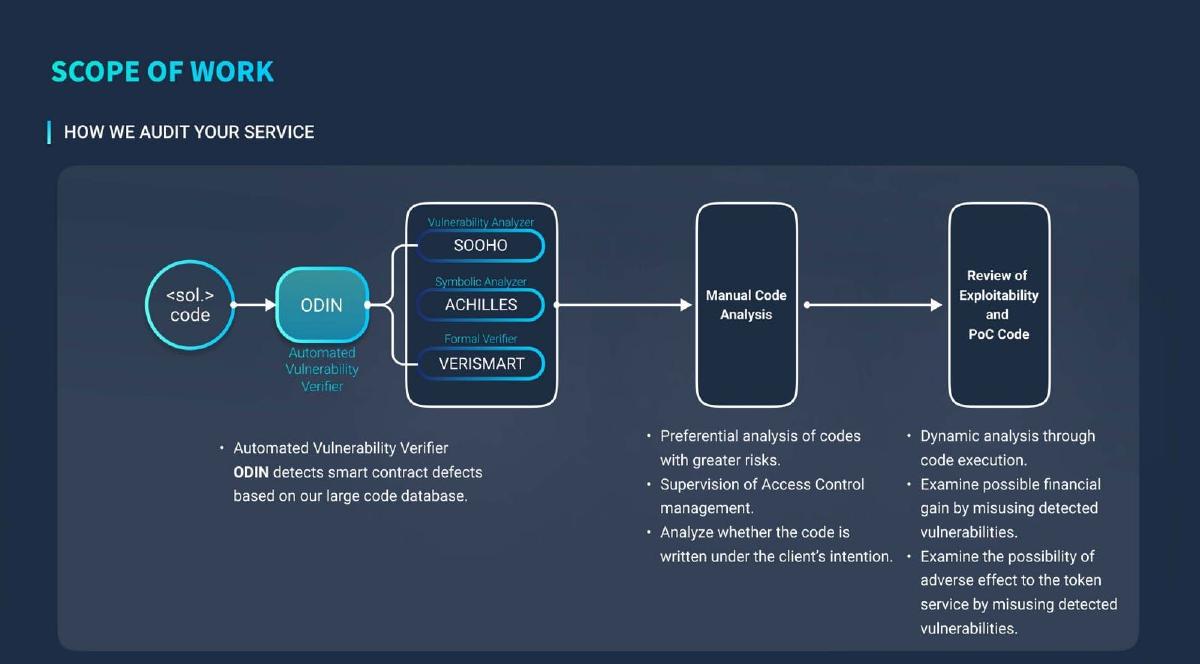
- A clear operational workflow is presented on Slide 6, detailing a three-stage process: automated verification, manual code analysis, and exploitability review.
- The deck emphasizes enterprise adoption by listing major partners such as Samsung SDS, LG CNS, and SK C&C on Slide 2.
- The presentation omits a dedicated team slide, financial ask, and future growth projections, focusing instead on current technical capabilities and deliverables.
Sooho.io: Technical Credibility in Blockchain Security
Sooho.io is a South Korean cybersecurity firm that specializes in automated blockchain security solutions. In a sector where a single bug can lead to hundreds of millions of dollars in losses, Sooho.io positions itself as a necessary safeguard for enterprises. The 9-slide deck analyzed here was used during a period leading up to their $4.5M Series A raise in 2024, as reported by Business Insider. The deck is notably technical, focusing on the 'how' of their security audits rather than the 'how much' of their financial projections.
Slide 1: Title and Positioning
The opening slide identifies the document as an 'AUDIT PARTNERSHIP PROPOSAL.' This suggests the deck may have served a dual purpose: both as a sales tool for enterprise clients and as a foundational document for investors. The tagline at the bottom, 'The Fastest, Most Convenient way to Secure your Blockchain System,' sets a clear value proposition centered on speed and ease of use in a typically cumbersome auditing market.
Slide 2: Partnership and Backing
Slide 2 is a heavy-hitter for credibility. It explicitly states that Sooho.io is 'backed by the ConsenSys founded by Joseph Rubin [sic], who co-founded the Ethereum.' Mentioning ConsenSys is a strategic move to align the company with the most established names in the blockchain space. Furthermore, the slide lists major South Korean conglomerates—Samsung SDS, LG CNS, and SK C&C—as users of their services. The bottom of the slide features a logo wall including Klaymore, WEMIX, and LG CNS, reinforcing their strong foothold in the Asian enterprise market.
Slide 3: The Problem (Background)
The 'Background' slide uses three stark metrics to justify the company's existence. It quotes Defipulse (Dec 2021) stating that 98% of the Top 50 DeFi services are audited, yet Rekt.news reports that 64% of unaudited DeFi services have been hacked. The centerpiece of the slide is the $604M Poly Network hack from August 2021, cited from Forbes. By framing the problem through the lens of massive financial loss, Sooho.io makes the case that their service is not an optional luxury but a business necessity.
Slide 4: Why Sooho? (Part 1)
This slide focuses on three pillars of differentiation. First, it highlights 'Smart Contract Professionals' and lists awards from Upbit, Binance, ConsenSys, and Klaytn to prove technical excellence. Second, it provides a 'Total Value Protected' figure of $2,983,111,084 as of October 2021. Third, it introduces the 'Technology of Sooho,' using a bubble chart to visualize how their tools (Achilles and VeriSmart) find bugs that manual audits might miss. The inclusion of the exchange rate (1 USD = 1,116.84 KRW) indicates a meticulous approach to data reporting.
Slide 5: Why Sooho? (Part 2)
Slide 5 provides a quantitative look at their automated vulnerability verifier's performance. A line graph tracks the number of vulnerabilities detected from January 2020 to September 2021. The 'TOTAL' line reaches 17,482, with the 'achilles' tool accounting for 13,809 of those findings. This data serves to prove that their software is not just theoretical but is actively identifying risks at scale. The growth in detections also implies a growing database of known vulnerabilities, which is a competitive moat in the cybersecurity industry.
Slide 6: Scope of Work
This slide details the technical workflow of an audit. It shows a pipeline starting with '<sol.> code' (Solidity) passing through 'ODIN' (Automated Vulnerability Verifier), then into a suite of analyzers (Sooho, Achilles, VeriSmart), followed by 'Manual Code Analysis,' and finally a 'Review of Exploitability and PoC Code.' This transparency into their process is designed to reassure enterprise clients that the audit is rigorous and multi-layered, combining the speed of AI with the precision of human oversight.
Slide 7: Audit Process
Slide 7 maps out the business engagement model: Proposal, Contract, Payment, Analysis, and Final Audit Report. It includes a feedback loop ('Reaudit') which is critical in the security world, as it ensures that once bugs are found, they are actually fixed and verified. The flowchart is clean and professional, emphasizing a structured, predictable experience for the client.
Slide 8: Deliverables
The 'Deliverables' slide shows what the client actually receives: a Security Assessment Report (available in English and Korean) and a 'SOOHO Certificate.' The certificate is positioned as a marketing asset for the client to 'Share with Investors, Exchanges, and your community.' This demonstrates that Sooho.io understands the secondary value of an audit: it is a badge of trust that helps their clients raise money and get listed on exchanges.
Slide 9: Contact and Socials
The final slide is a standard 'Thank You' with a contact email (audit@sooho.io) and icons for Twitter, Medium, GitHub, and Facebook. It is functional but lacks a specific call to action or a summary of the investment opportunity, further suggesting this version of the deck was tailored for a broad audience of partners and potential investors.
What Works in the Sooho.io Deck
Institutional Credibility: The deck does an excellent job of 'borrowing' authority. By leading with ConsenSys and Samsung SDS, they bypass the skepticism often directed at blockchain startups. If these giants trust Sooho.io, a new investor or client feels safer doing the same.
Data-Driven Validation: The use of specific numbers—17,482 vulnerabilities detected and $2.9B protected—provides tangible evidence of their market impact. These aren't just round numbers; they are precise figures that suggest a high level of internal tracking and professionalism.
Clear Technical Workflow: For a technical product, explaining the 'black box' is essential. Slide 6 effectively demystifies how their software and humans interact, which is crucial for building trust with CTOs and technical due diligence teams.
What is Missing from the Sooho.io Deck
The Team: Perhaps the most glaring omission is a team slide. While they mention having Ph.D. researchers, they don't name them or provide their backgrounds. In a Series A round, investors are usually betting as much on the founders as the technology.
Financials and Projections: There is no mention of revenue, burn rate, or future growth targets. While the 'Total Value Protected' is a great vanity/impact metric, it doesn't tell an investor how the company makes money or how it will scale to $100M in ARR.
The Ask: The deck ends without a specific funding request. We know from publisher reports that they raised $4.5M, but the deck itself doesn't specify what that money would be used for—whether it's for R&D, international expansion, or sales and marketing.
Founder's Guide: What to Copy
Use a 'Trust Wall': If you have high-profile backers or clients, put them on Slide 2. Don't wait until the end. Sooho.io uses their partnerships to set the tone for the entire presentation.
Quantify the Problem: Don't just say 'smart contracts are risky.' Use Slide 3's approach: cite specific hack amounts and percentages of unaudited vs. audited failures. It makes the 'need' for your product undeniable.
Show the 'Product in Action' via Metrics: Even if you don't show a live demo, a graph of your tool's output (like Slide 5) proves that your technology works and is being utilized. It turns a theoretical solution into a proven one.
Structure for Professionalism: The clean, consistent design and the inclusion of a 'Deliverables' slide (Slide 8) make the company look like a professional service provider rather than a scrappy startup. This is vital when selling to enterprises like LG and Samsung.
Frequently asked questions
- How much did Sooho.io raise with this deck?
- According to reports from Business Insider, Sooho.io raised $4.5 million in a Series A funding round in 2024. The deck itself does not state the amount raised or the specific terms of the investment ask, which is common in decks designed for initial partnership or high-level investor interest.
- Who are Sooho.io's main enterprise partners?
- Slide 2 of the deck lists several prominent global enterprises that use Sooho.io's services, including Samsung SDS, LG CNS, and SK C&C. It also mentions being backed by ConsenSys, a major player in the Ethereum ecosystem founded by Joseph Lubin.
- What technical tools does Sooho.io use for auditing?
- The deck identifies several proprietary and integrated tools on Slides 5 and 6. These include ODIN (an automated vulnerability verifier), Achilles (a symbolic analyzer), and VeriSmart (a formal verifier). These tools are used in tandem with manual code analysis to identify smart contract defects.
- What is the 'Total Value Protected' metric mentioned in the deck?
- On Slide 4, Sooho.io claims a 'Total Value Protected' of $2,983,111,084 (approximately 3.28 trillion KRW) as of October 2021. This metric is used to demonstrate the scale and trust placed in their security protocols by their client base.
- Does the deck include a team slide or founder bios?
- No, the 9-slide deck provided does not include a dedicated team slide or individual founder biographies. It mentions generally on Slide 2 that the team is composed of Ph.D. degree security researchers and white-hackers, but lacks specific names or career histories.