VIA Global Health’s 2015 Seed deck is a study in minimalism, containing only eight slides. The company positions itself as a digital intermediary in the global healthcare supply chain, specifically targeting the Africa and India markets, which it values at over $23 billion on slide 3. The deck relies heavily on visual metaphors and high-level growth metrics, such as scaling to 44,000 products within nine months (slide 4). While it successfully establishes the scale of the problem and the company's early traction across 17 countries (slide 5), it is notably absent of traditional venture capita…
Key takeaways
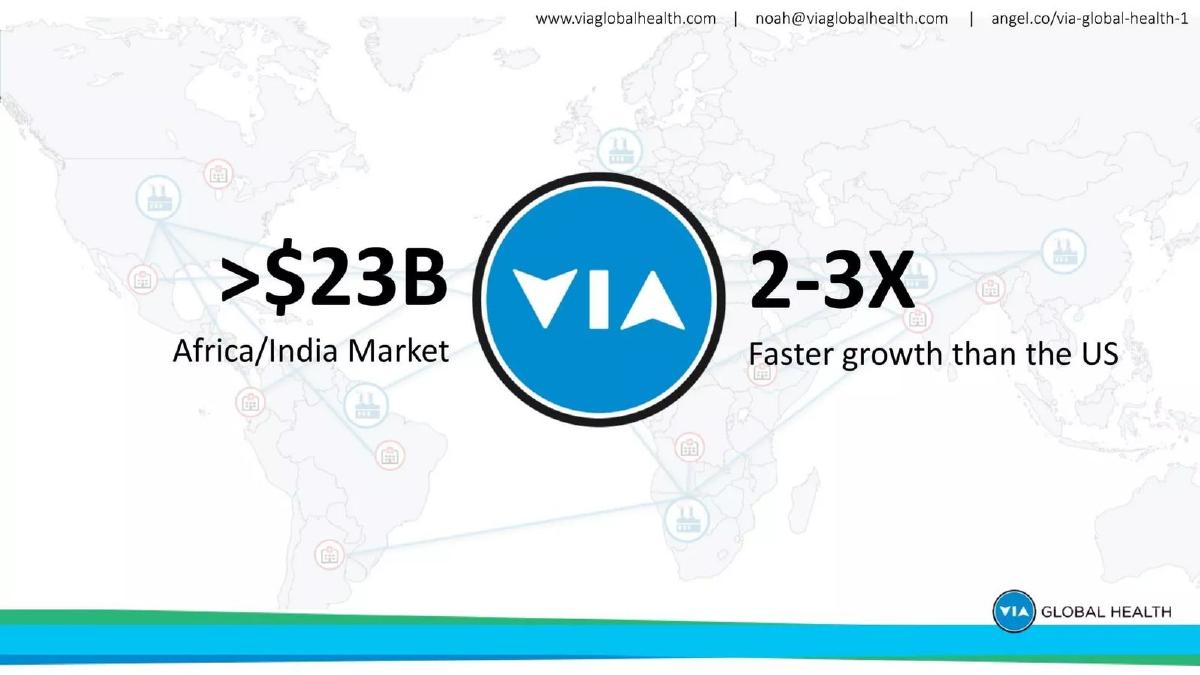
- The total addressable market for Africa and India is cited as greater than $23 billion on slide 3.
- The company claims the target market is growing 2-3x faster than the United States market (slide 3).
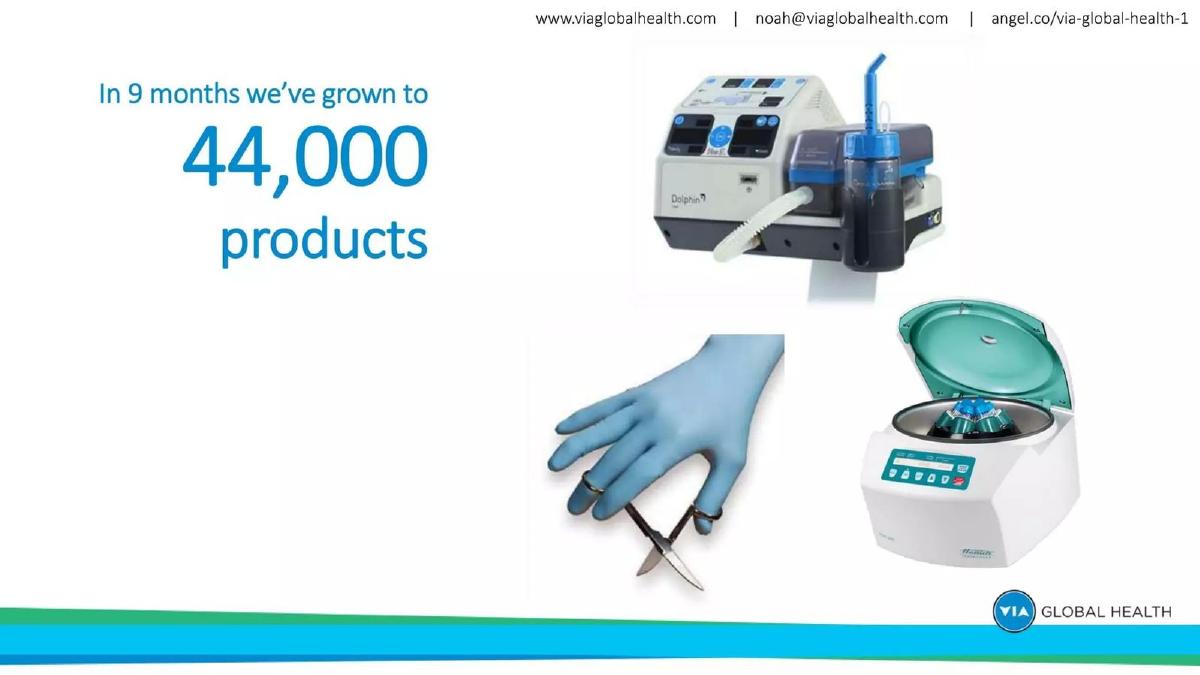
- Product inventory scaled from zero to 44,000 products in the first nine months of operation (slide 4).
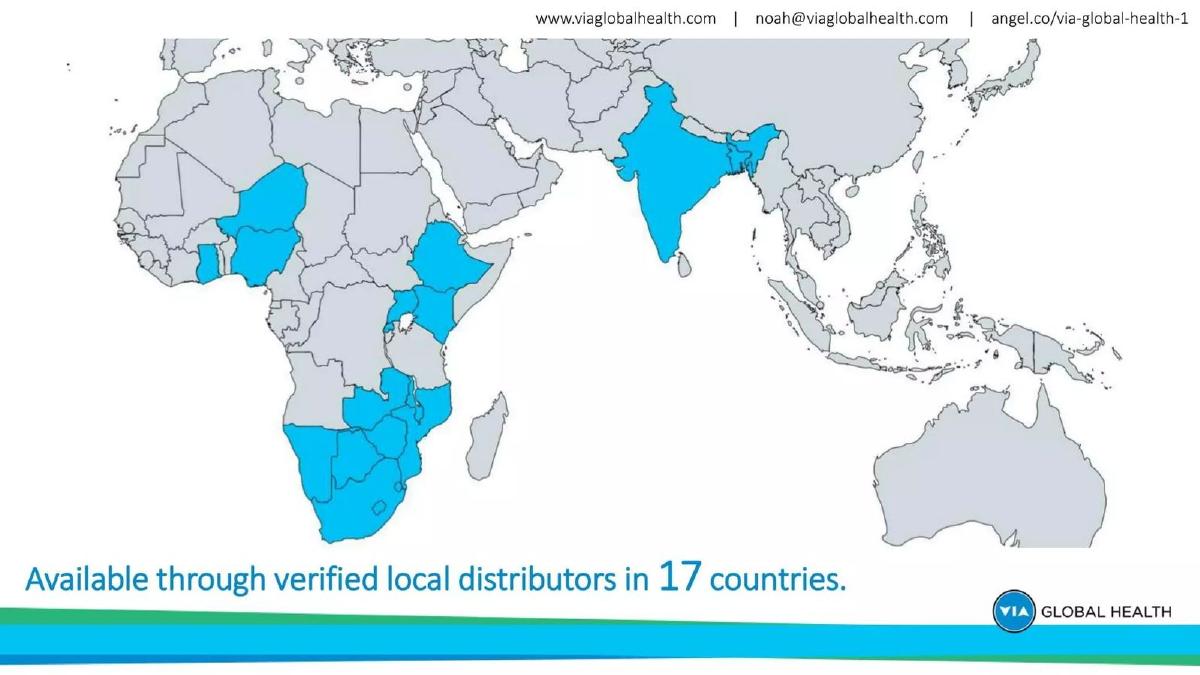
- The platform operates through a network of verified local distributors across 17 countries (slide 5).
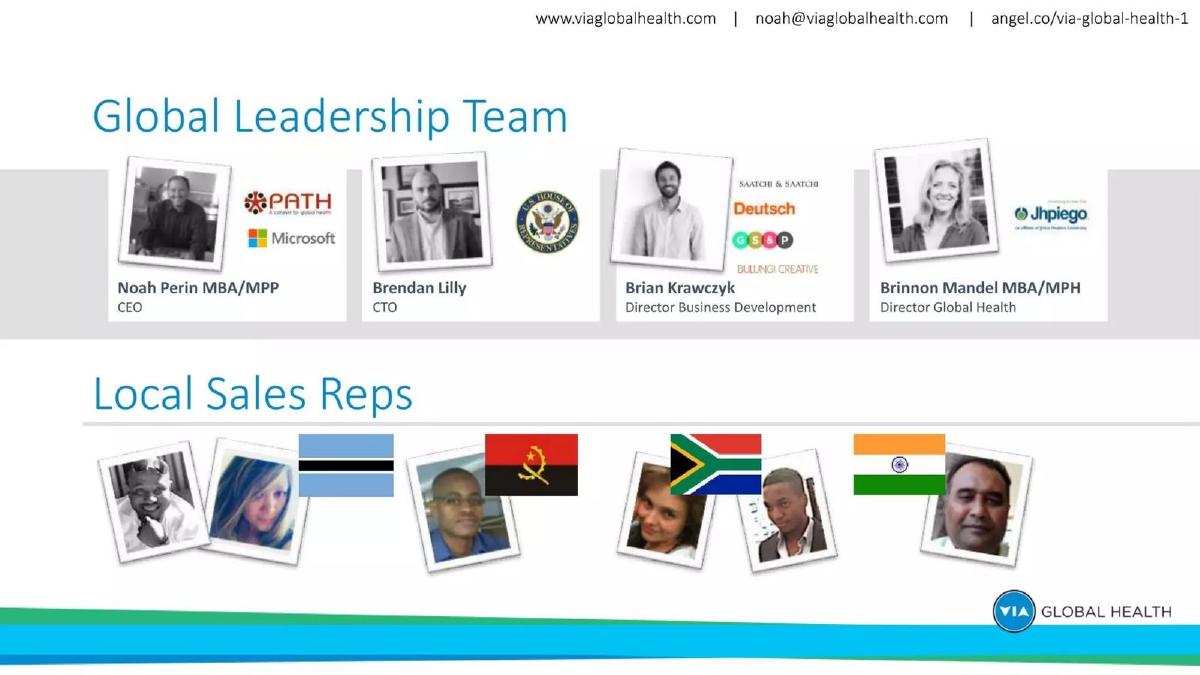
- The leadership team includes alumni from PATH, Microsoft, and Jhpiego (slide 6).
- The business model relies on managing logistics and cross-border transactions between manufacturers and global markets (slide 8).
- The deck contains no slide regarding the specific amount of capital being raised or the intended use of funds.
- There is a complete omission of financial projections, burn rate, or revenue to date within the slides.
The 8-Slide Marketplace Summary
VIA Global Health presented a Seed-stage deck in 2015 that serves as a template for extreme brevity. At only eight slides, the deck avoids the common pitfall of over-explaining technical medical specifications, instead focusing on the logistics and scale of a global marketplace. The company positions itself as the 'Amazon' or 'Alibaba' for medical supplies in regions where the supply chain is traditionally broken or inefficient.
Slide 1: Title and Vision
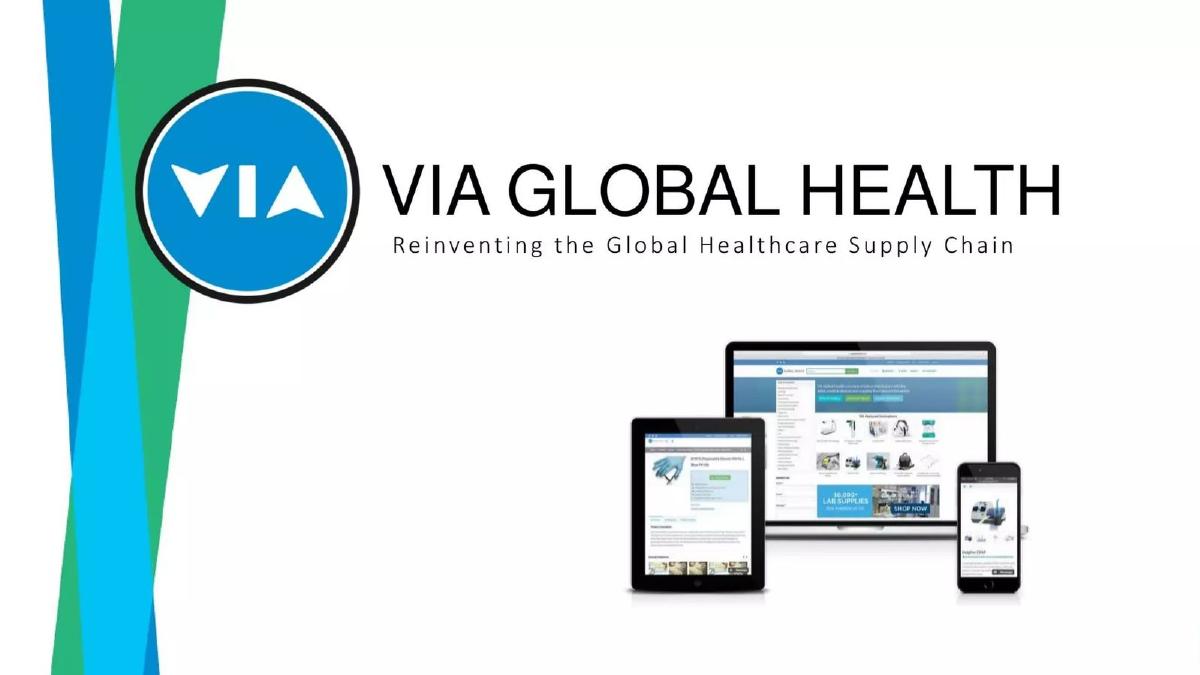
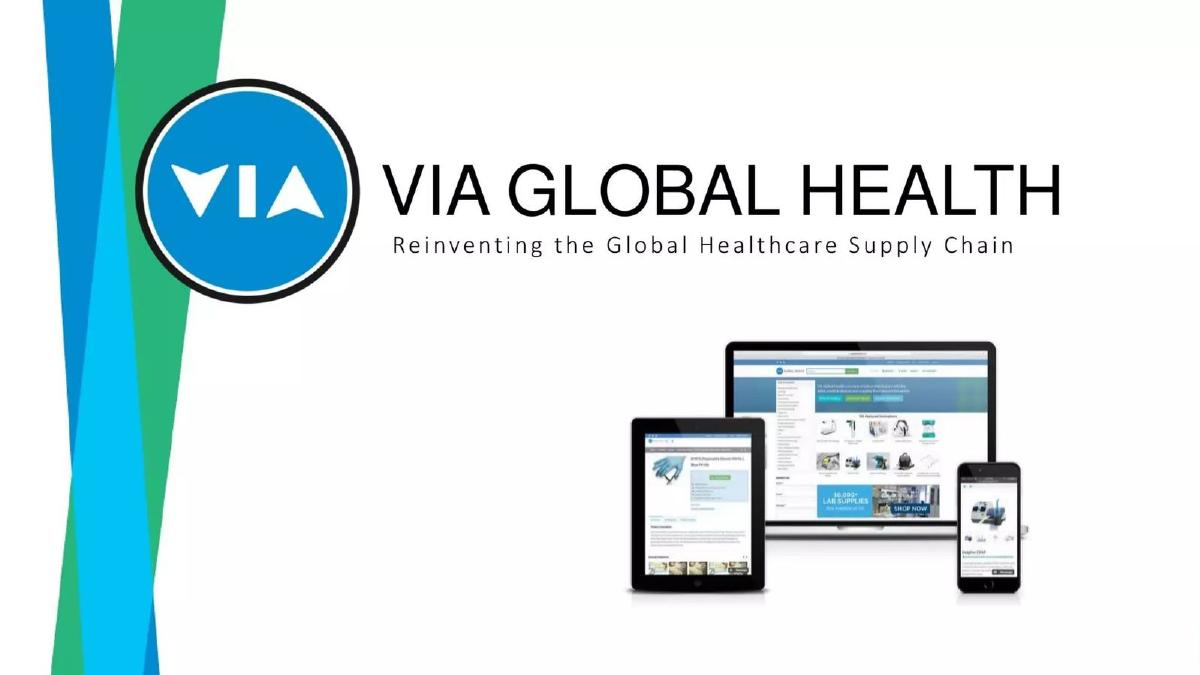
The cover slide introduces the company name and the tagline: Reinventing the Global Healthcare Supply Chain . It features a visual of the platform across three devices—tablet, laptop, and smartphone—signaling that this is a modern, tech-enabled solution. The imagery on the screens shows a clean e-commerce interface, which immediately categorizes the business as a marketplace rather than a medical device manufacturer.
Slide 2: The Traditional Supply Chain
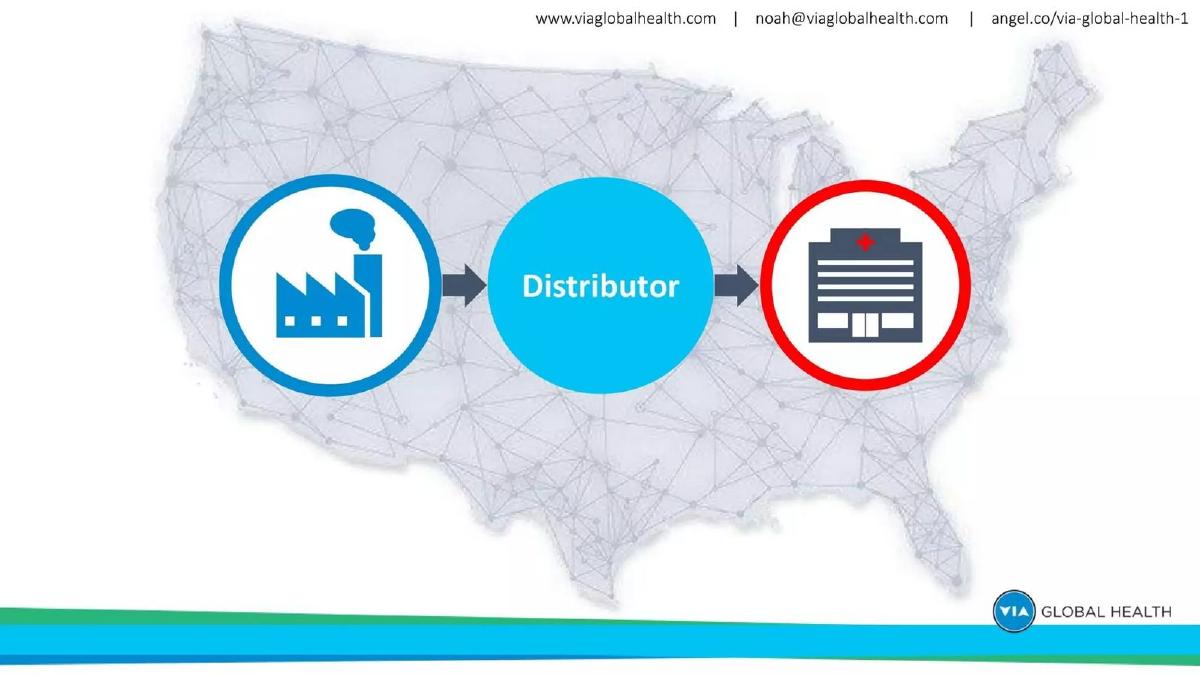
Slide 2 uses a simple diagram to illustrate the status quo. It shows a factory (Manufacturer) connected to a 'Distributor' which then connects to a hospital. The background is a map of the United States. This slide sets the stage for the contrast that follows, implying that while this chain works in the US, it is not optimized for the global stage.
Slide 3: The Market Opportunity
This is the 'Why Now' and 'How Big' slide. It features two massive figures: >$23B Africa/India Market and 2-3X Faster growth than the US . By placing the VIA logo in the center of a world map with connecting lines, the company suggests they are the bridge to this high-growth, high-value region. The slide effectively argues that the real growth in healthcare spending is shifting away from saturated Western markets toward emerging ones.
Slide 4: Inventory Traction
Traction is often the most important part of a Seed deck. VIA chooses to demonstrate traction through inventory growth rather than revenue. The slide states: In 9 months we’ve grown to 44,000 products . Visuals of medical equipment, including a centrifuge and surgical gloves, accompany the text. This metric is intended to show the speed at which they can onboard suppliers and the breadth of their catalog, which is a key moat for any marketplace business.
Slide 5: Geographic Footprint
Slide 5 provides a map highlighting 17 countries in blue, mostly in Africa and including India. The caption reads: Available through verified local distributors in 17 countries. This slide addresses the 'last mile' problem. By mentioning 'verified local distributors,' VIA explains their go-to-market strategy: they aren't building their own warehouses in every country; they are leveraging existing local infrastructure to fulfill orders placed on their platform.
Slide 6: Team and Local Presence
The team slide is split into two sections. The Global Leadership Team features four individuals with diverse backgrounds. Noah Perin (CEO) brings experience from PATH and Microsoft, while Brinnon Mandel (Director Global Health) comes from Jhpiego. The bottom half of the slide, titled Local Sales Reps , shows photos of individuals next to the flags of Botswana, Angola, South Africa, and India. This is a strategic inclusion; it proves the company has 'boots on the ground' to manage the cultural and regulatory nuances of their target markets.
Slide 7: The Mission Statement
Slide 7 is a transition or 'vision' slide. It states: We make the tools that save lives globally accessible. It repeats the multi-device imagery from the cover and provides contact information, including three different regional URLs (.com, .co.za, and .in). This reinforces the global nature of the brand and provides a clear call to action for interested parties.
Slide 8: The Business Model Diagram
The final slide is a flow chart of the business model. It shows a manufacturer on the left and a globe on the right. In the center is the VIA logo. Two arrows represent the value exchange: Logistics moving toward the global market, and Cross-border transactions moving back toward the manufacturer. This slide clarifies that VIA is a transactional platform that solves the two biggest headaches in international trade: getting the goods there and getting the money back.
What Works in This Deck
Clarity of Purpose: Within the first three slides, it is perfectly clear what VIA Global Health does. They are a marketplace for medical supplies in emerging markets. They do not clutter the deck with medical jargon or complex regulatory hurdles.
Speed of Execution: The mention of 44,000 products in 9 months (Slide 4) is a powerful indicator of operational velocity. For a Seed stage company, proving you can move fast is often more important than proving you are currently profitable.
Visual Simplicity: The deck uses a consistent color palette (blue and green) and very little text. This makes it easy to digest in a 2-minute skim, which is how most analysts first interact with a deck.
What Is Missing
The Ask: There is no mention of how much capital is being raised. A standard pitch deck should include a slide detailing the funding target and how those funds will be allocated (e.g., 40% engineering, 30% sales, etc.).
Financials and Unit Economics: The deck tells us the market is $23B, but it doesn't tell us how much VIA makes on a $1,000 centrifuge sale. Are they taking a 10% commission? Are they buying and reselling? The lack of margin data is a significant omission for a marketplace business.
Competitive Landscape: The deck assumes a vacuum. It does not address local competitors in India or Africa, nor does it address how they defend against large incumbents like GE Healthcare or Philips who might have their own distribution networks.
What a Founder Should Copy
The 'Local Reps' Strategy: If you are building a business that operates in fragmented international markets, showing the faces of your local representatives (Slide 6) builds immense credibility. It shows that you aren't just a team in Seattle or London trying to guess what a hospital in Luanda needs.
Market Growth Comparison: Comparing the growth rate of your target market to a well-known benchmark (like the US market on Slide 3) is a great way to create urgency. It tells the investor that while the US is stable, the real 'alpha' is in the regions where growth is 3x higher.
Focus on Logistics: By highlighting 'Cross-border transactions' and 'Logistics' as their core functions (Slide 8), VIA avoids being seen as just a 'website.' They are positioning themselves as a critical infrastructure layer, which commands a higher valuation than a simple directory.
Frequently asked questions
- What is the primary value proposition of VIA Global Health?
- Based on slide 8, VIA Global Health acts as the central hub connecting medical manufacturers to global markets. They handle the complexities of cross-border transactions and logistics, which typically act as barriers to entry for medical equipment in emerging economies. By streamlining this process, they aim to make life-saving tools more accessible.
- How does the company validate its geographic reach?
- On slide 5, the company provides a map highlighting their presence in 17 countries, primarily concentrated in Sub-Saharan Africa and India. They emphasize that this reach is facilitated by 'verified local distributors,' suggesting a partnership-heavy model rather than a direct-to-hospital sales force in every region.
- Who are the key members of the leadership team?
- Slide 6 introduces four leaders: Noah Perin (CEO), Brendan Lilly (CTO), Brian Krawczyk (Director Business Development), and Brinnon Mandel (Director Global Health). The slide highlights their pedigree with logos from organizations like Microsoft, the U.S. House of Representatives, and Saatchi & Saatchi.
- What market data does the deck provide to justify the opportunity?
- Slide 3 provides two primary data points: a market size of over $23 billion for the Africa/India region and a growth rate that is 2-3x faster than that of the US. This is intended to show investors that the 'emerging market' opportunity is both large and accelerating.
- What critical information is missing from this pitch deck?
- The deck is missing several standard components: a 'The Ask' slide (how much money they want), a 'Competition' slide, 'Unit Economics' (margins per transaction), and 'Financial Projections.' It focuses almost entirely on the 'what' and 'where' rather than the 'how much' and 'when.'