The Vettery Series A pitch deck is a highly efficient document that focuses on the core mechanics of a successful marketplace. By 2016, the company had already achieved significant scale, reporting over 1,700 hiring managers and 4,700 candidates on the platform. The deck's strength lies in its transparency regarding unit economics, specifically citing a $77 Candidate Acquisition Cost against a $15,960 Average Revenue per Placement. This massive LTV/CAC ratio, combined with a 90.3% gross margin, made the $9M investment a low-risk proposition for Series A investors. While the deck lacks a tradi…
Key takeaways
- The platform achieved a massive LTV/CAC ratio with a $77 acquisition cost vs. $15,960 revenue per placement (Slide 9).
- Vettery reported a 90.3% gross margin as of April 2016, indicating high operational efficiency (Slide 9).
- The marketplace successfully scaled to 1,700 hiring managers and 4,700 candidates within 57 weeks of launch (Slide 3).
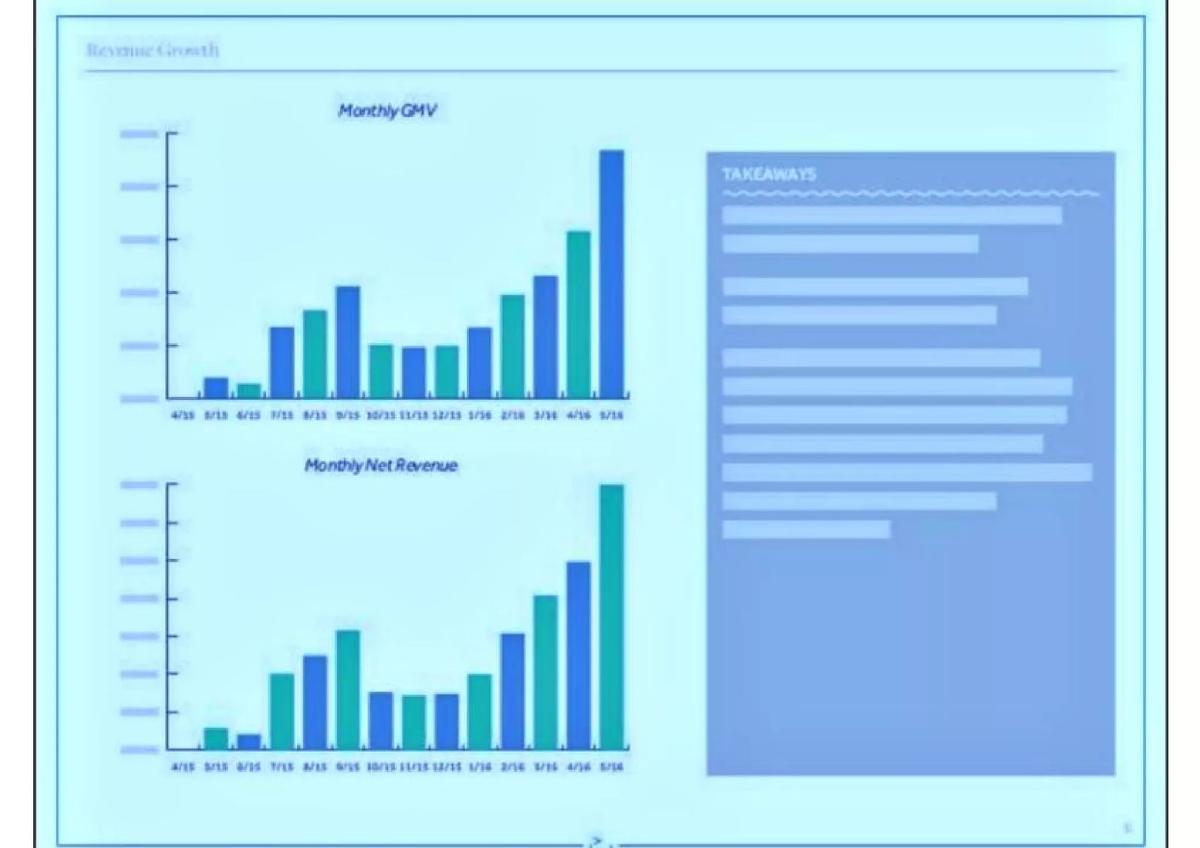
- Revenue and GMV charts show a distinct 'hockey stick' growth pattern starting in early 2016 (Slide 6).
- The company positioned itself as a mid-priced alternative between low-cost job boards and high-cost full-service recruiters (Slide 8).
- The deck completely omits a team slide, which is unusual for a Series A presentation.
- Market size is defined by the $120 billion U.S. staffing industry, highlighting the massive headroom for growth (Slide 7).
- The technology roadmap focuses on automation and integration, aiming to further streamline the interview funnel (Slide 10).
The Efficiency of Data-Driven Marketplaces
Vettery's Series A pitch deck from May 2016 is a masterclass in brevity. At only 11 slides, it bypasses the typical narrative storytelling found in seed decks and moves straight to the industrial-strength metrics required for a $9M Series A. The company, which describes itself as a "data-driven hiring marketplace," used this presentation to demonstrate how they were disrupting the $120 billion U.S. staffing industry by applying marketplace dynamics to professional recruitment.
The deck is remarkably clinical. There are no photos of the office, no deep dives into the founders' backgrounds, and no flowery language about "changing the world." Instead, Vettery focuses on the cold, hard reality of unit economics: how much it costs to get a candidate and how much revenue that candidate generates. This transparency is likely what led to their $100M acquisition by The Adecco Group less than two years after this deck was used.
The Vision and Product Overview (Slides 1-3)
Slide 1 is a standard title slide featuring the Vettery logo and the date, May 2016. The branding is consistent with the light blue color palette used throughout the deck.
Slide 2 presents the "Vettery Vision." It is a single sentence: "Vettery will be the marketplace used for hiring across all roles, levels, and geographies." This is a classic "Amazon of X" statement, signaling to investors that while they may be starting in tech or finance, the platform is built for horizontal scale.
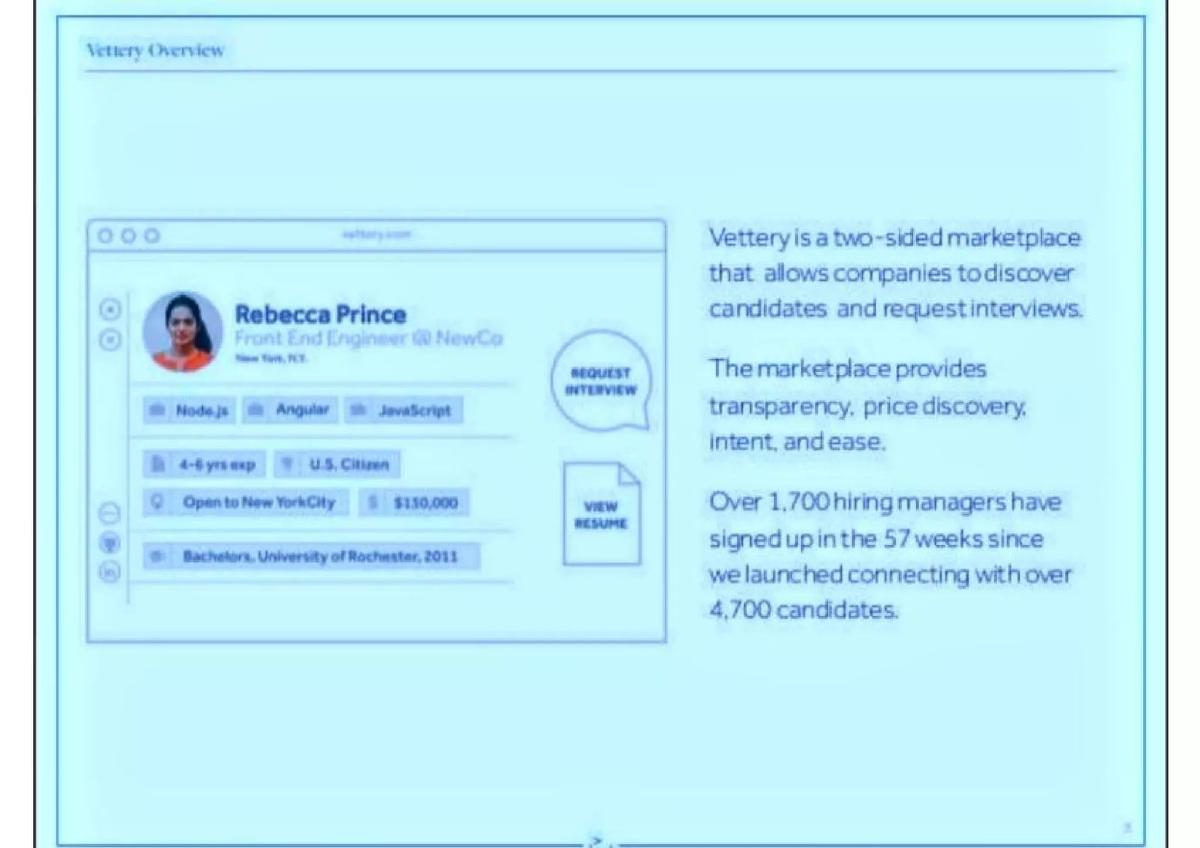
Slide 3 provides the "Vettery Overview." This is the first time we see the product interface—a clean, profile-based view of a candidate (Rebecca Prince, a Front End Engineer). The slide defines the business as a "two-sided marketplace that allows companies to discover candidates and request interviews." Crucially, it includes early traction data: "Over 1,700 hiring managers have signed up in the 57 weeks since we launched connecting with over 4,700 candidates." This establishes a ratio of roughly 2.7 candidates per hiring manager, indicating a curated, high-quality supply side rather than a flooded job board.
The Value Proposition (Slide 4)
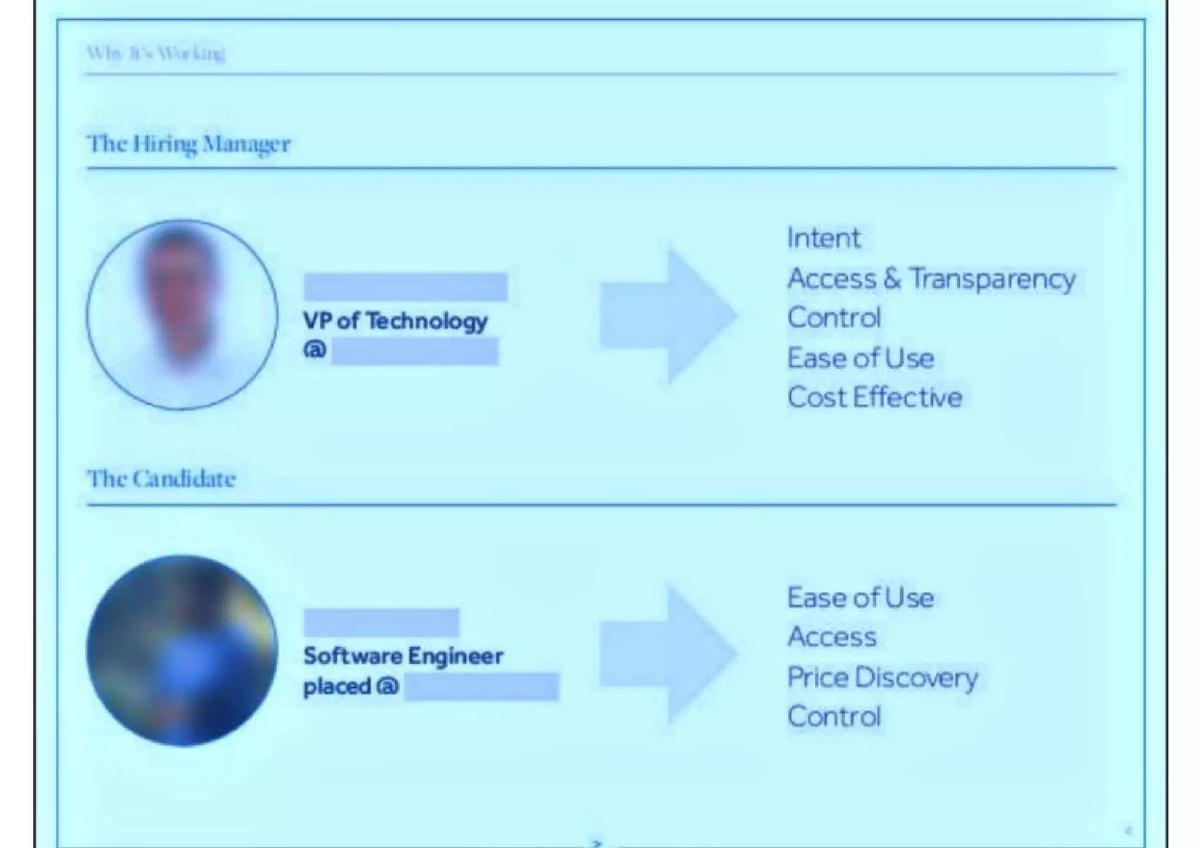
Slide 4 , titled "Why It's Working," breaks down the value for both sides of the marketplace. For the Hiring Manager, the benefits are Intent, Access & Transparency, Control, Ease of Use, and being Cost Effective. For the Candidate, the focus is on Ease of Use, Access, Price Discovery, and Control. The mention of "Price Discovery" for candidates is particularly important in recruitment, as it suggests the platform helps candidates understand their market value through real interview requests and salary offers.
The KPI Dashboard and Revenue Growth (Slides 5-6)
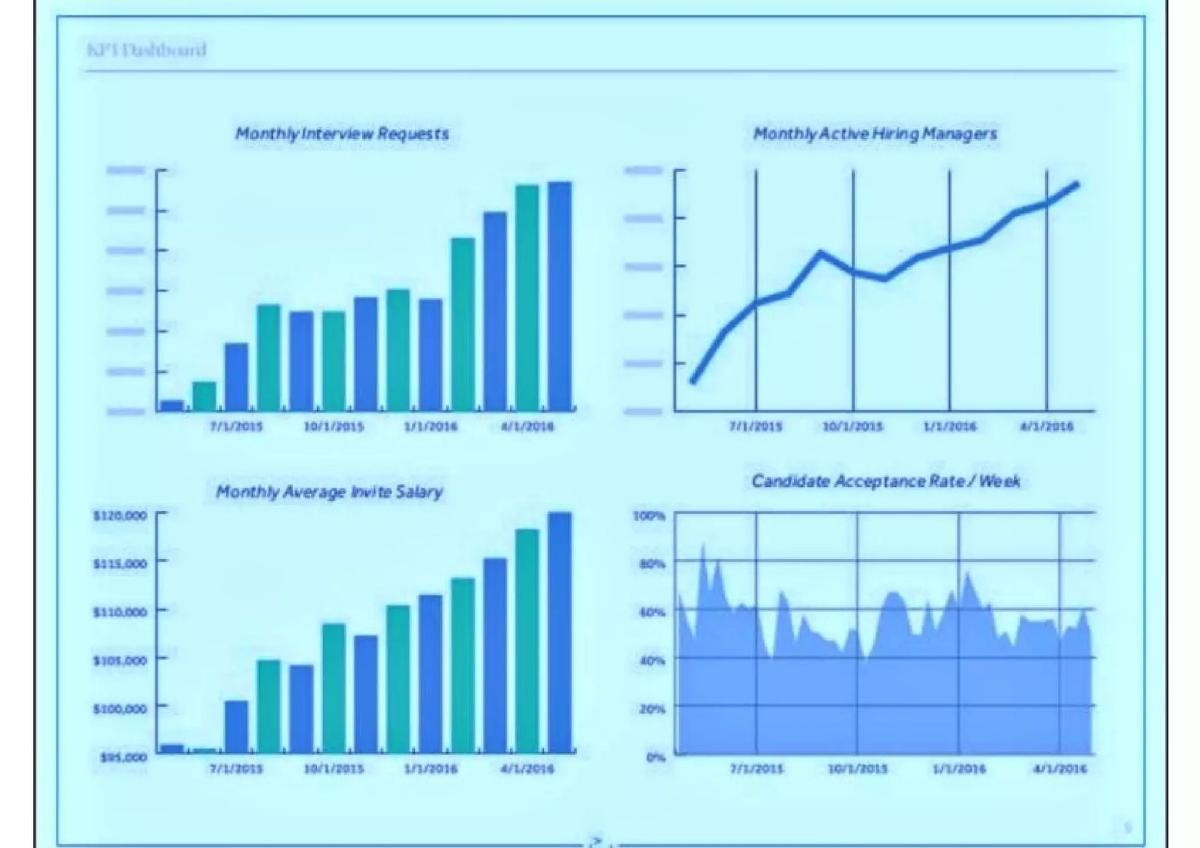
Slide 5 is the "KPI Dashboard," featuring four critical charts. The "Monthly Interview Requests" and "Monthly Active Hiring Managers" both show consistent month-over-month growth from July 2015 to April 2016. More interesting is the "Monthly Average Invite Salary," which climbed from approximately $96,000 to over $120,000 in less than a year. This indicates that Vettery was successfully moving up-market into higher-value roles. The "Candidate Acceptance Rate / Week" remains volatile but averages around 50-60%, showing healthy engagement.
Slide 6 focuses on "Revenue Growth." It displays "Monthly GMV" (Gross Merchandise Volume) and "Monthly Net Revenue." Both charts show a significant inflection point in early 2016. While the exact dollar amounts on the Y-axis are blurred or removed for the public version of the deck, the visual "hockey stick" trend is undeniable. A sidebar for "Takeaways" is included, though the text is placeholder lines in this version, suggesting the founders would speak to these points during the pitch.
Market Size and Competition (Slides 7-8)
Slide 7 addresses "Market Size." Vettery keeps it simple: the Annual U.S. Staffing Industry is $120 billion, and $500 billion globally. They add a compelling detail: "14 U.S. Staffing Firms generate >$1 billion in revenue per year." This tells investors that the market is not only huge but also capable of supporting multiple massive incumbents, making the exit potential very high.
Slide 8 covers "Competition." Vettery uses a three-column layout to categorize the landscape: Job Boards (Monster, LinkedIn, CareerBuilder, Indeed, Dice), Marketplaces (Vettery, Hired, Indeed Prime), and Full Service Incumbents (Betts Recruiting, Daversa Partners, Glocap, Michael Page, Riviera Partners, Robert Half). An arrow at the bottom indicates "Price" increasing from left to right. Vettery positions itself in the middle—more expensive (and valuable) than a job board, but significantly more affordable than a traditional headhunter.
The Business Model and Roadmap (Slides 9-10)
Slide 9 is arguably the most important slide in the deck, titled "Strong Business Model." It contains four staggering claims: 1) A 90.3% Gross Margin in April. 2) An estimate to be profitable and cash flow positive in May. 3) A belief that this is a "very high margin business" long term. 4) A "Very high return on investment" defined by a Candidate Acquisition Cost (CAC) of $77 against an Average Revenue/Placement of $15,960. This 200x+ ratio between revenue per unit and acquisition cost is the "holy grail" of marketplace economics.
Slide 10 outlines the "Technology Roadmap," divided into Data, Scaling, and HR Ecosystem Integrations. The focus is on "Better Matching," "Data driven curation," and "Integrations with Applicant Tracking Systems." This slide transitions the narrative from a recruiting firm to a technology platform, justifying a tech-multiple valuation rather than a service-multiple valuation.
Closing (Slide 11)
Slide 11 is a simple closing slide featuring the Vettery logo mark on the patterned blue background. There is no contact information or specific call to action on this slide.
What Works in This Deck
The standout feature of this deck is the Unit Economics (Slide 9) . By the Series A, investors want to see that the machine works. Vettery proves that for every $77 they put into the machine, they get nearly $16,000 out. This makes the decision to invest $9M very easy; the capital is clearly going toward a highly efficient customer acquisition engine.
The KPI Dashboard (Slide 5) is also excellent. By showing "Average Invite Salary," they prove they aren't just a platform for entry-level jobs. They are a platform for high-value talent, which justifies their high revenue per placement.
What is Missing
The most glaring omission is a Team Slide . Usually, a Series A deck highlights the pedigree of the founders and key hires. Vettery chooses to let the data do the talking. While this worked for them, most founders should still include a team slide to build trust.
There is also no Specific Ask . The deck doesn't state how much they are raising or how they plan to spend the funds. While this information is often handled in the verbal pitch or a follow-up document, including a "Use of Funds" slide can help investors visualize the next 18-24 months of growth.
What a Founder Should Copy
Founders should copy the Competitive Positioning (Slide 8) . Instead of just a 2x2 grid, Vettery categorizes the market by business model (Job Board vs. Marketplace vs. Full Service). This helps investors understand exactly where the company sits in the value chain and why its pricing model is disruptive.
Additionally, the Product Overview (Slide 3) is a great example of how to show a product without getting bogged down in features. By showing a single candidate profile and listing the high-level stats of the marketplace, they convey the "what" and the "how much" simultaneously.
Frequently asked questions
- Why did Vettery omit a team slide in their Series A deck?
- While unusual, Vettery likely omitted the team slide because, by the Series A stage, their metrics spoke louder than resumes. With 90% gross margins and a $100M exit trajectory, the founders likely felt the traction data on Slides 5 and 6 provided sufficient proof of the team's execution capability. In many high-growth rounds, the 'who' becomes secondary to the 'what' if the numbers are undeniable.
- How did Vettery calculate their $77 Candidate Acquisition Cost?
- Slide 9 lists the $77 CAC but does not provide a breakdown. In a marketplace like Vettery, this typically involves blended marketing spend across social media, referrals, and job board scraping. The low cost suggests a highly viral or organic component to their candidate acquisition, which is a key driver for their high-margin business model.
- What was Vettery's competitive positioning strategy?
- As shown on Slide 8, Vettery positioned itself in the 'Marketplace' category. This allowed them to charge more than 'Job Boards' like LinkedIn or Monster by providing higher intent and curation, while remaining significantly cheaper than 'Full Service Incumbents' like Robert Half, who charge high percentage-based contingency fees.
- Is a 90.3% gross margin realistic for a recruiting business?
- For a traditional agency, no. However, for a data-driven marketplace like Vettery (Slide 9), it is possible because the platform automates the matching process. Once the infrastructure is built, the marginal cost of connecting one additional candidate to a hiring manager is near zero, allowing for software-like margins in a service-heavy industry.
- What was the primary driver of their $100M acquisition?
- The acquisition by Adecco was likely driven by the 'Technology Roadmap' on Slide 10. Adecco, a traditional staffing giant, needed the 'Real Time Hiring Intelligence' and 'Data driven curation' that Vettery had perfected. The deck proves that Vettery wasn't just a recruiting firm, but a scalable technology layer for the staffing industry.