Versatile’s 13-slide deck is a masterclass in positioning a hardware-enabled SaaS product within a legacy industry. By identifying the crane as the single point of truth on a construction site, the company avoids the common pitfall of 'death by a thousand sensors.' The deck highlights a massive $265B inefficiency in the market and counters it with specific, high-impact ROI metrics like a 30% improvement in cycle times. Despite being a Series B deck, it maintains a lean structure, focusing heavily on social proof and rapid deployment (5-minute install). While it lacks a detailed financial brea…
Key takeaways
- Construction productivity has remained flat since 1947 compared to the massive gains in agriculture and manufacturing (Slide 2).
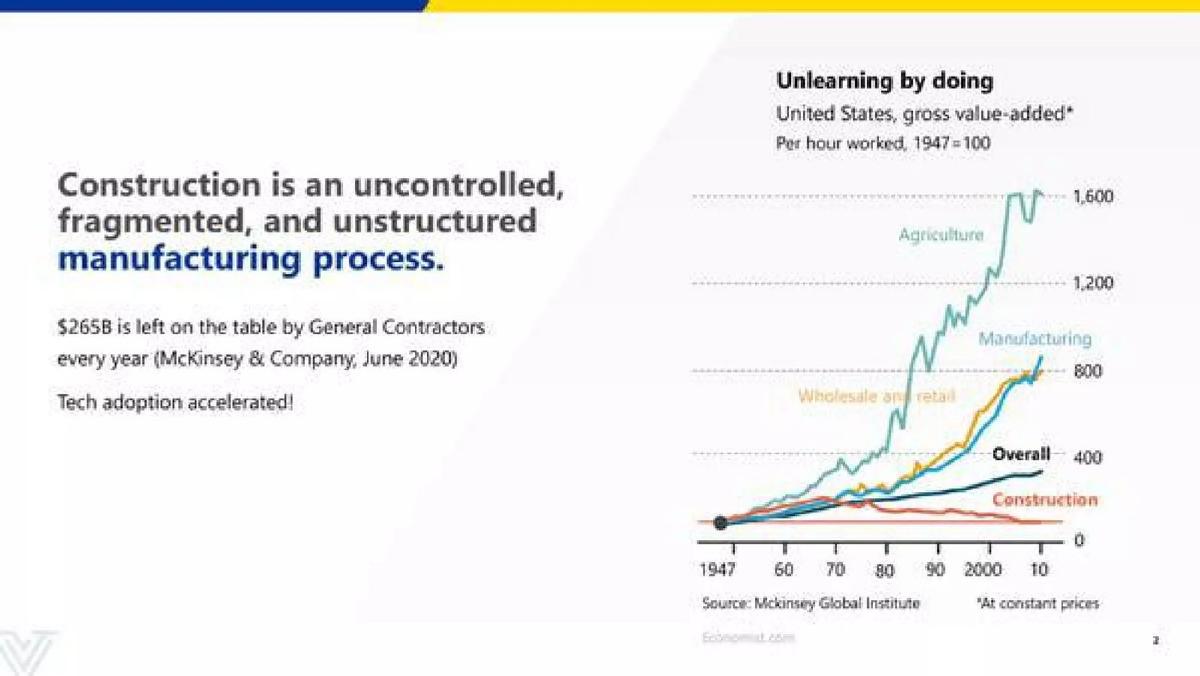
- The company claims a $265B annual loss for General Contractors due to unstructured processes (Slide 2).
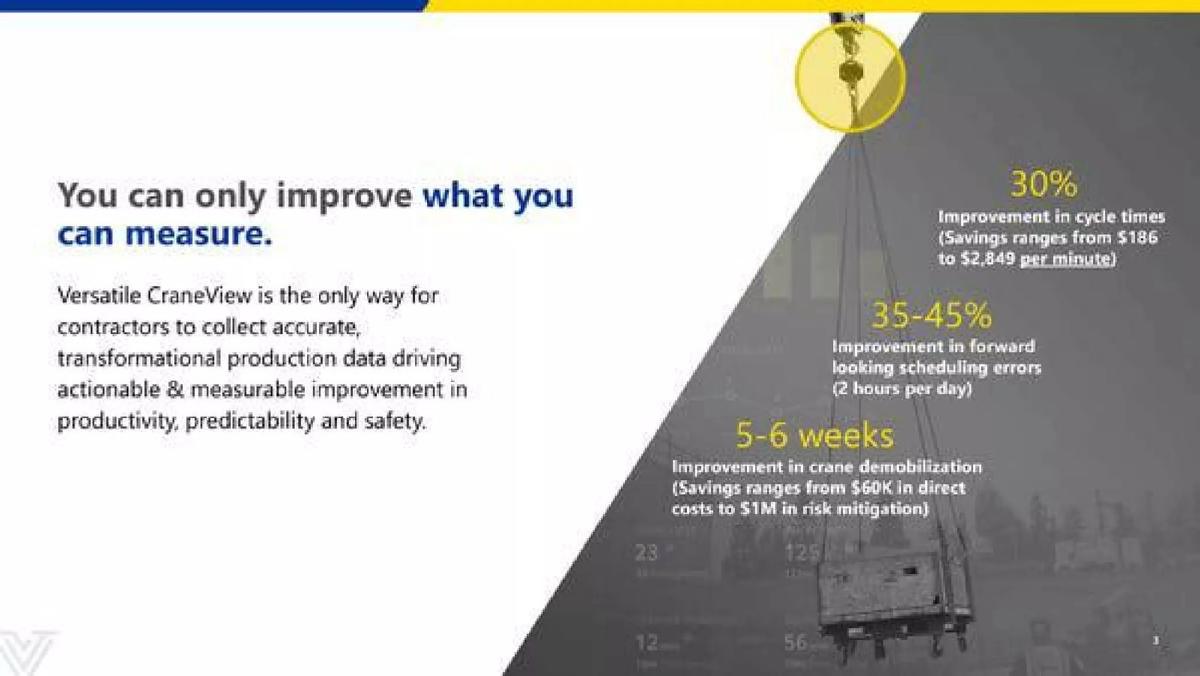
- CraneView provides a 30% improvement in cycle times, saving between $186 and $2,849 per minute (Slide 3).
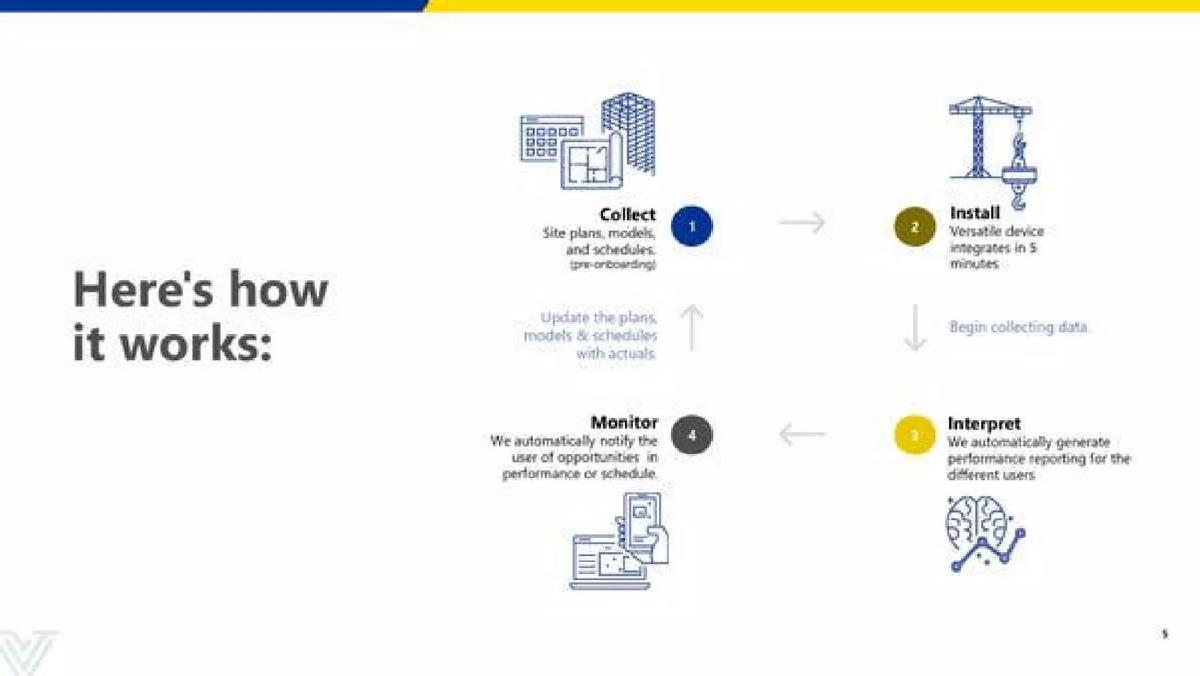
- The hardware device integrates in just 5 minutes, significantly lowering the barrier to entry for job site adoption (Slide 5).
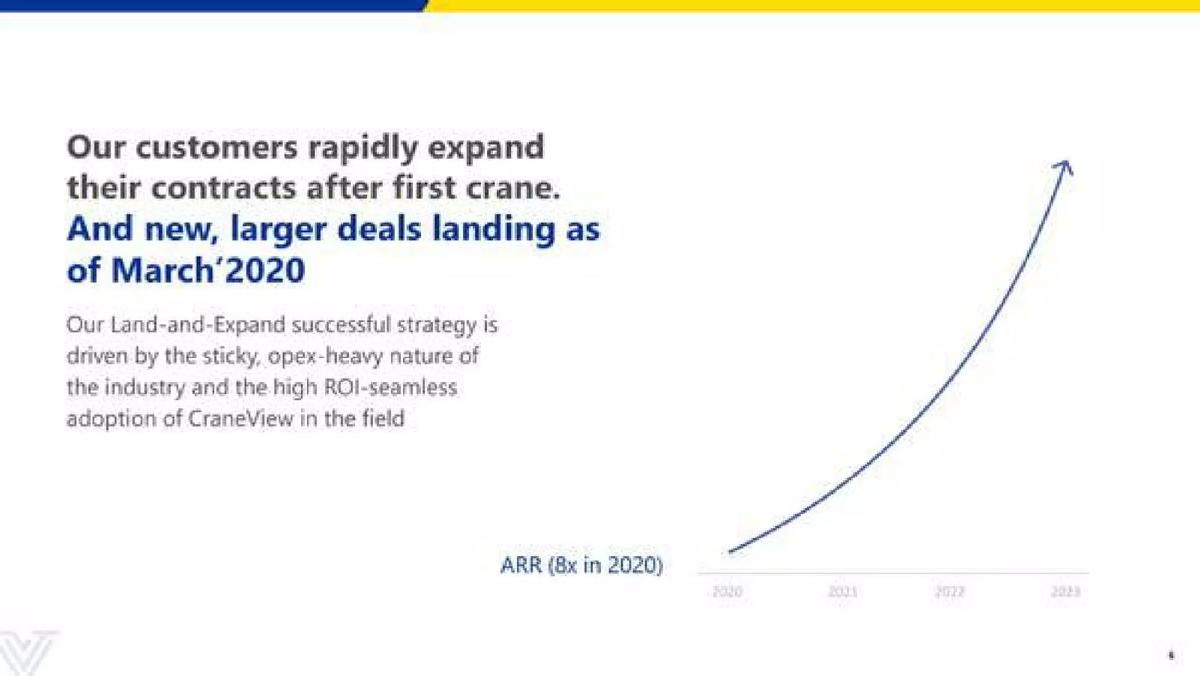
- Versatile reported an 8x growth in Annual Recurring Revenue (ARR) during 2020 (Slide 6).
- The 'Land-and-Expand' strategy is central to their growth, moving from a single crane to larger, multi-site deals (Slide 6).
- The team includes former executives from industry giants like Autodesk and Aconex, providing deep domain expertise (Slide 9).
- The deck highlights 'touchless deployments' as a key adaptation during the 2020 shelter-in-place orders (Slide 12).
Introduction: The Crane as the Source of Truth
Versatile’s Series B pitch deck, presented in 2020, tackles one of the oldest and most resistant industries to technological change: construction. The company’s core thesis is that construction is essentially an 'uncontrolled manufacturing process.' By utilizing AI and machine learning at the 'center of productivity'—the crane—Versatile aims to bring the precision of a factory floor to the chaos of a job site. This teardown examines how the company leveraged massive growth metrics and deep industry expertise to secure its position as a leader in construction tech.
The Macro Problem and Market Opportunity (Slides 1-2)
Slide 1: Title Slide. The deck opens with a bold mission statement: 'Turning Construction into Controlled Manufacturing.' This immediately sets the tone. They aren't just selling a sensor; they are selling a paradigm shift in how buildings are made. The slide identifies Meirav Oren as the Co-Founder & CEO and dates the presentation to 2020.
Slide 2: The Productivity Gap. This slide uses a well-known McKinsey Global Institute chart showing that while agriculture and manufacturing have seen explosive productivity growth since 1947 (1,600 and 800 index points respectively), construction has remained almost entirely flat. Versatile quantifies this stagnation by stating that $265B is 'left on the table' by General Contractors every year. This slide serves to validate the problem with third-party data, making the need for a solution feel urgent and inevitable.
The Solution and Product Value (Slides 3-5)
Slide 3: Measurable Improvement. Versatile introduces its product, CraneView, with the mantra: 'You can only improve what you can measure.' The slide provides three specific, high-impact ROI metrics: a 30% improvement in cycle times (saving up to $2,849 per minute), a 35-45% improvement in scheduling errors (saving 2 hours per day), and a 5-6 week improvement in crane demobilization (saving up to $1M in risk mitigation). These are not vague promises; they are hard numbers that a CFO or Project Manager can immediately value.
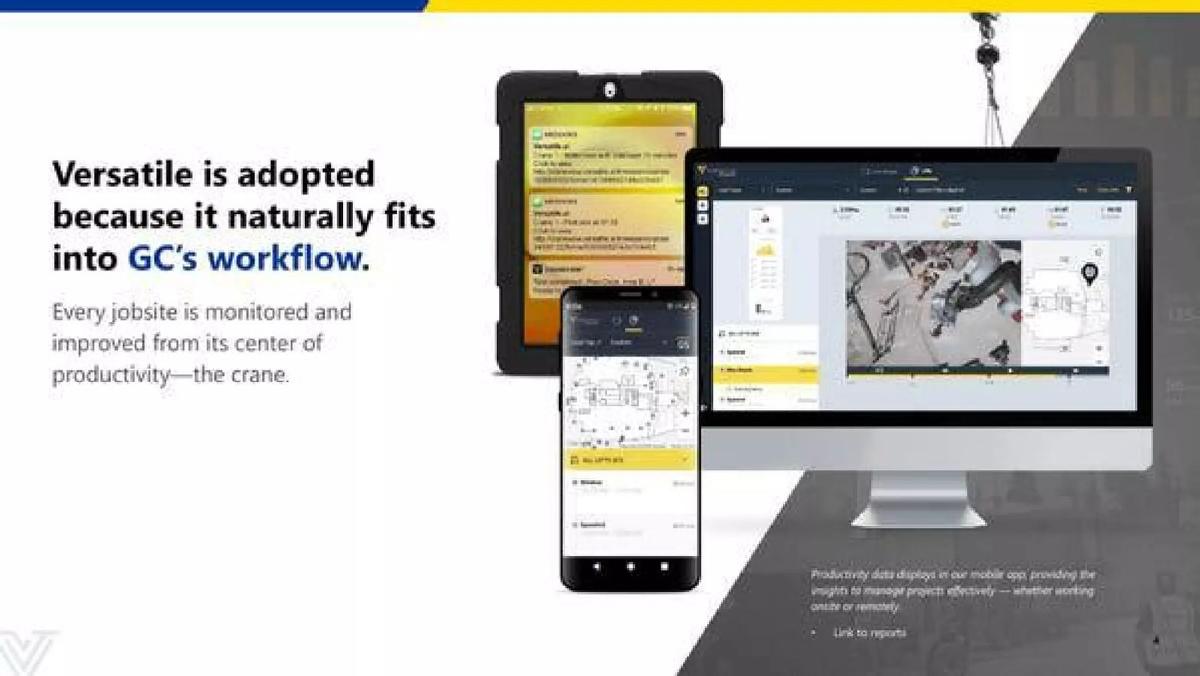
Slide 4: Workflow Integration. A common failure point for construction tech is that it requires workers to change their behavior. Versatile counters this by showing their mobile and desktop interfaces, stating the product 'naturally fits into GC’s workflow.' The visual shows the data being accessible on tablets and smartphones, emphasizing that job sites are monitored from the crane—the one piece of equipment that interacts with every part of the build.
Slide 5: The Process. This slide outlines a simple four-step cycle: Collect (site plans), Install (5-minute integration), Interpret (automatic reporting), and Monitor (performance notifications). The '5 minutes' claim is repeated here, which is a critical selling point for minimizing job site disruption.
Traction and Market Validation (Slides 6-8)
Slide 6: The Growth Curve. This is the 'money slide.' It shows an aggressive, upward-curving arrow representing ARR growth. While it lacks specific Y-axis dollar values, the text explicitly states 'ARR (8x in 2020).' It also introduces the 'Land-and-Expand' strategy, noting that customers rapidly expand contracts after the first crane. This indicates a high net-revenue retention, which is a key metric for Series B investors.
Slide 7: Social Proof. Instead of just listing logos, Versatile shows actual artifacts of success: screenshots of text messages, emails from happy superintendents, and press clippings from ENR (Engineering News-Record). One blurred text message reads, 'I already have HUGE proponent in... says he'd never do crane job without versatile.' This 'boots on the ground' validation is often more persuasive in construction than a high-level corporate logo.
Slide 8: Competitive Positioning. The company uses a standard 2x2 matrix. The X-axis is 'Seamless fit to workflows' and the Y-axis is 'Actionable production data.' Versatile places itself in the top-right quadrant, far above 'Crane Cameras,' 'Reality Capture,' and 'Scheduling Tools.' The headline reinforces the low barrier to entry: 'zero effort or change.'
Team and Market Reach (Slides 9-10)
Slide 9: The Team. The team slide is exceptionally strong for the sector. It features the four co-founders and highlights department leads with 'Former Head of Product Design at Autodesk' and 'Former Senior Manager... at Aconex' credentials. Aconex was a major exit in the construction tech space (acquired by Oracle), and having its founders, Leigh Jasper and Rob Philpot, as advisors/angels provides massive industry credibility.
Slide 10: Market Focus. This slide defines the Serviceable Obtainable Market (SOM). Interestingly, the slide contains placeholders: '$###B Serviceable Obtainable Market.' This suggests the deck might have been a template or that the specific number was redacted for public viewing. However, the strategy is clear: 'instrumenting every crane in the US first,' with a map highlighting North America, parts of Europe, and Australia.
Closing and COVID-19 Adaptation (Slides 11-13)
Slide 11: Call to Action. A simple 'Let's go' with a black-and-white photo of a worker attaching the CraneView device to a hook. It’s a high-energy transition to the final details.
Slide 12: COVID-19 Response. Given the 2020 timing, this slide is crucial. It explains how the company adapted to 'Shelter In Place' (SIP) by developing 'touchless deployments.' They used the time to interview superintendents and announced a 'stop charge' for all SIP projects, showing both operational agility and customer empathy. The slide includes a quote from a Project Manager at Gilbane Building Company, a major industry player.
Slide 13: The Hook. The final slide features a video play button (likely a demo in the live version) and the headline '5 Minute Time-to-Value.' It mentions a '$915M Annual Revenue GC' demonstrating the product, providing one last piece of enterprise-level social proof.
What Works in This Deck
Specific ROI: The deck avoids the trap of 'better, faster, cheaper.' By quoting specific dollar amounts saved per minute (Slide 3), they speak the language of General Contractors who operate on thin margins.
The 'Crane' Strategy: By focusing on the crane, Versatile solves the data collection problem without needing hundreds of sensors scattered across a site. This 'single point of truth' narrative is very clean and easy for an investor to grasp.
Industry Credibility: The team and advisor slide (Slide 9) is top-tier. In a 'tough' industry like construction, having former Autodesk and Aconex leadership is a significant de-risking factor for VCs.
What is Missing
The Ask: There is no slide detailing how much money is being raised or how the Series B funds will be spent (e.g., sales team expansion, R&D, international growth).
Unit Economics: While the 8x ARR growth is impressive, the deck lacks data on Customer Acquisition Cost (CAC), Lifetime Value (LTV), or payback periods, which are standard requirements for a Series B round.
Detailed Financials: The market size slide (Slide 10) is incomplete ($###B), and there are no projections for future revenue or profitability milestones.
What a Founder Should Copy
The 'Artifact' Slide: Slide 7, which shows real text messages and emails, is far more powerful than a simple list of testimonials. It feels authentic and proves that the product is actually being used in the field.
Positioning Against 'Change': Every founder in a legacy industry should copy the way Versatile emphasizes 'zero effort or change' (Slide 8). Acknowledging that your users are busy and resistant to new workflows is the first step to winning them over.
The Productivity Gap Chart: Using the McKinsey productivity chart (Slide 2) is a classic but effective way to frame a startup as a solution to a massive, decades-long macroeconomic failure.
Frequently asked questions
- What is the core value proposition of Versatile?
- Versatile positions itself as the tool that turns construction into 'controlled manufacturing.' By mounting an AI-powered device under the hook of a crane, they capture data that allows General Contractors to measure and improve cycle times, scheduling, and safety. The deck emphasizes that you can only improve what you can measure, and the crane is the ultimate measurement point for job site productivity.
- How does Versatile handle the difficulty of tech adoption in construction?
- The deck addresses this through two main points: seamless integration and rapid time-to-value. Slide 5 and Slide 13 both emphasize that the device integrates in just 5 minutes. Furthermore, Slide 8 uses a 2x2 matrix to show that Versatile offers higher 'actionable production data' than competitors while maintaining a 'seamless fit to workflows,' requiring zero effort or change from the workers.
- What growth metrics did Versatile share in this deck?
- The primary growth metric shared is an 8x increase in Annual Recurring Revenue (ARR) in 2020. While the slide (Slide 6) uses an illustrative upward curve rather than a detailed bar chart with specific dollar amounts, the 8x figure is a powerful indicator of product-market fit. They also mention a successful 'land-and-expand' strategy where customers increase contract sizes after the first crane deployment.
- Who are the key people behind Versatile?
- The team slide (Slide 9) showcases a mix of construction and SaaS experience. Key leaders include CEO Meirav Oren, CPO Danny Herman, and CTO Barak Cohen. The deck also highlights department leads with backgrounds at Autodesk and Aconex, and advisors like Leigh Jasper and Rob Philpot (founders of Aconex), which adds significant credibility in the construction tech space.
- What is missing from the Versatile pitch deck?
- The deck is missing a specific 'Ask' slide detailing how much capital they are looking to raise and how it will be allocated. It also lacks a detailed slide on unit economics (CAC, LTV) and a comprehensive competitor list beyond generic categories like 'Reality Capture' and 'Scheduling Tools.' Finally, the market size slide (Slide 10) uses placeholders ($###B) rather than final numbers.