Verishop’s 2022 Series B deck is a masterclass in framing a two-sided marketplace problem. By positioning independent brands as 'lost in the crowd' and consumers as frustrated by poor social shopping experiences, Verishop justifies its existence as a tech-heavy intermediary. The deck highlights significant scale, including $1B+ in inventory and 400K+ SKUs, while emphasizing an asset-light model that appeals to late-stage venture investors. Despite the impressive traction metrics like 99.5% merchant retention, the deck notably omits a traditional team slide and a specific financial 'ask' or us…
Key takeaways
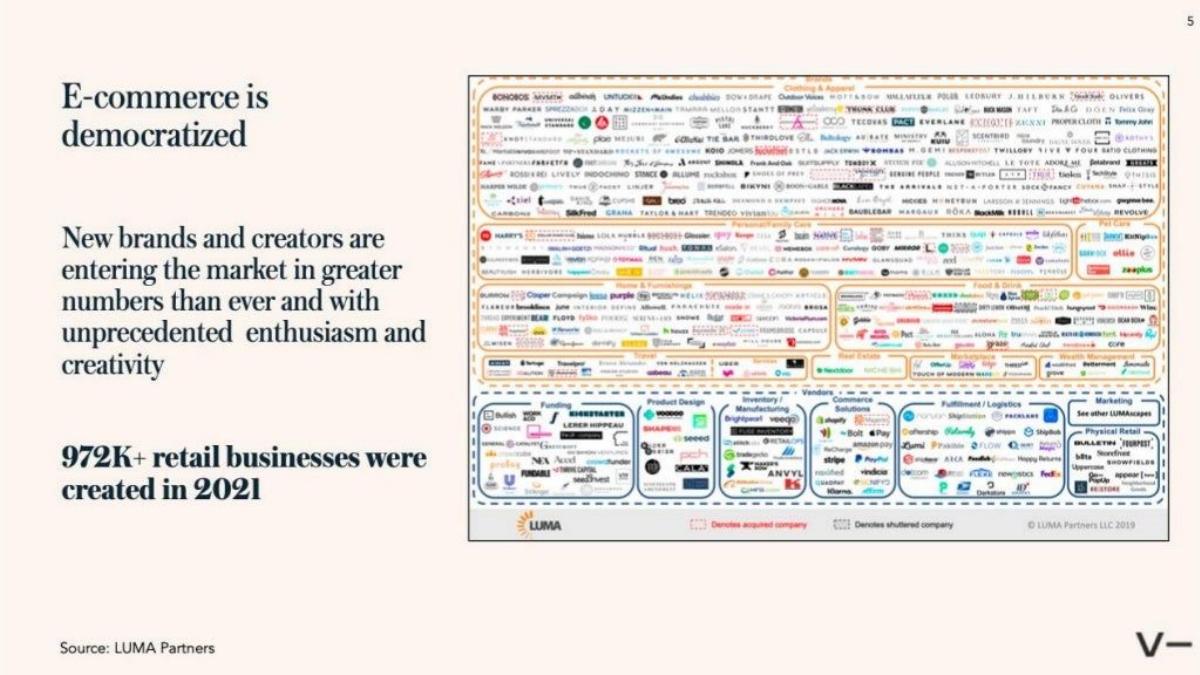
- The deck identifies a massive market entry point with 972K+ retail businesses created in 2021 (Slide 5).
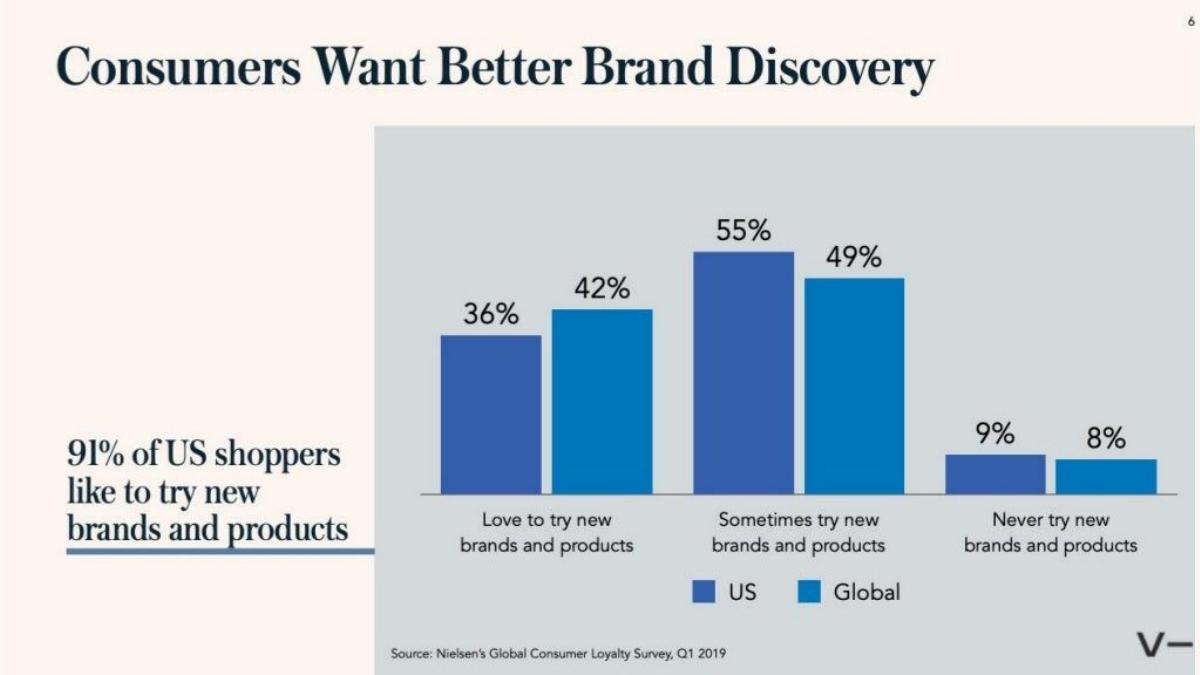
- Consumer demand for discovery is quantified by the fact that 91% of US shoppers like to try new brands (Slide 6).
- Verishop positions itself as a full-stack partner for brands, offering shared services, data insights, and micro-financing (Slide 9).
- The platform has achieved significant scale with over 3,000 independent brands and creators (Slide 10).
- Technology is a core differentiator, featuring an AI-driven content feed and a two-click purchase process (Slide 11).
- The company leverages external distribution through a 'Verishop Mini' integration within Snap (Slide 13).
- Operational efficiency is highlighted by a 99.5% merchant retention rate and a Net Promoter Score of 70 (Slide 15).
- The business model is explicitly described as 'Asset Light' with 'Multiple Rev Streams' to signal scalability (Slide 16).
The Narrative Arc: From Vision to Infrastructure
Verishop’s Series B deck is structured to move the investor from a broad social vision to a specific technical solution. It begins not with numbers, but with a philosophical question about equity and diversity in commerce. This sets the stage for a marketplace that isn't just about selling goods, but about empowering a specific class of creators: the independent brand.
Slides 1-4: The Vision and Mission
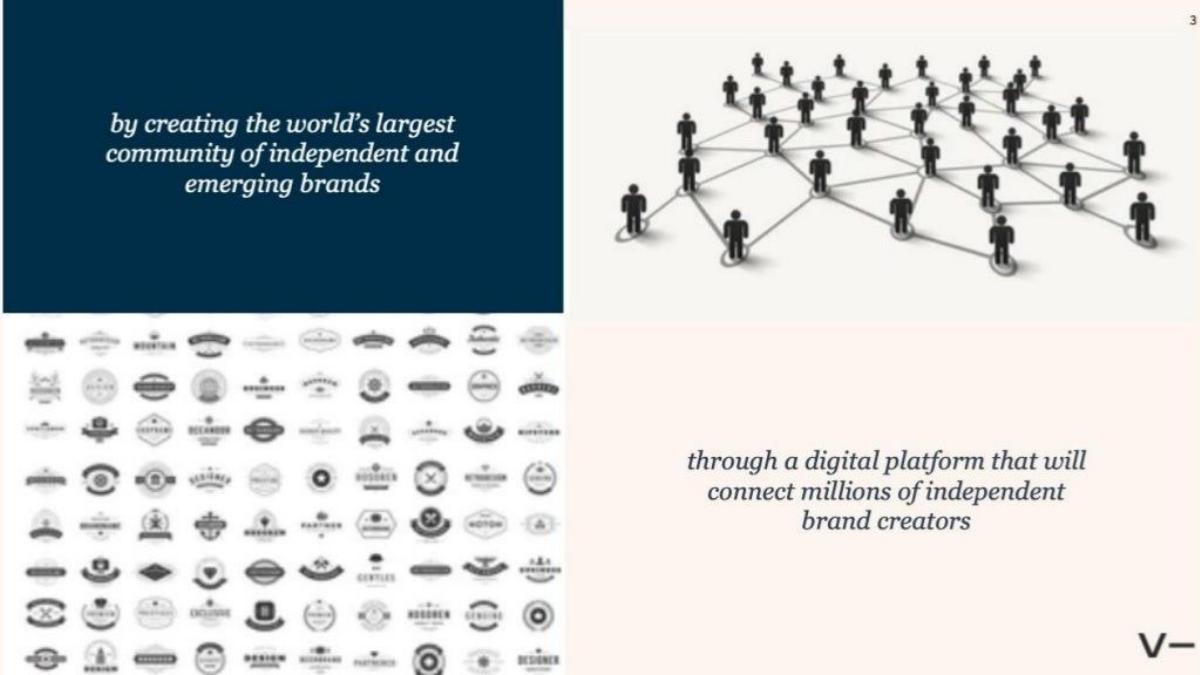
The deck opens with a minimalist title slide (Slide 1) followed immediately by a high-level mission statement. Slide 2 asks, "What if we had the ability to... make the world more equitable and diverse while delivering a better shopping experience?" This is a classic 'soft' opening designed to align the investor with the company's values before diving into the mechanics. Slide 3 and 4 define the 'how': creating the world's largest community of independent and emerging brands through a digital platform. By Slide 4, the company is introduced as a profit-driver for these 'indy' brands, establishing a clear B2B2C value proposition.
Slides 5-7: Market Dynamics and The Problem
Slide 5 uses data from LUMA Partners to show that e-commerce is 'democratized,' noting that 972K+ retail businesses were created in 2021. This slide is crucial because it proves the supply side of the marketplace is exploding. Slide 6 addresses the demand side, citing a Nielsen survey where 91% of US shoppers say they like to try new brands, yet only a small fraction 'always' do so. Slide 7 synthesizes these into a dual-sided problem: brands are 'lost in the crowd' and need help with operations/financing, while consumers find social media shopping 'not optimal' due to poor search and customer service. This slide effectively creates the 'villain'—the friction of modern social commerce.
Slides 8-10: The Solution and Brand Partnership
Slide 8 is a visual transition, using a lifestyle collage to show the aesthetic quality of the brands on the platform. Slide 9 gets into the weeds of the brand offering. Verishop isn't just a shop; it offers 'shared services & data insights,' including return software, image management, and 'micro-financing.' This is a significant indicator of a 'sticky' marketplace model. Slide 10 provides social proof, showcasing partners like Brightech and Grace & Stella, and stating that 'Over 3,000 Independent Brands and Creators Now Call Verishop Home.'
Slides 11-14: The Technology Stack
The middle of the deck focuses on the product. Slide 11 introduces 'Explorer,' an AI-driven content feed that manages over $1 billion in inventory. The key selling point here is the 'two-click' purchase with no redirects. Slide 12 highlights 'Livestream Shopping,' noting that their technology automatically records and edits shows to create a content library of over 1,000 hours. Slide 13 showcases their 'Verishop Mini' integration with Snap, demonstrating a sophisticated distribution strategy. Slide 14 summarizes the 'Proprietary Technology,' listing patents and patent-pending status for features like 'Shop Party' and 'Live Shopping,' which helps defend their valuation against larger incumbents.
Slides 15-16: Traction and Business Strengths
Slide 15, 'Verishop By the Numbers,' is the 'money slide.' It lists 3,000+ brands, 400K+ SKUs, $1B+ inventory, and a 99.5% merchant retention rate. The Net Promoter Score (NPS) of 70 is exceptionally high for retail, suggesting strong product-market fit. Slide 16 summarizes the 'Business Strengths,' explicitly calling out the 'Asset Light Model' and 'Multiple Rev Streams.' For a Series B investor, 'Asset Light' is a keyword that translates to high margins and scalability, as Verishop likely doesn't hold the $1B in inventory itself but facilitates the transactions.
What Verishop Does Exceptionally Well
Dual-Sided Problem Framing: Most marketplaces focus on one side of the transaction. Verishop clearly articulates why the current ecosystem fails both the brand (who can't scale) and the consumer (who can't discover). By solving for both, they position themselves as an essential utility.
Technology as a Moat: In a crowded e-commerce space, Verishop leans heavily on its 'Proprietary Technology' (Slide 14). Mentioning patents for 'Shop Party' and AI-driven computer vision for discovery helps move the company out of the 'retailer' bucket and into the 'tech platform' bucket, which typically commands higher valuation multiples.
Scale without Risk: The mention of $1B+ in inventory (Slide 15) alongside an 'Asset Light Model' (Slide 16) is a powerful combination. It tells investors that the company has the reach of a giant retailer without the balance sheet risk of owning and storing all those goods.
What is Missing from the Verishop Deck
The Team Slide: There is no mention of the founders or the leadership team. While Verishop was founded by former Snap executive Imran Khan, which likely provided significant credibility, a deck should generally stand on its own. The absence of a team slide is a notable omission for a teardown.
The Ask and Use of Funds: The deck ends on 'Business Strengths' without a clear 'Ask.' There is no slide detailing how much capital is being raised in this Series B or how that capital will be deployed (e.g., marketing, geographic expansion, or R&D).
Financial Projections: While the deck shows 'Traction,' it does not show growth rates over time or future revenue projections. Investors at the Series B stage typically expect to see a path to $100M+ in ARR, which is not explicitly mapped out here.
Competitive Landscape: The deck mentions that social media shopping is 'not optimal,' but it doesn't provide a direct comparison against competitors like Instagram Shop, TikTok Shop, or niche competitors like Italic or Maisonette.
Founder's Playbook: What to Copy
Use 'The Numbers' Slide for Impact: Slide 15 is a perfect example of how to present data. Big, bold numbers in simple boxes. It doesn't distract with charts; it just states the facts of the company's scale. · Highlight Strategic Partnerships: The Snap integration (Slide 13) is a major validator. If your startup has a deep integration with a major platform, give it a full slide. It proves your tech is enterprise-grade and your distribution has a 'unfair' advantage. · Define Your 'Shared Services': If you are a marketplace, don't just be a middleman. Slide 9 shows how Verishop adds value through financing and software. This makes your platform harder for brands to leave, which is reflected in their 99.5% retention rate. · Visual Consistency: The deck uses a consistent, high-end aesthetic that matches the 'Luxury' and 'Fashion' industry tags. The font choice and whitespace reflect the premium nature of the brands they host.
Frequently asked questions
- What is Verishop's core value proposition for brands?
- Verishop acts as a growth partner for independent brands that are 'lost in the crowd.' Beyond just a storefront, it provides a 'Dash' management interface, shared services, data insights, and even micro-financing to help these brands navigate marketing and operational challenges. This moves the relationship from a simple distribution channel to an essential business infrastructure partner.
- How does Verishop differentiate its shopping experience from social media?
- The deck argues that while consumers discover brands on social feeds, the experience is 'not optimal' due to poor search, sorting, and delivery. Verishop solves this with an AI-driven 'Explorer' feed and livestream shopping that allows for a seamless two-click checkout without site redirects, addressing the high friction typically found in social commerce.
- What are the key scale metrics mentioned in the deck?
- By the time of this Series B, Verishop reported over 3,000 brands, 400,000+ SKUs, and more than $1 billion in inventory available through its platform. They also maintain a high-performing team of 85 full-time employees, with over 40% dedicated to technology roles, underscoring their position as a tech company rather than just a retailer.
- What is the 'Verishop Mini' mentioned on Slide 13?
- Verishop Mini is a strategic partnership with Snap that allows users to access a version of the Verishop marketplace directly within the Snapchat app. This allows users to browse collections and participate in livestream shopping without leaving the Snap platform, while Verishop handles the full customer support and checkout experience.
- What critical startup deck elements are missing from this presentation?
- The deck lacks a dedicated team slide, which is unusual for a Series B, though the founders' pedigree may have been established in the meeting. It also omits a specific 'Ask' slide detailing how much capital is being raised and how it will be spent, as well as a detailed competition matrix or financial projections.