Vertice’s 12-slide Series A deck is a lean, problem-focused presentation that successfully secured $26M in 2022. The narrative centers on a massive, growing market inefficiency: 90% of SaaS buyers are overpaying for software. Rather than getting bogged down in technical architecture, the deck emphasizes the 'buying leverage' gained through data intelligence and the founders' significant track record, citing over $600M in successful exits with Wandera and ScanSafe. The deck is notably light on traditional financial metrics or a specific 'ask' slide, suggesting a high-conviction round driven by…
Key takeaways
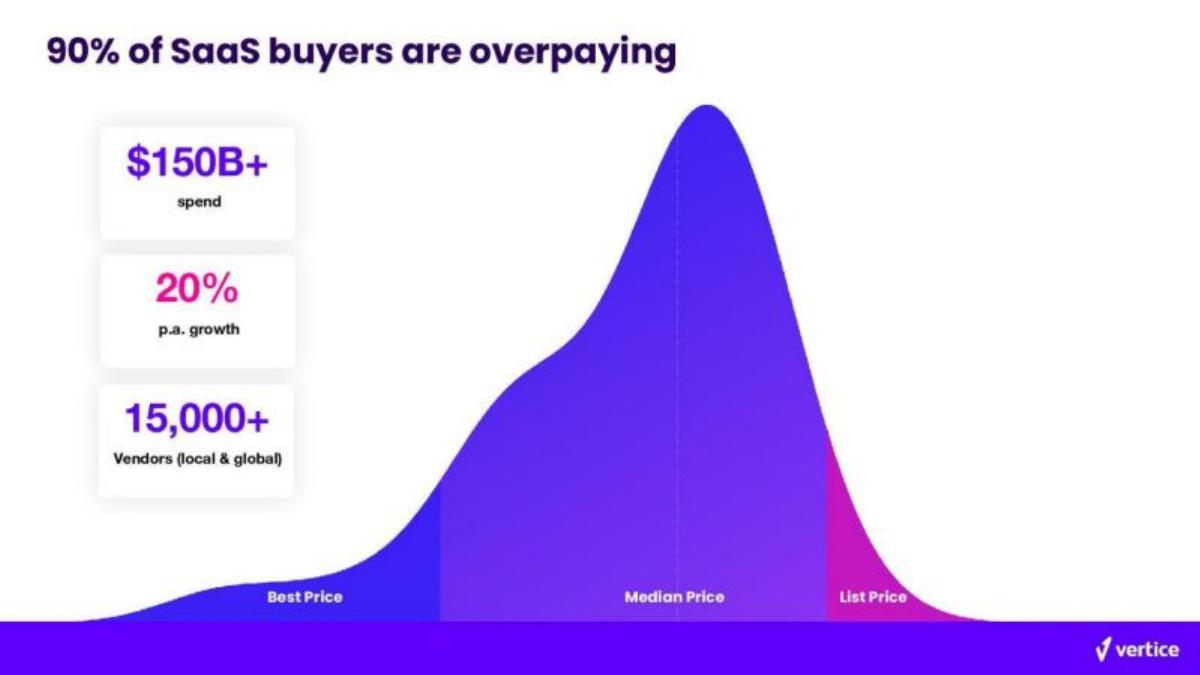
- The deck identifies a $150B+ total spend market with 20% annual growth on slide 2.
- Vertice claims that 90% of SaaS buyers are currently overpaying for their software stacks (slide 2).
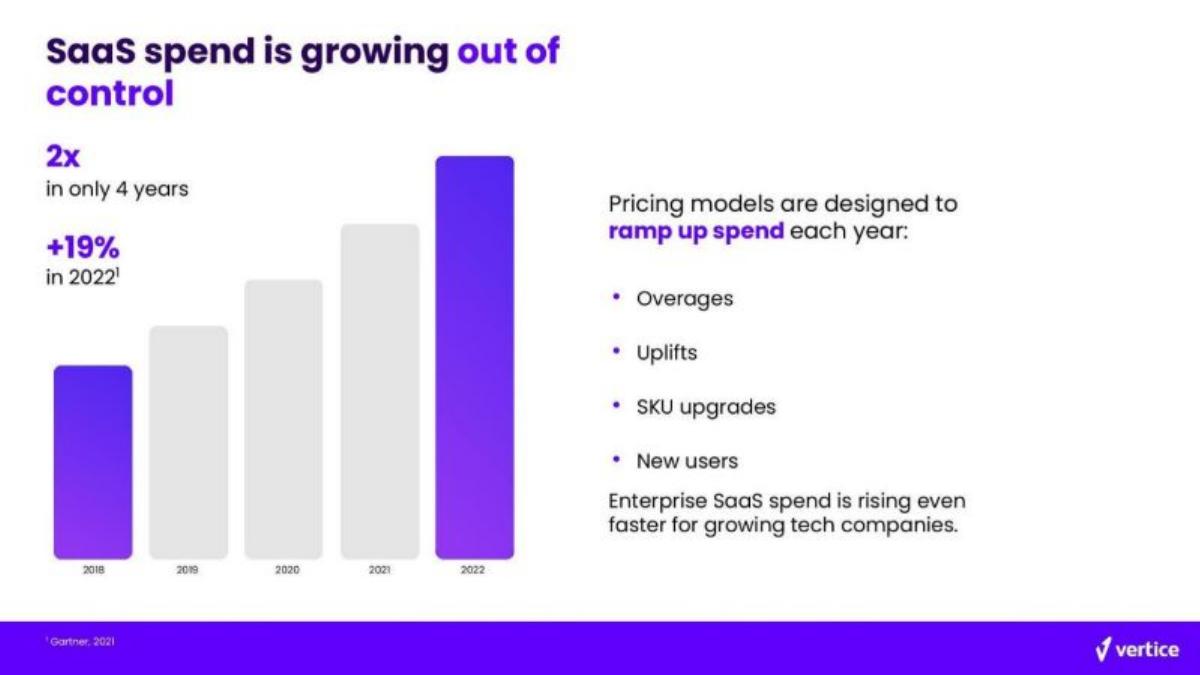
- SaaS spend is shown to have doubled in only four years, with a 19% increase in 2022 alone (slide 3).
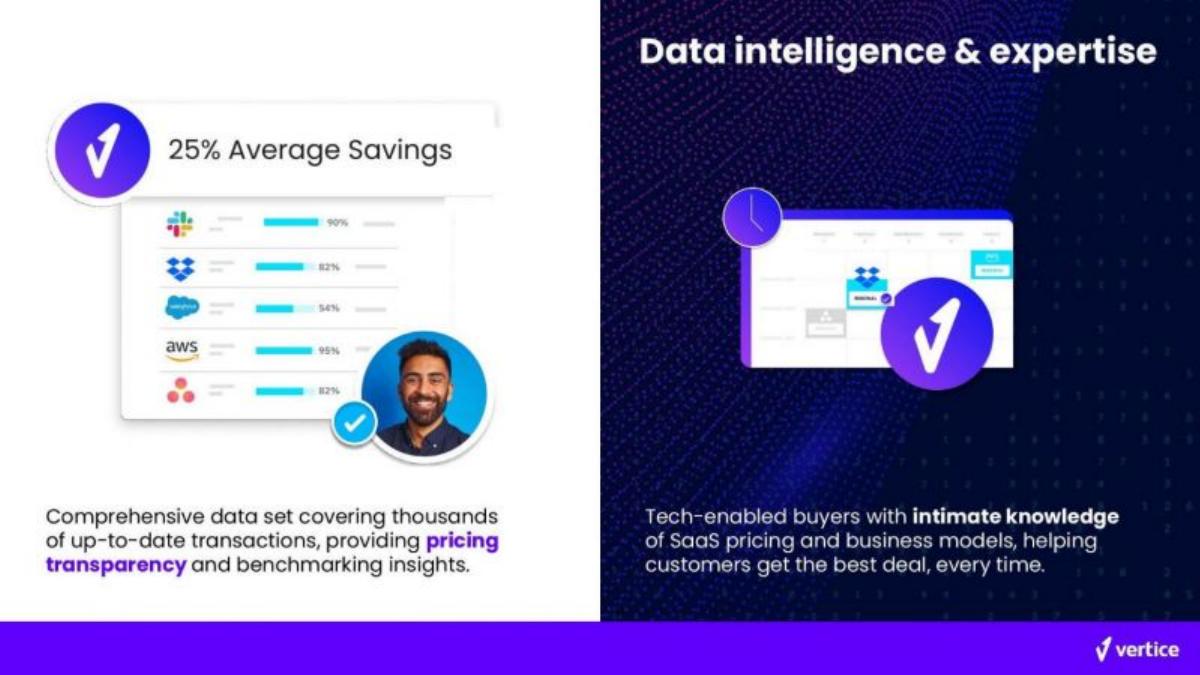
- The product promises an average savings of 25% for customers by using data intelligence and benchmarking (slide 6).
- The 'Tech platform' slide (slide 8) highlights a 360-degree view of the SaaS stack and integrations with major ERP and finance systems.
- Founder credibility is the deck's strongest asset, citing $600M+ in prior exits on slide 10.
- The deck omits a traditional 'Ask' slide, financial projections, and a detailed competitor matrix.
- The business model relies on 'repeated interactions' with vendors to secure better discounts for all customers (slide 7).
The $26M Narrative: Simplicity and Pedigree
Vertice’s Series A deck is a masterclass in narrative economy. At only 12 slides, it avoids the common pitfall of over-explaining features. Instead, it leans into a macro-trend that every CFO understands: SaaS costs are ballooning and opaque. By combining a clear market pain point with a team that has already returned hundreds of millions to investors, Vertice makes a $26M round look like a logical next step rather than a risky bet.
Slides 1-3: The Macro Problem
Slide 1 is a minimalist title slide featuring the tagline "Smarter SaaS spending." It establishes the brand identity immediately with a clean, professional aesthetic.
Slide 2 introduces the core thesis: "90% of SaaS buyers are overpaying." This is a bold, attention-grabbing headline. The slide supports this with three key figures: a $150B+ total spend, 20% p.a. growth , and a market of 15,000+ vendors . The visual aid is a bell curve showing that the vast majority of companies fall into the "Median Price" or "List Price" categories, while only a tiny fraction achieve the "Best Price."
Slide 3 hammers home the urgency. It states that SaaS spend is growing "out of control," having doubled in only 4 years . It cites a Gartner 2021 stat showing a +19% increase in 2022 . The slide lists the mechanisms vendors use to increase revenue: Overages, Uplifts, SKU upgrades, and New users. This slide effectively moves the conversation from "this is a problem" to "this is an accelerating crisis for finance teams."
Slides 4-5: The Customer Pain and Social Proof
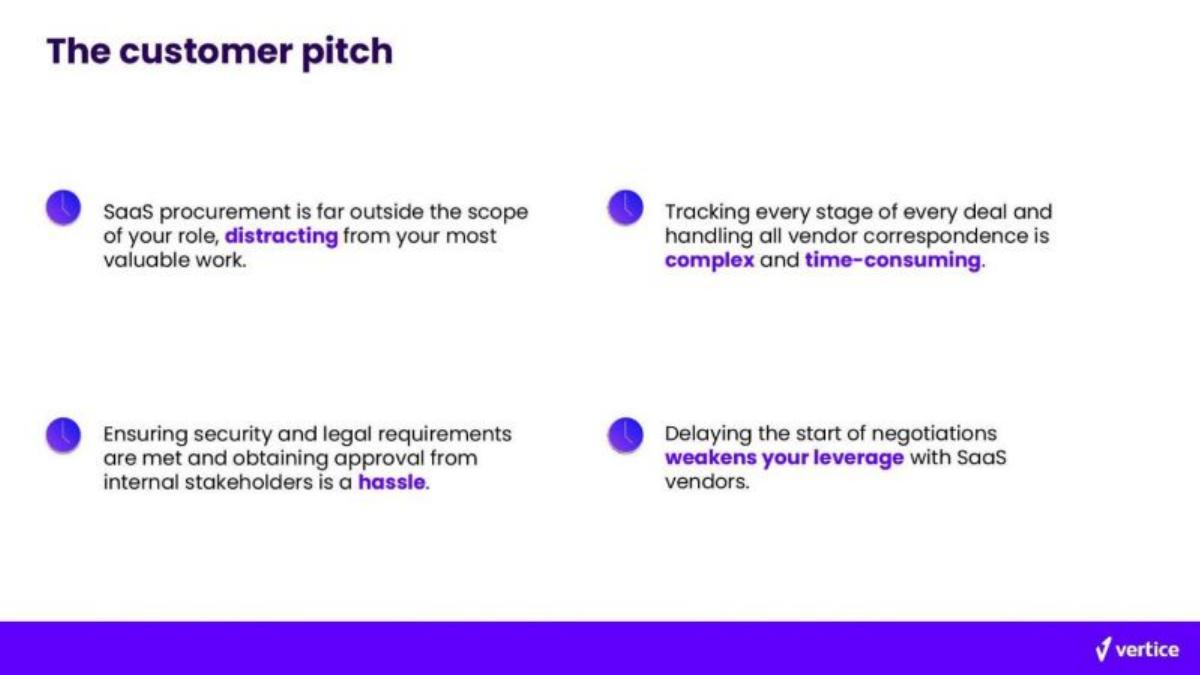
Slide 4 , titled "The customer pitch," pivots to the operational burden. It lists four friction points: procurement is a distraction from valuable work, tracking deals is complex, security/legal approvals are a hassle, and delayed negotiations weaken leverage. This slide identifies the "Internal Champion" (likely a CFO or Head of Finance) and speaks directly to their daily frustrations.
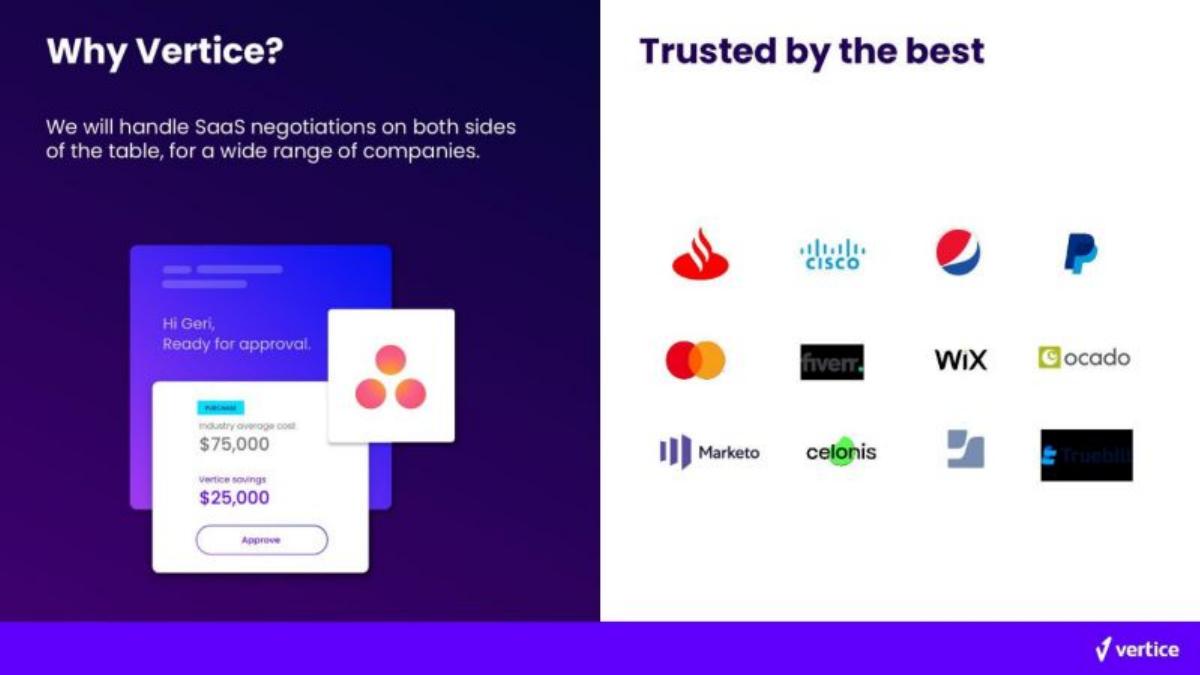
Slide 5 provides immediate credibility. Under the heading "Why Vertice?", it features a "Trusted by the best" logo wall. The inclusion of Mastercard, Cisco, Pepsi, PayPal, and Wix suggests that the solution is enterprise-ready and has already been vetted by sophisticated procurement departments. A small UI mockup shows a "Vertice savings" of $25,000 on an industry average cost of $75,000, providing a concrete example of the value proposition.
Slides 6-8: The Solution and The "Moat"
Slide 6 focuses on "Data intelligence & expertise." It claims an 25% Average Savings . The key differentiator here is the "comprehensive data set covering thousands of up-to-date transactions." This is the company's primary moat: they know what everyone else is paying, which gives them an information advantage that a single customer cannot replicate.
Slide 7 explains "Buying leverage." It argues that repeated interactions with the same vendors lead to "better discounts" and that "anything we learn from one customer benefits the others." This describes a network effect where the platform becomes more powerful as it scales, a key metric for venture investors.
Slide 8 showcases the "Tech platform." It promises a 360-degree view of the SaaS stack in one centralized location and a "streamlined approval process." Crucially, it mentions "Extensive integrations with all major ERP, finance and contract management systems," addressing the technical hurdle of implementation.
Slides 9-12: Process and Pedigree
Slide 9 is a simple three-step process: 1. Analyze the stack, 2. Map to customer objectives, 3. Work to save money. This simplicity is designed to lower the perceived barrier to entry for new clients.
Slide 10 is arguably the most important slide in the deck for a Series A. Titled "Proven track record of success," it features the two founders and highlights Over $600m in successful SaaS exits with Wandera and ScanSafe . For many investors, this slide alone justifies the valuation. It signals that the founders know how to build, scale, and exit a company in this specific sector.
Slide 11 is a simple closing slide with the logo and the URL "vertice.one," and Slide 12 is a promotional slide for the source library, not part of the original pitch.
What Vertice Does Well
The deck is exceptionally focused on the Value Proposition . It doesn't waste time on "how" the software works at a code level; it focuses entirely on the financial outcome (25% savings) and the information asymmetry it exploits. The use of a bell curve on Slide 2 is a brilliant way to visualize market inefficiency. Furthermore, the deck perfectly balances the "Problem" and the "Team." By the time an investor reaches the founder slide, they have already been sold on a massive market problem, making the experienced team seem like the inevitable winners.
What is Missing
For a teardown, the omissions are as striking as the content. There is no 'Ask' slide . We know from the catalogue that they raised $26M, but the deck doesn't state the amount sought or the intended use of funds. There is also no financial projection or detailed unit economics. While they mention "25% average savings," they don't explain their own revenue model—whether they take a percentage of savings or charge a flat SaaS fee. Finally, there is no competitor analysis . In a crowded field with players like Vendr or Tropic, Vertice chooses to ignore the competition entirely in this deck, relying instead on their founder pedigree to stand out.
Founder Takeaway
If you have a significant track record (previous exits), lead with the market pain and end with your face . Vertice proves that you don't need 30 slides to raise $26M if your problem is undeniable and your team is proven. Founders should copy the way Vertice uses macro-data (Gartner stats, total market spend) to validate the problem before introducing their specific solution. However, unless you have a $600M exit behind you, you will likely need to include the slides Vertice left out: the business model, the competition, and the specific financial ask.
Frequently asked questions
- What is the primary problem Vertice is solving?
- Vertice addresses the 'out of control' growth of SaaS spending. According to slide 3, pricing models like overages, uplifts, and SKU upgrades are designed to ramp up spend annually. Slide 2 notes that 90% of buyers overpay because they lack the data intelligence to negotiate effectively against the 15,000+ global vendors in the market.
- How does Vertice differentiate its solution from simple tracking tools?
- Vertice positions itself as a 'tech-enabled buyer' rather than just a dashboard. Slide 6 and 7 emphasize 'data intelligence' and 'buying leverage.' They claim to use a comprehensive dataset of thousands of up-to-date transactions to provide pricing transparency that individual companies cannot achieve on their own.
- What evidence of product-market fit is presented in the deck?
- The deck uses a 'Trusted by the best' slide (slide 5) featuring logos of major companies like Mastercard, Cisco, Pepsi, and PayPal. While it doesn't list specific case study data for each, it claims an 'Average Savings' of 25% on slide 6, supported by a visual of a $100,000 contract being reduced to $75,000.
- Who are the founders and why does their background matter?
- The founders, shown on slide 10, have a 'proven track record of success' with over $600M in exits from companies Wandera and ScanSafe. In a Series A, this level of pedigree often reduces the perceived risk for investors, allowing the deck to focus more on the market opportunity than on granular operational metrics.
- What is missing from this pitch deck that a typical Series A would include?
- This deck is exceptionally lean. It lacks a detailed competitive landscape, a slide explaining the specific revenue model (e.g., percentage of savings vs. SaaS fee), a hiring plan, and a formal 'Ask' slide detailing how the $26M will be spent. Its brevity suggests it was used as a supporting document for a high-momentum round.