Verkor’s Series A deck is a masterclass in industrial storytelling, shifting the focus from speculative software metrics to hard infrastructure and supply chain dominance. Raising $118.6M in 2021, the French startup addressed a critical gap in the European EV market: the geographic concentration of battery production in Northern Europe. The deck leans heavily on the 'pedigree' of its leadership team, featuring executives with backgrounds at Tesla, Apple, and BMW, alongside a robust partnership ecosystem including Renault Group and Schneider Electric. By emphasizing a phased approach—starting…
Key takeaways
- The company targets an initial production capacity of 16 GWh, scaling to 50 GWh by 2030 (Slide 2).
- Verkor identifies a market gap where European Gigafactories are currently concentrated in Northern Europe and cannot meet demand (Slide 3).
- The leadership team features deep industry experience from companies like Tesla, Apple, BMW, Renault, and Airbus (Slide 5).
- The technical team brings over 200 years of cumulative battery experience from Panasonic, Samsung, and Northvolt (Slide 6).
- Strategic partnerships are secured across the value chain, including Renault Group for application and Schneider Electric for manufacturing (Slide 7).
- The roadmap begins with the Verkor Innovation Centre (VIC), a 150 MWh pilot line in a 12,000 m2 building (Slide 9).
- The business model emphasizes 'digitalization' and 'real-time data analysis' to minimize scrap and ensure high plant efficiency (Slide 2).
- Verkor positions itself as a 'low carbon' manufacturer, specifically targeting the Southern European market (Slide 2).
Verkor: The Industrial Blueprint for European Battery Sovereignty
Verkor’s 2021 Series A deck is not a typical startup pitch. It is an industrial manifesto. In a sector where capital requirements are measured in billions rather than millions, the goal of a Series A deck is to prove that the team is capable of managing massive infrastructure projects and that the supply chain is already locked in. With $118.6M raised, this deck successfully moved the needle by focusing on 'The Three Ps': Pedigree, Partners, and Production capacity.
Slide 1: Title Slide
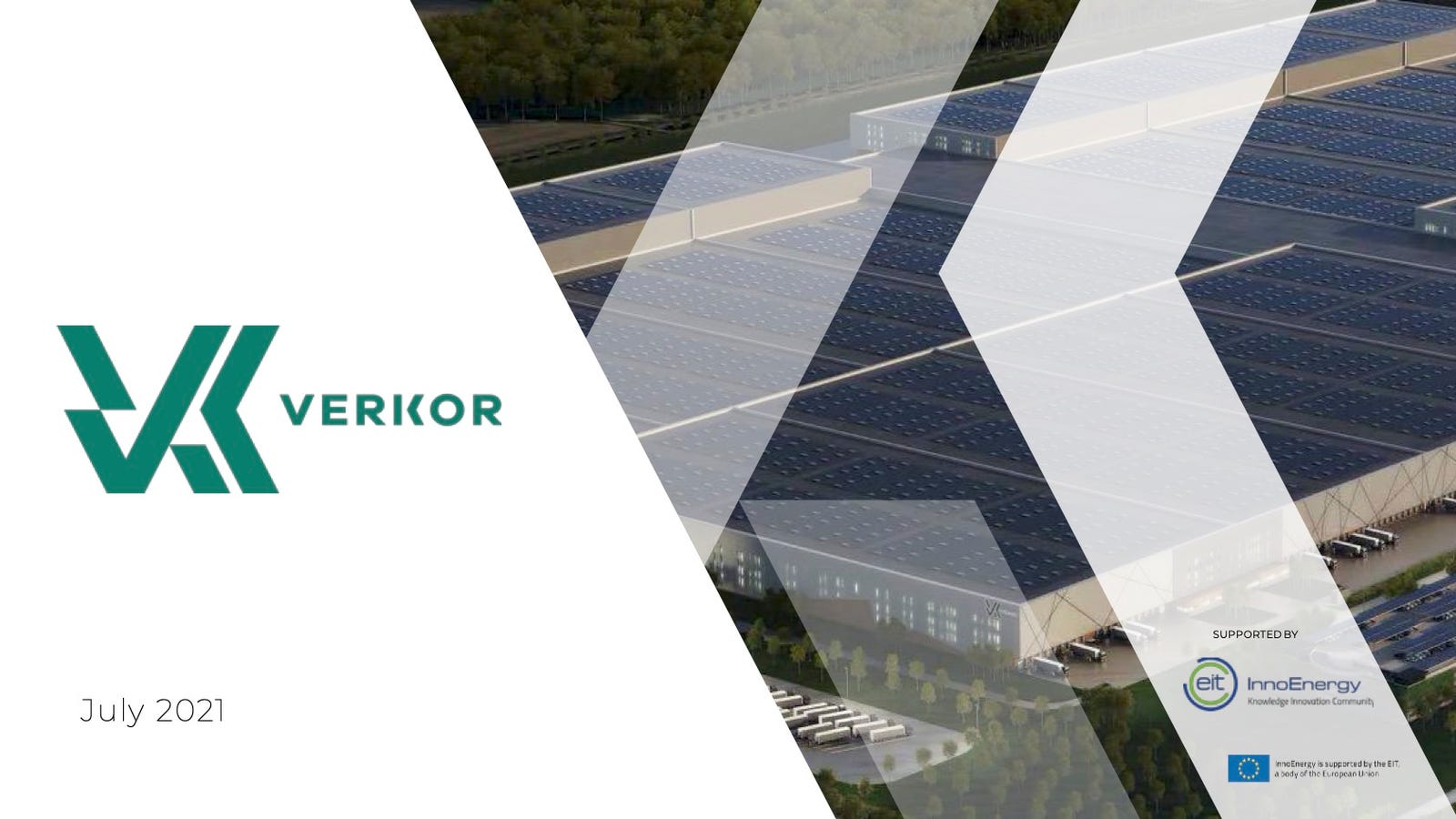
The cover slide features the Verkor logo and a high-resolution architectural rendering of a massive industrial facility covered in solar panels. The date 'July 2021' is clearly visible. The inclusion of the 'EIT InnoEnergy' logo at the bottom right immediately establishes institutional backing from a body of the European Union, providing early credibility for a capital-intensive hardware play.
Slide 2: Verkor at a Glance
This slide serves as the executive summary. It defines Verkor as a 'digital, smart & low carbon battery manufacturing company.' Key metrics are introduced early: a 16 GWh Gigafactory starting in 2024, with a target of 50 GWh by 2030. The bottom of the slide uses icons to highlight the social and economic impact: powering 300,000 cars per year, creating 2,000+ direct jobs, and 10,000 indirect jobs. This framing is essential for securing the government subsidies and regional support typical of European industrial projects.
Slide 3: Market Context and Gap Analysis
Slide 3 uses a map of Europe to visualize the competitive landscape. It plots existing and planned Gigafactories from players like Northvolt, Tesla, CATL, and LG. The headline is blunt: 'EUROPEAN GIGAFACTORIES CAN'T MEET DEMAND.' The visual evidence shows a heavy concentration in Northern Europe, leaving a clear opening for Verkor to dominate the Southern European market. This is a classic 'white space' argument, localized to geography and supply chain logistics.
Slide 4: What Makes Verkor Unique
This slide introduces the two pillars of their competitive advantage: 'Talents & Expertise' and 'Best Production Yield on the Market.' It mentions a 'best in class consortium' for digitalization and recycling. The slide includes a photo of the team, which humanizes the massive industrial scale, and an isometric graphic of a smart factory, reinforcing the 'digital' aspect of their manufacturing process. The stated outcomes are 'Reduction on cell cost' and 'Reduction on CO2 footprint.'
Slide 5: The Leadership Team
In deep-tech and hardware, the team is the most important slide. Verkor excels here by listing logos of former employers under each executive. CEO Benoît Lemaignan (Airbus), CTO Christophe Mille (BMW, Apple, Tesla), and CCO Philippe Chain (Tesla, Renault, Audi) represent a 'dream team' of automotive and tech veterans. The presence of former Tesla and Apple employees signals to investors that the company possesses the 'Silicon Valley' approach to hardware, while the Renault and Airbus backgrounds provide traditional industrial stability.
Slide 6: The Technical Bench
Verkor doubles down on talent by showcasing their 'Top Experts.' This slide lists eight additional specialists with backgrounds at Panasonic, Samsung, Northvolt, and A123 Systems. The bottom of the slide claims a 'Fast-growing team of +40 experts' with '+200 years of cumulative battery experience.' This level of granular detail on the engineering bench is designed to mitigate 'technical risk'—the fear that the company won't be able to actually manufacture cells that work at scale.
Slide 7: The Partner Ecosystem
For a Gigafactory to succeed, it needs raw materials coming in and customers taking product out. Slide 7 maps the value chain. It shows Arkema and Tokai Cobex for materials, Schneider Electric and Capgemini for manufacturing, and Renault Group for application. The mention of 'MoUs to be announced soon' for raw materials and packs indicates that the supply chain is actively being secured. The inclusion of EQT Ventures and Demeter at the bottom shows the existing financial syndicate.
Slide 8: Key Innovations in Production
This slide gets into the 'how.' It introduces two proprietary concepts: BIMS (Battery Intelligent Manufacturing System) and DROPS (Direct Recycling of Production Scraps). A flow chart shows the mixing, coating, pressing, and formation stages, all linked to a 'Unified architecture' on cloud servers. By emphasizing 'digitalization' in a traditionally 'analog' manufacturing sector, Verkor pitches itself as a high-margin technology company rather than just a commodity manufacturer.
Slide 9: The Verkor Innovation Centre (VIC)
Large-scale industrial projects often fail because they try to go from zero to one hundred too quickly. Slide 9 presents the 'de-risking' phase: The Verkor Innovation Centre. This is a 150 MWh pilot line in a 12,000 m2 building. It serves as a 'testing ground' for digital innovations and a training center for the first 100-150 direct jobs. This gives investors a tangible, near-term milestone to track before the full Gigafactory is completed.
Slide 10: Closing Slide
The deck concludes with the call to action: 'LET'S BUILD TOGETHER THESE SMART & LOW CARBON BATTERY GIGAFACTORIES.' It repeats the solar-clad factory rendering, leaving the investor with an image of the scale and sustainability of the project.
What Verkor Does Well
1. Credibility through Association: The deck is saturated with high-value logos. By placing Tesla, Apple, and Renault logos next to their team and partners, Verkor borrows the brand equity of established giants. This is a critical strategy for a startup asking for hundreds of millions of dollars.
2. Geographic Positioning: Instead of competing head-to-head with Northvolt in the Nordics, Verkor identifies a specific regional need (Southern Europe). This makes the investment feel like a strategic necessity for the European automotive industry rather than just another battery company.
3. Phased Execution: The VIC (Innovation Centre) slide is the most important for risk mitigation. It shows that the founders understand the complexities of manufacturing and are not just building 'vaporware' factories. They have a plan to iterate on a pilot scale first.
What is Missing from the Verkor Deck
1. Financial Projections: There are no slides detailing the projected revenue, EBITDA, or the cost per kilowatt-hour (kWh). While these were likely in a separate data room, their absence in the main deck makes it difficult to assess the business's profitability potential from this document alone.
2. The 'Ask': The deck does not specify how much money is being raised or how the funds will be allocated. In a Series A, one would typically expect to see a 'Use of Funds' slide. Its omission suggests this deck was used for high-level partner discussions where the terms were already understood.
3. Detailed Unit Economics: While the deck mentions 'scrap minimization' and 'digitalization,' it doesn't provide the hard data on how much these innovations actually lower the cost of production compared to incumbents like CATL or LG Chem.
Founder Takeaways: How to Pitch Industrial Scale
Focus on the 'Who' before the 'What': If you are building a capital-intensive hardware startup, your team’s previous experience at scale is your most valuable asset. Verkor dedicated two full slides (20% of the deck) to the pedigree of their employees. If your team has built factories for Tesla or Boeing, that is your lead story.
Map the Ecosystem: No Gigafactory is an island. Founders should follow Verkor’s lead in Slide 7 by showing exactly where they fit in the value chain. Showing that you have a 'downstream' customer (like Renault) and 'upstream' suppliers (like Arkema) proves that there is a market for your output and a source for your input.
Sell the 'Smart' Version of a Commodity: Batteries are essentially a commodity. Verkor avoids the 'commodity trap' by pitching themselves as a 'digital' and 'smart' company. By branding their manufacturing software (BIMS) and recycling process (DROPS), they create intellectual property that justifies a venture-scale valuation rather than a standard industrial multiple.
Use Geography as a Moat: If you are entering a crowded market, look for geographic gaps. Verkor’s use of the European map to show the 'underserved' South is a perfect example of how to turn a crowded global market into a wide-open local opportunity. De-risk with a Pilot: Never ask for the full 'Gigafactory' budget on day one. Show the 'Innovation Centre' or the 'Alpha Lab' first. Proving you can build a 150 MWh line makes the jump to 16 GWh feel like a logical progression rather than a blind leap of faith.
Frequently asked questions
- How much did Verkor raise with this deck?
- As reported by Business Insider, Verkor raised $118.6 million in a Series A round in 2021. The deck itself does not state the amount being raised, which is common for high-profile industrial rounds where the 'ask' is negotiated with a small group of strategic and institutional partners.
- Who are Verkor's main strategic partners?
- Slide 7 highlights a comprehensive value chain consortium. Key partners include Renault Group for battery application, Schneider Electric and Capgemini for manufacturing and digitalization, and Arkema and Tokai Cobex for active materials. They also list EQT Ventures and InnoEnergy as supporting entities.
- What is the planned production capacity?
- According to Slide 2, Verkor plans to start operations with a 16 GWh Gigafactory in 2024. The long-term target is to reach 50 GWh by 2030. This is preceded by a 150 MWh pilot line at the Verkor Innovation Centre (VIC) described on Slide 9.
- What is Verkor's unique value proposition?
- Verkor differentiates itself through a combination of talent and process efficiency. Slide 4 and Slide 8 emphasize 'Best Production Yield' achieved through a 'Battery Intelligent Manufacturing System' (BIMS) and 'Direct Recycling of Production Scraps' (DROPS), aiming for lower cell costs and a reduced CO2 footprint.
- Does the deck include a competitive analysis?
- Slide 3 provides a geographic competitive map of Europe. It shows competitors like Northvolt, Tesla, CATL, and LG concentrated in Northern and Central Europe, arguing that these facilities cannot meet the total demand, thereby justifying a new Gigafactory in Southern Europe.