Verbit’s 15-slide deck presents a compelling case for a hybrid approach to the transcription market, combining Automated Speech Recognition (ASR) with human editing. The company addresses a fragmented multi-billion dollar market across legal, medical, and educational sectors. By the time of this deck, Verbit had already raised $34M in total funding (Slide 2) and secured over 100 customers, including major universities like Stanford and Harvard (Slide 3). The narrative centers on overcoming the 75% accuracy ceiling of pure ASR solutions to reach a 99.9% accuracy threshold required by professio…
Key takeaways
- The company was founded in 2017 and had already raised $34M in funding at the time of the deck (Slide 2).
- Verbit employs a hybrid model that claims to reach 99.9% accuracy at record-breaking speed (Slide 7).
- The platform utilizes a network of 5,000+ transcribers to perform '2x human editing' on ASR-generated text (Slides 2 and 9).
- The deck identifies a massive market opportunity across nine distinct verticals, including a $4B court reporter market in the US (Slide 6).
- Traction is demonstrated through a logo cloud featuring Stanford, Harvard, Coursera, and Udacity (Slide 3).
- The technology claim includes 5 pending patents and adaptive algorithms that improve results over time (Slides 2 and 9).
- Verbit promises a 50% reduction in operating costs for customers compared to manual methods (Slide 10).
- The team slide lists 9 key executives, including three co-founders and VPs for Sales, Finance, and HR (Slide 11).
Verbit: The Hybrid Approach to Professional Transcription
Verbit’s pitch deck is a masterclass in identifying a technological gap and positioning a hybrid solution to bridge it. The deck moves quickly from high-level traction to the specific technical hurdles of the transcription industry. By acknowledging that pure AI (ASR) is currently insufficient for professional standards, Verbit builds a credible case for its human-in-the-loop system. The following teardown examines how they presented this $23M Series A opportunity.
Introduction and Traction (Slides 1-3)
Slide 1: Title Slide The deck opens with the tagline 'Transcription Just Got a lot Smarter.' The visual background shows a classroom setting, immediately hinting at one of their primary target verticals: higher education.
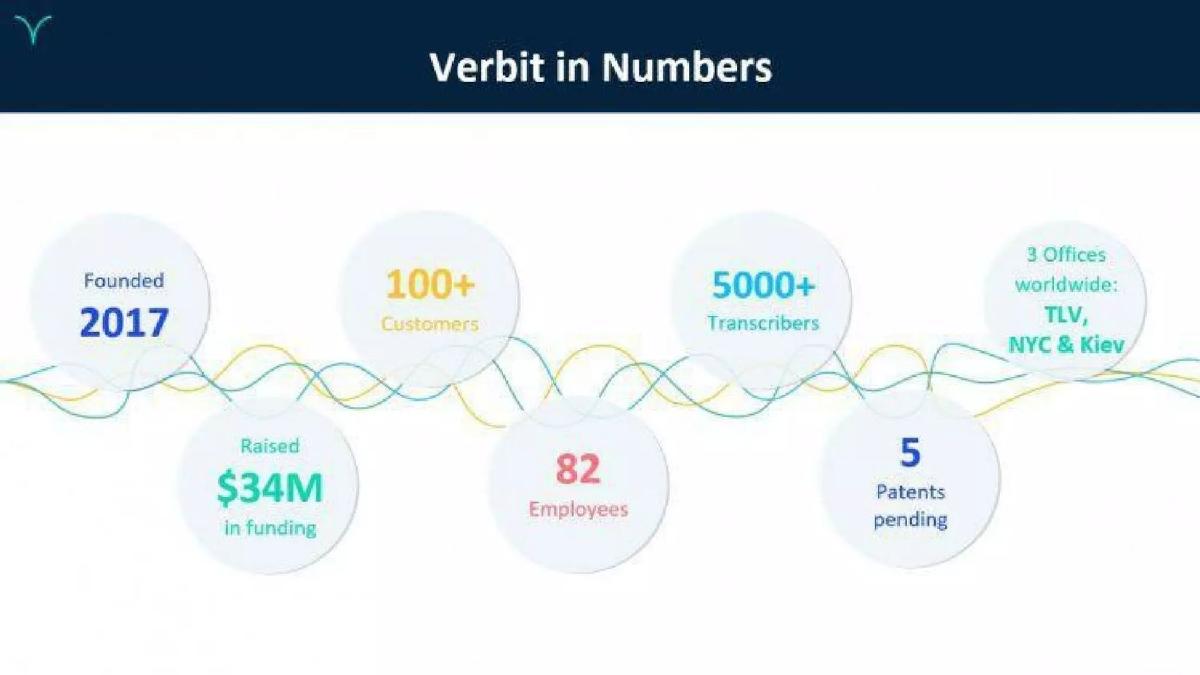
Slide 2: Verbit in Numbers This is a high-impact 'why now' and 'why us' slide. It lists several key milestones: founded in 2017, $34M in funding already raised (note: the catalogue listing mentions a $23M round, suggesting this deck may have been used for a subsequent or slightly different internal reporting period), 100+ customers, 82 employees, 5,000+ transcribers, 5 pending patents, and 3 worldwide offices (TLV, NYC, & Kiev). This slide establishes immediate credibility through scale.
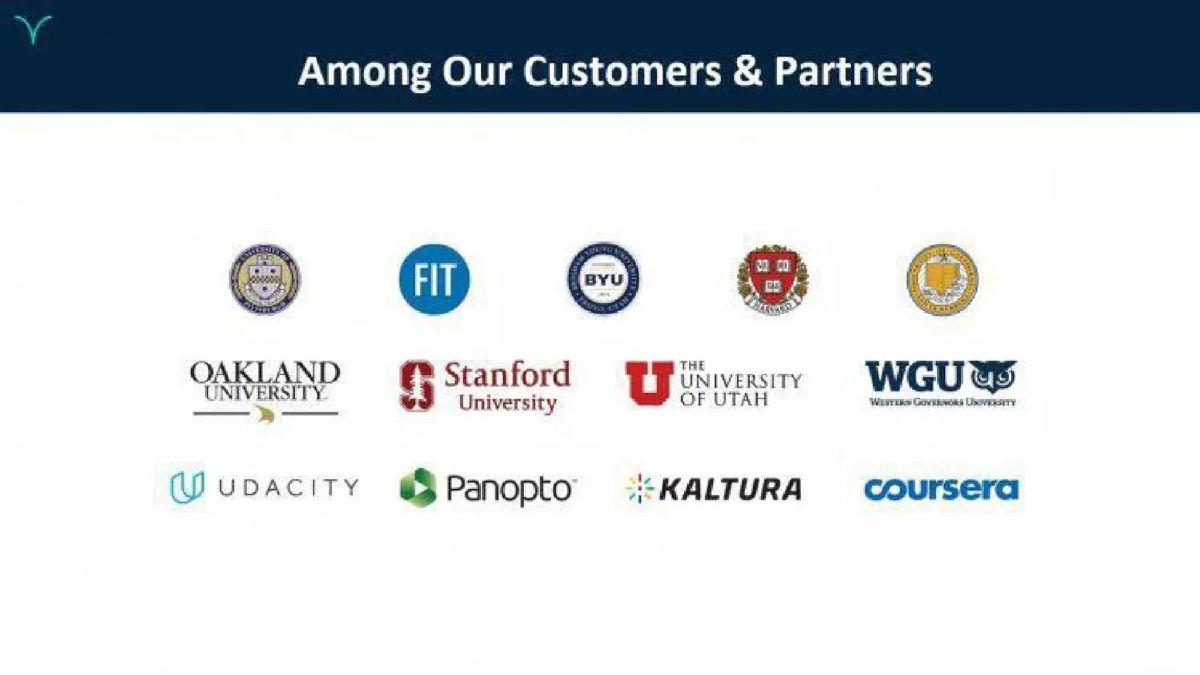
Slide 3: Among Our Customers & Partners A standard but effective logo cloud. It features prestigious academic institutions like Stanford University, Harvard, and the University of Utah, alongside massive e-learning platforms like Coursera, Udacity, and Kaltura. This validates the product's utility in high-stakes environments where accuracy is non-negotiable.
The Problem and Market Opportunity (Slides 4-6)
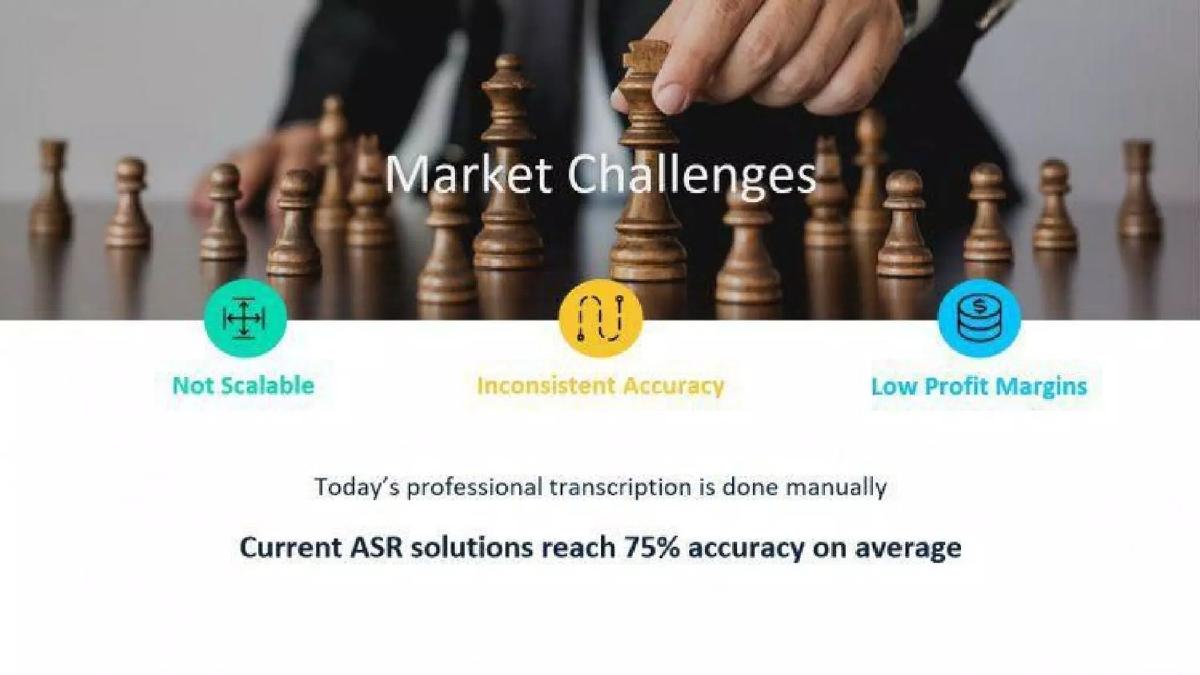
Slide 4: Market Challenges Verbit identifies three core pain points: 'Not Scalable,' 'Inconsistent Accuracy,' and 'Low Profit Margins.' The slide explicitly states that today’s professional transcription is done manually and that current ASR (Automated Speech Recognition) solutions only reach 75% accuracy on average. This sets the stage for their 99.9% accuracy claim later in the deck.
Slide 5: Technology Gap A simple transition slide with the text: 'Speech recognition technologies are not utilized in the transcription market.' This reinforces the idea that the industry is stuck in a manual past, despite the existence of AI.
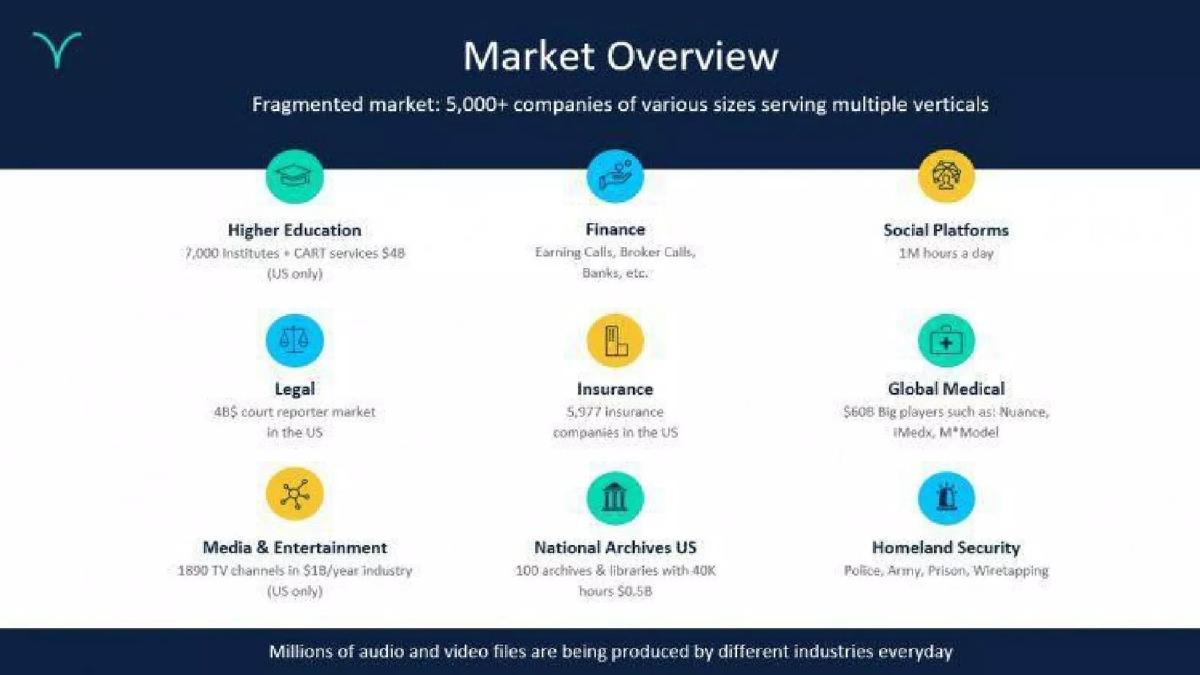
Slide 6: Market Overview This slide breaks down the 'fragmented market' of 5,000+ companies. It lists nine verticals with specific data points: Higher Education ($4B US market), Legal ($4B US court reporter market), Media ($1B/year industry), and Global Medical ($60B industry). By showing the breadth of the market, Verbit suggests that their solution is a horizontal platform rather than a niche tool.
The Solution and Technology (Slides 7-9)
Slide 7: Our Unique Hybrid Model The core value proposition is introduced here. Verbit claims to 'harness the power of artificial and human intelligence' to reach 99.9% accuracy at 'record-breaking speed.' This is the 'secret sauce' of the deck—admitting that AI alone isn't enough and that humans are the necessary final mile.
Slide 8: Our Solutions Verbit categorizes its offerings into three buckets: Transcription (audio to text), Captioning (video optimization), and Real-Time (CART). This shows the versatility of their engine across different media formats and use cases.
Slide 9: Our Technology: AI Makes the Difference This slide provides a workflow diagram. It starts with an audio/video upload to the 'Verbit Cloud,' passes through an 'ASR Engine,' generates an 'Automatically transcribed file,' undergoes '2x human editing,' and results in a 'File is ready' status. Crucially, it shows a feedback loop where 'Adaptive algorithms improve results' based on the human edits. This demonstrates a technical moat: the more they transcribe, the better the AI becomes.
Value Proposition and Social Proof (Slides 10-12)
Slide 10: Our Added Value A summary slide highlighting three pillars: 'Dramatically lower costs' (up to 50% reduction in operating costs), 'Record-breaking speed' (10x faster than competition), and 'Unparalleled accuracy' (99%+). It also mentions 'Enhanced customization' through adaptive technology.
Slide 11: Meet the Team The team slide features nine individuals. The three co-founders—Tom Livne (CEO), Kobi Ben Zvi (VP Engineering), and Eric Shellef (CTO)—are highlighted at the top. The supporting team includes VPs for Corporate Development, Sales & Marketing, Finance, Product & Operations, HR, and a Chief Revenue Officer. The presence of a CRO and VP of Sales suggests a company that is heavily focused on go-to-market execution.
Slide 12: What Our Customers Are Saying Three testimonials provide qualitative proof. Michael Thompson (Thompson Court Reporters) confirms the 99.9% accuracy requirement. George H. Michaels (UCSB) calls it a 'game-changer.' Valerie Sturm (BYU-Idaho) highlights the 'Real-Time' solution as a 'lifesaver' for hard-of-hearing students. These quotes map directly back to the target verticals identified in Slide 6.
Vision and Conclusion (Slides 13-15)
Slide 13: What’s Next? This slide focuses on the 'Opportunity to become a category leader in a multi-billion dollar market.' It reiterates the fragmented nature of the current market and the unique positioning of Verbit’s AI-human hybrid model.
Slide 14: Our Vision A high-level vision statement: 'We help organizations maximize the potential of their audio and video files by making the information within searchable, accessible and actionable.' This moves the conversation from 'transcription' to 'data accessibility.'
Slide 15: Thank You A standard closing slide with the company logo and a 'Thank You' message. It lacks contact information or a final call to action, which is a minor omission for a pitch deck.
What Works in this Deck
Clear Problem/Solution Fit: The deck does an excellent job of explaining why existing AI solutions (ASR) aren't enough for professional industries. By quantifying the 'ASR gap' (75% vs. 99.9%), they make the need for their hybrid model obvious. Strong Social Proof: The combination of a high-tier logo cloud (Slide 3) and specific, attributed testimonials (Slide 12) makes the claims of accuracy and speed feel verified rather than aspirational. Market Specificity: Instead of just saying 'the market is big,' Slide 6 provides specific dollar amounts and company counts for nine different industries. This shows the founders have done their homework on where the revenue actually sits.
What is Missing from this Deck
The 'Ask': There is no slide detailing how much money is being raised in the current round, the valuation, or the specific use of funds. While this information is often shared in a separate document or verbal conversation, its absence in the deck leaves the narrative without a clear conclusion. Unit Economics: While Slide 10 mentions a '50% reduction in operating costs' for the customer, it doesn't explain Verbit's own margins. Managing 5,000+ transcribers is a significant operational overhead; investors would likely want to see how the company maintains SaaS-like margins while paying for human labor. Competitive Landscape: The deck mentions 'manual transcription' and 'current ASR solutions' generally, but it doesn't name specific competitors like Rev.com or Trint. A competitive matrix would have helped define their moat more clearly.
What a Founder Should Copy
The Workflow Diagram (Slide 9): If you have a complex technical process, especially one involving human-in-the-loop or AI, copy this layout. It clearly shows the input, the automated step, the human verification step, and the feedback loop that creates the technical moat. The 'Numbers' Slide (Slide 2): Placing a 'traction at a glance' slide early in the deck is a great way to anchor the investor's attention. It proves the company is a moving train before you even get to the problem statement. Vertical Segmentation (Slide 6): If your product is horizontal, don't just list one big TAM number. Break it down into specific verticals with individual data points as Verbit did. This helps investors visualize the different 'wedges' you can use to enter the market.
Conclusion
Verbit’s deck is a highly professional, well-structured Series A presentation. It leans heavily on the credibility of its existing investors ($34M raised) and its elite customer base. By focusing on the 'accuracy gap' in the transcription market, they successfully frame their hybrid model not as a compromise, but as a technological necessity. While it lacks the granular financial detail seen in some late-stage decks, it provides a clear, logical path from a massive, fragmented problem to a scalable, AI-driven solution.
Frequently asked questions
- What is Verbit's core product offering?
- Verbit offers three primary solutions: Transcription, which transforms audio to text using AI and human intelligence; Captioning, which optimizes video content; and Real-Time (CART), providing AI-enhanced transcription in real time. These are delivered through a hybrid model that combines automated speech recognition with human editors to ensure high accuracy.
- How does Verbit differentiate itself from standard ASR solutions?
- According to Slide 4, standard ASR (Automated Speech Recognition) solutions only reach 75% accuracy on average, which is insufficient for professional use. Verbit differentiates itself by using a hybrid model that incorporates human editing to reach 99.9% accuracy. They also claim to be 10x faster than traditional manual transcription competition.
- Which market segments is Verbit targeting?
- Verbit targets a highly fragmented market across multiple verticals. Slide 6 specifically highlights Higher Education (7,000 institutes), Legal ($4B US market), Media & Entertainment ($1B/year industry), Finance, Insurance, National Archives, Social Platforms, Global Medical ($60B market), and Homeland Security.
- What is the scale of Verbit's human workforce?
- As stated on Slide 2, Verbit manages a network of over 5,000 transcribers. This human element is a critical part of their '2x human editing' workflow shown on Slide 9, where the AI-transcribed file is reviewed by people to ensure the final output meets the 99.9% accuracy guarantee.
- What financial metrics are included in the deck?
- The deck is light on specific financial performance metrics like ARR or MRR. It mentions $34M in total funding raised and 100+ customers on Slide 2. On Slide 10, it claims to provide a 50% reduction in operating costs for customers, but it does not disclose the company's internal margins or revenue growth rates.