Ventura Labs positions itself as a 'Creative Economy Hub' designed to address a critical talent shortfall in Indonesia, a problem validated by VCs like Golden Gate Ventures and Ideosource. Operating as a social enterprise under the Indoplan Institute, the organization launched the DSI Bootcamp in 2016 to provide practitioner-led training. The deck focuses heavily on the educational architecture of their first batch, which targeted 28 students for a six-month program. While the mission is highly localized and impact-driven, the deck functions more as a program proposal than a traditional ventu…
Key takeaways
- The company identifies a 'talent shortfall' as the primary barrier to Indonesia's startup growth, citing external validation from VCs on Slide 2.
- Ventura Labs is structured as an independent social enterprise founded by the Indoplan Institute (Slide 3).
- The 2016 pilot project, DSI Bootcamp, consists of a 6-month program split into 3 months of classroom training and 3 months of capstone/internship (Slide 6).
- The program is highly selective and small-scale, limiting its first batch to only 28 students (Slide 6).
- The curriculum is divided into three tiers: Fundamental, Machine Learning/Statistical Model, and Elective Courses/Data Visualization (Slide 7).
- Ventura Labs uses global tech giants like Uber, Airbnb, and Alibaba to illustrate the scale of the 'Creative Economy' they aim to join (Slide 9).
- The deck lacks a formal 'Ask' slide, missing details on funding requirements, valuation, or use of proceeds.
- There is no dedicated team slide detailing the founders' backgrounds, though some trainers are listed on a program flyer on Slide 6.
Introduction: The Macro-Economic Hook
Ventura Labs opens its presentation not with a product, but with a national mission. The deck is framed around the 'Youth Dividend' of Indonesia, positioning the company as the bridge between a massive demographic opportunity and the technical reality of the modern economy. As an initiative of the Indoplan Institute, the deck carries an academic and social-enterprise tone rather than a high-growth tech startup vibe.
Slide 1: Title Slide
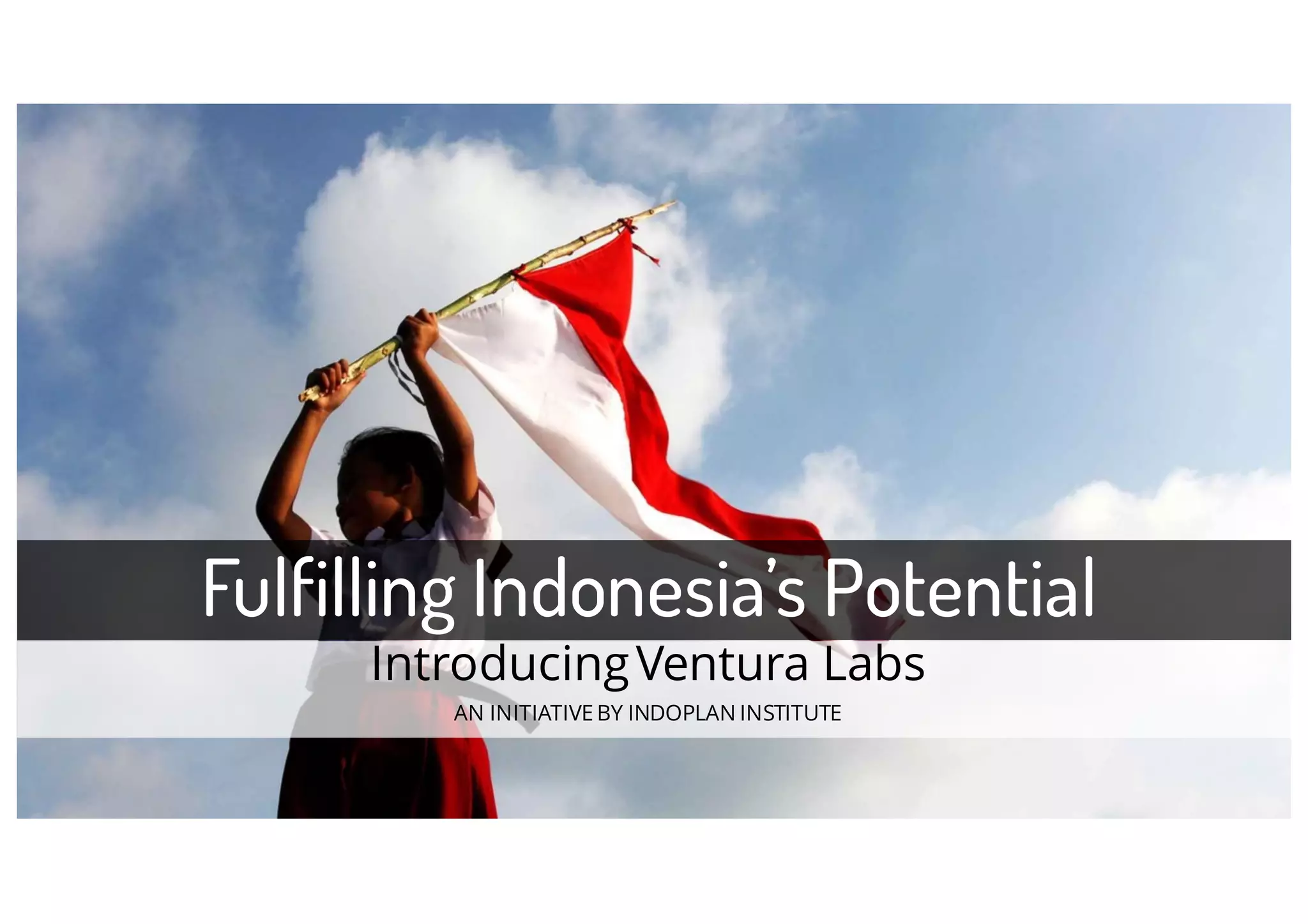
The cover slide features a child holding the Indonesian flag with the headline 'Fulfilling Indonesia’s Potential.' It clearly establishes the geographic focus and the social mission. The sub-heading introduces Ventura Labs as an initiative by the Indoplan Institute. There is no specific date or version number on this slide.
Slide 2: The Problem Statement
This slide identifies a 'talent shortfall' as the core obstacle to economic growth. It quantifies the opportunity by mentioning '65 million young Indonesians.' Crucially, it uses third-party validation by citing VCs like Golden Gate Ventures, Ideosource, and Fenox to prove that the lack of talent is a recognized industry pain point. This is a strong way to build urgency.
Slide 3: The Solution and Identity
Ventura Labs defines itself as a 'Creative Economy Hub.' The slide outlines three pillars: providing practitioner-led training, acting as a hub for stakeholders (NGOs, Government, Youth), and being a self-sustaining social enterprise. The footer introduces the 'Pilot project: DSI Bootcamp 2016,' which serves as the concrete example of their mission in action.
Slide 4: Transition Slide
A full-bleed image of modern skyscrapers with the text 'Are We Being Crazy Ambitious?' serves as a rhetorical bridge. It shifts the narrative from the 'why' (the national problem) to the 'how' (the specific program).
Slide 5: Agenda/Roadmap
This slide introduces a three-part structure for the remainder of the presentation: #1 Data Science Bootcamp, #2 Lesson Plan, and #3 What Our Students Will Be. This provides the viewer with a clear expectation of the technical deep-dive to follow.
Slide 6: The DSI Bootcamp Details
This slide provides the logistics for the first batch of the Data Science Indonesia (DSI) Bootcamp. Key figures include a '6 months training Program' consisting of '3 months classroom training' and '3 months capstone project / internship.' It notes the program is 'Only for 28 Students' and takes place 'Twice a week.' An embedded flyer shows the date '26 March 2016' and lists several trainers, including Yanti Nisro and Dany Kosasih, providing some 'team' context through the lens of the teaching staff.
Slide 7: The Curriculum (Lesson Plan)
This is the most technical slide in the deck. It breaks down the 'Design Curriculum' into a hierarchy. At the base are 'FUNDAMENTAL' skills (SQL, Statistics). Above that are 'Machine Learning / Statistical Models' split into Unsupervised and Supervised learning. The top tier includes 'Elective Courses' and 'Data Visualization & Story Telling.' This slide demonstrates that the program is not just a high-level overview but a rigorous technical course.
Slide 8: Section Header
A simple transition slide highlighting section #3: 'WHAT OUR STUDENTS WILL BE.' This prepares the audience for the 'output' or the value proposition of the graduates.
Slide 9: The Creative Economy Context
To explain the value of the skills being taught, Ventura Labs uses the 'World's Largest' analogy. It lists Facebook (media), Alibaba (retail), Airbnb (accommodation), and Uber (taxi) to show that modern leaders in the creative economy often own no physical assets, relying instead on data and platforms. The slide argues that 'Indonesia needs the skills to match' this global shift.
Slide 10: Conclusion
The final slide is a simple 'THANK YOU, LET’S BUILD INDONESIA TOGETHER!' It lacks a call to action, contact information, or a specific request for partnership or funding, which is a significant omission for a pitch deck.
What Works Well
Problem Validation: By citing specific Venture Capital firms on Slide 2, Ventura Labs moves the 'talent gap' from a theoretical problem to a market-validated reality. This is highly persuasive for potential partners or investors who follow the tech sector.
Curriculum Transparency: Slide 7 is excellent. It shows exactly what the 'product' is. For an education-based startup, the curriculum is the engine, and Ventura Labs provides a detailed look at that engine, covering everything from K-Mean clustering to Sentiment Analysis.
Clear Structure: The deck uses roadmap slides (Slide 5 and 8) effectively. The viewer always knows where they are in the presentation, which is helpful for longer decks (this deck is 30 slides in its full version).
What Is Missing
The 'Ask': There is no slide indicating what Ventura Labs needs. Do they need $500k in seed funding? Do they need corporate partners for internships? Do they need government grants? Without an 'Ask,' the deck is a brochure, not a pitch.
Business Model/Unit Economics: While Slide 3 mentions being a 'self-sustaining social enterprise,' it never explains how. Are students charged tuition? Do companies pay a placement fee for graduates? Without these details, the sustainability of the model is unproven.
Founder Backgrounds: While some trainers are mentioned on a flyer in Slide 6, there is no dedicated slide for the core leadership team of Ventura Labs or the Indoplan Institute. Investors invest in people first, especially in the early stages.
Competitive Landscape: The deck does not mention other bootcamps or universities. Explaining why Ventura Labs is better or different than existing computer science programs in Indonesia would strengthen the case.
What a Founder Should Copy
The 'Macro-to-Micro' Flow: Start with a massive national or global problem (Slide 2), then narrow down to your specific solution (Slide 3), and finally show the granular details of how that solution works (Slide 7). This creates a logical 'funnel' for the audience's attention.
Using Industry Analogies: Slide 9's use of Facebook, Uber, and Airbnb is a classic but effective way to explain a complex shift in the economy. It helps the audience visualize the 'end state' of the market the founder is trying to enter.
Pilot Project Focus: Instead of promising a global empire on day one, focusing the deck on a specific 'Pilot Project' (the 2016 Bootcamp) makes the venture feel grounded and achievable. It provides a manageable set of metrics for a first-time founder to track and report.
Final Analysis
Ventura Labs has produced a deck that is strong on mission and technical curriculum but weak on the 'business' of being a startup. It reads more like a program proposal for a non-profit or a government grant than a venture capital pitch. To attract serious investment, the founders would need to add slides on revenue models, scalability (how do they go from 28 students to 28,000?), and a clear financial 'Ask.' However, as a document intended to build credibility for a new educational initiative in a developing tech ecosystem, it successfully communicates the necessity and the rigor of its program.
Frequently asked questions
- What is the primary business model of Ventura Labs?
- Based on Slide 3, Ventura Labs operates as a 'self-sustaining social enterprise.' It functions as a platform providing practitioner-led training in startup skills and acting as a hub for industry leaders, NGOs, and the government. While it mentions being self-sustaining, the deck does not explicitly detail its revenue streams, such as tuition fees or corporate placement commissions.
- Who is the target audience for their training programs?
- The program specifically targets 'young Indonesians' and 'fresh graduates' with academic backgrounds in Statistics, Computer Science, Economics/Business, or Mathematics. Slide 6 notes that the first batch was limited to 28 students and held sessions twice a week, including weekdays after office hours and weekends, suggesting a focus on both students and early-career professionals.
- What specific technical skills does the curriculum cover?
- The curriculum detailed on Slide 7 is comprehensive for data science. It includes 'Fundamental' topics like SQL and Basic Statistics, 'Machine Learning' covering supervised (Regression, Naïve Bayes, SVM) and unsupervised (K-Mean, Hierarchical clustering) models, and 'Elective' topics like Sentiment Analysis and Social Network Analysis.
- Does the deck provide evidence of market demand?
- Yes, Slide 2 cites that major venture capital firms including Golden Gate Ventures, Ideosource, and Fenox have reinforced the claim that Indonesia's startup potential is hampered by a critical lack of talent. This frames the venture as a solution to a problem already recognized by the local investment community.
- What is the relationship between Ventura Labs and Indoplan Institute?
- Slide 3 states that Ventura Labs was founded by the Indoplan Institute as an independent social enterprise. The Indoplan Institute appears to be the parent organization or the initiating body, providing the institutional backing for the Ventura Labs initiative.