Cellarity's Series C pitch deck is a sophisticated example of how to market a 'platform-first' biotech company. Rather than leading with a single blockbuster drug candidate, the deck emphasizes a proprietary methodology that combines systems biology and machine learning to study cell behavior in its entirety. By shifting the focus from narrow molecular targets to holistic cellular health, Cellarity positions itself as a paradigm shift in the industry. The deck effectively uses visual metaphors for data mapping and provides a clear validation roadmap across multiple therapeutic areas, includin…
Key takeaways
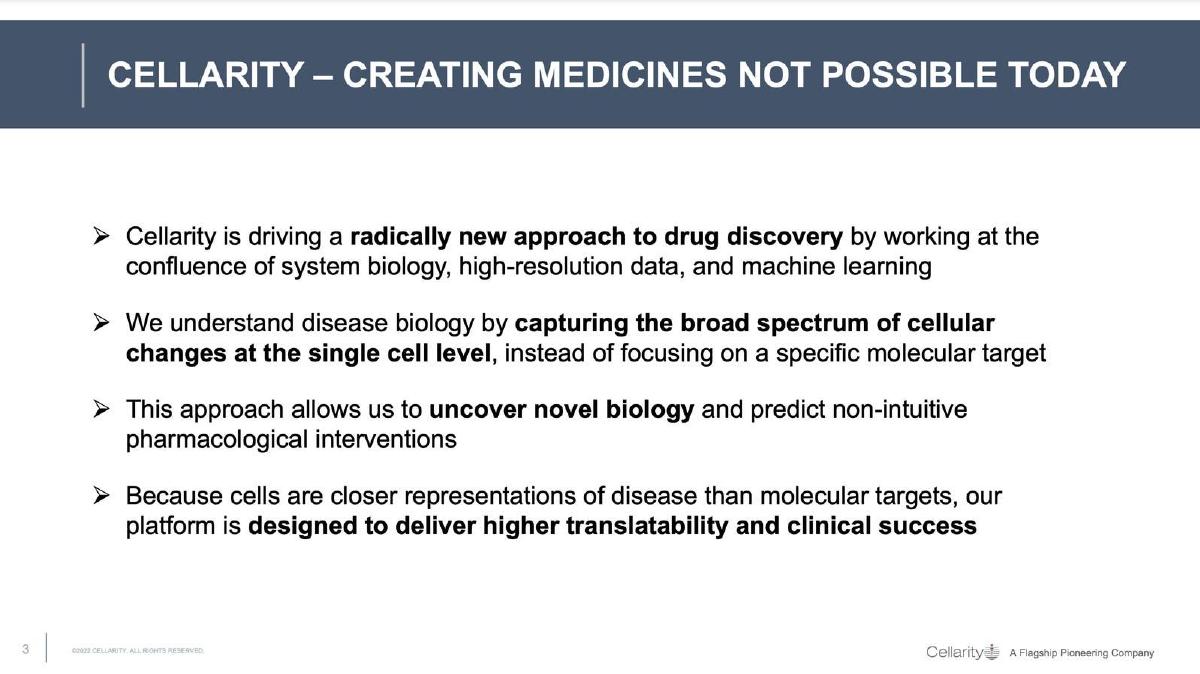
- The company positions its technology as a 'radically new approach' that captures cellular changes at the single-cell level (Slide 3).
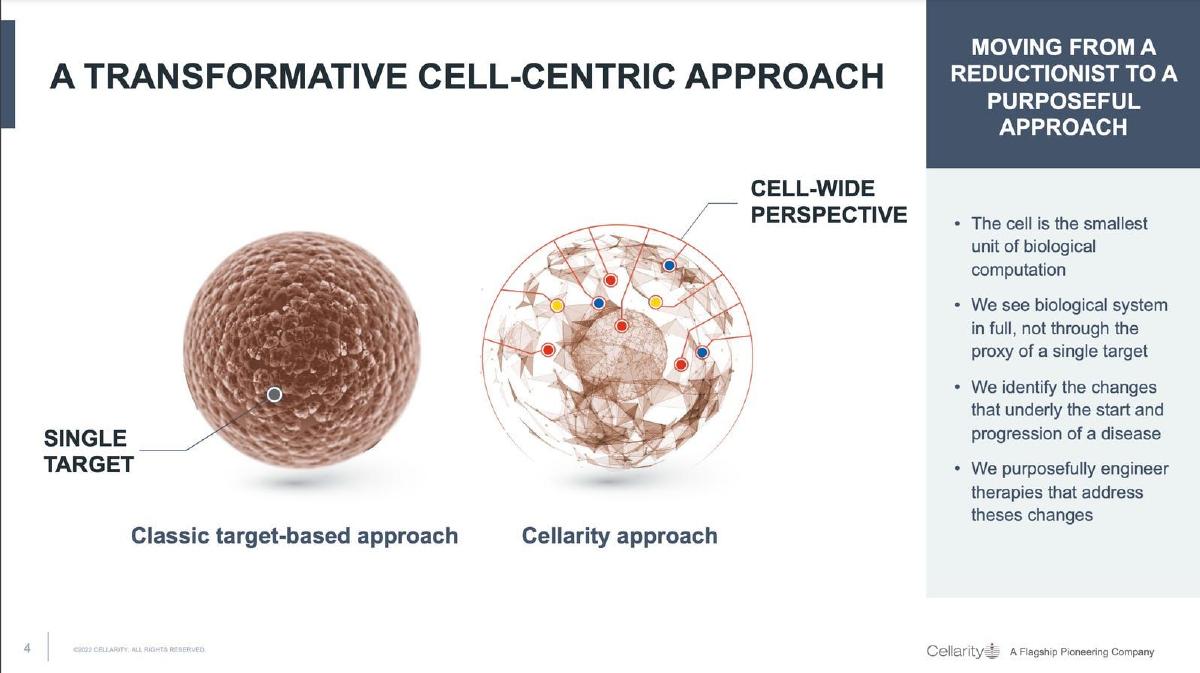
- Cellarity moves away from the traditional 'classic drug discovery' model of individual target identification to a model of 'encoding biology' (Slide 9).
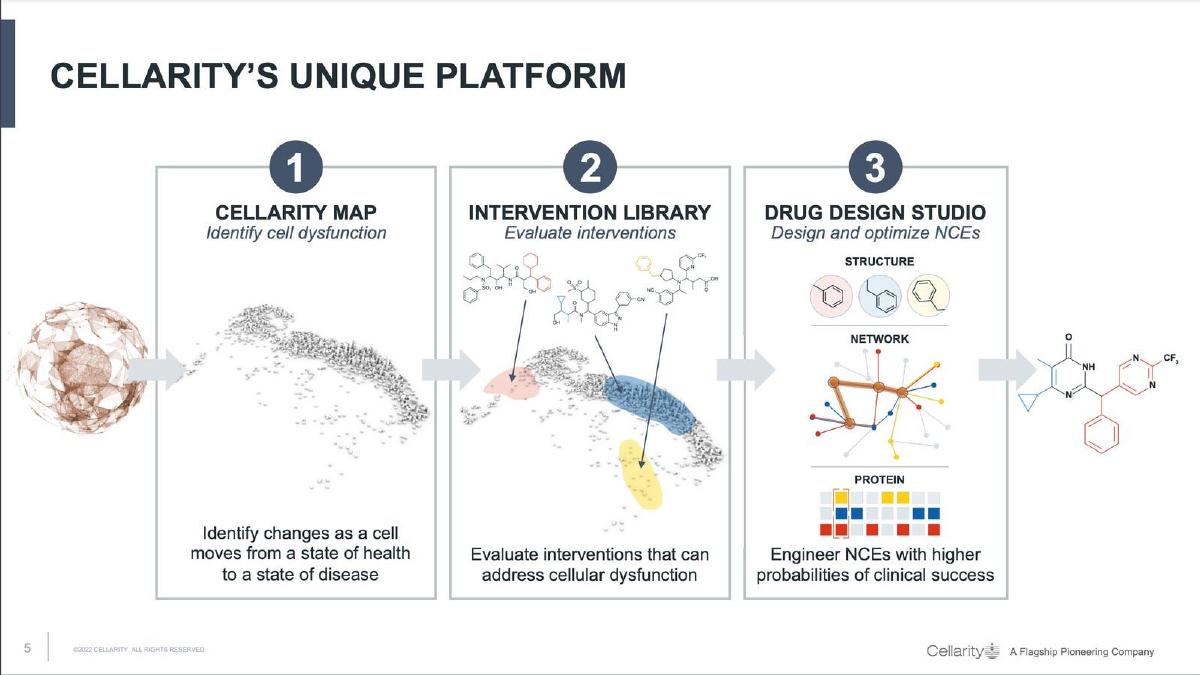
- The proprietary platform is divided into three distinct pillars: Cellarity Map, Intervention Library, and Drug Design Studio (Slide 5).
- The deck showcases a broad pipeline covering Metabolic Disease, Hematology, Immuno-Oncology, and Respiratory sectors (Slide 7).
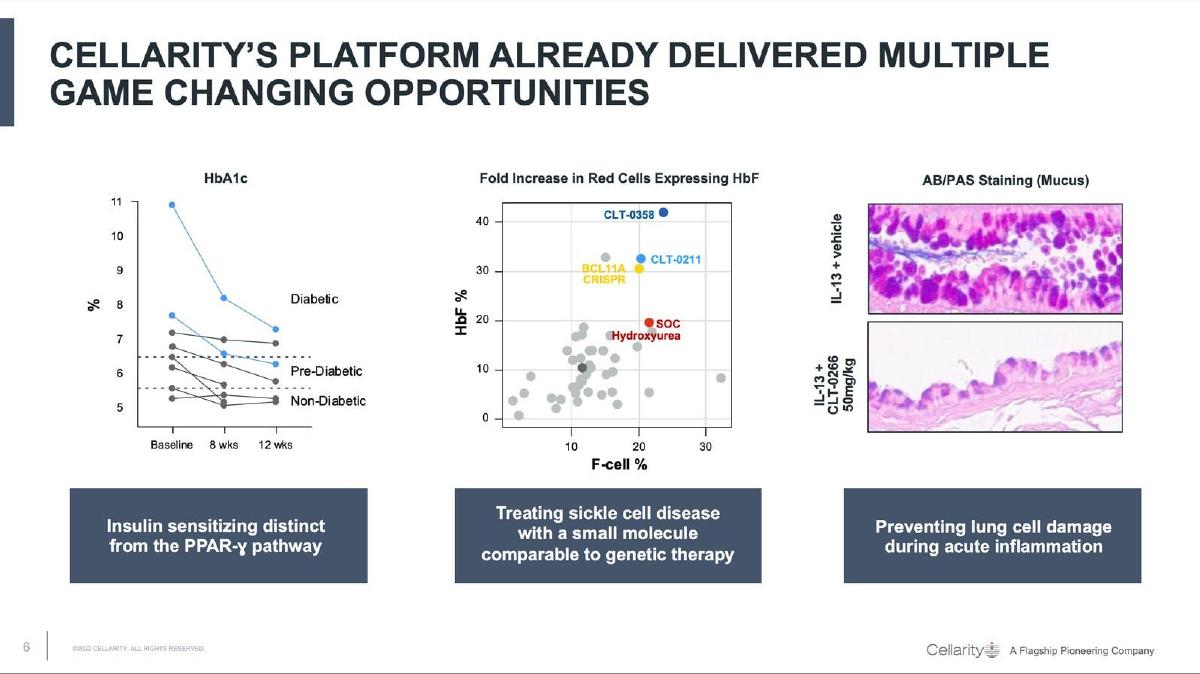
- Validation is clearly tracked across three stages: In Vitro, In Vivo, and NHP (Non-Human Primate), showing significant progress in insulin sensitization and hemoglobinopathy (Slide 7).
- The team slide is exceptionally dense, featuring 13 executive leaders and 8 board members/founders, emphasizing deep institutional experience from Novartis, Pfizer, and Biogen (Slide 11).
- The visual identity relies on complex data visualizations to represent 'cell dysfunction' as a topographical map, reinforcing the high-tech nature of their data (Slide 5).
- As reported by Business Insider, the company successfully raised $121M in 2024 following this Series C presentation.
The Paradigm Shift: Moving from Targets to Cells
Cellarity’s Series C deck is a masterclass in narrative positioning. In the world of biotechnology, most startups live or die by a single molecular target. Cellarity uses its opening slides to argue that this traditional approach is limited. By raising $121M in 2024, as reported by Business Insider, the company proved that investors are hungry for platform plays that leverage machine learning to look at the 'whole picture' of cellular health.
Slide 1: The Visual Hook
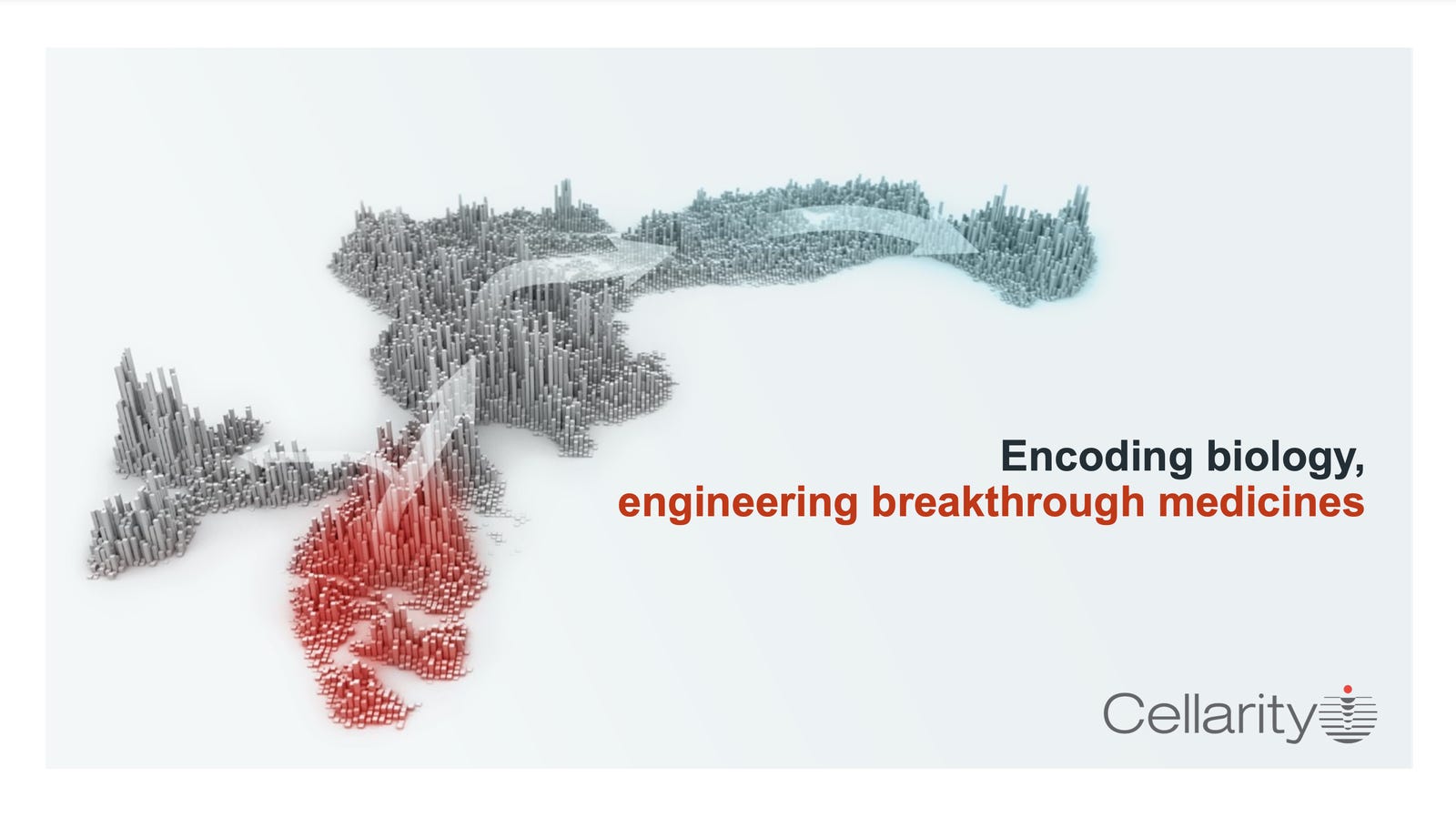
The title slide features a sophisticated 3D data visualization of what appears to be a cellular landscape transitioning from a healthy state (grey) to a diseased state (red). The tagline, "Encoding biology, engineering breakthrough medicines," immediately establishes the company as a hybrid of software engineering and biological science. There is no clutter here; the focus is entirely on the scale of the data they are processing.
Slide 3: Defining the Radical Approach
Slide 3 serves as the executive summary. It lists four key pillars of their value proposition. Most notably, it claims to work at the "confluence of system biology, high-resolution data, and machine learning." The slide explicitly states they focus on the "broad spectrum of cellular changes at the single cell level, instead of focusing on a specific molecular target." This is a critical distinction for Series C investors who are looking for a platform that can generate multiple 'shots on goal' rather than a single-asset gamble.
Slide 5: The Three-Step Platform Process
This slide provides the technical 'how-it-works.' The platform is broken down into three numbered stages:
1. Cellarity Map: Identifying cell dysfunction by mapping how a cell moves from health to disease. · 2. Intervention Library: Evaluating chemical interventions that can reverse that dysfunction. · 3. Drug Design Studio: Designing and optimizing New Chemical Entities (NCEs) with higher probabilities of clinical success.
The visual flow from a messy biological cluster to a structured chemical formula (an NCE) effectively communicates the transition from abstract data to a tangible product.
Slide 7: The Pipeline and Validation Roadmap
For a Series C deck, traction is mandatory. Slide 7 uses a checkmark matrix to show the "Breadth and Speed" of their progress. The pipeline is diversified across four major areas: Metabolic Disease, Hematology, Immuno-Oncology, and Respiratory. The slide shows that two programs (Insulin Sensitization and Hemoglobinopathy) have already reached the NHP (Non-Human Primate) validation stage. This is a high-value milestone that de-risks the platform for late-stage investors. It also notes that the Myelofibrosis program was "Launched Q4 2021," giving a sense of the company's operational velocity.
Slide 9: The Competitive Landscape (Paradigm Comparison)
Rather than a standard 'X vs. Y' feature list, Slide 9 compares three eras of drug discovery. It places "Classic drug discovery" (target identification) at the bottom, "AI-enabled drug discovery" (AI augmenting classic targets) in the middle, and "Cellarity" at the top as an "Entirely new approach." By positioning themselves as the evolution of AI-enabled discovery, they justify a higher valuation than companies simply using AI to find traditional targets faster.
Slide 11: The 'Institutional' Team
The team slide is one of the most crowded in the deck, which in this context is a strength. It features 21 high-resolution headshots. The pedigree is undeniable, with former executives from Novartis, Pfizer, Takeda, Biogen, and Roche . The presence of Noubar Afeyan (Co-Founder and CEO of Flagship Pioneering) and Stephen Berenson (Chairman) signals to investors that this company has the full weight of the Flagship ecosystem behind it. This slide is designed to project 'inevitability'—the idea that this team is too experienced to fail.
What Cellarity Does Exceptionally Well
The deck excels at Visual Metaphor . Biology is notoriously difficult to visualize without looking like a textbook. Cellarity uses 'topographical maps' of data to represent cellular states, which makes their machine-learning claims feel more concrete. They also do an excellent job of Category Creation . By framing their work as 'Encoding Biology,' they move the conversation away from 'we found a new protein' to 'we have a new way of seeing.' This is how you raise $121M in a tight market—you sell a new standard, not just a new drug.
What is Missing from the Deck
Despite the $121M raise, several standard elements are missing from these specific slides:
The Ask: There is no slide detailing exactly how the $121M will be spent (e.g., 'X% to Phase 1 trials, Y% to platform scaling'). · Unit Economics: While this is biotech, investors often want to see the projected cost-savings of the platform compared to traditional R&D. · Intellectual Property: There is no mention of patent counts or the specific 'moat' protecting their 'Intervention Library.' · Market Size: The deck assumes the investor already knows that Metabolic Disease and Oncology are multi-billion dollar markets. It skips the 'TAM/SAM/SOM' slides entirely.
Founder's Playbook: Lessons from Cellarity
If you are building a platform-based company, copy Cellarity’s Validation Matrix (Slide 7) . Many founders make the mistake of showing a pipeline without showing the stage of validation for each item. By using In Vitro, In Vivo, and NHP as columns, Cellarity creates a clear scorecard of success. Additionally, founders should note how Cellarity uses Slide 9 to define their own category. Don't just say you are better than the competition; say you are playing a different game entirely. Finally, if you have a large, prestigious board, don't hide them in the appendix. Put them on a main slide to show the depth of your institutional support.
Frequently asked questions
- What is the core difference between Cellarity and traditional biotech?
- According to Slide 9, traditional discovery focuses on individual target identification via high-throughput screening. Cellarity uses a 'new drug discovery paradigm' that encodes biology to see cell behavior in full, engineering therapies to change that behavior rather than just hitting a single protein target.
- How does Cellarity demonstrate that its platform actually works?
- Slide 7 provides a validation matrix. It shows that their programs for Insulin Sensitization and Hemoglobinopathy have already reached NHP (Non-Human Primate) validation, while others like T-Cell Exhaustion have completed In Vivo testing.
- What are the three steps of the Cellarity platform?
- Slide 5 outlines the process: 1) Cellarity Map to identify cell dysfunction, 2) Intervention Library to evaluate how different interventions affect that dysfunction, and 3) Drug Design Studio to optimize New Chemical Entities (NCEs).
- Who is behind Cellarity?
- The company is a Flagship Pioneering company. Slide 11 lists a massive team including CEO Fabrice Chouraqui (former President of Novartis Pharma US) and Co-Founder Noubar Afeyan (CEO of Flagship Pioneering).
- Does the deck mention specific diseases they are treating?
- Yes, Slide 7 lists specific indications: Insulin Sensitization, Energy Wasting, Hemoglobinopathy, Chemotherapy-Induced Thrombocytopenia, Myelofibrosis, T-Cell Exhaustion, and Goblet Cell Hyperplasia.