CellBreaker’s 2017 pitch deck is a study in minimalism, relying on visual metaphors and large-scale traction numbers rather than dense technical explanations. The company, which helps consumers exit cell phone contracts without early termination fees, used just 10 slides to communicate its value proposition. Key highlights include a reported $331,200 in customer savings and a total addressable market of $14 billion. While the deck lacks a formal 'Ask' slide, financial projections, or a detailed business model, it successfully leverages social proof through logos from Wired, TechCrunch, and AB…
Key takeaways
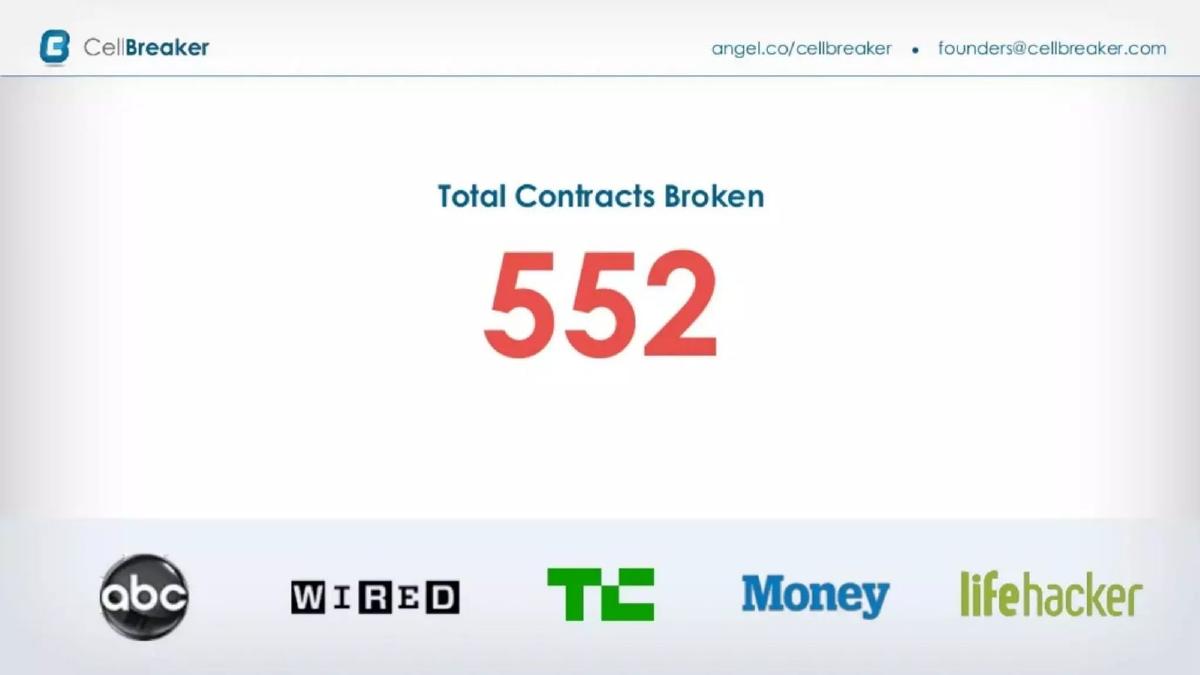
- The deck reports a total of 552 contracts broken at the time of the presentation (Slide 3).
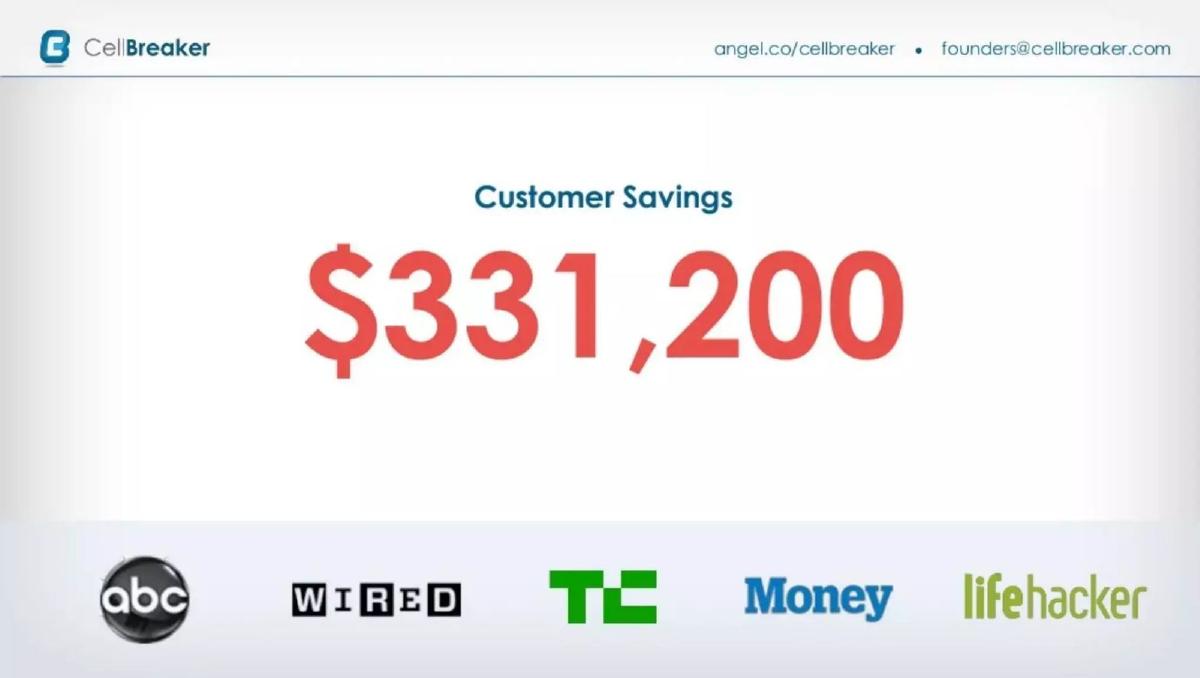
- Total customer savings are highlighted as a primary success metric, totaling $331,200 (Slide 4).
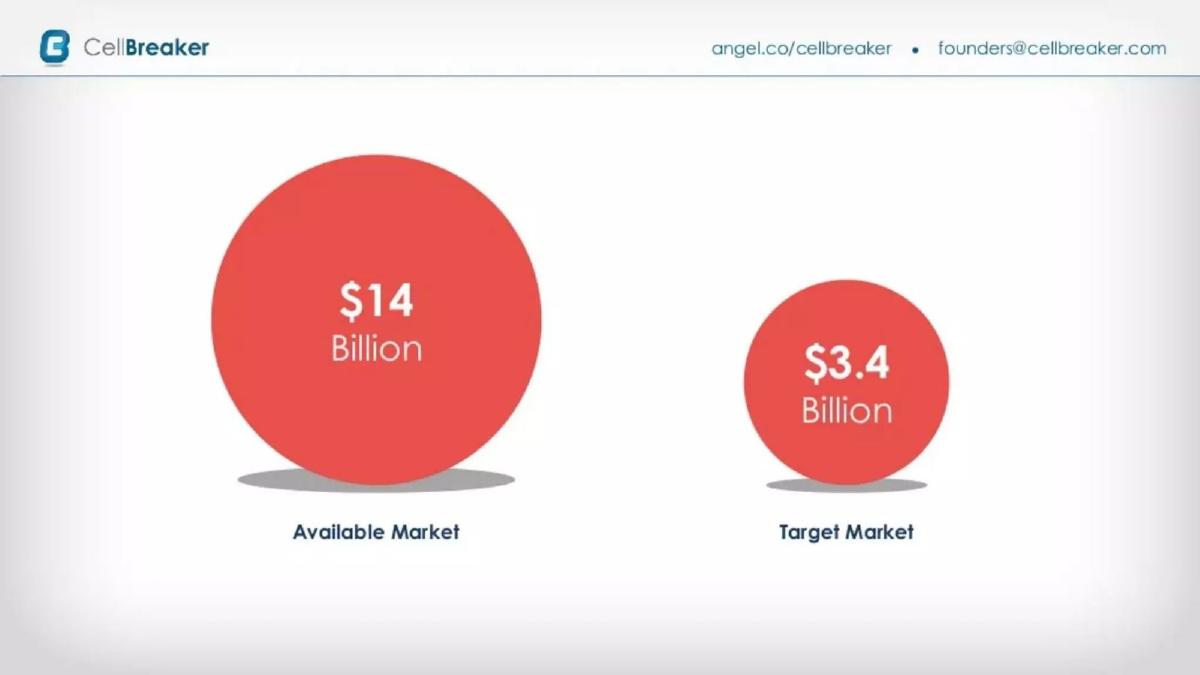
- The startup identifies a $14 billion available market and a $3.4 billion target market (Slide 6).
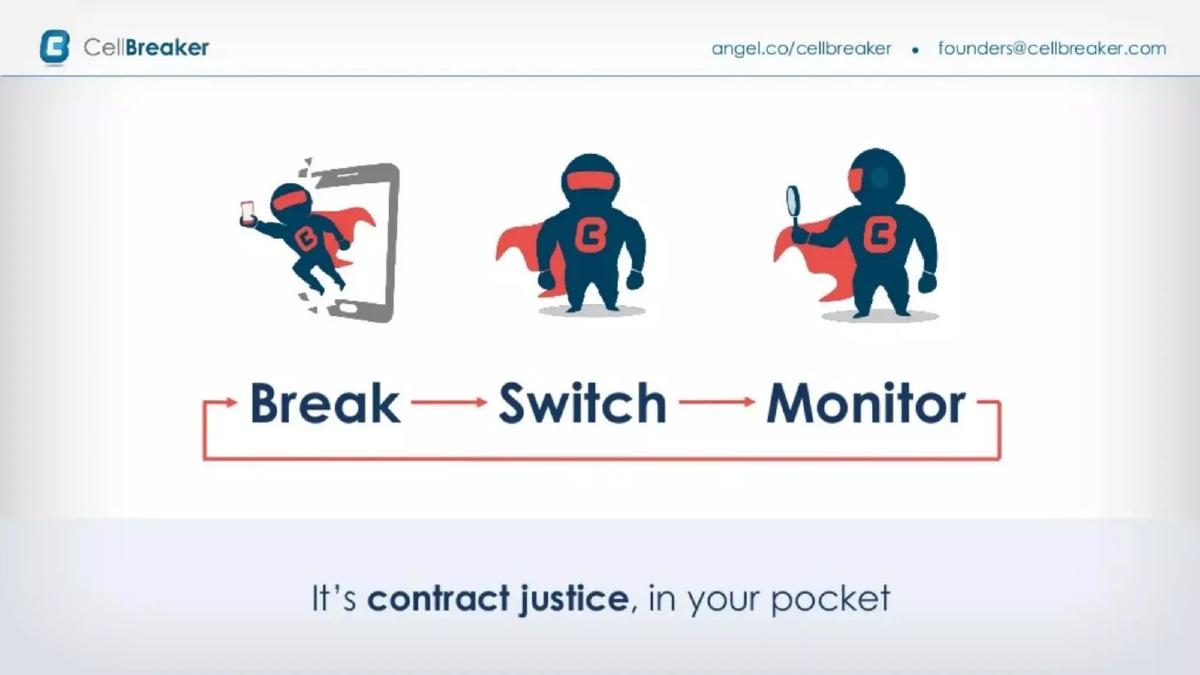
- The core product workflow is simplified into three steps: Break, Switch, and Monitor (Slide 5).
- Social proof is established early through media logos from Wired, TechCrunch, ABC, Money, and Lifehacker (Slides 3 and 4).
- The leadership team brings a combined 37 years of experience in telecom, legal, and operations (Slide 7).
- The deck completely omits a financial 'Ask' or use of funds slide, despite being used for fundraising.
- Visual storytelling is prioritized over data, using recurring imagery of a 'superhero' mascot and a man burning money (Slides 1, 2, 8, and 9).
The CellBreaker Pitch Deck: Minimalist Consumer Justice
CellBreaker entered the market with a specific, high-friction problem: the early termination fee (ETF). For years, mobile carriers used these fees to lock consumers into long-term contracts. CellBreaker’s 2017 pitch deck, which helped secure $396,000, is a masterclass in brevity. With only 10 slides and almost no bullet points, the deck relies on the 'show, don't tell' principle. It frames the company not just as a utility, but as a 'superhero' for the average consumer.
The Hook and the Pain Point (Slides 1-2)
Slide 1 introduces the brand with a minimalist logo: a superhero character with a 'C' on its chest. This immediately sets a tone of advocacy and protection. The inclusion of an AngelList link and a founder email address at the bottom of every slide ensures that the call to action is always present, even if a dedicated 'Ask' slide is missing.
Slide 2 is a full-bleed image of a man in a suit lighting a cigar with a burning hundred-dollar bill. There is no text on this slide. In a pitch setting, this serves as a visual metaphor for the wastefulness of cell phone contracts and the perceived 'arrogance' of big telecom carriers. It is designed to trigger an emotional response from anyone who has ever felt overcharged by a service provider.
Traction and Social Proof (Slides 3-4)
Slide 3 gets straight to the point with a single number: 552 . This represents the 'Total Contracts Broken.' By using the word 'broken,' CellBreaker leans into its disruptive identity. Below the number, the deck features logos from ABC, Wired, TechCrunch, Money, and Lifehacker . This is a critical move for a legal-tech startup; it proves that their method for exiting contracts has been vetted or at least recognized by major journalistic outlets.
Slide 4 follows up with the financial impact: $331,200 in 'Customer Savings.' This slide mirrors the layout of the previous one, reinforcing the message that the company creates tangible value. For an investor, these two slides provide the 'Why now' and the 'Does it work?' in under ten seconds of viewing time.
The Solution and Market Opportunity (Slides 5-6)
Slide 5 explains the product workflow using three icons and three words: Break, Switch, Monitor . The tagline 'It’s contract justice, in your pocket' positions the company as a mobile-first platform. This slide is the closest the deck gets to a product demo, showing the superhero mascot emerging from a smartphone screen. It suggests a seamless, automated process for a task that is traditionally manual and litigious.
Slide 6 addresses the market size. It uses two red circles to compare the $14 Billion Available Market to the $3.4 Billion Target Market . While the deck doesn't provide a source for these figures or a breakdown of how they were calculated, the scale is large enough to interest seed-stage investors. The simplicity of the visualization prevents the audience from getting bogged down in the math, focusing instead on the 'billion-dollar' potential.
The Team and the 'Why' (Slides 7-10)
Slide 7 introduces the leadership. The team is small but specialized. Jon Colgan (CEO) brings 8 years of telecom contract experience, which is the core of the business. Mike Greenberg (CLO) is perhaps the most important hire for this model, with 24 years in consumer protection. Jules Hill (COO) rounds out the trio with 5 years in operations. The slide also notes they have an 'In-House Engineering Team,' 'In-House Legal Counsel,' and an 'Experienced Sales Team,' suggesting they are a fully functional organization rather than just a landing page.
Slide 8 repeats the 'burning money' image from Slide 2. In a 10-slide deck, repeating an image is a bold choice. It likely served as a transition slide during a live pitch, allowing the founder to summarize the problem before moving to the conclusion.
Slide 9 returns to the superhero mascot, this time without any text. This is a branding play, reinforcing the identity of the 'CellBreaker' character.
Slide 10 is the closing slide, featuring a photo of a baby wearing a CellBreaker onesie. This is a common tactic in early-stage decks to humanize the founders and leave the audience with a positive, memorable image. It includes the website and contact email once more.
What Works in the CellBreaker Deck
The primary strength of this deck is its unwavering focus on the 'Hero' narrative . By using a mascot and aggressive language like 'breaking' contracts, they differentiate themselves from boring legal services. The social proof on slides 3 and 4 is also exceptionally strong; for a startup that deals with the legality of contracts, having Wired and TechCrunch logos is a major trust signal.
The minimalist design is another win. Many founders clutter their slides with too much data, leading to 'death by PowerPoint.' CellBreaker does the opposite, forcing the investor to listen to the presenter or focus on one single, massive metric per slide. This is particularly effective for a $396k raise where the goal is to generate enough interest for a follow-up meeting rather than to close the deal on the spot.
What is Missing from the CellBreaker Deck
While the deck is visually striking, it leaves several critical questions unanswered for a sophisticated investor:
The Business Model: How does CellBreaker make money? Do they charge the consumer a percentage of the savings, a flat fee, or do they take a lead-generation fee from the new carrier the user switches to? The deck is silent on revenue. · The 'Ask': There is no slide detailing how much money they are raising, the valuation, or what the milestones will be for the next 18 months. · Competition: The deck implies they are the only ones doing this. However, companies like BillShark or even automated legal services like DoNotPay operate in similar spaces. A slide on their 'moat' or legal advantage would have been beneficial. · Unit Economics: What is the Customer Acquisition Cost (CAC) versus the Lifetime Value (LTV)? Since they are a consumer-facing platform, these metrics are vital for scaling.
What a Founder Should Copy
Founders should emulate CellBreaker's use of 'Big Numbers' . If you have traction, don't hide it in a chart; put it in 100-point font in the center of the slide. The repetition of contact information on every slide is also a smart move, making it effortless for an investor to reach out after viewing the PDF.
Finally, the three-step process slide (Slide 5) is a perfect example of how to explain a complex backend (legal contract analysis) as a simple frontend experience. If your product is complicated, find a way to boil it down to three verbs. This makes the solution feel attainable and scalable.
Frequently asked questions
- How much did CellBreaker raise with this deck?
- According to catalogue data from pitchdeckhunt.com, CellBreaker raised $396,000 in 2017. Interestingly, the deck itself does not state a specific funding goal or 'Ask' amount on any of its 10 slides.
- What is the core business model of CellBreaker?
- The deck describes the service as 'contract justice' that allows users to break, switch, and monitor cell phone contracts. While the slides focus on consumer savings, the company listing notes they serve two segments: consumers stuck in contracts and carriers looking to acquire those users as new leads.
- Who are the founders of CellBreaker?
- The team consists of Jon Colgan (CEO), who has 8 years of experience in telecom contracts; Mike Greenberg (CLO), with 24 years in consumer protection; and Jules Hill (COO), with 5 years in operations and logistics.
- What traction does the deck show?
- The deck highlights two main traction points: 552 total contracts broken and $331,200 in total customer savings. These figures are presented as large-format callouts on slides 3 and 4 to emphasize the platform's real-world impact.
- Is there a competitive analysis in the deck?
- No. The 10-slide deck omits a competitive landscape, unit economics, and a detailed go-to-market strategy. It relies almost entirely on the perceived pain point of high early termination fees and the team's legal expertise to win over investors.