Lexyom’s 9-slide deck is a concise exercise in market sizing and team credibility. Targeting the Middle East and North Africa (MENA) region, the company identifies a massive gap between 20 million SMBs and 200,000 lawyers. The deck leans heavily on the founders' pedigree, featuring logos from NYU Law and Harvard Law to establish trust in a highly regulated industry. While the deck successfully communicates a $20 billion market opportunity and a clear dual-revenue model (subscriptions and transaction fees), it lacks a specific financial ask or a detailed roadmap. However, for a 2016 seed round…
Key takeaways
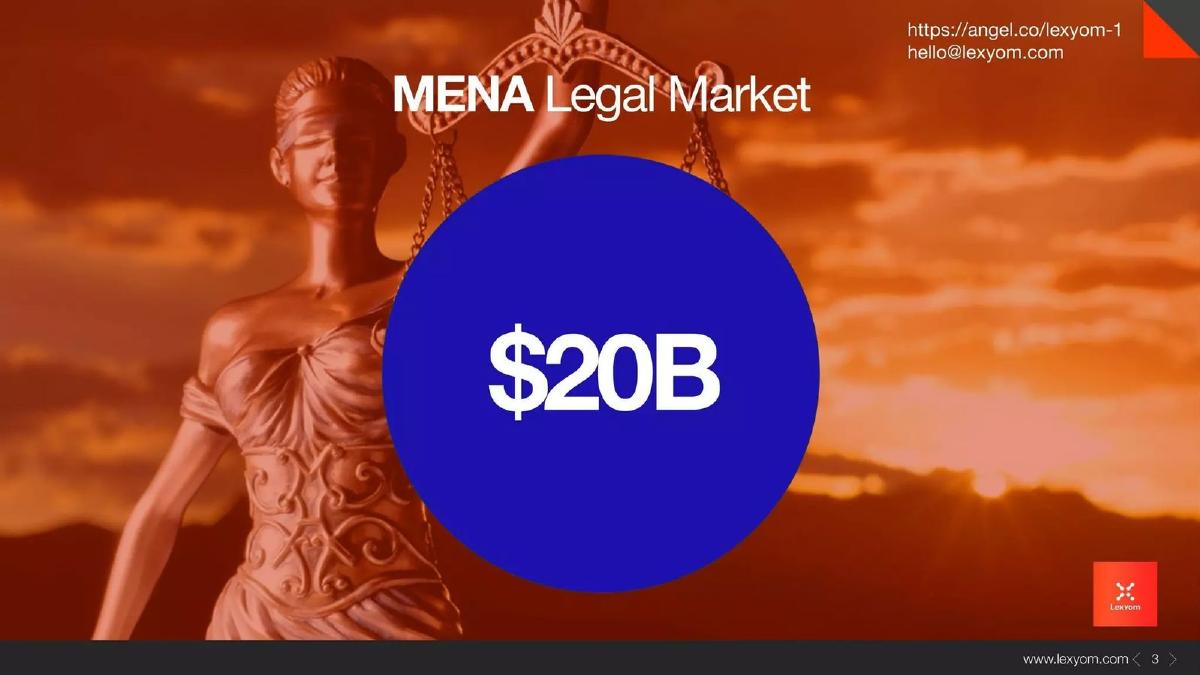
- The company identifies a $20 billion total addressable market within the MENA legal sector on slide 3.
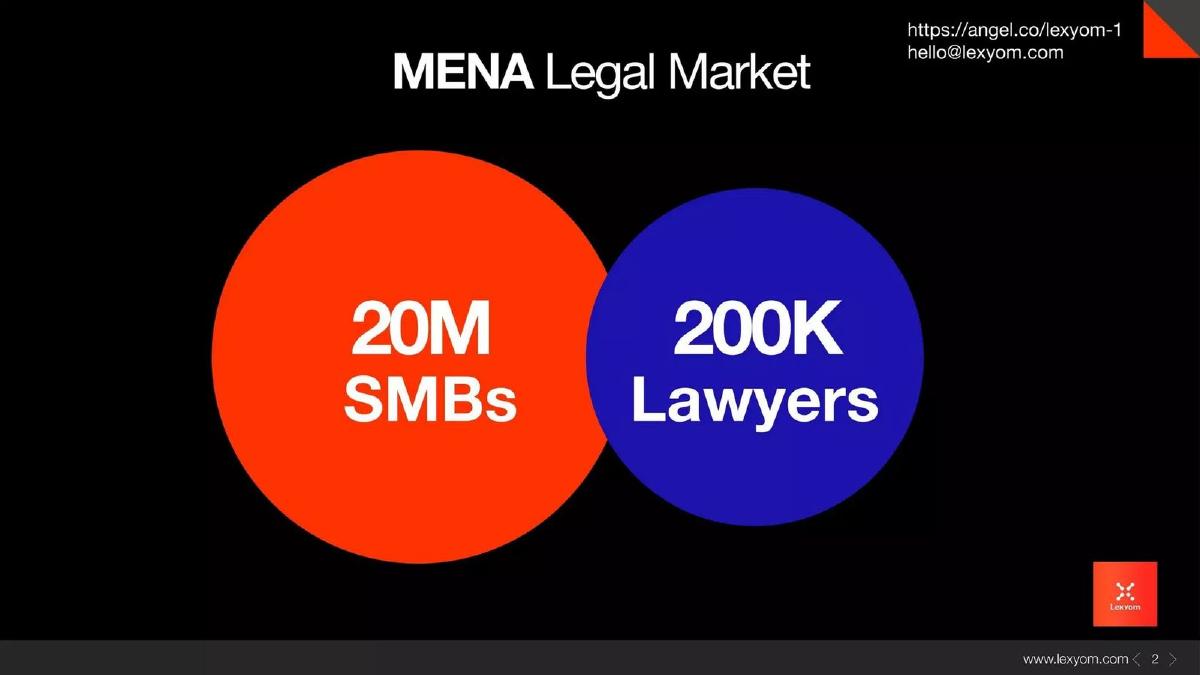
- Lexyom highlights a significant supply-demand gap, noting 20 million SMBs served by only 200,000 lawyers on slide 2.
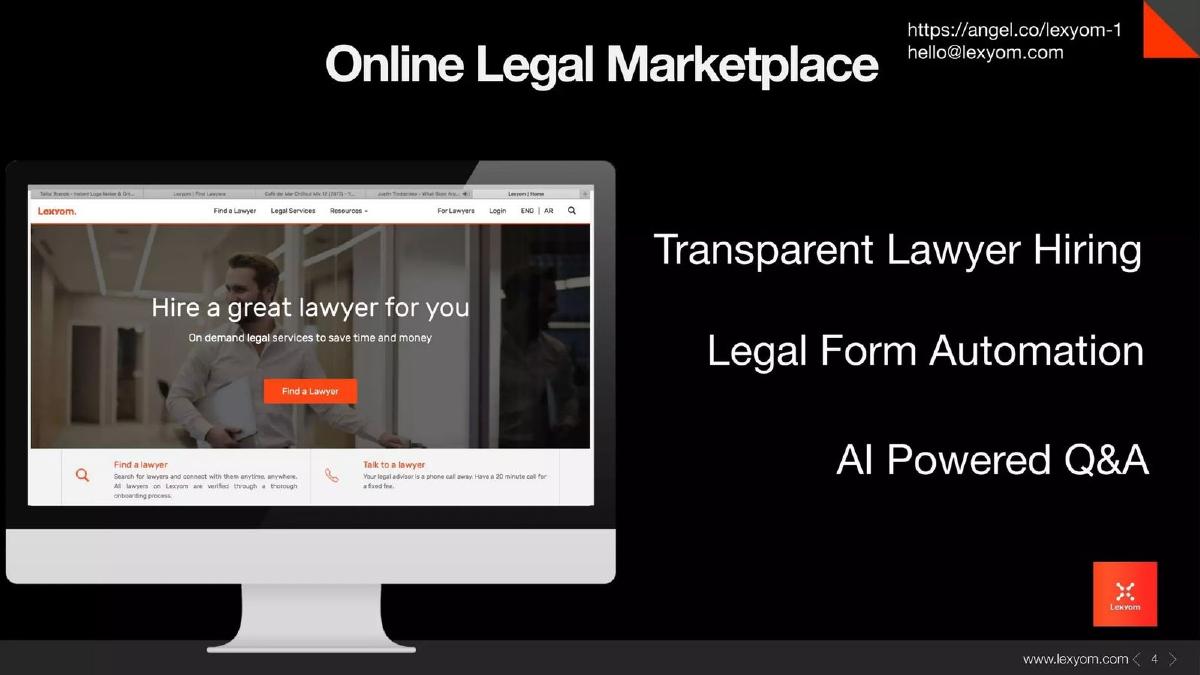
- The product is positioned as a three-pillar platform: Transparent Lawyer Hiring, Legal Form Automation, and AI Powered Q&A on slide 4.
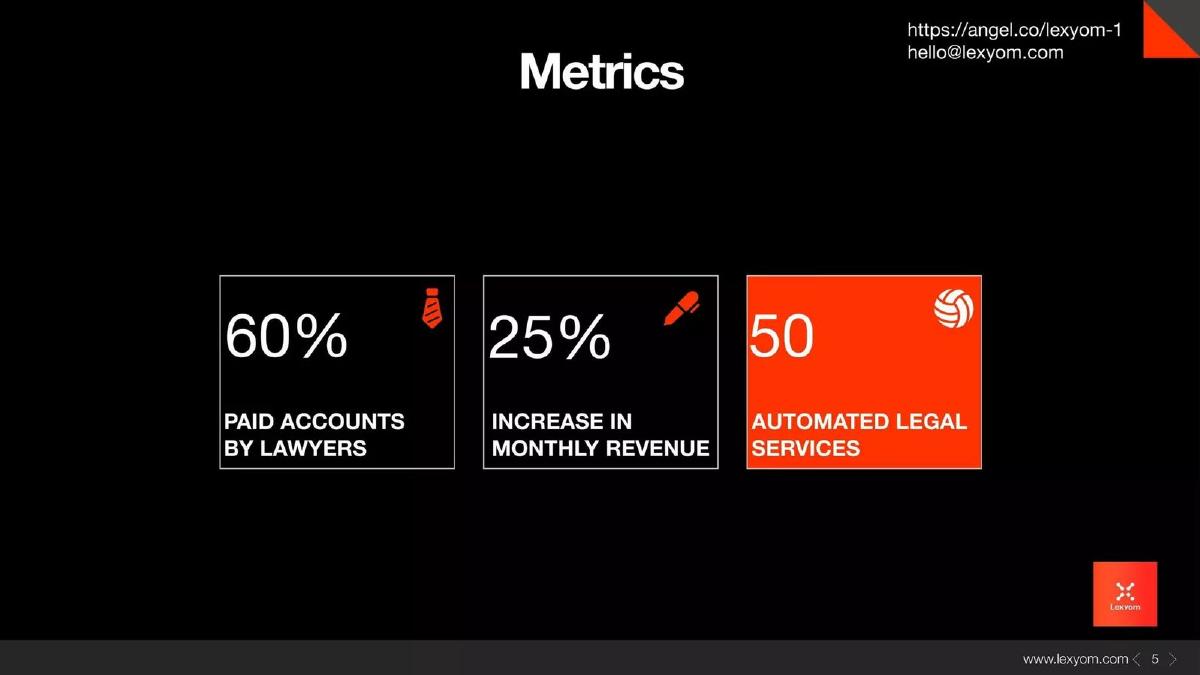
- Early traction is evidenced by a 25% increase in monthly revenue and the launch of 50 automated legal services as shown on slide 5.
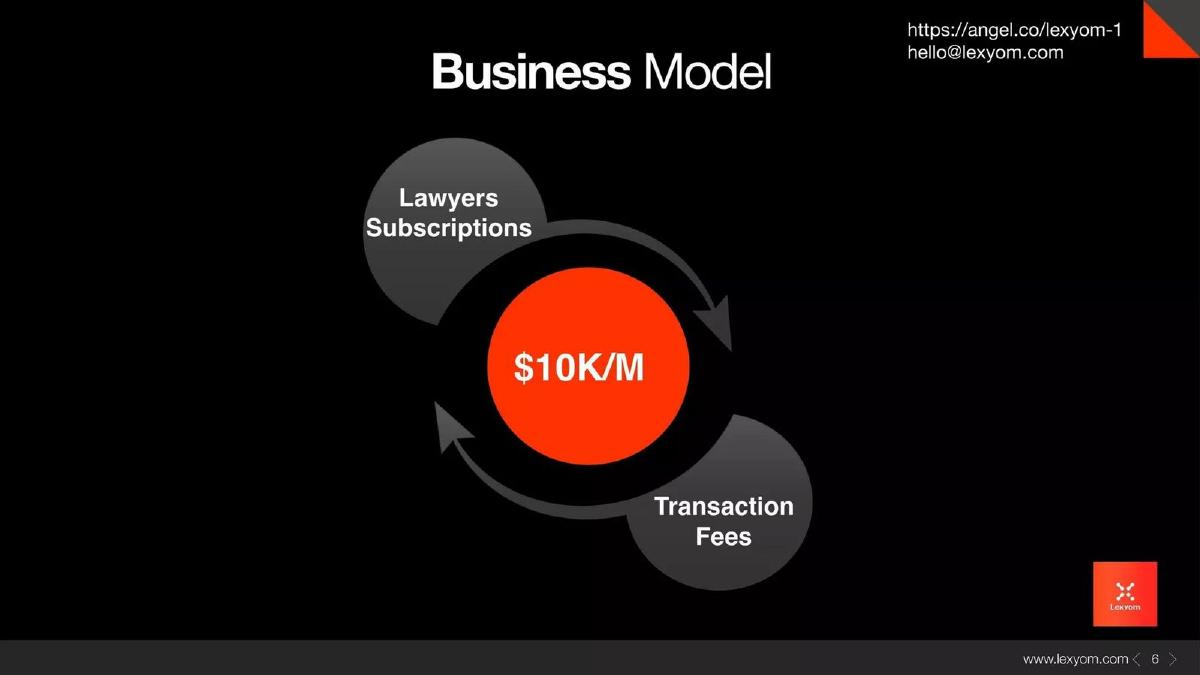
- The business model relies on two revenue streams: Lawyer Subscriptions and Transaction Fees, centered around a $10K/M figure on slide 6.
- The team slide emphasizes elite academic credentials, specifically NYU Law, Harvard Law School, and the American University of Beirut on slide 8.
- The deck completely omits a 'The Ask' slide, leaving the specific funding goal and use of proceeds unstated within the presentation.
- Competitive advantages are listed as being early movers, multilingual capabilities, automation, and knowledge of local laws on slide 7.
The Lexyom Pitch Deck: A Regional Play for Legal Tech
Lexyom’s 2016 seed deck is a streamlined 9-slide presentation that focuses on a specific geographic opportunity: the Middle East and North Africa (MENA). At a time when legal tech was booming in the US and Europe, Lexyom sought to capture a $20 billion market by combining a lawyer marketplace with AI-driven automation. The deck is characterized by high-contrast visuals and a heavy reliance on the founders' professional pedigree to overcome the trust barriers inherent in legal services.
Slide 1: Title and Tagline
The deck opens with a bold red title slide featuring the Lexyom logo and the tagline: "your legal answered." The contact information is clearly displayed in the top right corner, including an AngelList link and a general email address. The branding is clean, though the tagline is slightly ungrammatical, likely a stylistic choice or a translation nuance.
Slides 2-3: The MENA Market Opportunity
The company immediately moves into market sizing. Slide 2 uses a simple bubble graphic to illustrate the scale of the MENA Legal Market , citing 20M SMBs and 200K Lawyers . This establishes the supply-and-demand dynamic the platform intends to mediate. Slide 3 follows up with a single, massive figure: $20B . By placing this number over a background image of Lady Justice, the deck emphasizes the financial scale of the opportunity within the regional legal sector.
Slide 4: The Solution and Product
Slide 4 introduces the Online Legal Marketplace through a desktop mockup of the Lexyom website. The slide lists three core value propositions:
Transparent Lawyer Hiring: A marketplace to find and connect with verified lawyers. · Legal Form Automation: Tools to generate documents automatically. · AI Powered Q&A: Using technology to provide immediate legal answers.
The screenshot shows a user interface with clear calls to action like "Find a Lawyer" and "Talk to a lawyer," suggesting the product was already live and functional at the time of the pitch.
Slide 5: Performance Metrics
The Metrics slide provides three data points to demonstrate early traction:
60% Paid Accounts by Lawyers: Indicating a high conversion rate for the supply side of the marketplace. · 25% Increase in Monthly Revenue: Showing month-over-month growth. · 50 Automated Legal Services: Demonstrating the breadth of their automated document library.
These metrics are presented in simple boxes with icons, making the traction easy to digest for a seed-stage investor.
Slide 6: The Business Model
Slide 6 explains how Lexyom makes money. The Business Model is a circular flow between Lawyers Subscriptions and Transaction Fees . In the center of this diagram is the figure $10K/M . It is unclear if this represents current monthly recurring revenue (MRR) or a target, but given its central placement on the business model slide, it likely refers to a recent revenue milestone.
Slide 7: Competitive Advantages
Under the heading Our Edge , Lexyom lists four key differentiators represented by keys unlocking a padlock:
Early movers: Claiming a first-mover advantage in the MENA region. · Multilingual: Essential for a region with diverse languages and legal systems. · Automation: Their proprietary tech for document generation. · Local laws: Deep expertise in the specific regulations of Middle Eastern jurisdictions.
Slides 8-9: Team and Culture
The Our Team slide (Slide 8) is perhaps the strongest in the deck. It features the three co-founders: Rami Alamé (CEO) , Magda Farhat (CLO) , and Makram Raydan (CTO) . Below their photos are the logos for NYU Law , Harvard Law School , and AUB (American University of Beirut) . For a legal startup, this level of academic and professional validation is a critical de-risking factor. Slide 9 concludes the deck with a group photo of the larger team, reinforcing the company's tagline and providing a final contact email.
What Works in the Lexyom Deck
1. Geographic Specificity: By focusing specifically on the MENA region, Lexyom carves out a defensible niche. They don't try to be a global legal platform; they aim to dominate a specific $20 billion market where local expertise is a significant barrier to entry.
2. Credibility Signaling: In the legal industry, the "who" is often as important as the "what." Featuring Harvard and NYU Law logos prominently on the team slide immediately signals to investors that the founders have the necessary expertise to navigate complex legal frameworks.
3. Clear Revenue Streams: The business model slide is refreshingly simple. By showing both a subscription model (SaaS) and a transaction model (Marketplace), they demonstrate multiple paths to scaling revenue.
What is Missing from the Lexyom Deck
1. The Ask: The most significant omission is a funding slide. There is no mention of how much capital is being raised, the valuation, or the specific milestones that the funding will enable. This is a critical component of a pitch deck that is entirely absent here.
2. Competitive Landscape: While they mention being "early movers," the deck does not acknowledge existing competitors, whether they are traditional law firms or other emerging legal tech players in the region. Investors generally want to see a matrix or list of competitors to understand the startup's relative positioning.
3. Use of Proceeds and Roadmap: There is no forward-looking information. The deck shows what has been built and the current metrics, but it fails to outline the next 12-24 months of product development or market expansion.
What a Founder Should Copy
1. Minimalist Market Sizing: Slides 2 and 3 are excellent examples of how to communicate market size without clutter. One slide for the audience (SMBs vs. Lawyers) and one slide for the dollar value ($20B) makes the opportunity impossible to miss.
2. High-Contrast Design: The use of a consistent, high-contrast color palette (red, black, and white) makes the deck feel professional and modern. It avoids the "corporate blue" cliché of many legal decks while remaining clean.
3. Outcome-Oriented Tagline: "Your legal, answered" is a strong, benefit-driven tagline. It tells the user exactly what the platform does for them in three words, focusing on the result rather than the process.
Frequently asked questions
- What is the primary market Lexyom is targeting?
- Lexyom is focused exclusively on the MENA (Middle East and North Africa) legal market. According to slides 2 and 3, this market consists of 20 million SMBs and 200,000 lawyers, representing a total market value of $20 billion. This regional focus is a core part of their 'Edge' listed on slide 7, specifically their expertise in local laws.
- How does Lexyom generate revenue?
- Based on slide 6, the company utilizes a dual-revenue business model. They generate income through 'Lawyers Subscriptions,' where legal professionals likely pay for access to the platform or leads, and 'Transaction Fees,' which are presumably taken from the legal services facilitated through the marketplace.
- What specific metrics does the deck provide regarding traction?
- Slide 5 outlines three key metrics: 60% of accounts held by lawyers are 'Paid Accounts,' there has been a 25% increase in monthly revenue, and the platform has successfully deployed 50 'Automated Legal Services.' These figures suggest early validation of both the marketplace and the automation product.
- Who are the founders and what is their background?
- The leadership team consists of Rami Alamé (CEO), Magda Farhat (CLO), and Makram Raydan (CTO). As shown on slide 8, the team possesses high-level legal and technical credentials from prestigious institutions including NYU Law, Harvard Law School, and the American University of Beirut (AUB).
- What is missing from this pitch deck?
- The deck is notably missing several standard components: a specific funding ask (how much they are raising), a slide detailing the use of proceeds, a formal roadmap or future milestones, and a detailed competitive landscape analysis beyond a general 'Our Edge' slide.