Level Therapy’s 2015 seed deck is a masterclass in minimalism, containing only 10 slides and very few words. The company successfully raised $650,800 by framing mental health as a massive, underserved market opportunity. The deck identifies a 43.7 million person problem where 60% never seek treatment, leading to a $193.2 billion economic impact. By positioning itself as a B2B solution selling directly to employers, Level Therapy leveraged high-profile logos like Teach For America and Stanford Medicine to build credibility. While the deck lacks traditional deep dives into unit economics, compe…
Key takeaways
- The deck identifies a massive total addressable market of 43.7 million people on slide 2.
- A critical pain point is highlighted on slide 3: 60% of those with mental health needs never seek treatment.
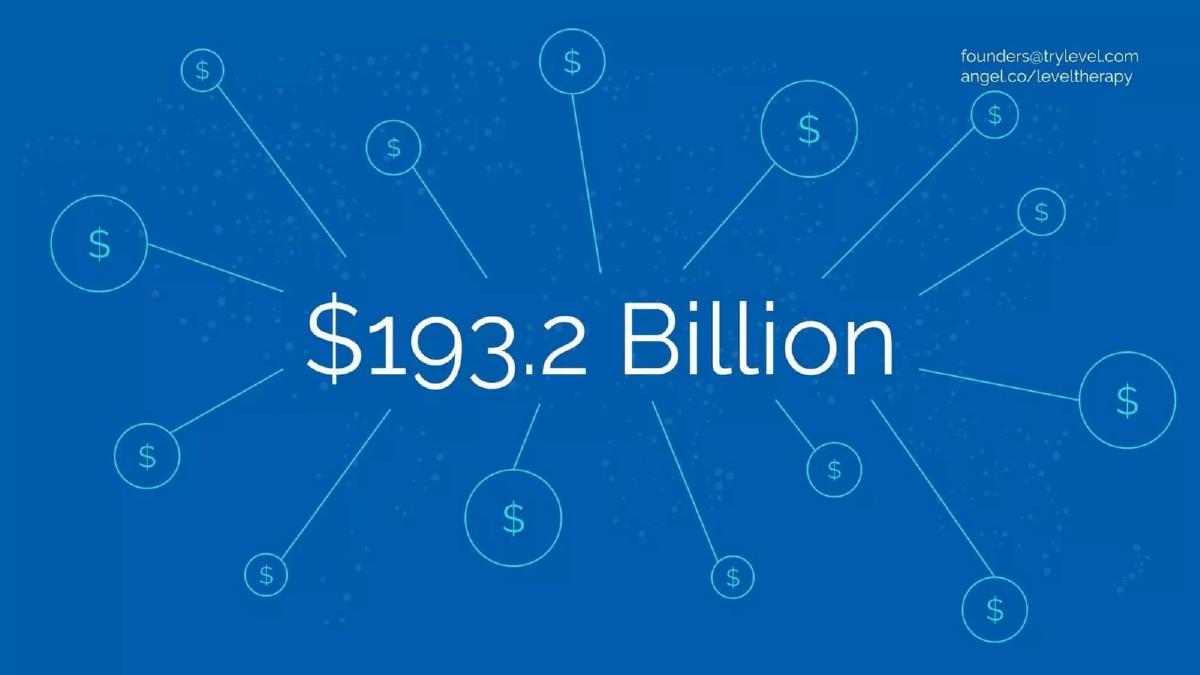
- The economic cost of the problem is quantified at $193.2 billion on slide 4.
- The business model is explicitly B2B, stated as 'We sell to employers' on slide 7.
- Traction is demonstrated through high-authority clients like Stanford Medicine and Teach For America on slide 8.
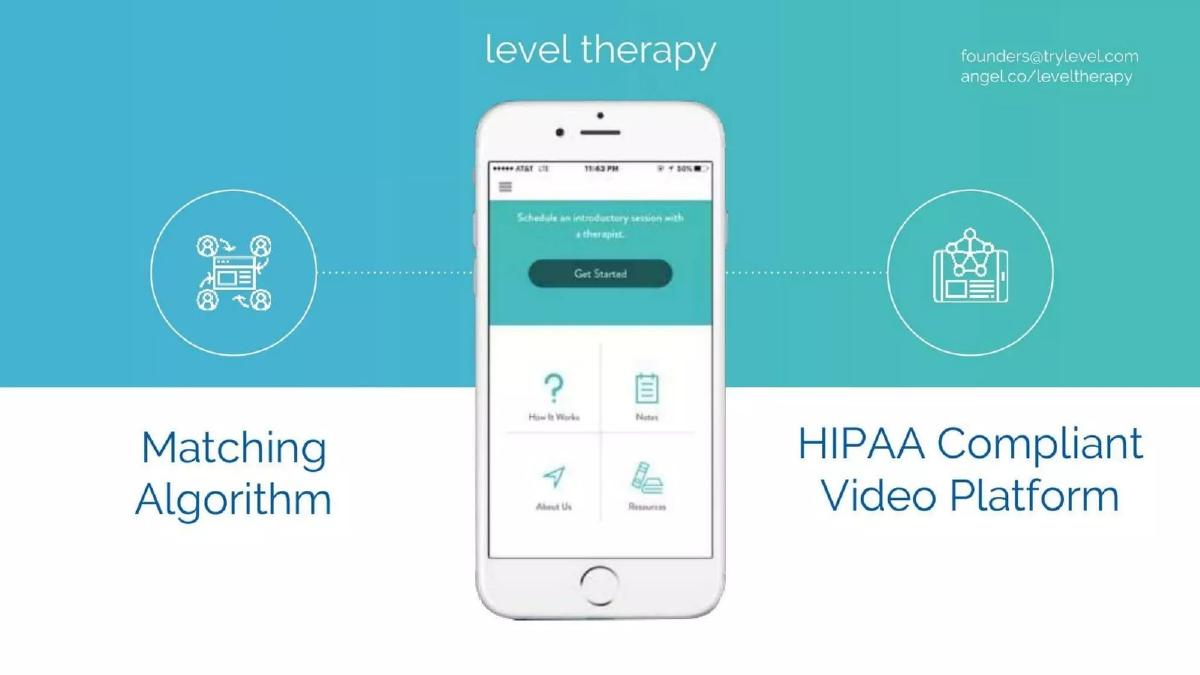
- The product relies on two core pillars: a matching algorithm and a HIPAA-compliant video platform (slide 6).
- The deck omits a formal 'Ask' slide, financial projections, and a competitive landscape analysis.
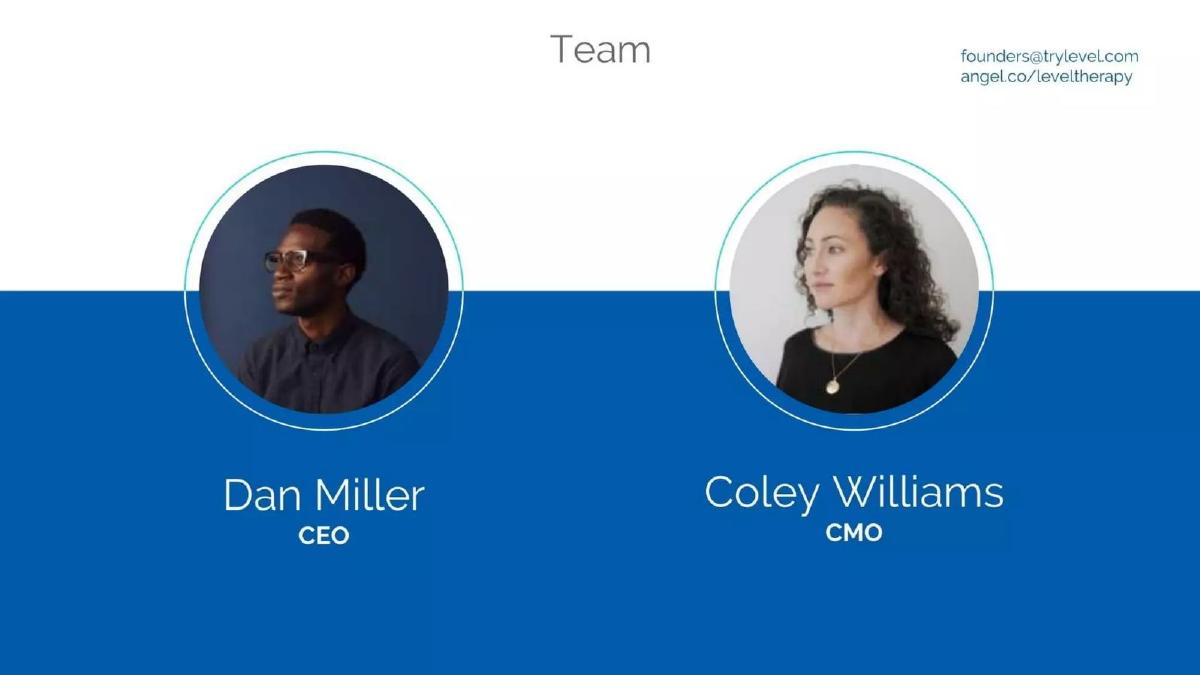
- The team slide (slide 5) features only two members, Dan Miller (CEO) and Coley Williams (CMO), without biographical text.
The Minimalist Approach to Mental Health Fundraising
The Level Therapy pitch deck from 2015 is a striking example of 'less is more.' In an era where many founders feel the need to pack 40 slides with data, Dan Miller and Coley Williams raised over $650,000 using just 10 slides, most of which contain fewer than ten words. This teardown examines how they used high-level market stats and brand association to overcome a lack of detailed financial reporting.
Slide 1: Title and Vision
The deck opens with a simple title slide: 'level therapy.' The subtitle, 'Moving therapy to balance your life,' sets a lifestyle-oriented tone rather than a clinical one. Notably, the contact information in the top right corner includes an AngelList link (angel.co/leveltherapy), which was a standard signal for seed-stage startups in 2015 to show they were active in the fundraising ecosystem.
Slides 2-4: The Macro Problem and Market Size
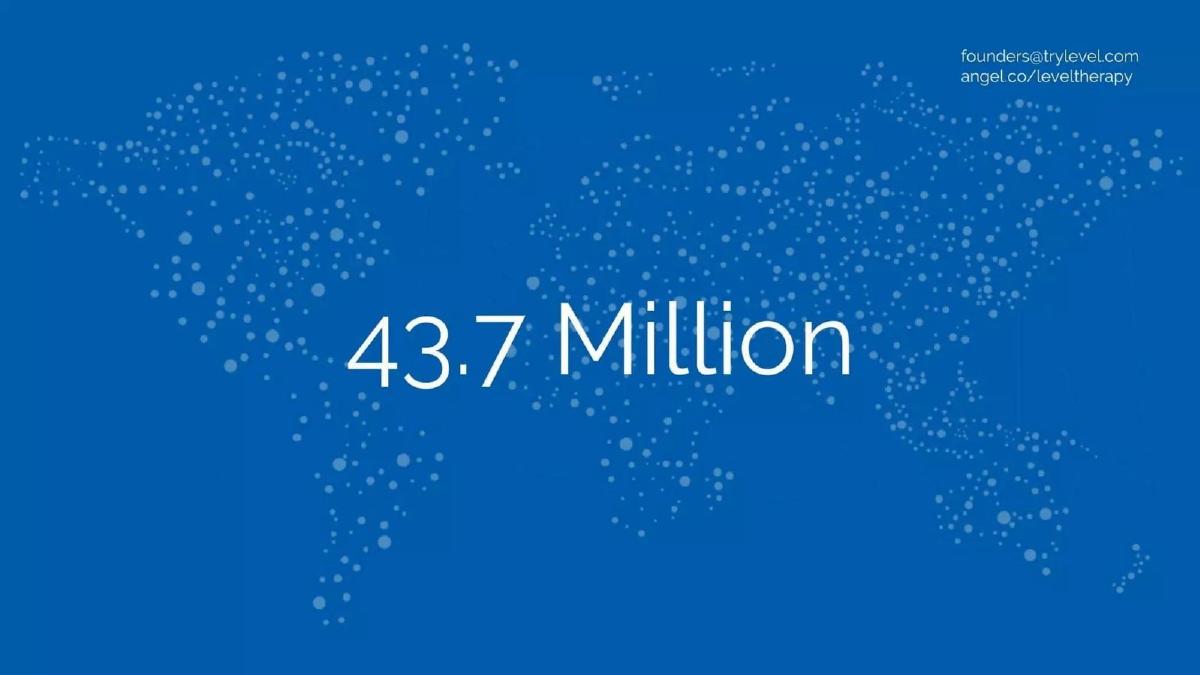
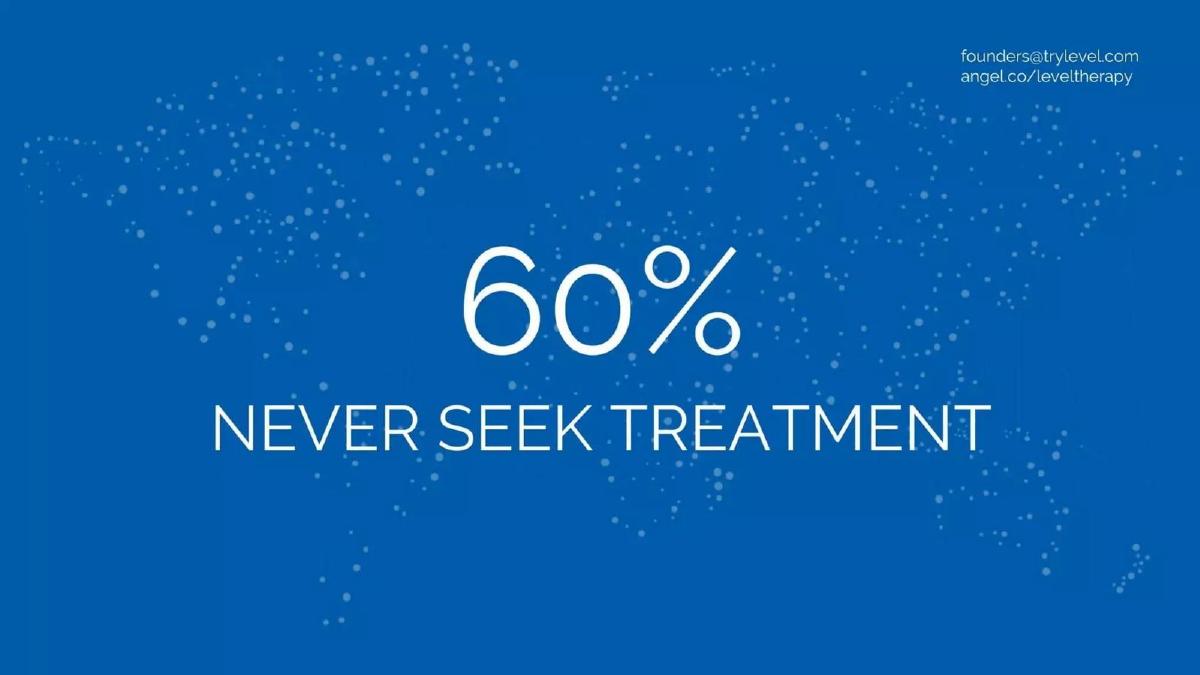
Level Therapy uses a three-slide sequence to establish the 'Why Now.' Slide 2 displays the number 43.7 Million over a world map. While the slide doesn't explicitly define this number, it represents the population of Americans experiencing mental illness in a given year. Slide 3 provides the critical friction point: 60% NEVER SEEK TREATMENT . This identifies the 'non-consumption' gap that the startup intends to fill.
Slide 4 attaches a dollar value to this neglect: $193.2 Billion . This figure represents the lost earnings and economic costs associated with serious mental illness. By leading with these three slides, the founders establish that the market is massive, the current system is failing, and the economic incentive to fix it is enormous. They aren't just selling 'better therapy'; they are selling a solution to a hundred-billion-dollar economic drain.
Slide 5: The Team
The team slide is exceptionally sparse. It features headshots of Dan Miller (CEO) and Coley Williams (CMO) . There are no bullet points regarding their background, education, or previous exits. In a seed round, the team is usually the most important factor. By omitting their resumes, the founders are likely relying on the verbal pitch to carry their credibility, or they assume the investor has already vetted their LinkedIn profiles via the AngelList link provided on every slide.
Slide 6: The Product Solution
Slide 6 introduces the mobile app interface. It highlights two core value propositions: a Matching Algorithm and a HIPAA Compliant Video Platform . The visual shows a smartphone with a 'Get Started' button and icons for 'Notes' and 'Resources.' This slide tells the investor that the product is not just a directory; it is a full-stack clinical tool that handles the connection, the session, and the administrative compliance required for healthcare.
Slide 7: Business Model
In one of the most direct slides in the deck, Slide 7 states: 'We sell to employers.' This is a pivotal strategic choice. Rather than fighting for individual consumers in a crowded App Store, Level Therapy positions itself as an enterprise benefit. This model typically offers lower churn and higher contract values, which is highly attractive to seed-stage investors looking for scalable B2B plays.
Slide 8: Traction and Social Proof
This is arguably the strongest slide in the deck. Under 'Clients,' it lists Teach For America and Stanford Medicine . Securing Stanford Medicine as a client provides immense clinical validation. Under 'Pipeline,' the deck shows logos for Airbnb, Slack, and Dropbox . Even if these were only in the early stages of negotiation, listing them alongside established clients suggests that the product has strong 'product-market fit' within the tech-forward employer segment.
Slides 9-10: The Big Vision and Closing
Slide 9 presents the 'North Star' metric or ambition: 'Largest mental health practice in the world.' This is a classic venture capital requirement—the 'billion-dollar vision.' It suggests that Level Therapy doesn't want to be a niche app; it wants to be the primary infrastructure for mental health delivery globally. Slide 10 closes with the logo and a person standing on a pier with arms outstretched, reinforcing the 'balance your life' theme from the first slide.
What Works in This Deck
Clarity of Mission: There is zero ambiguity about what this company does. They provide therapy via an app, and they sell it to companies. The lack of jargon makes the deck highly readable.
High-Signal Logos: The inclusion of Stanford Medicine (Slide 8) does more for the company's credibility than five slides of clinical data would. In healthcare, trust is the primary barrier to entry, and this logo solves that problem.
Economic Framing: By using the $193.2 billion figure (Slide 4), the founders move the conversation from 'wellness' to 'ROI.' Employers care about mental health because it affects the bottom line, and this deck speaks that language.
What Is Missing
The 'Ask': There is no slide detailing how much money is being raised, what the valuation cap is, or what the milestones for the next 18 months are. While this information is often omitted from 'teaser' decks, its absence in a full pitch deck is notable.
Competitive Landscape: In 2015, companies like Talkspace and BetterHelp were already gaining traction. This deck does not explain how Level Therapy differs from these incumbents or how it defends its 'Matching Algorithm' against them.
Unit Economics: There is no mention of the cost to acquire an employer (CAC), the average contract value (ACV), or the margin on therapy sessions. Investors usually want to see how the $193 billion market translates into a profitable unit of service.
What a Founder Should Copy
The 10-Slide Rule: Level Therapy proves that you don't need a massive deck to get a check. If your market is large and your traction is high-quality, brevity is your friend.
The 'Pipeline' Slide: If you are in the B2B space, showing which logos are in your sales funnel is a great way to demonstrate market demand before you have closed a dozen deals. However, ensure you can back up those logos with real data if asked during due diligence.
Focus on Compliance: For any health-tech founder, mentioning 'HIPAA Compliant' (Slide 6) is mandatory. Level Therapy makes it a headline feature, which reassures investors that the founders understand the regulatory hurdles of their industry.
Frequently asked questions
- How much did Level Therapy raise with this deck?
- According to the catalogue facts, Level Therapy raised $650,800 in 2015 during its Seed stage. The deck itself does not state the amount raised or the terms of the round, which is common for decks shared publicly after a round closes.
- What is the core product offering?
- The product is a mobile-first mental health platform. Slide 6 highlights two primary technical features: a 'Matching Algorithm' to connect patients with the right providers and a 'HIPAA Compliant Video Platform' to facilitate remote therapy sessions securely.
- Who is the target customer for Level Therapy?
- Level Therapy utilizes a B2B (business-to-business) model. Slide 7 explicitly states, 'We sell to employers.' This strategy aims to integrate mental health services into corporate benefits packages rather than relying solely on direct-to-consumer marketing.
- What traction did the company have at the time of the pitch?
- Slide 8 shows significant early traction with 'Clients' including Teach For America and Stanford Medicine. It also lists a 'Pipeline' featuring the logos of Airbnb, Slack, and Dropbox, suggesting active sales conversations with major tech firms.
- What are the biggest omissions in this pitch deck?
- The deck is extremely sparse. It lacks a slide for unit economics (CAC/LTV), a detailed roadmap, a competitive analysis, and a specific financial ask. Additionally, the team slide provides names and titles but no professional history or prior successes.