Jini's 2012 pitch deck for the LeWeb Paris competition is a product of its time, focusing on the then-emerging field of mobile sensor fusion. The company, founded in Spring 2011 in Belgium, aimed to move beyond 'static' recommendations by using a 'Context Cube' that combined social mining with hardware sensors like accelerometers, gyroscopes, and NFC. While the deck is visually minimalist and designed for a live stage presentation—including a dedicated slide for a live demo—it is notably thin on business fundamentals. It explicitly states the company is 'pre-revenue' with a 'low burn-rate' an…
Key takeaways
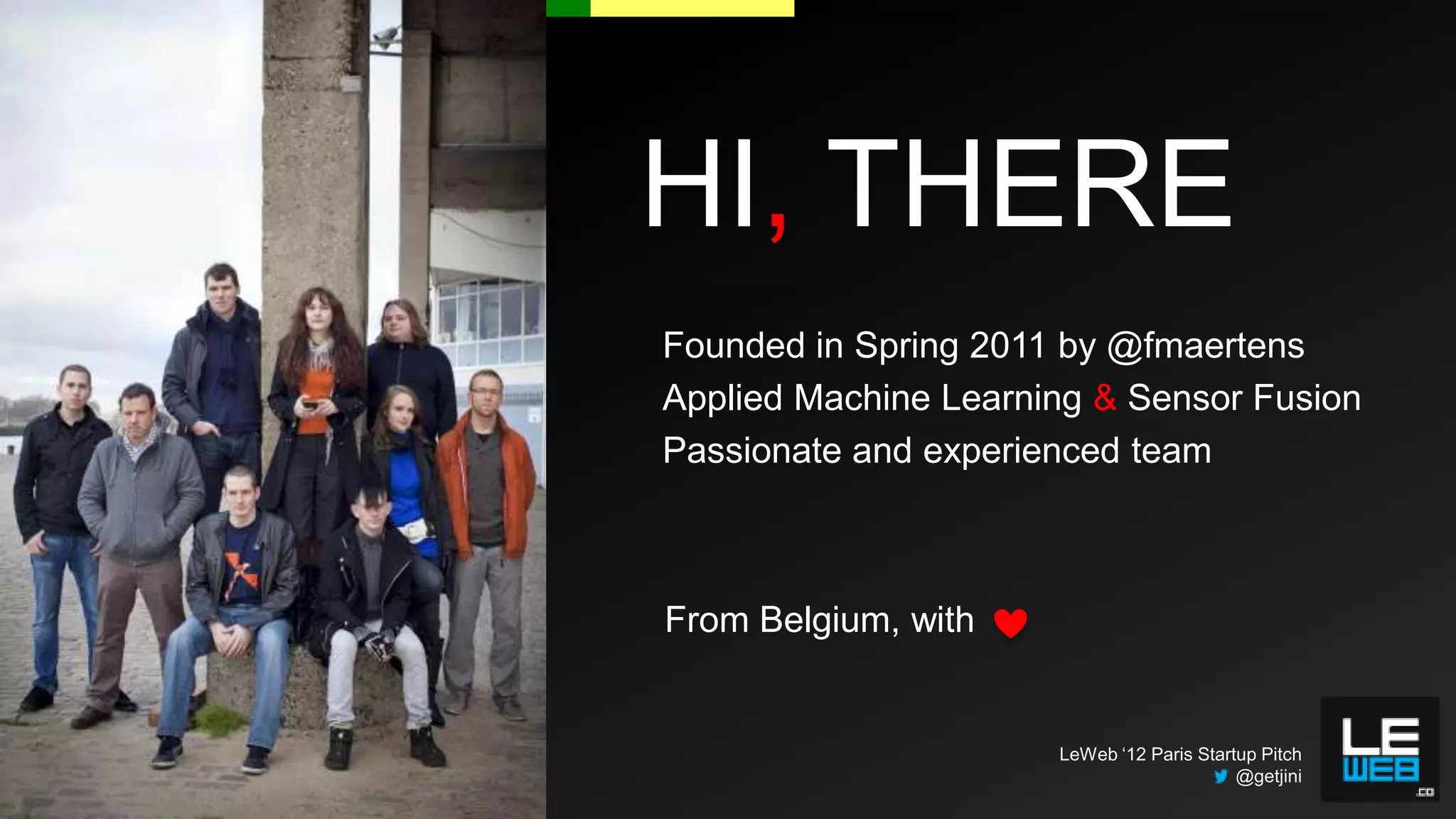
- The company was founded in Spring 2011 by @fmaertens and is based in Belgium (Slide 1).
- Jini identifies a problem where content is ubiquitous but context is scarce, and human-produced data is inherently biased (Slide 2).
- The 'Secret Sauce' is a 'Context Cube' that integrates social mining, sensor fusion, and behavioral contextualization (Slide 3).
- Technical inputs for the platform include NFC, gyroscope, accelerometer, humidity, and light conditions (Slide 3).
- The business model relies on a B2B approach with fees per SDK instance and API volume pricing per month (Slide 5).
- As of the pitch, the company was pre-revenue and focused on user and developer acquisition rather than immediate monetization (Slide 6).
- The deck lacks a formal team slide with biographies, a market size (TAM/SAM/SOM) analysis, and a specific capital requirement or 'ask' (Omitted).
Introduction: The Context-Aware Era
The Jini pitch deck, presented at the LeWeb 2012 Paris Startup Competition, represents an early attempt to commercialize sensor fusion in the smartphone era. At a time when mobile apps were beginning to move beyond simple interfaces, Jini proposed a layer of intelligence that could understand a user's physical and social environment. The deck is minimalist, designed for a high-energy stage presentation rather than a deep-dive read, which explains the lack of dense text and the inclusion of a live demo slide.
Slide 1: Title and Origin
The deck opens with a group photo of the team against an industrial backdrop. The text identifies the founder as @fmaertens and notes the company was founded in Spring 2011. The core competencies are listed as 'Applied Machine Learning & Sensor Fusion.' The slide establishes the company's identity as a 'passionate and experienced team' from Belgium. Notably, it uses a Twitter handle for the founder, reflecting the social-media-heavy culture of the 2012 tech scene.
Slide 2: The Problem Statement
Under the heading 'broken by design,' Jini outlines four key pain points. First, they argue that while content is 'ubiquitous,' context is 'scarce.' Second, they claim that existing recommendations are 'static' while life is 'dynamic.' Third, they contrast biased human data with objective sensor-observed behavior. Finally, they critique advertisers for focusing on quantity over quality. This slide effectively sets up the need for a more intelligent, automated way to understand user intent without relying on manual input.
Slide 3: The Secret Sauce
This is the most technical slide in the deck, introducing 'The Context Cube.' It is a visual representation of how Jini combines 'Social mining' (visualized as a network graph) with 'Sensor fusion' (visualized as a circuit board). The cube itself is labeled with various data points: light conditions, language, family, calories, sleep, location, sentiment, Bluetooth, movies, speed, place, activity, NFC, search, travel, music, volume, phone, compass, humidity, and accelerometer. The slide claims this allows them to 'Contextualize Behavior,' turning raw sensor data into actionable insights.
Slide 4: The Live Demo
Slide 4 is a transition slide for a 'LIVE DEMO.' It includes the text 'This is the part where things can go very wrong ;)' which is a common trope in startup competitions to build rapport with the audience. While this works well in person, in a deck teardown, it marks a significant missing piece of information regarding how the user interface actually looks or how the 'Context Cube' translates into a user benefit.
Slide 5: SDK & API
This slide addresses the product delivery and business model. It shows images of mobile devices and a terminal screen (bash) showing a user profile with data points like 'Current emotion: Positive (0.79)' and 'Next activity: Music (0.32).' The monetization strategy is twofold: a 'Fee per SDK instance' and 'API volume pricing p.m.' (per month). This confirms Jini is a developer-facing platform (B2B) rather than a direct-to-consumer app.
Slide 6: Financial Projections
In a departure from typical pitch decks that show 'hockey stick' growth charts, Jini is blunt: 'We are pre-revenue. Low burn-rate.' They state their 2012 goal is to focus on users and API developers to provide a 'good experience.' While honest, this slide lacks the forward-looking financial ambition usually required to attract venture capital, though it may have been appropriate for a startup competition where the focus is on innovation and technology.
Slide 7: Conclusion
The deck ends with a simple 'THANK YOU' slide. It includes the Jini logo, the LeWeb '12 Paris Startup Pitch branding, and the Twitter handle @getjini. There is no call to action, no contact email, and no summary of why an investor should follow up, which is a missed opportunity even in a competition format.
What Jini Does Well
The deck excels at defining a clear technical vision. By using the 'Context Cube' metaphor, the founders managed to take a complex concept—sensor fusion—and make it visually digestible. The distinction between 'static' and 'dynamic' recommendations is a strong narrative hook that remains relevant in the machine learning space today. The honesty regarding their pre-revenue status and low burn rate builds credibility, even if it lacks the 'hype' often found in Silicon Valley decks. The focus on being an SDK/API provider shows a clear understanding of their place in the tech stack; they aren't trying to build every app, just the intelligence that powers them.
What is Missing from the Jini Deck
The omissions in this deck are significant, even for a competition pitch. First, there is no market sizing. Investors need to know if 'context-aware' apps represent a million-dollar or a billion-dollar opportunity. Second, there is no competitive analysis. In 2012, companies like Google were already heavily investing in context-aware features (e.g., Google Now), and failing to acknowledge the competitive landscape is a red flag. Third, the team slide is just a photo. While the photo shows a sizable team, there are no names (other than the founder's Twitter handle) and no professional backgrounds to prove they can actually execute on 'Applied Machine Learning.' Finally, there is no 'Ask.' It is unclear if Jini was looking for 500k Euros or 5 million, or what they intended to do with the funds beyond 'focusing on users.'
Founder Takeaways: What to Copy
Visual Metaphors: The 'Context Cube' is an excellent way to show how disparate data sources (sensors + social) merge into a single product. If your tech is 'under the hood,' find a way to visualize the engine. · Honesty on Stage: Acknowledging that a live demo might fail is a great way to humanize a technical pitch and lower the audience's guard. · Clear Business Model: Even though they are pre-revenue, they clearly state how they will make money (SDK fees and API volume). This prevents the 'how does this become a business?' question from lingering. · Minimalism: For a stage pitch, less is more. The slides are not cluttered with bullet points, allowing the speaker to be the center of attention.
Founder Takeaways: What to Avoid
Omitting the Team's Pedigree: A photo of people standing in front of a concrete pillar does not convey 'experienced team.' Use logos of former employers or specific years of experience in the field. · Ignoring the Market: Never assume the audience knows how big the opportunity is. Even one slide on the projected growth of the mobile sensor market would have added weight to the pitch. · Vague Financials: 'Low burn-rate' is relative. Providing a simple table of monthly expenses versus runway is much more professional and useful for an analyst. · Missing Call to Action: Every deck should end with a specific next step. Whether it's 'We are raising X amount' or 'Visit our booth for a demo,' don't leave the audience wondering what to do next.
Frequently asked questions
- What exactly does Jini's 'Context Cube' do?
- According to Slide 3, the Context Cube is a framework for 'Sensor Fusion' and 'Social Mining.' It processes various inputs—ranging from hardware sensors like the accelerometer, compass, and light conditions to social data like sentiment and 'friends'—to contextualize user behavior. The goal is to create dynamic recommendations that reflect the user's current environment and activity rather than relying on static, biased data.
- What is the revenue model for Jini?
- Jini's monetization strategy is presented on Slide 5 as a developer-centric model. It features two primary streams: a fee charged per SDK instance installed on devices and a volume-based pricing model for API calls per month. This indicates a B2B2C strategy where Jini acts as the underlying intelligence layer for other mobile applications.
- How does Jini address its financial status in the deck?
- On Slide 6, titled 'financial projections,' the company is remarkably candid, stating, 'We are pre-revenue. Low burn-rate.' Instead of providing five-year forecasts, they state their 2012 focus is strictly on acquiring users and API developers to ensure a 'good experience,' suggesting they were in a pre-seed or seed stage focused on product-market fit.
- Who are the competitors mentioned in the deck?
- The deck does not mention any specific competitors by name. It frames the competition broadly as 'Advertisers' who work on quantity rather than quality and existing recommendation systems that are 'static' while life is 'dynamic' (Slide 2). This lack of a competitive landscape slide is a significant omission for a fundraising pitch.
- What is the 'Live Demo' slide intended for?
- Slide 4 is a placeholder for a live demonstration, accompanied by the self-deprecating text, 'This is the part where things can go very wrong ;).' In a competition setting like LeWeb, this is used to prove the technology works in real-time. However, for a static deck review, it represents a gap where the most compelling evidence of the product's value would have been shown.