LEX Markets utilized a 16-slide deck to secure $15M in Series A funding in 2022. The company addresses the illiquidity of commercial real estate (CRE) by facilitating single-asset IPOs, allowing retail investors to purchase shares for as little as $250. The deck emphasizes their vertically integrated model, which includes licensed investment banking, a FINRA-member broker-dealer, and an SEC-registered Alternative Trading System (ATS) powered by Nasdaq. While the deck is strong on regulatory positioning and product infrastructure, it notably lacks a dedicated team slide, detailed financial pro…
Key takeaways
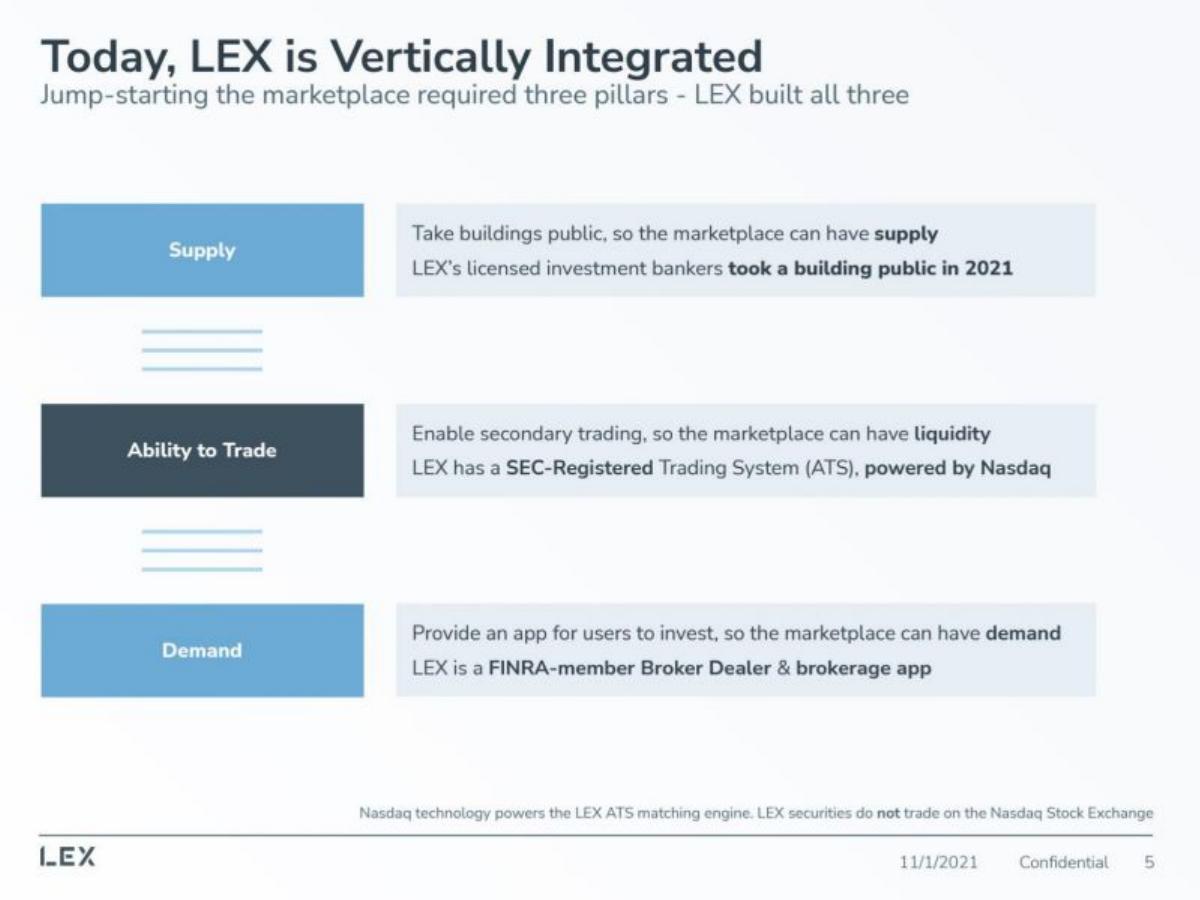
- LEX positions itself as a vertically integrated solution covering supply (investment banking), trading (ATS), and demand (brokerage app) on slide 5.
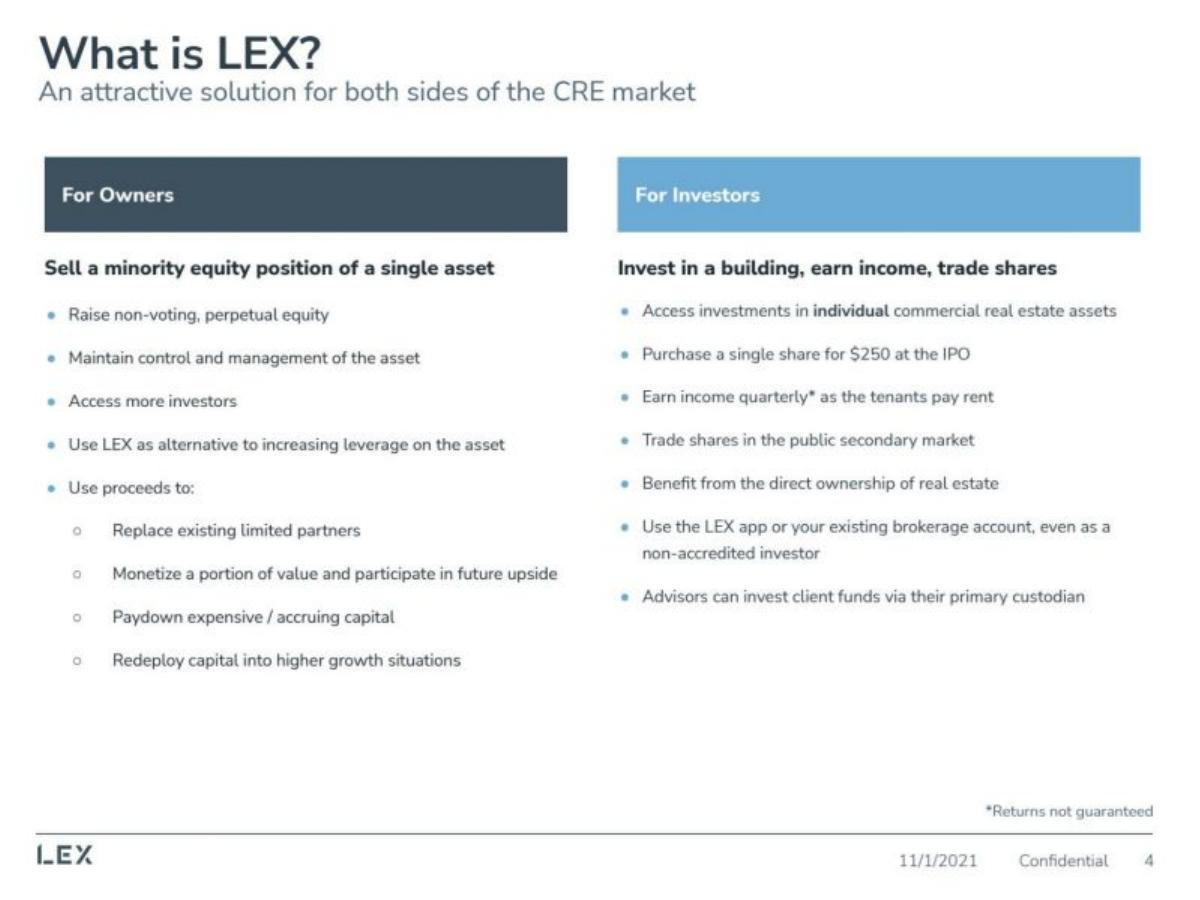
- The platform allows retail investors to purchase equity in single CRE assets starting at $250 per share, as noted on slide 11.
- The company highlights a critical partnership with Nasdaq, which powers their SEC-registered Alternative Trading System for secondary market liquidity on slide 7.
- LEX reports having 12,000+ users and 1,600+ brokerage accounts at the time of the deck's creation on slide 8.
- The deck identifies a massive potential distribution market of 100+ million investors and $20+ trillion in AUM across partner platforms on slide 9.
- Competitive positioning is visualized through a Venn diagram on slide 12, placing LEX at the intersection of Real Estate, Single Asset, and Publicly Tradable equities.
- The deck omits a team slide, failing to showcase the specific expertise of the founders or executive leadership.
- There is no explicit 'Ask' slide detailing the $15M round size or the specific allocation of capital mentioned in the catalogue facts.
Executive Summary: The Institutionalization of Retail Real Estate
LEX Markets presents a compelling case for the fractionalization of commercial real estate (CRE). Their Series A deck, dated November 2021, focuses heavily on the infrastructure required to make an illiquid asset class liquid. By positioning themselves as a vertically integrated financial institution rather than just a software layer, LEX addresses the high regulatory and technical hurdles of the CRE market. The deck is professional, minimalist, and relies on the strength of its partnerships—most notably Nasdaq—to build credibility.
Slide 1: Title and Partnerships
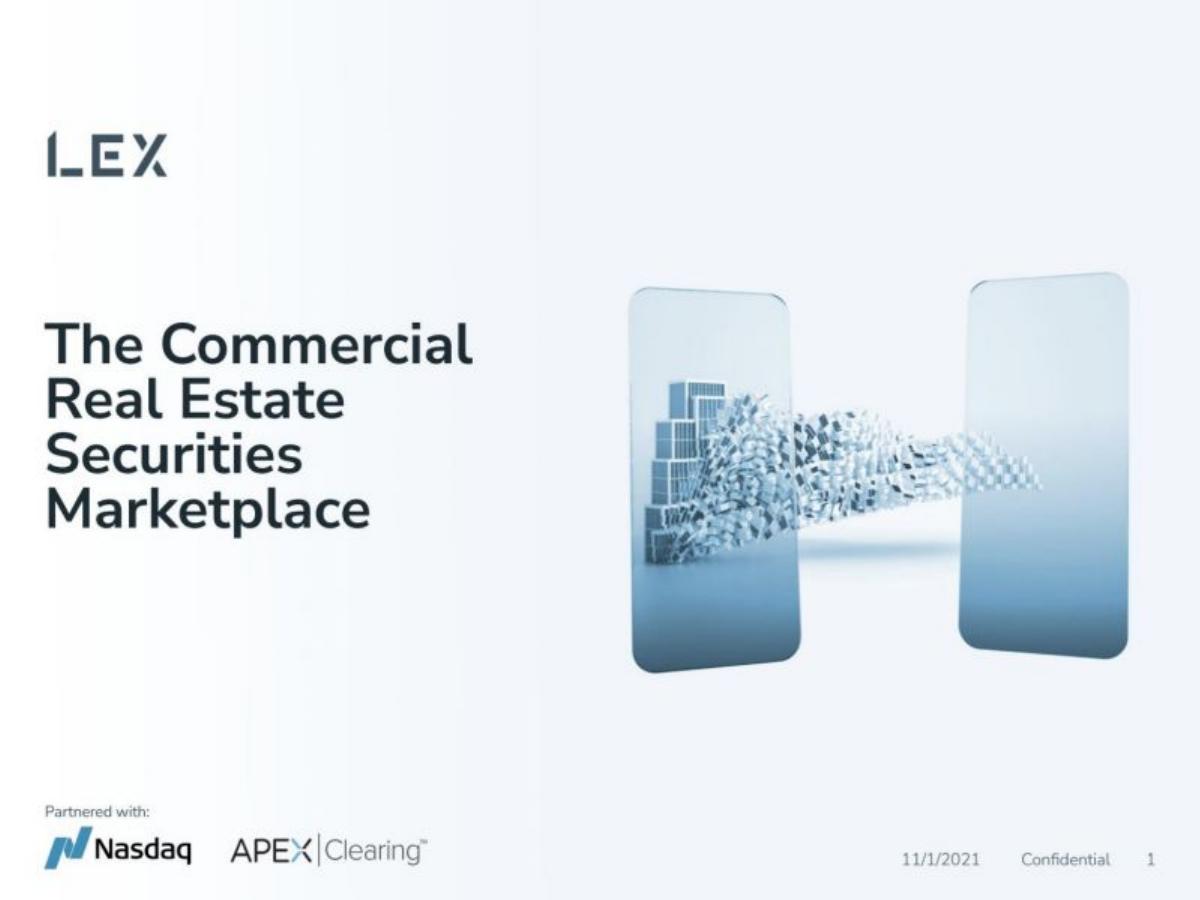
The cover slide establishes LEX as 'The Commercial Real Estate Securities Marketplace.' It immediately highlights two critical partners: Nasdaq and APEX Clearing . This is a strategic move to signal institutional readiness and regulatory compliance from the first second an investor views the deck.
Slide 2: Mission Statement
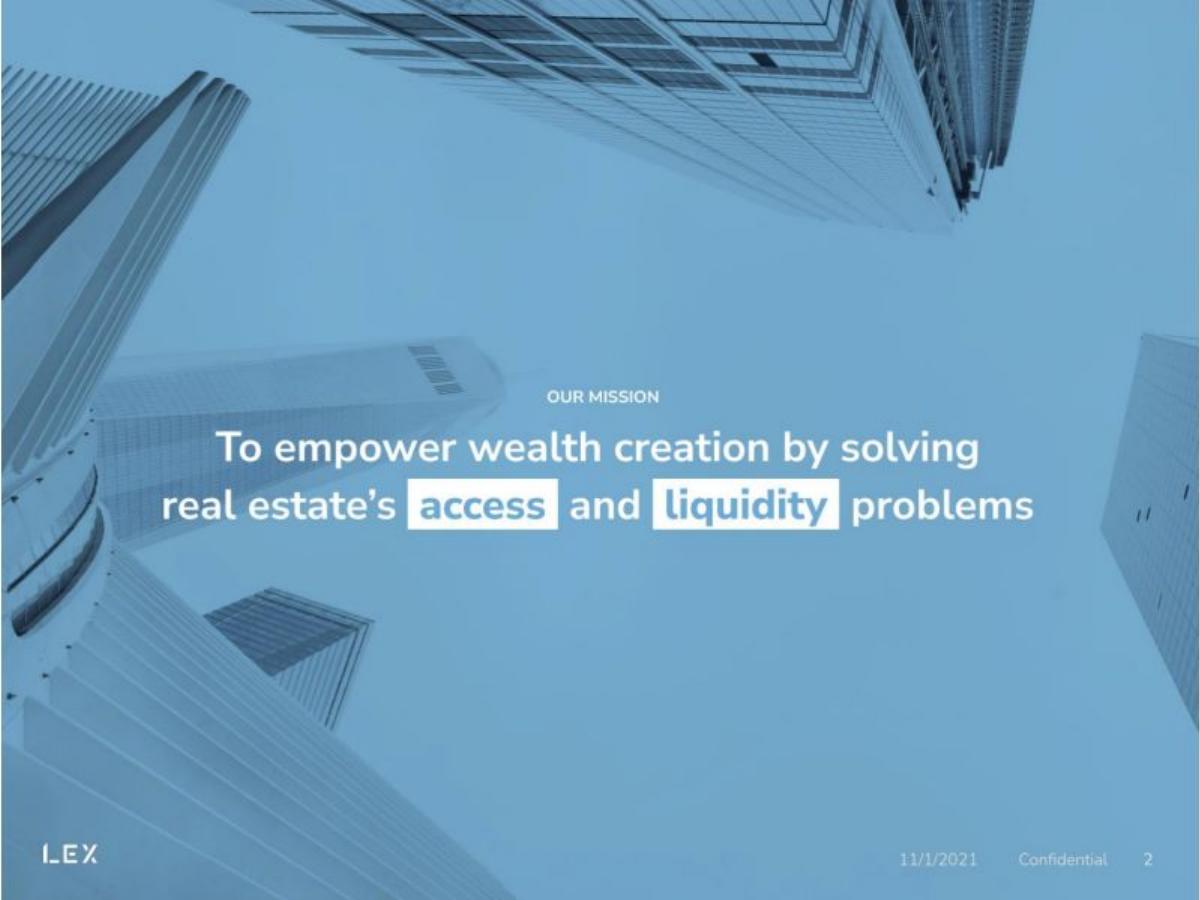
The mission is 'To empower wealth creation by solving real estate’s access and liquidity problems.' The use of a low-angle skyscraper photo reinforces the industry focus while the bolded keywords define the company's value proposition.
Slide 3: The Two-Sided Problem
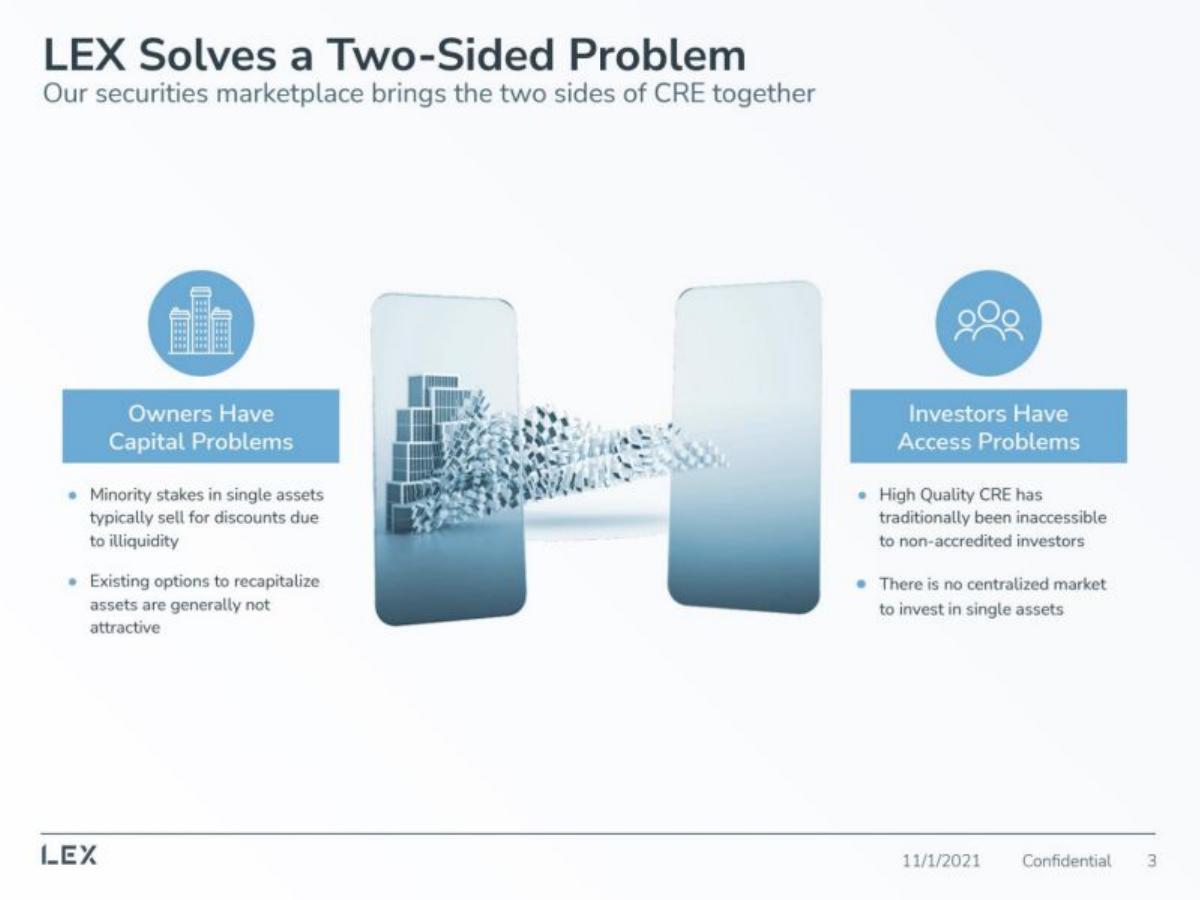
LEX identifies specific pain points for both sides of the market. For Owners , minority stakes in single assets are hard to sell and usually face 'illiquidity discounts.' For Investors , high-quality CRE is traditionally inaccessible to non-accredited individuals, and there is no centralized market for single-asset investment.
Slide 4: The Solution (What is LEX?)
This slide breaks down the product benefits. For owners, LEX offers a way to raise non-voting, perpetual equity while maintaining management control. For investors, it offers access to individual assets for as little as $250 per share , quarterly income from rent, and the ability to trade shares on a secondary market.
Slide 5: Vertical Integration
LEX argues that jump-starting this marketplace required building three pillars: Supply (Investment Banking), Ability to Trade (SEC-Registered ATS), and Demand (Brokerage App). They claim to have built all three, noting they 'took a building public in 2021.'
Slide 6: Creating Supply
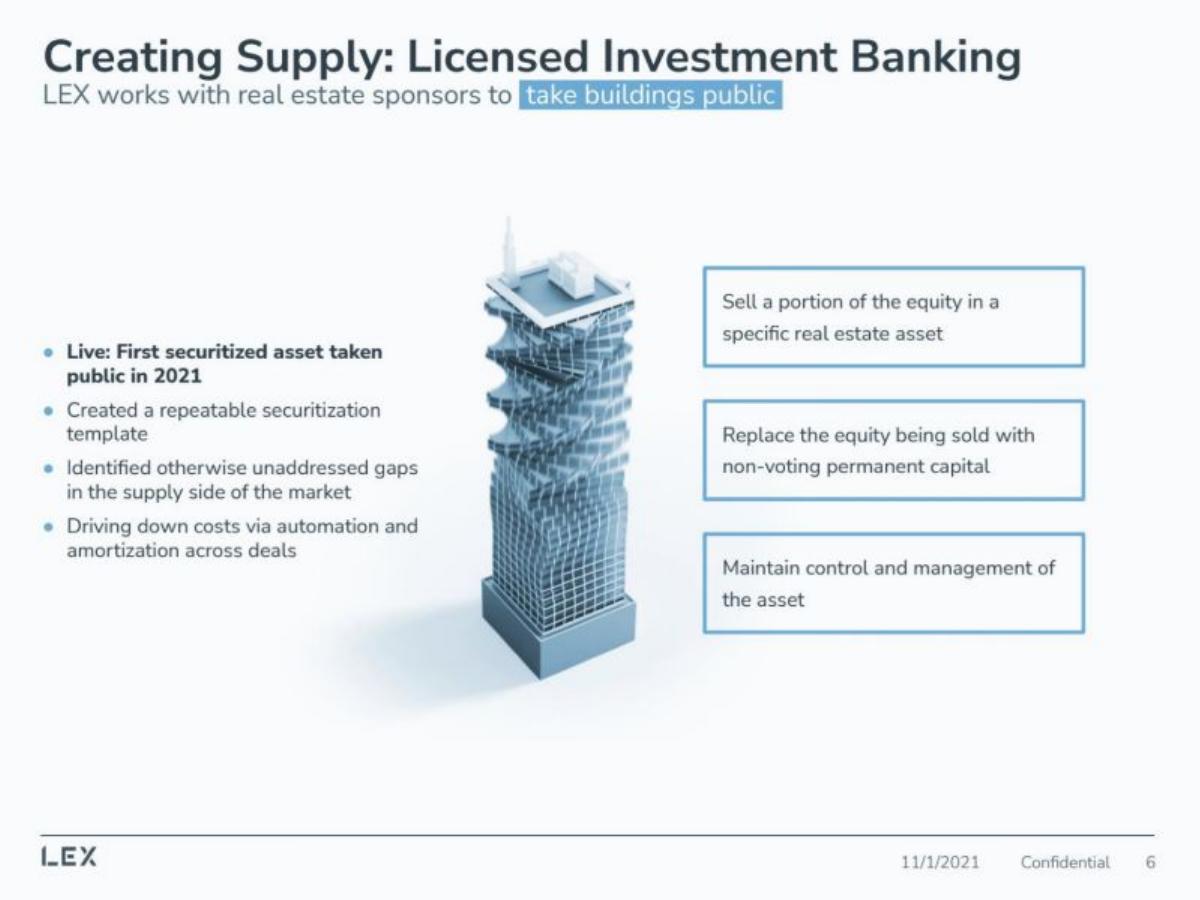
This slide details the investment banking arm. LEX works with real estate sponsors to securitize specific assets. They emphasize a 'repeatable securitization template' and the ability to drive down costs through automation. The visual of a stylized building reinforces the 'single-asset' focus.
Slide 7: Liquidity and the Nasdaq Partnership
This is arguably the most important slide for a Series A investor. It explains the LEX ATS , a regulated venue for secondary trading. It highlights continuous matching from 9:30-4:00, T+2 settlement via DTCC, and data feeds that show up in Bloomberg and ICE. The Nasdaq logo is central here, providing significant 'social proof' for their trading engine.
Slide 8: The LEX App and Traction
Slide 8 provides the only hard traction metrics in the deck. LEX reports 12,000+ users and 1,600+ brokerage accounts . The slide features screenshots of the mobile and desktop interfaces, which look like modern retail trading apps (e.g., Robinhood), but for 'buildings instead of brands.'
Slide 9: Distribution Channels
LEX clarifies that their app is not the only way to access these securities. By using CUSIPs and being DTCC/CNS eligible, they can distribute through RIAs, retail brokerages, and wealth management platforms. They cite a massive TAM: 100+ million investors and $20+ trillion in AUM on these potential partner platforms.
Slide 10: Milestones to Date
A simple checklist slide confirming they have proven the IPO process, received regulatory approvals, and launched both the brokerage and the ATS. It serves as a transition from 'what we will do' to 'what we have done.'
Slide 11: The Investor Experience
This slide maps the user journey: Buy (equity in single assets), Earn (quarterly distributions), and Sell (via the ATS without holding periods). It explicitly contrasts this with other platforms that have high minimums or sell portfolios rather than single buildings.
Slide 12: Competitive Landscape
LEX uses a Venn diagram to show its unique placement. They sit at the intersection of 'Real Estate,' 'Publicly Tradable,' and 'Single Asset.' They list competitors like FundRise (Real Estate/Publicly Tradable but not Single Asset) and YieldStreet, Cadre, and CrowdStreet (Real Estate/Single Asset but not Publicly Tradable).
Slide 13: The 'Why Now' / Investment Thesis
A transition slide stating that 'An investment in LEX is an investment in leveling the playing field.' It is a high-level emotional appeal to the democratization of finance.
Slide 14: Backers and Partners
The final content slide lists their property analytics partner ( Moody's Analytics ) and their venture backers. Greycroft and Thor Equities are the lead names, lending significant credibility to the round.
Slide 15: Legal Disclosures
A standard, dense legal disclaimer slide. It includes important notes about the speculative nature of the investments and the fact that LEX securities are not listed on a national exchange but rather an ATS.
What LEX Markets Does Well
The deck excels at regulatory signaling . In the world of FinTech and real estate, the biggest risk is often the SEC or FINRA. By repeatedly mentioning their licenses, their ATS status, and their partnership with Nasdaq, LEX de-risks the investment for a Series A venture capitalist. They don't just say they have a platform; they show they have the legal and technical plumbing to operate it.
The competitive positioning on slide 12 is also very effective. Instead of a standard 'check-box' grid, the Venn diagram clearly illustrates that LEX is carving out a specific niche (Single Asset + Publicly Tradable) that established players like FundRise or Cadre were not occupying at the time.
What is Missing from the LEX Markets Deck
The most glaring omission is a Team Slide . For a company that requires deep expertise in real estate, securities law, and high-frequency trading infrastructure, knowing who is at the helm is vital. Investors want to see founders with backgrounds at major banks, real estate firms, or tech giants. Omission of the team suggests this deck may have been part of a larger data room where bios were provided separately, but as a standalone pitch, it is a significant gap.
Furthermore, there is a total lack of Financial Projections or Unit Economics . While they mention 12,000 users, they don't explain how they make money. Do they take a percentage of the IPO? A management fee? A trading commission? A spread on the ATS? Without a business model slide, the 'how' of their revenue generation is left to the imagination.
Finally, there is no Ask Slide . A pitch deck is a fundraising tool, yet this deck never specifies how much capital is being raised or what it will be used for (e.g., hiring, marketing, geographic expansion). While we know from external sources it was a $15M round, the deck itself fails to close the loop.
Founder Takeaways: Copy the Infrastructure, Show the People
Founders in highly regulated spaces should copy LEX's approach to infrastructure-first storytelling . If your business relies on a complex legal or technical setup, make that a feature, not a footnote. The way LEX integrates Nasdaq and APEX into their story makes the business feel inevitable rather than experimental.
However, founders should avoid the 'faceless' approach. Even if you are a well-known founder, a team slide is a chance to highlight the 'unfair advantage' your staff possesses. Additionally, always include a clear business model slide. Investors need to see that you have thought through the path to profitability, especially in a Series A round where the 'idea phase' is over and the 'execution phase' has begun.
Frequently asked questions
- What is the core business model of LEX Markets?
- LEX Markets operates as a specialized marketplace for commercial real estate securities. They facilitate 'single-asset IPOs,' allowing building owners to sell minority equity positions as non-voting, perpetual equity. For investors, LEX provides a platform to buy, earn quarterly distributions from rent, and trade shares in individual buildings, rather than diversified REITs.
- How does LEX handle liquidity for real estate investments?
- Unlike traditional real estate investments which often have long holding periods, LEX enables secondary market trading through its own SEC-registered Alternative Trading System (ATS). According to slide 7, this system is powered by Nasdaq technology and allows for continuous matching of orders during business hours with T+2 settlement via DTCC.
- Who are the primary investors in LEX Markets according to the deck?
- Slide 14 lists several prominent backers, including Greycroft, Thor Equities, Raj Capital, Gaingels, Modern Venture Partners, and Kawawa. The catalogue facts indicate they raised $15M in a Series A round in 2022.
- What are the entry requirements for retail investors on the platform?
- As stated on slides 4 and 11, LEX is open to both accredited and non-accredited investors. The minimum investment to purchase a single share at an IPO is $250. This low barrier to entry is a key part of their mission to 'level the playing field' in wealth creation.
- What critical information is missing from the LEX pitch deck?
- The deck is missing three standard components: a team slide (crucial for FinTech/Regulated entities), a financial slide showing revenue growth or unit economics, and a specific 'Ask' slide. While the catalogue confirms the $15M raise, the deck itself does not state the amount sought or how the funds will be used.