Letter AI’s Series B deck is a study in brevity, relying on the strength of its founding team and rapid enterprise adoption to secure $40M. In an era of bloated 20-slide decks, Letter AI uses just 8 slides to define a broken 'revenue enablement' market and position itself as the AI-native successor to legacy tools. The deck lacks traditional Series B components like a detailed financial forecast, a specific 'Ask' slide, or a competitive landscape matrix. Instead, it leans on G2 momentum charts and a roster of blue-chip logos including Adobe, Lenovo, and Plaid. By highlighting the CEO’s 8 AI p…
Key takeaways
- The deck is exceptionally short for a Series B, consisting of only 8 slides, omitting detailed financials and a formal 'Ask' (Slide 1-8).
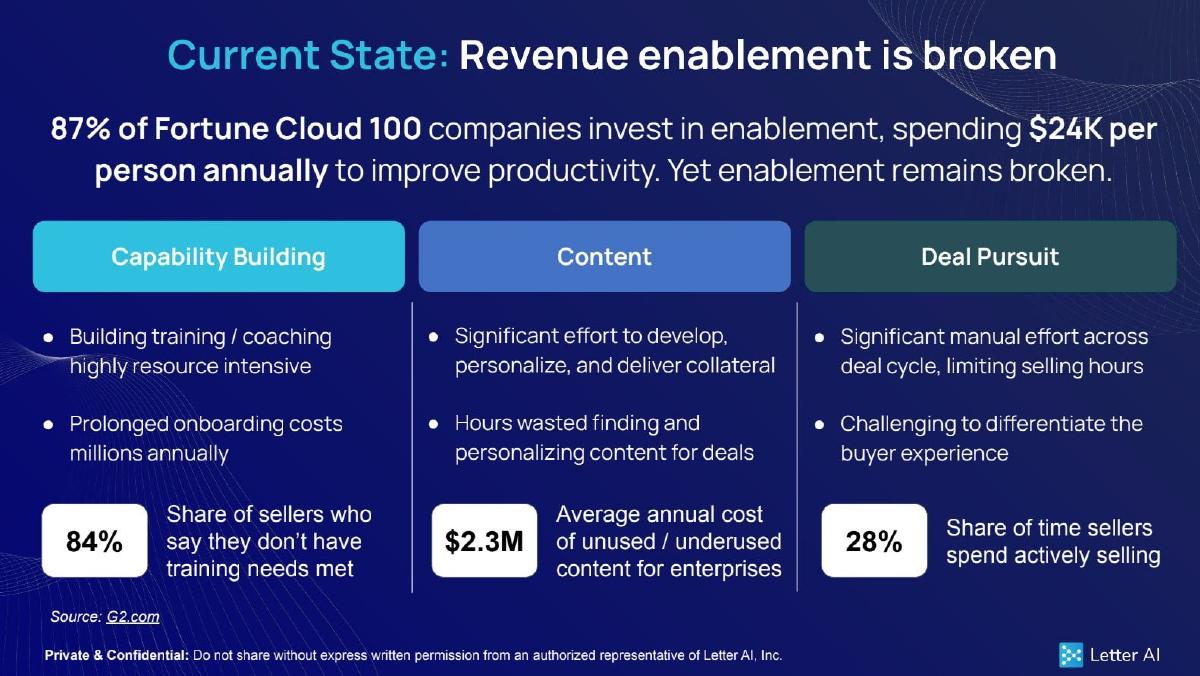
- Letter AI defines the problem through three pillars: Capability Building, Content, and Deal Pursuit, citing a $2.3M annual cost of unused content (Slide 2).
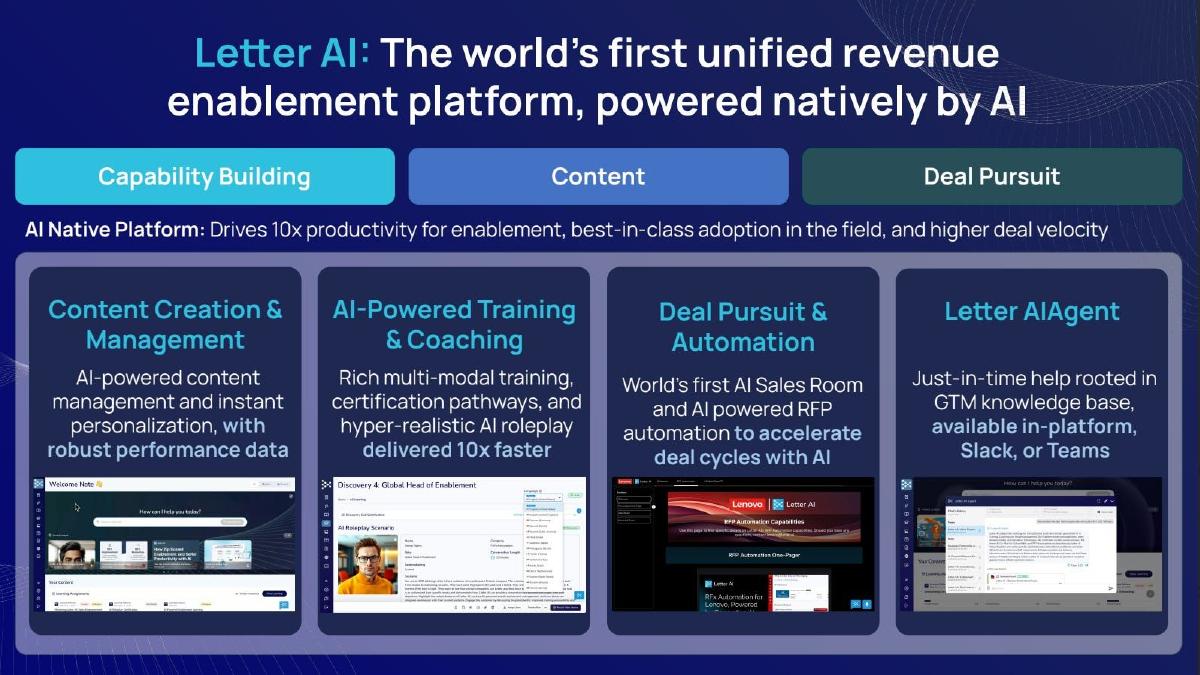
- The product is positioned as an 'AI-native' platform that drives 10x productivity for enablement teams (Slide 3).
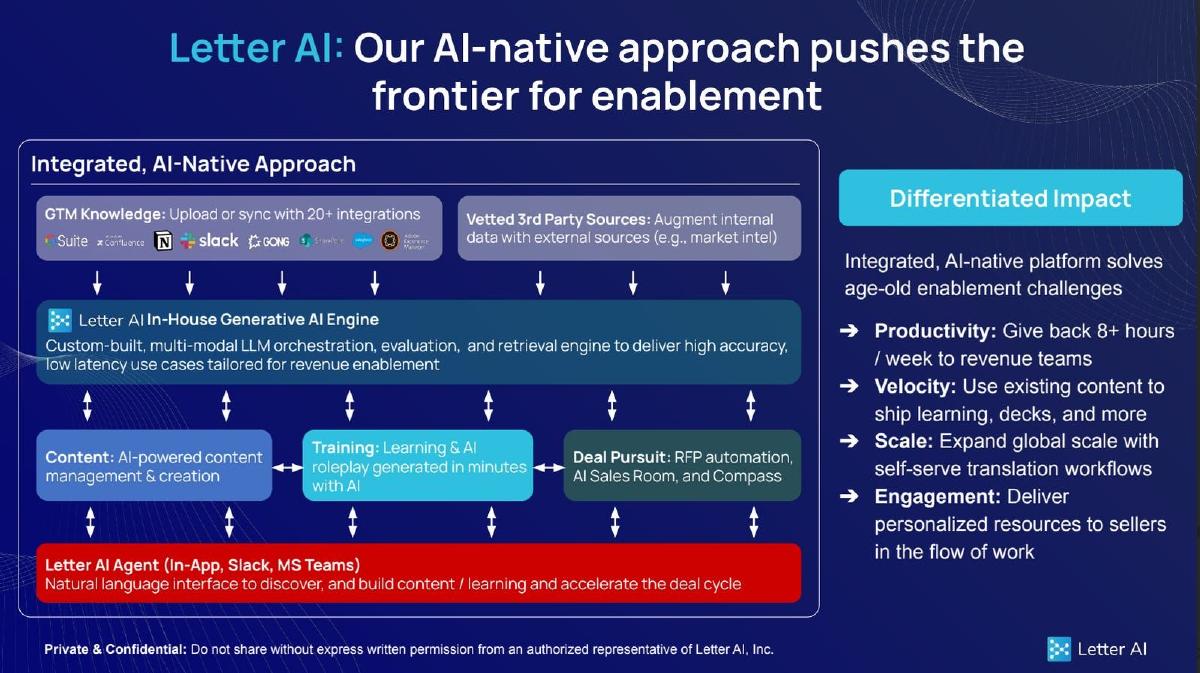
- The technical architecture slide emphasizes an 'In-House Generative AI Engine' and 20+ integrations with GTM tools like Gong and Salesforce (Slide 4).
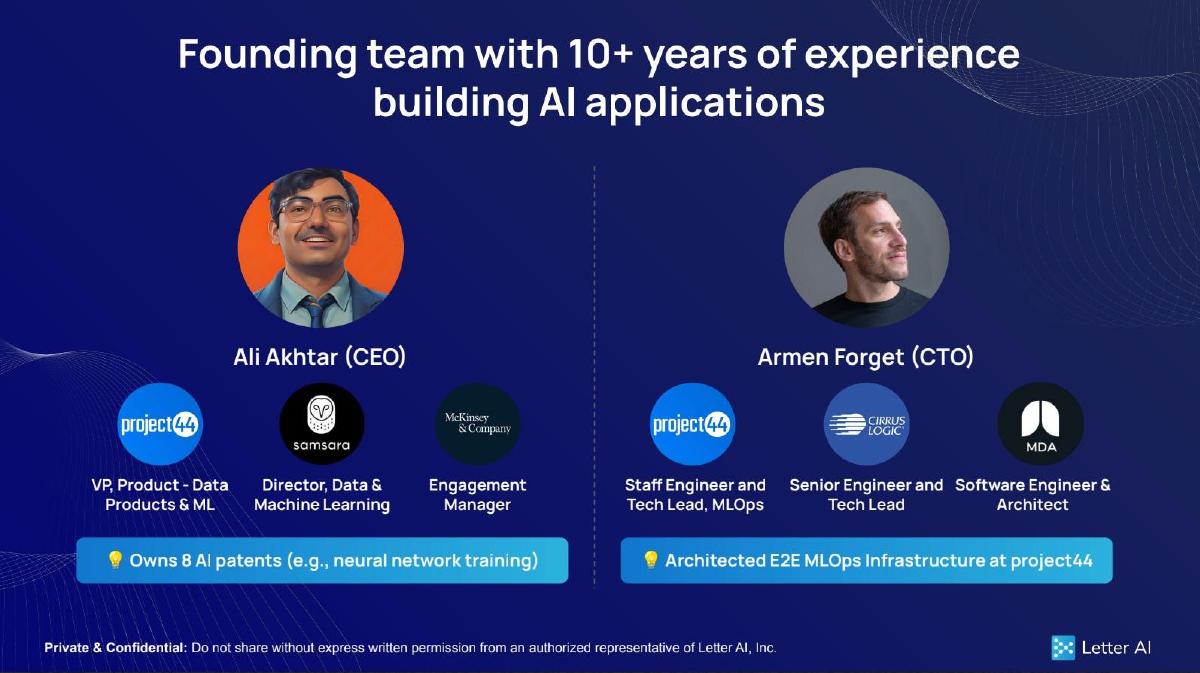
- Founder pedigree is a central pillar, with CEO Ali Akhtar noted as owning 8 AI patents (Slide 5).
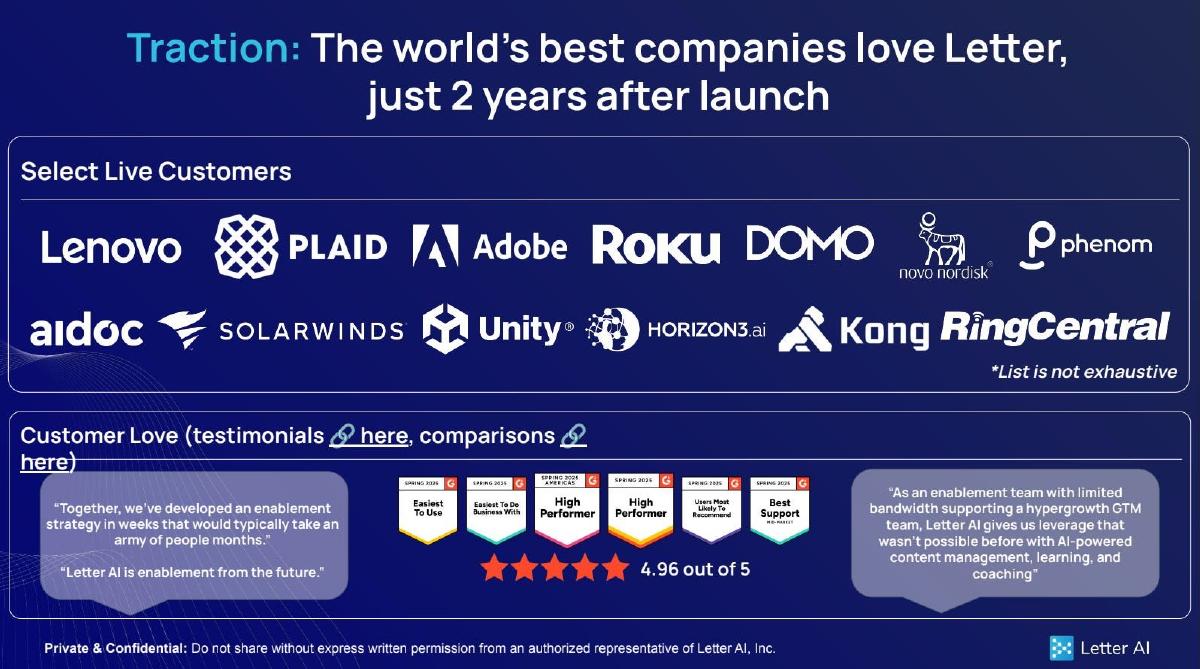
- Traction is demonstrated through a logo wall of 14 major companies, including Roku, Unity, and RingCentral (Slide 6).
- The company uses a G2 Momentum Grid to claim the 'highest in momentum' spot among all enablement platforms (Slide 7).
- The deck reports that sellers spend only 28% of their time actively selling, providing a clear efficiency-based value proposition (Slide 2).
The 8-Slide Series B: Letter AI’s High-Conviction Narrative
Letter AI’s Series B deck is an anomaly in the world of venture capital. Typically, by the time a company reaches a $40M Series B, the pitch deck is a dense document filled with cohort analysis, CAC/LTV ratios, and complex market expansion maps. Letter AI, as reported by Business Insider in 2024, managed to secure its funding with a lean, 8-slide presentation that prioritizes narrative and social proof over raw data. This teardown examines how they leveraged technical authority and rapid enterprise adoption to bypass the traditional data-heavy pitch.
Slide 1: Title and Confidentiality
The deck opens with a standard title slide. It identifies the round as the 'Series B Deck' and includes a 'Proprietary & Confidential' warning. The branding is clean, utilizing a dark blue palette that suggests enterprise stability rather than consumer flashiness. There are no taglines here; the company relies on the name 'Letter AI' to signal its sector immediately.
Slide 2: The Problem – Revenue Enablement is Broken
Slide 2 sets the stage by quantifying the inefficiency in the current market. It targets the 'Fortune Cloud 100,' noting that 87% of these companies invest in enablement, spending $24K per person annually. Despite this spend, the slide claims enablement remains 'broken.' The problem is categorized into three buckets: Capability Building, Content, and Deal Pursuit. Key figures cited include an 84% share of sellers who say training needs aren't met, a $2.3M annual cost of unused content for enterprises, and the striking statistic that sellers spend only 28% of their time actively selling. This slide is effective because it uses a third-party source (G2.com) to validate the pain points, making the problem feel industry-wide rather than anecdotal.
Slide 3: The Solution – Unified and AI-Native
Letter AI introduces itself as the 'world’s first unified revenue enablement platform, powered natively by AI.' This slide mirrors the three-column structure of the problem slide, showing how the platform addresses Capability Building, Content, and Deal Pursuit. It introduces four product modules: Content Creation & Management, AI-Powered Training & Coaching, Deal Pursuit & Automation, and the Letter AI Agent. The slide includes small UI screenshots, which, while difficult to read, serve to prove that the product is real and functional. The headline promise is a '10x productivity' boost, a bold claim that sets the bar for the technical slides to follow.
Slide 4: Technical Differentiation
This is arguably the most important slide for an AI startup in 2024. It explains the 'AI-native approach' through a technical architecture diagram. It shows 20+ integrations (including Slack, Salesforce, and Gong) feeding into a 'Letter AI In-House Generative AI Engine.' By highlighting 'custom-built, multi-modal LLM orchestration,' the company is signaling to investors that they are not just a thin wrapper around OpenAI’s API. The right side of the slide lists 'Differentiated Impact,' claiming to give back 8+ hours per week to revenue teams and offering self-serve translation workflows for global scale. This slide bridges the gap between 'what it is' and 'why it’s better than what exists.'
Slide 5: The Team Slide
In a Series B, the team slide is often moved to the back, but here it remains a core pillar of the argument. The focus is exclusively on the two founders: Ali Akhtar (CEO) and Armen Forget (CTO). The pedigree is high-tier, featuring logos from Project44, Samsara, and McKinsey. The 'kicker' facts are highlighted in yellow boxes: the CEO 'Owns 8 AI patents' and the CTO 'Architected E2E MLOps Infrastructure at project44.' This establishes the 'Founder-Market Fit' and technical defensibility required to justify a large Series B valuation in a competitive AI landscape.
Slide 6: Traction and Social Proof
Slide 6 is a 'logo wall' and testimonial slide. It features 14 'Select Live Customers,' including heavy hitters like Adobe, Lenovo, Plaid, Roku, and Unity. The headline emphasizes that this was achieved 'just 2 years after launch,' signaling high velocity. Below the logos, the company displays its G2 ratings: a 4.96 out of 5 stars and several 'Spring 2025' badges (Easiest To Use, Best Support, etc.). The testimonials use high-praise language, with one customer calling it 'enablement from the future.' For a Series B investor, this slide answers the question: 'Does the market actually want this?' with a resounding yes.
Slide 7: Market Momentum
Letter AI doubles down on third-party validation by showing a G2 Momentum Grid for Sales Enablement Software. The grid shows Letter AI in the top-right 'Momentum Leaders' quadrant, positioned higher on the momentum axis than established incumbents (whose logos are visible but not named in the text). The slide also includes screenshots of internal Slack messages and texts from users, such as 'This is the most incredible tool I have ever used in my life.' While anecdotal, these 'raw' testimonials provide a sense of user delight that formal case studies often lack.
Slide 8: The Call to Action
The final slide is a simple contact page with a link to 'See Letter AI for yourself' and a general email address. Notably, there is no 'Ask' slide detailing how much they are raising or how they will spend the money. This suggests the deck was likely used for a round that was already in high demand or pre-empted, where the terms were being discussed in a separate term sheet rather than on a slide.
What Letter AI Does Exceptionally Well
1. Extreme Focus on Social Proof: Out of 8 slides, two are dedicated almost entirely to customer logos, G2 rankings, and testimonials. For a Series B, this is a powerful way to show that the 'Product-Market Fit' phase is over and the 'Scaling' phase has begun.
2. Technical Authority: The mention of 8 AI patents and MLOps architecture is a direct counter-argument to the 'AI wrapper' criticism that plagues many current SaaS startups. They successfully frame their product as a technical breakthrough rather than just a UI improvement.
3. Quantified Pain Points: By citing that sellers only spend 28% of their time selling, they create a clear, mathematical reason for their product to exist. If they can move that number even slightly, the ROI for an enterprise customer is massive.
What is Missing from the Deck
1. Financial Metrics: There is zero mention of ARR (Annual Recurring Revenue), growth rates, churn, or NRR (Net Revenue Retention). In a standard Series B, these are usually the most scrutinized slides. Their absence suggests this deck was a narrative tool rather than a comprehensive financial disclosure.
2. Competitive Landscape: While the G2 grid shows other logos, there is no 'Checklist' slide or 'Magic Quadrant' style analysis explaining exactly how Letter AI beats specific competitors like Highspot or Seismic on a feature-by-feature basis.
3. The Ask and Use of Funds: The deck never specifies that they are looking for $40M or how that capital will be deployed (e.g., hiring, international expansion, R&D). This information was likely kept in a separate document or discussed verbally.
Lessons for Founders
Brevity can be a signal of strength. If your traction is undeniable and your team is world-class, you don't need 25 slides to convince an investor. Letter AI’s deck proves that a tight narrative focused on 'Problem, Technical Solution, and Proof' can be enough to trigger a major investment round. However, founders should only attempt this if they have the 'Blue Chip' logos and technical pedigree to back it up. Without the Adobe and Lenovo logos, this deck would likely be viewed as too light on detail.
Use third-party validation early and often. Letter AI didn't just say their product was good; they used G2 data, Fortune Cloud 100 stats, and direct customer quotes to say it for them. This shifts the burden of proof from the founder to the market, which is a much more persuasive position to be in during a fundraise.
Frequently asked questions
- Why is the deck so short for a Series B?
- At the Series B stage, investors often have access to a full data room. This deck serves as a high-level narrative anchor. By focusing on team pedigree and massive enterprise logos, Letter AI establishes immediate credibility, leaving the granular unit economics for the due diligence phase.
- What is missing from this pitch deck?
- The deck lacks a financial slide (revenue growth, ARR, NRR), a competitive landscape analysis, a go-to-market strategy, and a specific use-of-funds slide. These are standard for Series B, suggesting this deck was likely used as a teaser or a conversation starter for a pre-empted round.
- How does Letter AI differentiate itself from legacy sales enablement tools?
- They lean heavily on being 'AI-native.' Slide 4 highlights an in-house generative AI engine and multi-modal LLM orchestration, contrasting this with legacy platforms that may have simply 'bolted on' AI features to an older architecture.
- What metrics does the deck use to prove product-market fit?
- Instead of traditional SaaS metrics, they use social proof: a 4.96 out of 5 rating on G2, 'High Performer' badges, and testimonials claiming the tool is 'enablement from the future.' They also cite giving back 8+ hours per week to revenue teams.
- Is the team slide effective?
- Yes. It specifically highlights '8 AI patents' for the CEO and 'Architected E2E MLOps' for the CTO. In a crowded AI market, proving that the founders are builders rather than just wrappers is a critical differentiator for VCs.