Leo AI, a North American startup, successfully raised a $9.7M Seed round in 2024 to tackle the inefficiencies inherent in mechanical engineering design. The 10-slide deck identifies a critical bottleneck: engineers spend approximately 55% of their time on information retrieval due to siloed knowledge across tribal expertise, document archives, and CAD data. Leo AI positions itself as a 'Mechanical Engineering AI' copilot that automates conceptualization, technical spec drafting, and part selection. While the deck is visually polished and provides clear product mockups, it notably lacks a dedi…
Key takeaways
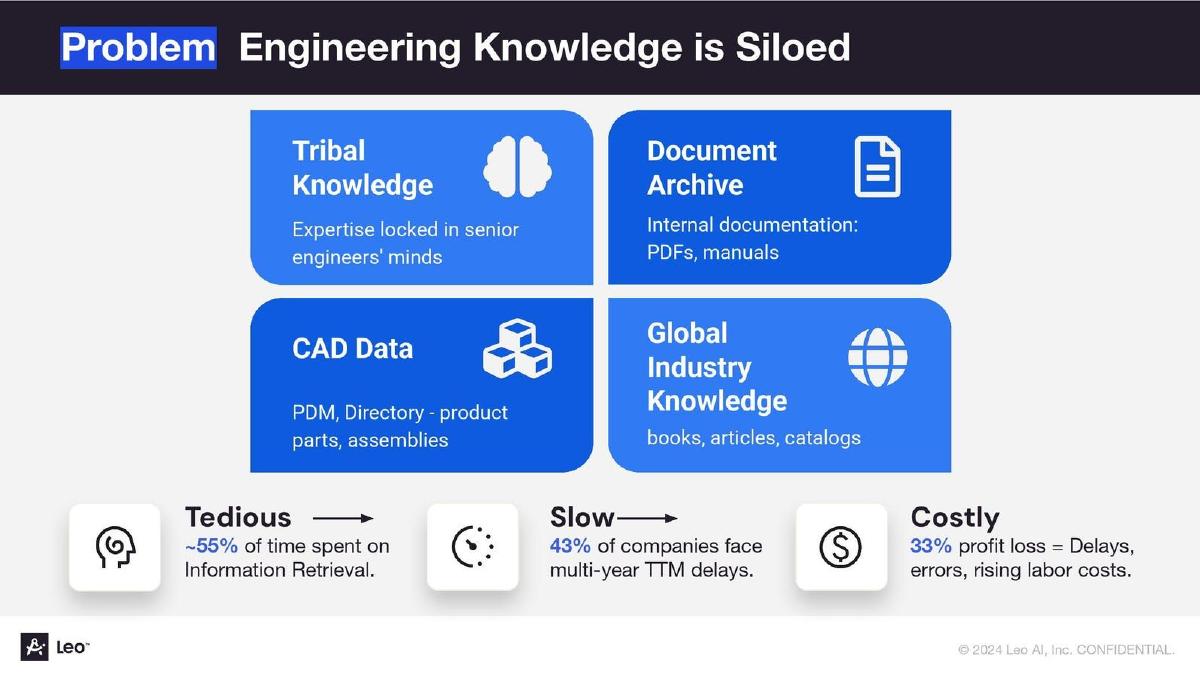
- The deck identifies that 55% of an engineer's time is wasted on information retrieval (Slide 3).
- Leo AI targets four specific knowledge silos: Tribal Knowledge, Document Archives, CAD Data, and Global Industry Knowledge (Slide 3).
- The product aims to automate conceptualization, drafting technical specs, and part selection (Slide 5).
- A 'CAD Autocomplete' feature is explicitly roadmapped for September 2025 (Slide 8).
- The startup claims that 43% of companies face multi-year time-to-market (TTM) delays (Slide 3).
- The deck omits a formal 'Ask' slide, market sizing (TAM/SAM/SOM), and a detailed business model.
- Founder information is limited to names and titles on the final slide, omitting professional backgrounds or prior exits (Slide 10).
- The publisher reports a $9.7M Seed round raised in 2024 following this general product direction.
Leo AI: The Generative Copilot for Mechanical Systems
Leo AI entered the market at a time when 'AI for X' was the dominant venture theme, but mechanical engineering remained a relatively underserved vertical compared to software development or marketing. Their 2024 Seed round of $9.7M, as reported by Business Insider, suggests that investors bought into the premise that physical product design is ripe for a 'GitHub Copilot' equivalent. The deck is lean, totaling only 10 slides, and focuses heavily on the user experience and the high cost of engineering inefficiency.
Slide 1-2: Branding and Positioning
The deck opens with a high-fidelity 3D render of mechanical components, immediately signaling the industry focus. The subtitle on Slide 1, 'The Mechanical Engineering AI,' is a bold, category-defining statement. Slide 2 is a duplicate or transition slide, maintaining the visual theme. The use of 'Leo AI Customer Deck | Q1, 2025' suggests this version of the deck may have been adapted for external partners or early customers, which explains the heavy emphasis on product utility over venture-specific metrics like CAC/LTV.
Slide 3: The Problem of Siloed Knowledge
This is the most data-dense slide in the deck. It breaks down the 'Problem' into four quadrants: Tribal Knowledge (senior engineers' minds), Document Archive (PDFs/manuals), CAD Data (PDM/directories), and Global Industry Knowledge (catalogs). The bottom of the slide provides the 'Why now' and the economic stakes:
Tedious: ~55% of time spent on Information Retrieval. · Slow: 43% of companies face multi-year TTM (Time-to-Market) delays. · Costly: 33% profit loss due to delays, errors, and rising labor costs.
By quantifying the 'Tedious' nature of the work, Leo AI builds a case for a tool that doesn't just design, but acts as a retrieval engine.
Slide 4-5: The Solution and Automation Scope
Slide 4 presents a simple checklist, asserting that Leo AI integrates all four previously mentioned silos into a single AI interface. Slide 5 expands on the specific tasks the AI automates: Conceptualization, drafting technical specs, answering technical questions, and part selection/retrieval. Crucially, it marks '3D & CAD generation' as 'coming soon,' managing expectations about the current state of the technology versus the long-term vision.
Slide 6-7: Product Demo and Interface
Slide 6 serves as a transition to the demo. Slide 7 provides a look at the actual UI. The interface is split between a standard CAD environment (showing a shock absorber model) and the Leo AI chat sidebar. The sidebar features four prompt categories: Part search, Develop, Ideate, and Learn. This slide is critical because it demonstrates that the AI is meant to live inside the engineer's existing workflow, rather than requiring them to switch to a standalone web browser.
Slide 8: The Roadmap to CAD Autocomplete
Slide 8 is a placeholder for a future feature: 'CAD Autocomplete (Coming Sept ‘25)'. The text explains that Leo will complete user models by integrating parts from internal libraries and authorized vendors. This is a significant technical claim, as it implies the AI understands the spatial and functional constraints of a mechanical assembly well enough to suggest the next logical component.
Slide 9-10: North Star and Team
Slide 9 defines their 'North Star' as 'Happy Engineers,' a qualitative metric that aligns with their focus on reducing 'tedious' work. Slide 10 concludes the deck with the names of the two founders: Maor Farid, PhD (CEO) and Moti Moravia (CTO). The inclusion of a PhD for the CEO suggests a deep technical or academic foundation for the underlying 'large mechanical model' mentioned in publisher reports.
What Works in the Leo AI Deck
Specific Problem Quantification: The deck does an excellent job of quantifying the pain. Citing that engineers spend 55% of their time on information retrieval (Slide 3) gives investors a clear 'efficiency gain' metric to track. If Leo AI can reduce that 55% to 20%, the ROI for a large engineering firm is massive and easily calculated.
Workflow Integration: The mockups on Slide 7 show the AI as a sidebar within what looks like SolidWorks or a similar CAD tool. This addresses a common investor concern: 'Will engineers actually use this?' By showing it as a copilot rather than a replacement platform, they lower the barrier to adoption.
Clear Feature Roadmap: By explicitly dating the 'CAD Autocomplete' for September 2025 (Slide 8), the founders show they have a realistic view of the technical hurdles. They aren't claiming to have solved generative 3D design yet; they are building the knowledge retrieval layer first.
What is Missing from the Leo AI Deck
The Team Slide: While the founders are listed on the final slide, there is no detail on their backgrounds. For a $9.7M Seed round in a deep-tech space like AI for mechanical engineering, investors usually want to see a 'Why us?' slide. Where did the PhD come from? What did the CTO build previously? This information is entirely absent from the slides.
Market Sizing (TAM): There is no mention of how many mechanical engineers exist globally or the size of the CAD software market. While the problem is clearly stated, the scale of the opportunity is left to the reader's imagination.
Business Model and Go-To-Market: The deck does not explain how Leo AI makes money. Is it a per-seat SaaS model? An enterprise license? Does it take a cut of part sales through the 'authorized vendors' mentioned on Slide 8? The lack of a GTM strategy is a notable omission for a Seed round deck.
Competition: The deck operates in a vacuum. There is no mention of incumbent CAD providers (Autodesk, Dassault Systèmes) and their own AI initiatives, nor other startups in the generative design space. A 'Competitor Matrix' or 'Landscape' slide would have helped position Leo AI against the field.
Founder Takeaway: The 'Customer Deck' vs. 'Investor Deck'
This deck is labeled as a 'Customer Deck' on Slide 1, which explains many of the omissions. However, founders should note that the line between a customer deck and a seed-stage investor deck is often thin. Leo AI uses this deck to sell the vision and the product . For a Seed round, where the product is often still in development, the 'Problem' slide (Slide 3) is the most important asset. Leo AI's breakdown of the four knowledge silos is a masterclass in explaining a complex, fragmented workflow in a way that makes an automated solution feel inevitable. If you are building in a technical vertical, focus on the 'Time Wasted' metrics to prove your value proposition before you even show a line of code.
Frequently asked questions
- What specific problem does Leo AI solve for engineers?
- According to Slide 3, Leo AI addresses the problem of siloed engineering knowledge. It notes that engineers spend ~55% of their time on information retrieval and that 43% of companies suffer from multi-year delays in getting products to market. By centralizing tribal knowledge, manuals, and CAD data, the AI aims to reduce these delays and the 33% profit loss associated with them.
- Is the Leo AI tool currently capable of generating full CAD models?
- Not yet. Slide 5 lists '3D & CAD generation' as 'coming soon,' and Slide 8 specifically identifies 'CAD Autocomplete' as a feature scheduled for release in September 2025. Currently, the tool focuses on conceptualization, technical specs, and part search/retrieval within existing CAD environments like SolidWorks.
- Who are the founders of Leo AI?
- The founders listed on Slide 10 are Maor Farid, PhD (Co-Founder & CEO) and Moti Moravia (Co-Founder & CTO). While the deck mentions Dr. Farid's PhD, it does not provide further details on their specific industry experience or academic background within the slides themselves.
- What are the primary use cases shown in the product demo?
- Slide 7 highlights four primary interaction types: Part Search (e.g., finding ball bearings with specific diameters), Develop (comparing efficiency of robotic arm actuation), Ideate (designing wearable filtration devices), and Learn (understanding jet engine stators). The UI shows a chat-based interface integrated alongside a 3D modeling environment.
- Does the deck include financial projections or a business model?
- No. The 10-slide deck is primarily a product and problem overview. It lacks a slide on unit economics, revenue models, go-to-market strategy, or financial projections. It appears to be a 'vision' or 'customer' deck rather than a full investor due diligence package.