The TalentBase pitch deck is a masterclass in brevity, consisting of only nine slides. Despite its short length, it successfully secured $330,000 in funding in 2015 by focusing on high-impact data points: a 30% month-over-month growth rate and a massive $24 billion market opportunity. The deck identifies a specific pain point—that 90% of African SMBs still use manual payroll processes—and positions TalentBase as the first mobile-first solution for this demographic. While the deck lacks detailed financial projections, unit economics, or a competitive landscape analysis, its reliance on strong…
Key takeaways
- The deck highlights a specific market inefficiency: 90% of African SMBs manage payroll manually (Slide 3).
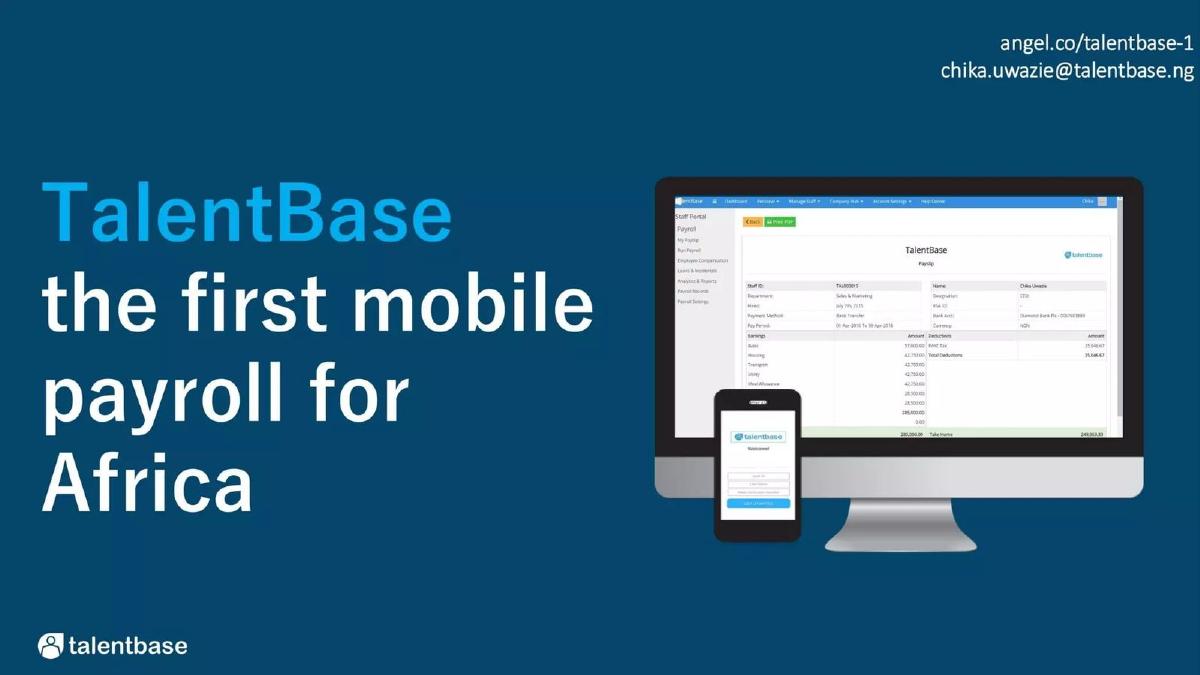
- TalentBase claims to be the first mobile payroll solution for the African continent (Slide 4).
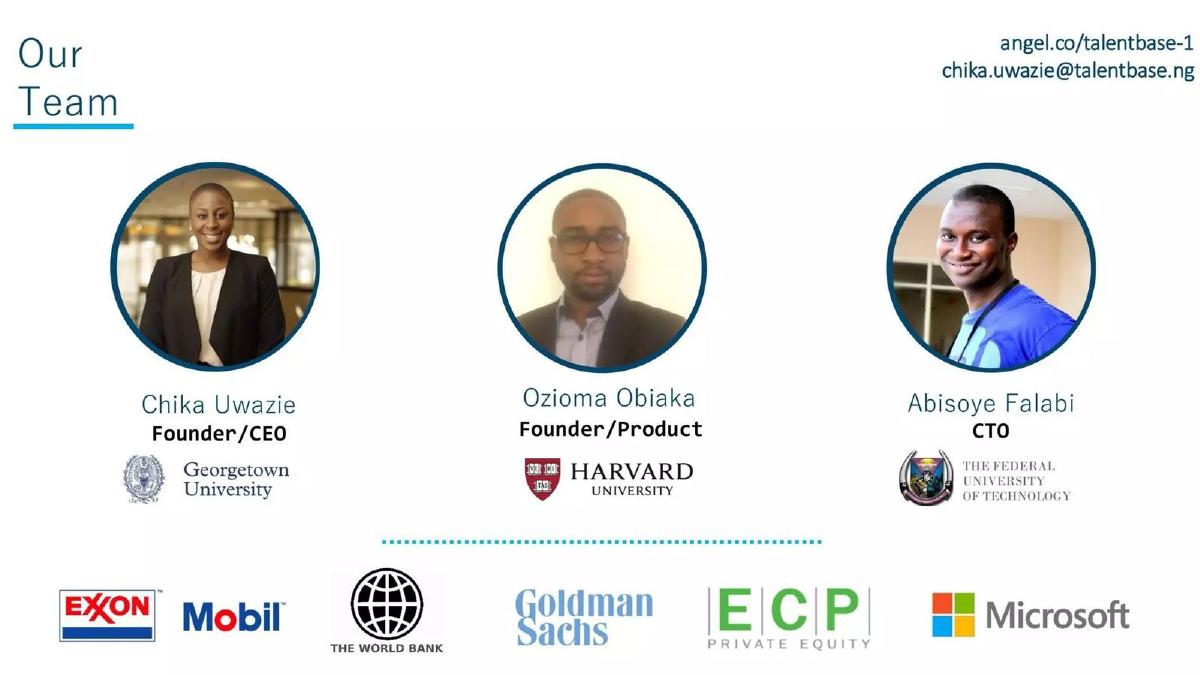
- The founding team possesses significant corporate pedigree from ExxonMobil, Goldman Sachs, and Microsoft (Slide 5).
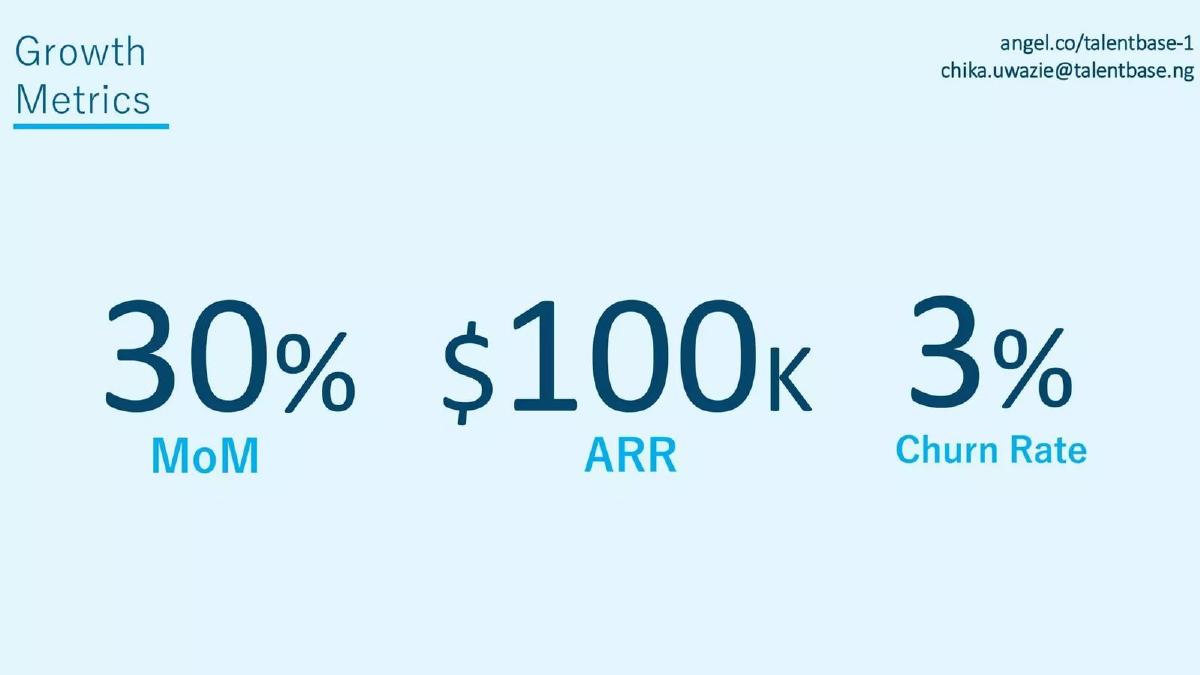
- At the time of the deck, the company had reached $100k in Annual Recurring Revenue (Slide 6).
- Traction is evidenced by a 30% month-over-month growth rate and a low 3% churn rate (Slide 6).
- Distribution strategy relies on signed partnerships with two banks to reach 1 million clients by 2018 (Slide 7).
- The total addressable market is valued at $24 billion across the continent (Slide 8).
- The deck completely omits a specific 'Ask' slide, failing to state the amount of capital sought or the planned use of funds.
Introduction: The Power of a Nine-Slide Narrative
The TalentBase pitch deck, used to raise $330,000 in 2015, is an exercise in minimalism. In an industry where decks often stretch to 20 or 30 slides filled with complex architectural diagrams and dense financial tables, TalentBase opted for a high-level, punchy narrative. The company describes itself as an affordable payroll solution for African SMBs, and the deck reflects that focus on simplicity and efficiency.
This teardown will look at how the founders used large-scale imagery and bold metrics to compensate for a lack of granular detail. While the deck is missing several 'standard' slides, the strength of the team and the clarity of the market gap provided enough signal for investors to move forward.
Slide 1: Title and Vision
The cover slide is functional and clean. It features the TalentBase logo and the tagline: Automating Payroll for African SMBs . The background is a stylized, blue-tinted skyline of a modern African city, likely Lagos, given the company's .ng domain. Notably, the slide includes contact information for CEO Chika Uwazie and an AngelList link directly in the top right corner. This is a practical addition for a deck intended for digital circulation, making it easy for investors to perform immediate due diligence.
Slide 2: The Human Element
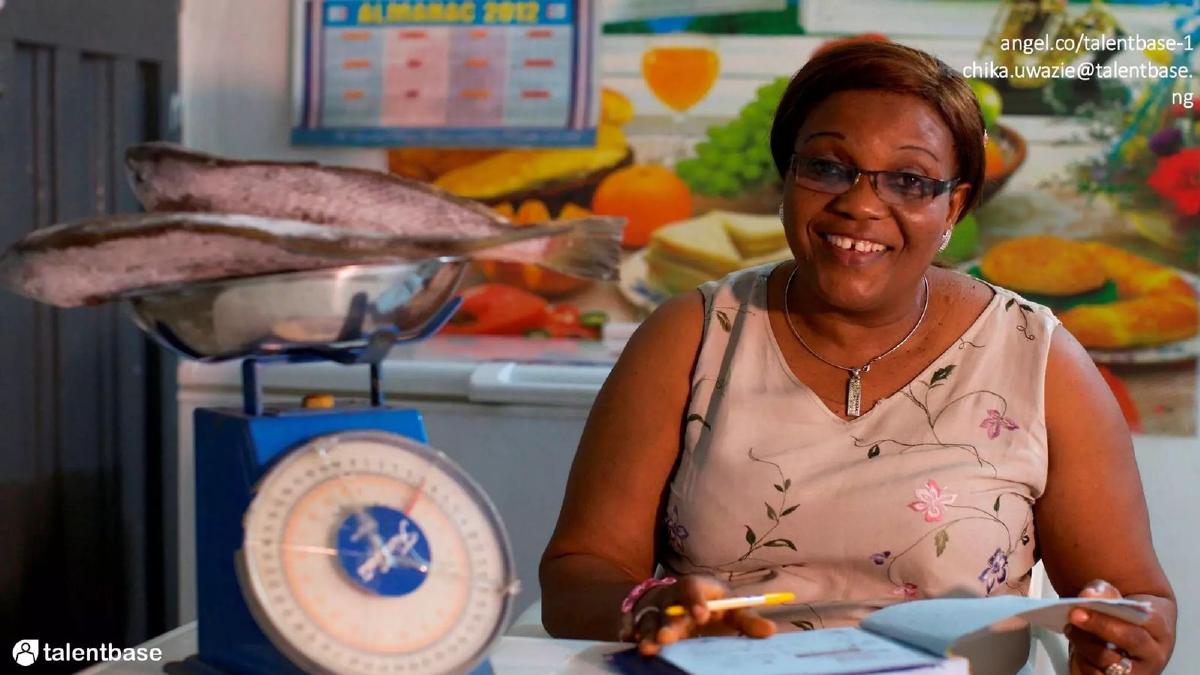
Slide 2 is a full-bleed photograph of a woman working at a desk with a ledger and a scale, with fish in the foreground. There is no text on this slide other than the logo. This is a 'show, don't tell' slide. It visually represents the target demographic: the small business owner in Africa who is currently managing operations manually. It grounds the high-tech solution in a real-world, relatable context.
Slide 3: The 90% Problem
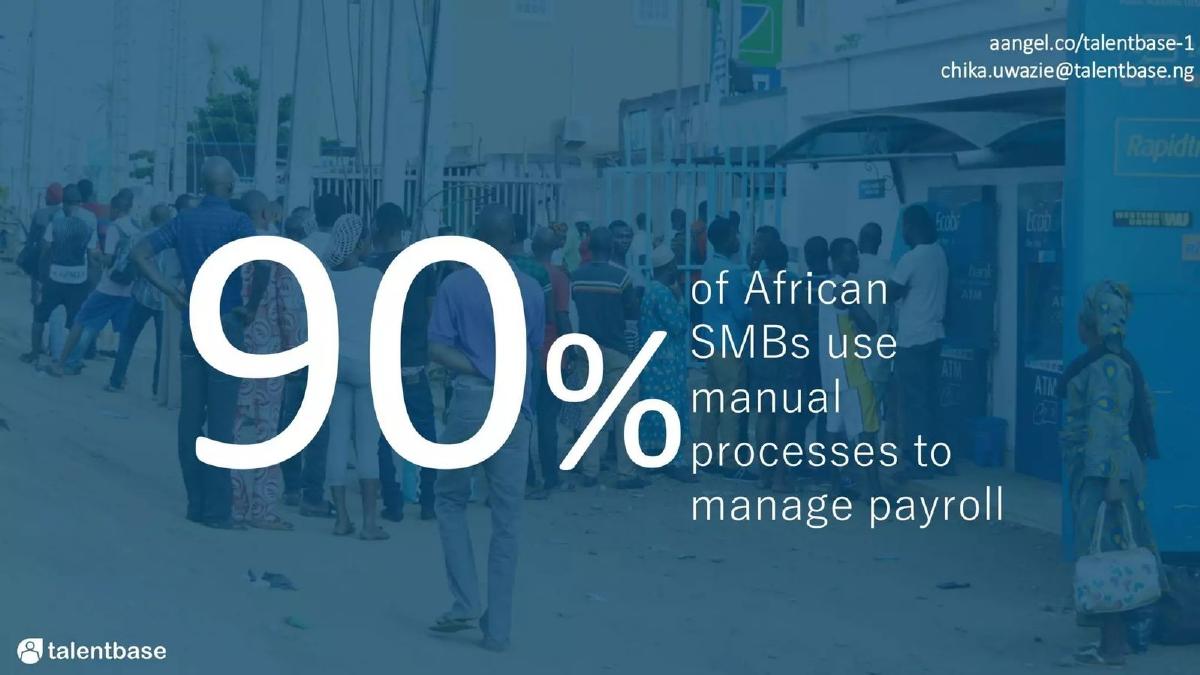
This is the 'Problem' slide, and it is highly effective. It uses a background image of a long queue at a bank or ATM to evoke the frustration of manual financial processes. The text is simple: 90% of African SMBs use manual processes to manage payroll . By leading with a massive percentage, the founders establish that the current market is almost entirely unserved by modern software. This justifies the existence of the company without needing a long list of bullet points.
Slide 4: The Mobile-First Solution
Slide 4 introduces the product. The headline states: TalentBase the first mobile payroll for Africa . The slide features a mockup of the software on both a desktop monitor and a smartphone. The desktop view shows a 'Staff Portal' with clear navigation for 'Run Payroll,' 'Employee Compensation,' and 'Analytics & Reports.' The inclusion of the mobile phone is critical, as mobile penetration in Africa often outpaces desktop usage. This slide defines the product's unique selling proposition (USP) as being the first to bring this specific functionality to mobile devices in the region.
Slide 5: Team Pedigree
The 'Our Team' slide is one of the strongest in the deck. It features three key members: Chika Uwazie (Founder/CEO) , Ozioma Obiaka (Founder/Product) , and Abisoye Falabi (CTO) . Below their photos and university affiliations (Georgetown, Harvard, and The Federal University of Technology), the slide displays a row of high-profile corporate logos: ExxonMobil, The World Bank, Goldman Sachs, ECP Private Equity, and Microsoft . This communicates that while the startup is small, its leadership has experience at the highest levels of global finance and technology. For a $330k raise, this level of 'founder-market fit' and professional credibility is often the deciding factor.
Slide 6: Growth Metrics
This slide provides the 'Traction' evidence. It lists three key figures: 30% MoM (Month-over-Month growth), $100k ARR (Annual Recurring Revenue), and a 3% Churn Rate . These are healthy numbers for an early-stage SaaS company. The 30% growth rate suggests strong momentum, while the $100k ARR proves that the market is willing to pay for the solution. The 3% churn rate is particularly impressive for the SMB sector, which is notoriously fickle, suggesting that once a business starts using TalentBase, they find it difficult to leave.
Slide 7: Distribution and Projections
Slide 7 addresses how the company plans to scale. It mentions Signed Partnerships with Two Banks . In the African fintech ecosystem, partnering with established banks is a common and effective shortcut to acquiring thousands of SMB customers who already trust their financial institution. The slide sets an ambitious goal: $60M Projected ARR and 1M SMB Clients by 2018 . While these are aggressive projections, they are tied to a specific distribution channel (the banks), which gives them more weight than mere guesswork.
Slide 8: Market Opportunity
The 'Market Opportunity' slide features a large $24 BILLION figure next to a map of Africa with pins in several countries. This represents the Total Addressable Market (TAM). By showing the pins across the continent, the founders are signaling that while they may be starting in one region (Nigeria), the solution is geographically agnostic and can scale across the entire continent. The $24B figure is large enough to interest venture capitalists looking for 'unicorn' potential.
Slide 9: The Closing Call to Action
The final slide asks: Looking to be at the forefront of African Fintech? It repeats the contact information and summarizes the three most compelling data points from the deck: $24B Untapped Market , $60M Projected ARR by 2018 , and 30% MoM . This slide serves as a summary for an investor who might have skimmed the middle of the deck, ensuring the most important numbers are the last thing they see.
What Works in the TalentBase Deck
Clarity of Mission: From the first slide to the last, there is no ambiguity about what TalentBase does. They automate payroll for African SMBs. The deck avoids jargon and 'feature creep,' focusing entirely on the core value proposition.
Strong Social Proof: The team slide is excellent. By showcasing logos like Goldman Sachs and Microsoft, the founders borrow the credibility of those institutions. This reduces the perceived risk for the investor, as it suggests the founders have been vetted by world-class organizations.
Metric-Driven Narrative: The deck relies on hard numbers rather than adjectives. 90% manual process, 30% growth, 3% churn, $100k ARR. These figures provide a concrete foundation for the pitch and make the 'opportunity' feel real rather than theoretical.
What is Missing from the TalentBase Deck
The Ask: The most glaring omission is a slide detailing the fundraise. There is no mention of how much money is being raised, what the valuation is, or how the funds will be allocated (e.g., 50% engineering, 30% sales). An investor finishing this deck knows the company is good, but they don't know what the company wants from them.
Competitive Landscape: The deck claims to be the 'first,' but it doesn't address how they will defend their position against local copycats or international players like Gusto or Xero if they decide to enter the African market. A simple 2x2 matrix or a feature comparison table would have helped here.
Unit Economics: While the deck mentions ARR and churn, it says nothing about the cost to acquire a customer (CAC) or the lifetime value (LTV) of that customer. For a SaaS business, these are the 'engine' metrics that prove the business model is sustainable at scale.
Product Depth: We see one mockup, but we don't know how the system handles local tax regulations, pension contributions, or different currencies. Payroll is a compliance-heavy business, and a slide addressing the 'moat' created by navigating these regulatory hurdles would have been valuable.
What a Founder Should Copy
The 'Problem' Visualization: Use a single, powerful statistic to define your problem. TalentBase's '90% manual' stat is the anchor of the whole deck. If you can find one number that proves your market is broken, put it in giant font.
Channel Partner Strategy: If you are selling to SMBs, don't just say you will use 'social media marketing.' Copy TalentBase's approach of highlighting specific channel partnerships (like banks) that provide a clear path to thousands of users.
Minimalist Design: This deck is proof that you don't need 20 slides. If your team is great and your growth is high, get out of the way and let those facts speak for themselves. Use high-quality imagery to set the mood and keep the text to a minimum.
Contact Info on Every Slide: While TalentBase only put it on the first, last, and top corners, having a clear way for an investor to reach out (or see who the deck belongs to) as they flip through is a small but important detail in a crowded inbox.
Conclusion
The TalentBase deck is a 'momentum deck.' It was designed to show that a highly qualified team had found a massive, underserved market and was already growing at a rapid clip. While it lacks the technical and financial depth required for a Series A or B, it was perfectly calibrated for a 2015 seed-stage environment. It prioritizes the 'Who' and the 'How Fast' over the 'Exactly How,' which is often the right trade-off for early-stage fundraising.
Frequently asked questions
- What is the primary problem TalentBase aims to solve?
- TalentBase targets the extreme inefficiency in African small and medium-sized businesses. According to slide 3, 90% of these businesses still use manual processes to manage their payroll. This manual overhead creates errors, wastes time, and prevents scale, which TalentBase addresses through an automated, mobile-first HR and payroll platform.
- How did TalentBase demonstrate early traction?
- The company used slide 6 to showcase three critical SaaS metrics: a 30% month-over-month (MoM) growth rate, a $100,000 Annual Recurring Revenue (ARR) milestone, and a 3% churn rate. These figures suggested a product-market fit and a sticky user base, which are vital for attracting early-stage investors.
- What was the distribution strategy presented in the deck?
- Rather than relying solely on direct sales, TalentBase focused on channel partnerships. Slide 7 notes that they had signed partnerships with two banks. This strategy was intended to help them scale rapidly to a projected 1 million SMB clients and $60 million in ARR by 2018.
- Is there a competitive analysis in the TalentBase deck?
- No. The deck completely omits a competitive landscape slide. It positions the company as the 'first' mobile payroll for Africa (Slide 4), implying a lack of direct local competition, but it does not address global incumbents or other regional fintech players entering the HR space.
- What information is missing from this pitch deck?
- The deck is missing several standard components: a detailed breakdown of the product features, a competitive analysis, unit economics (LTV/CAC), a roadmap of future features, and a formal 'Ask' slide detailing how much money they are raising and how it will be spent.