Take the Time is a project proposal aimed at solving the crisis of pet relinquishment by educating new owners before they acquire animals. The deck identifies that 6.5 million animals enter shelters annually and proposes a content-driven solution featuring interactive quizzes, infographics, and veterinary videos. Led by Carey Blankenship, the initiative operates on a remarkably small scale, requesting a total budget of just $3,677.50 to cover five weeks of content creation and basic web hosting. While the mission is socially impactful, the deck describes a project rather than a scalable start…
Key takeaways
- The problem is defined by high shelter entry rates (6.5 million animals/year) and a 63% relinquishment rate for dogs (Slide 3).
- The solution relies on three content pillars: interactive quizzes, infographics, and expert videos (Slide 6).
- The project is led by a single individual, Carey Blankenship, who plans to hire freelancers for overflow content (Slide 9).
- The total requested budget is highly specific at $3,677.50, covering five weeks of work (Slide 10).
- Labor costs are calculated at $22/hour for infographics/social media and $42/hour for production (Slide 10).
- Success is measured by social media engagement metrics like hashtag usage and quiz completions (Slide 11).
- The deck explicitly states the project has not yet launched and remains in the proposal stage (Slide 12).
- There is no mention of a business model, revenue generation, or long-term financial sustainability.
Executive Summary: A Micro-Proposal for Animal Welfare
The Take the Time pitch deck is a 12-slide presentation that outlines a content-driven initiative to combat pet relinquishment. Unlike typical startup decks that seek millions in seed funding, this proposal is hyper-focused on a five-week execution window with a total budget of $3,677.50. It positions itself as a solution to the lack of pre-purchase research among pet owners, using 'fun' educational tools to bridge the information gap. While the social mission is clear and the budget is transparent, the deck lacks the traditional components of a business—specifically a revenue model and a plan for long-term sustainability.
Slide 1: Title Slide
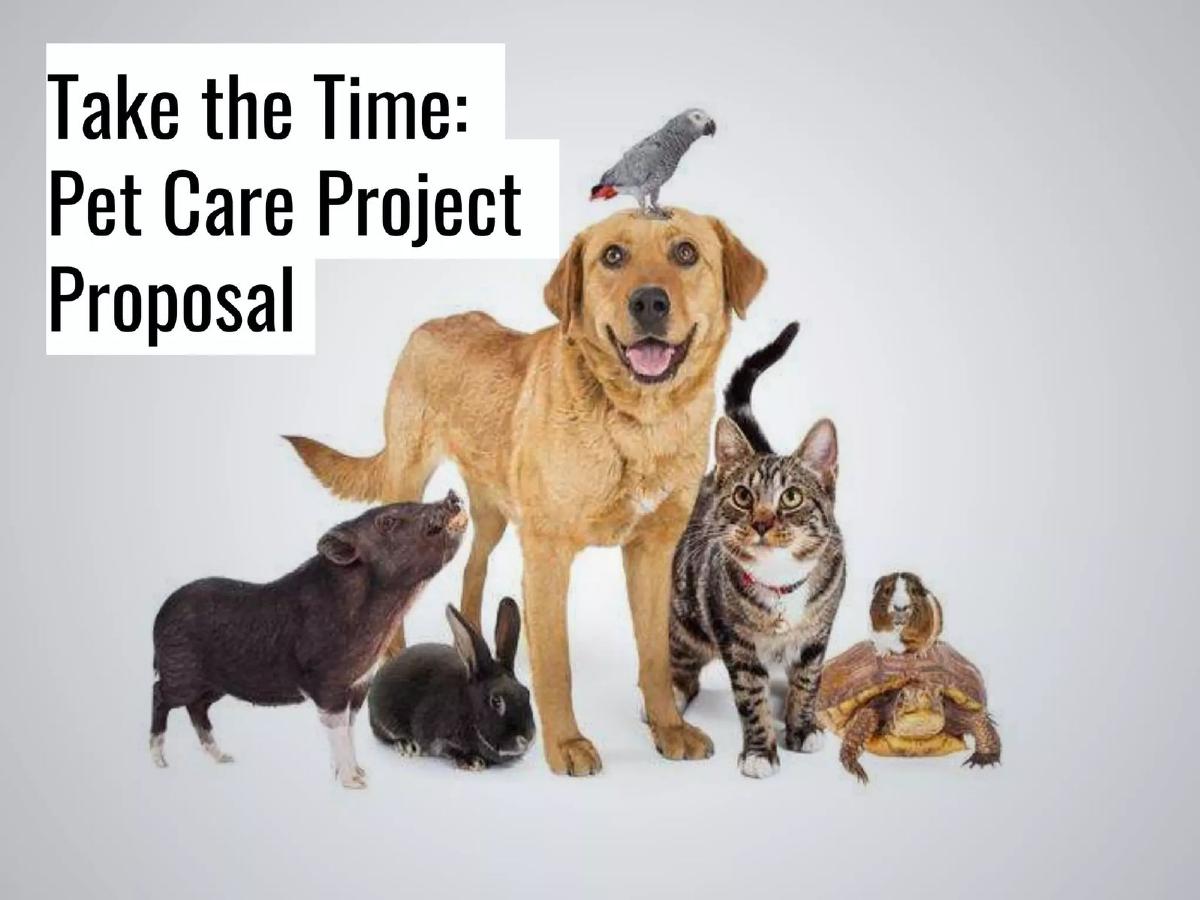
The deck opens with 'Take the Time: Pet Care Project Proposal.' The imagery features a variety of animals, including a dog, cat, pig, rabbit, bird, and turtle. This immediately establishes the broad scope of the initiative, signaling that it is not limited to just dogs or cats. The use of the word 'Proposal' rather than 'Startup' or 'Company' sets the tone for a project-based ask.
Slides 2-3: The Problem and Market Statistics
Slide 2 defines the problem simply: new pet owners fail to research their animals before acquisition. Slide 3 provides the statistical weight behind this claim, citing that 6,500,000 animals enter shelters annually and 1,500,000 are euthanized. Most strikingly, it notes that 63% of dogs are relinquished during their lifetimes. These figures serve to create urgency, though the deck does not cite the specific sources for these statistics, which is a common omission in early-stage proposals.
Slides 4-5: The Proposition and 'The Magic'
Slide 4 outlines the three main goals: educating the public, lowering rescue numbers, and providing incentives for proper care. Slide 5, titled 'The Magic,' attempts to define the unique value proposition. The 'magic' here is gamification—making the 'not fun' task of research 'fun.' This is a psychological approach to a behavioral problem, suggesting that the barrier to education is boredom rather than a lack of resources.
Slide 6: The Take the Time Model
This slide introduces the product interface. The model relies on three platforms: interactive quizzes, infographics, and videos from vet experts. A screenshot of a sample quiz question is shown: 'What's the first step you should take before purchasing your new dog?' The options range from researching breeds to buying a matching collar. This slide is crucial as it shows the actual output of the project, though the 'three different platforms' mentioned appear to be content types rather than distinct software platforms.
Slide 7: The Five-Week Timeline
The timeline is aggressive and granular. First Week involves purchasing the domain and developing the dog quiz. Second Week moves to website layout and cat content. Third Week covers guinea pigs, Fourth Week covers Betta fish, and Fifth Week focuses on social media launch and flyer distribution. This slide demonstrates that the founder has a clear execution plan, though it raises questions about the depth of content that can be produced in such a short timeframe.
Slide 8: Benchmarking
Slide 8 shows screenshots of Guinea Lynx, Caudata.org, and the American Kennel Club (AKC) website. These are presented as benchmarks. However, the deck does not explain how Take the Time will differ from these established resources. The AKC, for instance, already provides extensive breed research. The implied differentiator is the 'fun' quiz format, but a formal competitive analysis is missing.
Slide 9: The Team
Carey Blankenship is introduced as the project head. Her qualifications include being an 'avid animal activist' with experience in marketing and digital content creation. The slide notes she will 'complete most of the creation herself' while hiring freelance writers for overflow. This confirms the project is a solo-founder initiative with a heavy reliance on gig labor for content production.
Slide 10: The Projected Budget
This is the most detailed slide in the deck. The founder breaks down costs into 'Materials' and 'Time & Talent.' Materials include $100/year for hosting and $7.50 for 50 colored flyers. Time & Talent includes 16 hours for infographics at $22/hour ($352), 24 hours for production at $42/hour ($1,008), and 20 hours a week for social media creation at $22/hour over five weeks ($2,200). The Final Total is $3,677.50 . This level of transparency is rare and provides a clear view of how the funds will be utilized, though the hourly rates suggest a very lean operation.
Slides 11-12: Metrics and Conclusion
Slide 11 lists the 'Metrics of Success,' which are standard top-of-funnel engagement markers: quiz completions, Instagram likes, video views, and hashtag usage (#TaketheTime). Slide 12 concludes by reiterating that the project is still a proposal and has not yet launched. There is no 'Ask' slide in the traditional sense (e.g., equity offered), further suggesting this is a request for a grant or a flat-fee sponsorship.
What Works in This Deck
Granular Budgeting: The budget on Slide 10 is exceptionally specific. By breaking down hourly rates and total hours per task, the founder removes any ambiguity about where the money goes. This builds trust with potential donors or sponsors.
Clear Problem/Solution Fit: The connection between the lack of research (Slide 2) and the high rate of relinquishment (Slide 3) is logical. The solution—interactive, 'fun' research—directly addresses the identified barrier of research being 'not fun.'
Defined Scope: The five-week timeline on Slide 7 shows a disciplined approach to a Minimum Viable Product (MVP). It focuses on four specific animal types, which prevents the project from becoming over-encumbered at launch.
What Is Missing From This Deck
Revenue Model: There is no mention of how the project will sustain itself after the initial $3,677.50 is spent. Without a plan for recurring revenue or ongoing funding, the project risks disappearing once the five-week content cycle ends.
Competitive Differentiation: Slide 8 lists benchmarks like the AKC, but it doesn't explain why a user would choose Take the Time over these established, high-authority sites. The deck needs to articulate why the quiz format is a superior or necessary addition to the existing landscape.
Distribution Strategy: While the deck mentions social media and '50 colored flyers,' it lacks a robust plan for how to drive traffic to the site. In a crowded digital space, 50 flyers and a new Instagram account are unlikely to reach a significant portion of the 6.5 million people getting pets each year.
Long-term Vision: The deck stops at the five-week mark. There is no 'Slide 13' explaining what happens in Year 2 or how the initiative scales to cover more species or geographic regions.
Founder Takeaways: Lessons from Take the Time
Be specific with your ask: If you are looking for a small amount of money, show exactly how every dollar is spent. The budget slide here is a masterclass in transparency for micro-funding. · Use statistics to build a narrative: The transition from Slide 2 to Slide 3 uses large, impactful numbers to turn a simple observation ('people don't research') into a national crisis. · Define your 'Magic': Every project needs a hook. Identifying that research is 'boring' and proposing to make it 'fun' is a clear, psychological hook that investors can easily grasp. · Avoid the 'Project' trap: If you want to build a company, avoid calling it a 'Project Proposal.' This language signals to investors that the initiative has an end date rather than a growth trajectory. · Address sustainability early: Even for non-profits, you must explain how the lights stay on after the initial grant. A deck that only shows expenses without showing future inflows is a difficult sell for anyone looking for long-term impact.
Frequently asked questions
- What is the primary goal of Take the Time?
- The primary goal is to reduce the number of animals entering shelters and being euthanized. According to Slide 4, the initiative seeks to educate the public to raise healthier pets and provide incentives for proper care. By making the research process 'fun' through quizzes and videos (Slide 5), the founder hopes to reach prospective owners before they make uninformed purchasing decisions.
- How does the company plan to make money?
- The deck does not include a business model or revenue slide. Based on the 'Projected Budget' on Slide 10, the initiative appears to be a non-profit project or a one-time educational campaign. The budget focuses entirely on the costs of creation—such as $100 for web hosting and $352 for infographic design—without any mention of monetization through advertising, subscriptions, or partnerships.
- Who is the target audience for this initiative?
- The target audience is prospective and new pet owners. Slide 2 identifies the core problem as new owners who 'don't take the time to do research before getting their new pet.' The content strategy, including quizzes for dogs, cats, guinea pigs, and betta fish (Slide 7), suggests a broad focus across common household pets.
- What is the timeline for the project's launch?
- The proposal outlines a five-week development cycle on Slide 7. The first week involves purchasing a domain and developing a dog quiz. Subsequent weeks focus on other animals and video production, culminating in a fifth week dedicated to social media account creation, flyer design, and advertising. As of Slide 12, the project remains unlaunched.
- Is this a viable investment for a venture capitalist?
- Likely no. The deck describes a 'project proposal' with a total cost of under $4,000, which is significantly below the threshold for venture capital. Furthermore, the lack of a scalability plan, revenue model, or proprietary technology makes it more suited for a community grant, a crowdfunding campaign, or a corporate social responsibility (CSR) sponsorship.