Tafari Capital’s 2021 pitch deck outlines a comprehensive strategy to bridge the financial inclusion gap in Africa through its eChankura platform. By integrating payment services, micro-insurance, and an e-commerce marketplace, the company aims to capture a significant portion of the informal economy. The deck is notable for its detailed bottom-up market sizing, which calculates a $26 billion annual opportunity in South Africa alone, and its transparent multi-scenario financial forecasting. However, the sheer breadth of the product suite—ranging from remittances to vehicle license renewals—pr…
Key takeaways
- The company is backed by a unique structure of 85 successful black professionals and entrepreneurs who contributed $1.2 million in initial capital (Slide 2, 13).
- Tafari Capital operates through three distinct pillars: Financial Services, Tech, and Investment Ltd (Slide 3).
- The problem statement highlights that 77% of all jobs in Africa are created by SMEs, yet 60% of transactions remain cash-based (Slide 5).
- The eChankura platform is positioned as a 'super-app' combining payments, savings, credit, remittances, and an e-commerce marketplace (Slide 7).
- Revenue is diversified across transaction fees (ZAR 2.00 per external transaction), interest on balances (5%), and marketplace commissions (up to 6%) (Slide 12).
- Market sizing is calculated through a granular bottom-up approach, totaling a $26 billion annual TAM for South Africa (Slide 15).
- The team features deep institutional experience, including a Chairman who managed a R1.2b Public Private Partnership (Slide 17).
- Financial projections are aggressive, targeting a jump from $10m in revenue in 2022 to $142m by 2026 (Slide 18).
Executive Summary and Vision
Tafari Capital’s pitch deck, published in 2021, presents a high-conviction play for the South African fintech market. The deck is structured to move from a broad macroeconomic opportunity to a specific, multi-layered product solution. Unlike many early-stage startups led by a small duo, Tafari emphasizes its collective backing by 85 professionals, signaling a strong network and initial internal capitalization of $1.2 million. The core value proposition is the formalization of the informal economy through a digital 'super-app' called eChankura.
Slides 1-3: Identity and Structure
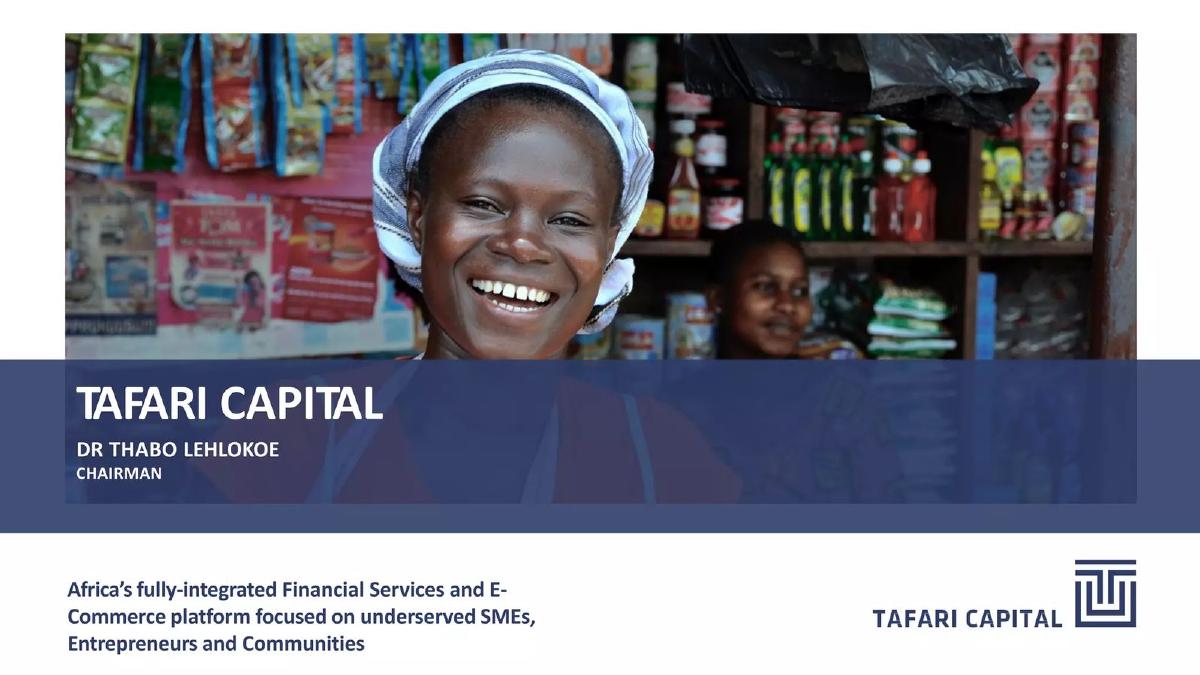
The deck opens with a clear mission statement on Slide 1: a fully-integrated Financial Services and E-Commerce platform for underserved SMEs and communities. Slide 2 introduces the 'Who,' highlighting the 85 black professionals behind the venture. This is a strategic move to demonstrate 'skin in the game' and social proof, further bolstered by a quote from Mark Elliot, Division President of Mastercard Southern Africa. Slide 3 outlines the organizational structure, dividing the company into Financial Services, Tech, and Investment arms, which suggests a plan for regulatory compliance and specialized operations from the outset.
Slides 4-6: The Macro Opportunity and Problem
Slide 4 provides a data-heavy look at the African market, citing a projected GDP of $29 trillion by 2050 and a massive mobile money market valued at $495 billion in 2020. Slide 5 narrows the focus to the 'Problem,' noting that 77% of jobs are created by SMEs, yet 60% of transactions are cash-based due to high costs and mistrust in banks. Slide 6 quantifies the 'Opportunity' specifically for credit, citing an IFC source that there is a $132 billion unmatched credit need for 81 million SMEs in Sub-Saharan Africa. This section successfully establishes a massive, underserved TAM (Total Addressable Market).
Slides 7-11: The eChankura Product Ecosystem
Slide 7 introduces eChankura. The platform is ambitious, listing ten distinct features including payments, trading accounts, remittances, and SME support services. Slide 8 emphasizes the API-based nature of the ecosystem and the 'free' entry point for users (free accounts and store builds). Slide 9 lists 'Intrinsic Products' like prepaid electricity and bus tickets, alongside 'eSmartMall' services like micro-investments. Slide 10 attempts to define the 'Secret Sauce,' focusing on the 'one-stop portal' aspect and the ability for merchants to accept card payments without a physical POS device. Slide 11 uses personas (taxi commuters, food stall owners, nail technicians) to ground the abstract technology in real-world use cases.
Slides 12-13: Business Model and Traction
Slide 12 is one of the most critical in the deck, detailing the unit economics. It breaks down revenue into MaChankura (banking/remittances) and eSmartMall (marketplace). Specific figures are provided: ZAR 2.00 per transaction, 5% interest on balances, and 6% revenue share on mall transactions. Slide 13 provides a timeline of traction since 2016. Key milestones include the acquisition of Techtrend Global to bring development in-house and obtaining an Authorized FSP license in September 2020. The slide notes that the MVP was ready for market launch in July 2021.
Slides 14-16: Market Strategy and Competition
Slide 14 outlines the Go-to-Market strategy, targeting key South African cities (Cape Town, Durban, Johannesburg) before expanding to neighboring countries like Lesotho and Namibia. Slide 15 provides a rare, detailed bottom-up market sizing. It calculates the $26 billion annual TAM by multiplying specific transaction fees and interest margins by a target customer base of 1.5 million. This level of detail is superior to the typical 'top-down' percentage of a global market often seen in decks. Slide 16 is a standard competitive matrix where Tafari checks every box, while traditional banks and telcos fail on metrics like 'no monthly fees' and 'trust systems for informal entrepreneurs.'
Slides 17-22: Team, Financials, and the Ask
Slide 17 introduces the leadership team, featuring Dr. Thabo Lehlokoe and others with significant experience in Siemens, PIC, and DBSA. Slide 18 projects aggressive growth, with Net Revenue climbing from $10 million in 2022 to $142 million in 2026, maintaining a 24% net profit margin. Slide 19 provides a 'Scenario Analysis' (Expected, Middle, Low, and Critical roads), which shows maturity in financial planning. Slide 20 contains the 'Ask': $2.5m to $5m to reach $59m in revenue and 750,000 customers. Slide 21 introduces the Board of Directors, adding further institutional weight to the venture. The deck concludes with contact information on Slide 22.
What Works Well
Granular Market Sizing: Slide 15 is a masterclass in bottom-up TAM calculation. By showing the math (ZAR 3.60 x 56 transactions x 1.5m customers), the founders make their $26 billion claim feel grounded rather than aspirational. · Scenario Planning: Including a 'Critical Road' in the financial projections (Slide 19) demonstrates that the management team has considered downside risks and isn't just presenting a 'hockey stick' graph. · Institutional Credibility: The combination of 85 professional backers, an FSP license, and a team with Siemens and Harvard backgrounds (Slide 17) significantly lowers the perceived 'people risk' for investors. · Clear Use of Personas: Slide 11 does an excellent job of explaining how a complex 'super-app' actually functions for a nail technician or a taxi driver, making the value proposition tangible.
What Is Missing or Weak
Product Focus/Over-extension: The deck lists an enormous number of features (Slide 7 and 9). Building a remittance platform, a micro-insurance provider, a stock trading app, and an e-commerce mall simultaneously is a massive undertaking for a $2.5m-$5m raise. The deck lacks a 'Phase 1' focus. · Acquisition Cost (CAC) vs. LTV: While the revenue per user is detailed, the cost to acquire these users is not. With a target of 750,000 customers, the marketing budget of ~29% of $5m (approx. $1.45m) implies a CAC of less than $2.00 per user, which may be unrealistic. · Regulatory Complexity: Operating across payments, lending, insurance, and remittances requires multiple licenses across different jurisdictions. The deck mentions an FSP license but doesn't detail the status of other necessary regulatory approvals for the full suite of services.
Founder Takeaways
Show the Math: If you are claiming a multi-billion dollar opportunity, use a slide like Slide 15 to show exactly how many transactions and what fee levels lead to that number. · Leverage Your Network: If you have a large group of initial backers, highlight it. Tafari’s '85 professionals' is a unique differentiator that suggests a built-in distribution and advisory network. · Provide Scenarios: Investors know that projections are rarely 100% accurate. Providing 'Low' and 'Critical' roads shows you are a pragmatic operator who understands your break-even points. · Use Visual Personas: When building a platform for the 'underserved' or 'informal' sector, use photos and specific stories to help investors (who are often not part of that demographic) understand the daily utility of your product.
Frequently asked questions
- What is the core product offered by Tafari Capital?
- The core product is eChankura, described on Slide 7 as a fully integrated financial services platform and e-commerce marketplace. It includes payment services, savings and credit accounts, remittances, micro-insurance, and a digital mall. It aims to be a one-stop portal that makes informal participants visible to the formal economy and lenders.
- How does Tafari Capital plan to make money?
- According to Slide 12, the business model is a mix of freemium accounts and transaction-based fees. Revenue streams include a ZAR 2.00 fee per external transaction, a 1.5% fee on escrow/remittances, 5% interest on account balances, and a 6% revenue share on mall transactions. They also mention a ZAR 285 annual fee for 'power users'.
- What is the company's current traction?
- Slide 13 details several milestones: raising $1.2 million from 85 individuals, signing an MOU with the Lesotho Government for a Covid-19 app, and securing an Authorized Financial Services Provider (FSP) status in September 2020. As of August 2021, they were beginning a customer onboarding process with an objective of 50,000 users by quarter-end.
- Who are the competitors and how does Tafari differentiate?
- Slide 16 compares Tafari against traditional banks, telco mobile money, retailers, and fintechs. Differentiators include offering no monthly fees, instant access to payment rails without a POS device for merchants, and a bi-directional trust system based on financial activity rather than traditional credit scores.
- What are the financial goals for the current fundraising round?
- Slide 20 states the company is seeking $2.5 million to $5 million. The stated goal for this capital is to reach $59 million in revenues and onboard 750,000 customers over a 36-month period. The funds are split between product development (37%), operations (34%), and marketing (29%).