Synthesia’s Series D pitch deck, used to secure $180M in 2024, is a masterclass in narrative-driven enterprise scaling. The deck moves away from technical AI jargon to focus on the 'video-first world' and the efficiency gains of moving from professional video editors (days of work) to GPT-assisted creation (minutes of work). By positioning itself as a vertically integrated platform rather than a point solution, Synthesia differentiates itself from competitors like HeyGen and D-ID. The deck highlights a significant shift in product focus: 85% of videos are now finalized within their own editor…
Key takeaways
- Synthesia reports that 85% of all videos are now finalized within their platform, rather than exported to third-party editors (Slide 6).
- The product roadmap shows a clear evolution from 'Avatar Clips' (2020-2022) to 'Assisted Creation' (2024) and 'Real-time Agents' projected for 2025 (Slide 5 and 6).
- The company uses a 2x2 matrix to position itself as the only 'Vertically Integrated Platform' in the 'Upmarket Enterprise' segment (Slide 8).
- Synthesia claims to reduce video production time from days (professional editors) to minutes (GPT-assisted creation) (Slide 6).
- The deck leverages Mehrabian’s 7-38-55 rule to justify the technical necessity of full-body AI avatars for effective communication (Slide 7).
- Executive hires include a CTO from Amazon/AWS and a CRO who scaled Navan from $0 to $250M in 20 months (Slide 9).
- The deck identifies a market gap between high-cost advertising productions and low-engagement daily business interactions like Zoom or Teams (Slide 2).
- Synthesia positions its 'Express-2' avatars as a breakthrough in body language, which accounts for 55% of communication effectiveness (Slide 7).
Synthesia Series D: A Masterclass in Enterprise AI Positioning
Synthesia’s Series D deck, which supported a $180M raise in 2024, is a strategic document that focuses less on the 'magic' of AI and more on the 'utility' of the platform within a corporate environment. As a London-based leader in generative AI, Synthesia uses these 18 slides to prove they have moved past the experimental phase and are now a core part of the enterprise tech stack.
Slide 1: The Vision Statement
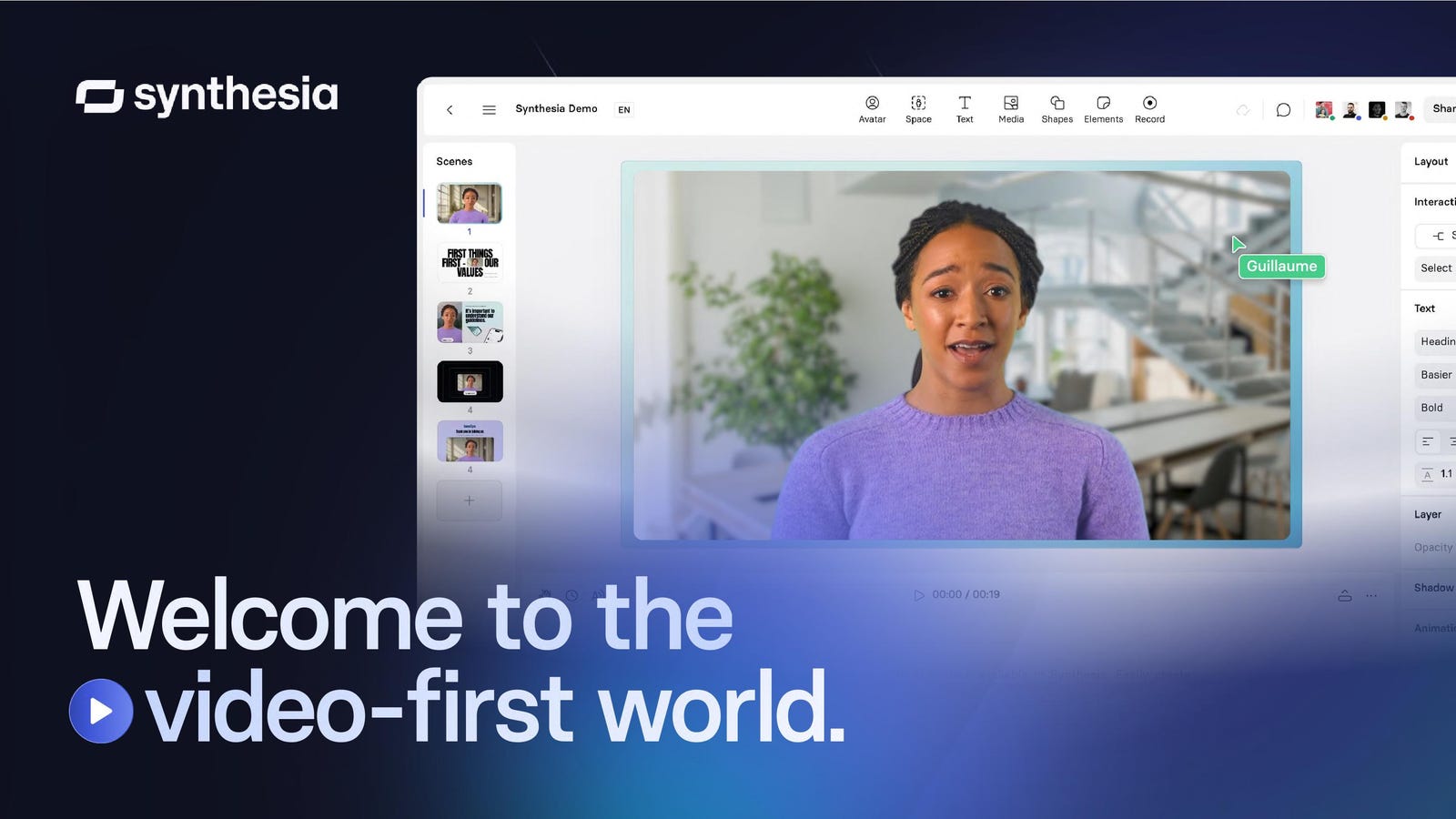
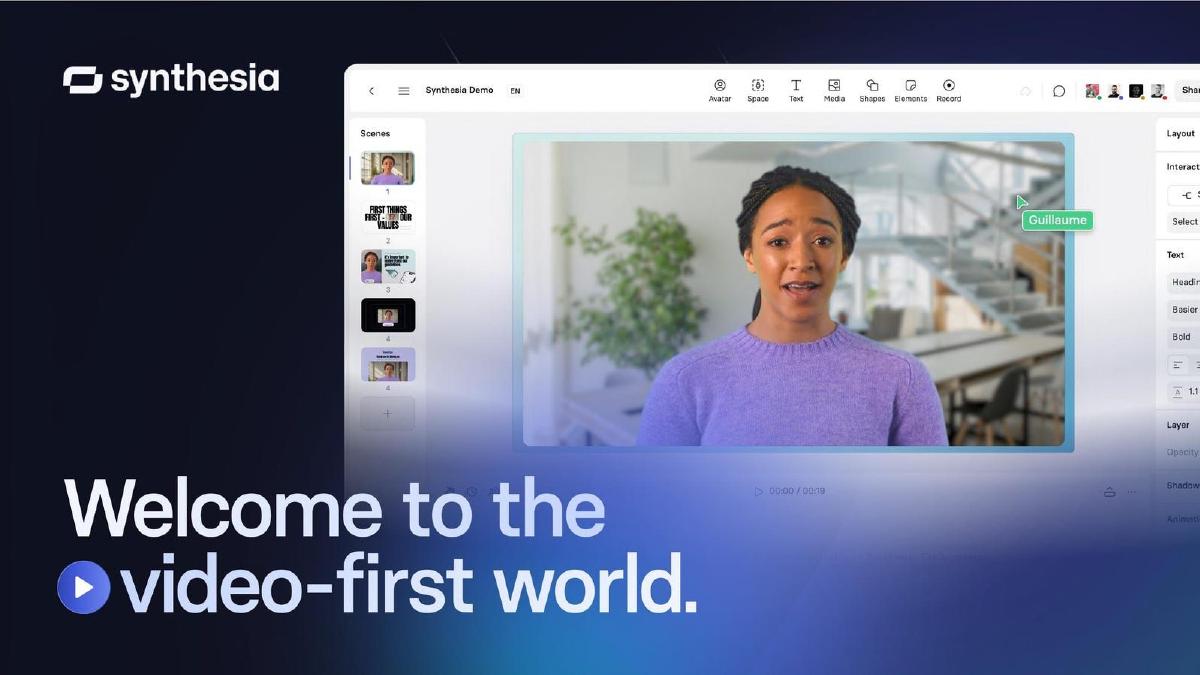
The deck opens with a high-fidelity screenshot of the Synthesia interface. The headline, "Welcome to the video-first world," sets a macro-trend narrative. By showing a diverse avatar in a clean, professional editing environment, the company immediately establishes that this is a tool for business, not just a deepfake novelty. The presence of a collaborator tag ("Guillaume") in the UI subtly hints at the platform's multi-user, enterprise-ready features.
Slide 2: The Volume vs. Cost Gap
Slide 2 identifies the market opportunity using a pyramid structure. At the top are high-budget advertising productions (high cost, low volume). At the bottom are daily business interactions like Teams, Zoom, and Loom (low cost, high volume). Synthesia positions itself to fill the massive middle ground where companies need high-quality video but cannot afford traditional production costs. This slide effectively argues that video is 'everywhere' but currently inefficiently produced.
Slide 3 & 4: The Efficiency-Engagement Trade-off
These slides use a standard Cartesian coordinate system to map communication methods. Slide 3 shows the status quo: E-mail and Documents are high efficiency but low engagement, while Zoom and Video are high engagement but low efficiency. Slide 4 introduces the 'Synthesia' solution in the top-right quadrant: High Efficiency and High Engagement. This is a classic 'best of both worlds' pitch that justifies a premium enterprise valuation.
Slide 5: The Evolution of AI Video
Slide 5 provides a timeline of the technology. It categorizes 2020-2023 as the era of "Static Video," 2024 as "Dynamic AI Video," and 2025 as the year of "Real-time Agents." The visual shows a customer service interface with an AI avatar, suggesting that Synthesia’s future lies in interactive, live communication rather than just asynchronous video creation. This forward-looking statement is crucial for a Series D round, where investors are looking for the next billion-dollar growth lever.
Slide 6: Lowering the Barrier to Entry
This is perhaps the most important data slide in the deck. It tracks the product’s evolution from 'Avatar Clips' to a 'Rich Video Editor' and finally to 'Assisted Creation.' The key metric cited is that "85% of all videos [are] finalized in Synthesia." This proves that Synthesia has successfully evolved from a plugin or a component into a destination platform. The slide also quantifies the value prop: moving from 'days to create' for professional editors to 'minutes to create' for everyone using GPT-assisted tools.
Slide 7: The Science of Communication
Synthesia invokes "Mehrabian’s 7-38-55 rule of communication" to explain why their technical focus on body language matters. The slide breaks down communication into 7% spoken word, 38% tone of voice, and 55% body language. By showing their 'Express-2' avatars covering the full 55% of body language, they provide a scientific justification for their R&D spending. It moves the conversation from 'does this look cool?' to 'does this communicate effectively?'
Slide 8: Competitive Landscape
The competitive matrix on Slide 8 is aggressive. It plots 'Point Solution' vs. 'Platform' on the X-axis and 'SMB' vs. 'Enterprise' on the Y-axis. Synthesia places itself alone in the top-right quadrant. Competitors like HeyGen, D-ID, Tavus, and Colossyan are grouped as point solutions or SMB-focused. This slide is designed to tell investors that while there are many AI video companies, only Synthesia is building a vertically integrated platform for the world's largest companies.
Slide 9: The Scaling Team
The final slide shown focuses on the executive team. For a Series D, investors want to see 'scale-up' DNA. Synthesia highlights four key hires: Peter Hill (CTO) from Amazon/AWS, Ken Lawshe (CRO) from Navan, Laura Gonzalez (Chief of Staff) from Google, and Gabe Stern (General Counsel) from Slack. The descriptions emphasize their experience in growing companies from hundreds to thousands of employees and scaling revenue from $0 to $250M. This slide serves as the ultimate de-risking mechanism.
What Works in the Synthesia Deck
Platform Narrative: The shift from being an 'avatar tool' to an 'enterprise video platform' is clearly documented through the 85% finalization metric. · Scientific Justification: Using the 7-38-55 rule gives the product a psychological and physiological basis for existence, which is more compelling than just 'better pixels.' · Clear Roadmap: The transition to 'Real-time Agents' in 2025 gives investors a clear vision of how the company will expand its Total Addressable Market (TAM) into customer service and live support. · Executive Pedigree: The team slide is exceptionally strong, featuring leaders who have seen the 'movie' of scaling a multi-billion dollar company before.
What is Missing from the Synthesia Deck
Financial Specifics: While the publisher reports a $180M raise, the slides themselves omit ARR, NRR (Net Revenue Retention), and CAC (Customer Acquisition Cost). For a Series D, these are usually mandatory, suggesting they may have been in a separate data room or omitted from this public version. · Unit Economics: There is no mention of the cost of compute or gross margins. As a generative AI company, the 'cost of goods sold' is a major investor concern that isn't addressed here. · Customer Case Studies: While the deck mentions 'Enterprise,' it doesn't name specific Fortune 500 customers or provide testimonials on the ROI achieved by these clients.
Founder Takeaways: How to Copy Synthesia’s Success
Quantify the 'Old Way' vs. 'New Way': Slide 6 is a perfect example of this. Don't just say you are faster; say you turn 'days' into 'minutes.' · Own the Category: If you are in a crowded space, create a 2x2 matrix that defines a new category (like 'Vertically Integrated Platform') where you are the only player. · Focus on Finalization: If you are a tool, show that users are finishing their work in your app. High 'finalization' or 'export' rates within your ecosystem are a proxy for high stickiness. · Hire for the Next Stage: Your team slide shouldn't just be the founders. By Series C or D, it should be the people who are going to take you to an IPO.
Frequently asked questions
- What is Synthesia's core value proposition in this deck?
- Synthesia focuses on efficiency and engagement. They argue that while video is the most engaging medium, it has historically been the least efficient to produce. By using AI to turn documents or URLs into editable videos in minutes, they allow enterprises to scale video communication across all departments, moving beyond high-budget advertising into daily business operations.
- How does Synthesia differentiate itself from other AI video startups?
- On Slide 8, Synthesia uses a competitive landscape chart to separate 'Point Solutions' from 'Platforms.' They position competitors like HeyGen, D-ID, and Tavus as point solutions or SMB-focused tools, while Synthesia claims the top-right quadrant as a vertically integrated platform specifically built for the upmarket enterprise segment.
- What metrics does the deck use to show product-market fit?
- The deck is light on traditional financial metrics (like ARR or Churn) but heavy on usage and efficiency metrics. Specifically, Slide 6 highlights that 85% of videos are finalized in-platform, and the time-to-create has dropped from days to minutes. This suggests high user stickiness and a successful transition to a full-featured editor.
- Who are the key people Synthesia hired to scale the business?
- Slide 9 showcases four major hires: Peter Hill (CTO, ex-Amazon/AWS), Ken Lawshe (CRO, ex-Navan/TriNet), Laura Gonzalez (Chief of Staff, ex-Google), and Gabe Stern (General Counsel, ex-Slack). These hires are intended to show investors that the company has the 'adult supervision' and experience required to manage a $1B+ valuation and potential public listing.
- What is the future roadmap for Synthesia according to the slides?
- Slide 5 outlines a clear technological progression. They have moved from static video (2020-2023) to dynamic AI video (2024). The next frontier, slated for 2025, is 'Real-time Agents,' which implies interactive, conversational AI avatars that can function in live environments rather than just pre-recorded video.