Diplomat Pharmacy’s March 2017 investor deck, presented at the Barclays Healthcare Conference, outlines the company's position as the largest independent specialty pharmacy in the U.S. With a 2017 estimated revenue of ~$4.5 billion and a 54% CAGR from 2006-2016, the company emphasizes its 'high-touch' model as a competitive advantage against retail giants like CVS and Walgreens. The deck is heavily focused on growth through M&A, detailing six major acquisitions between 2013 and 2017, including the $272 million purchase of BioRx. While the financials show strong top-line growth, the 4Q16 resul…
Key takeaways
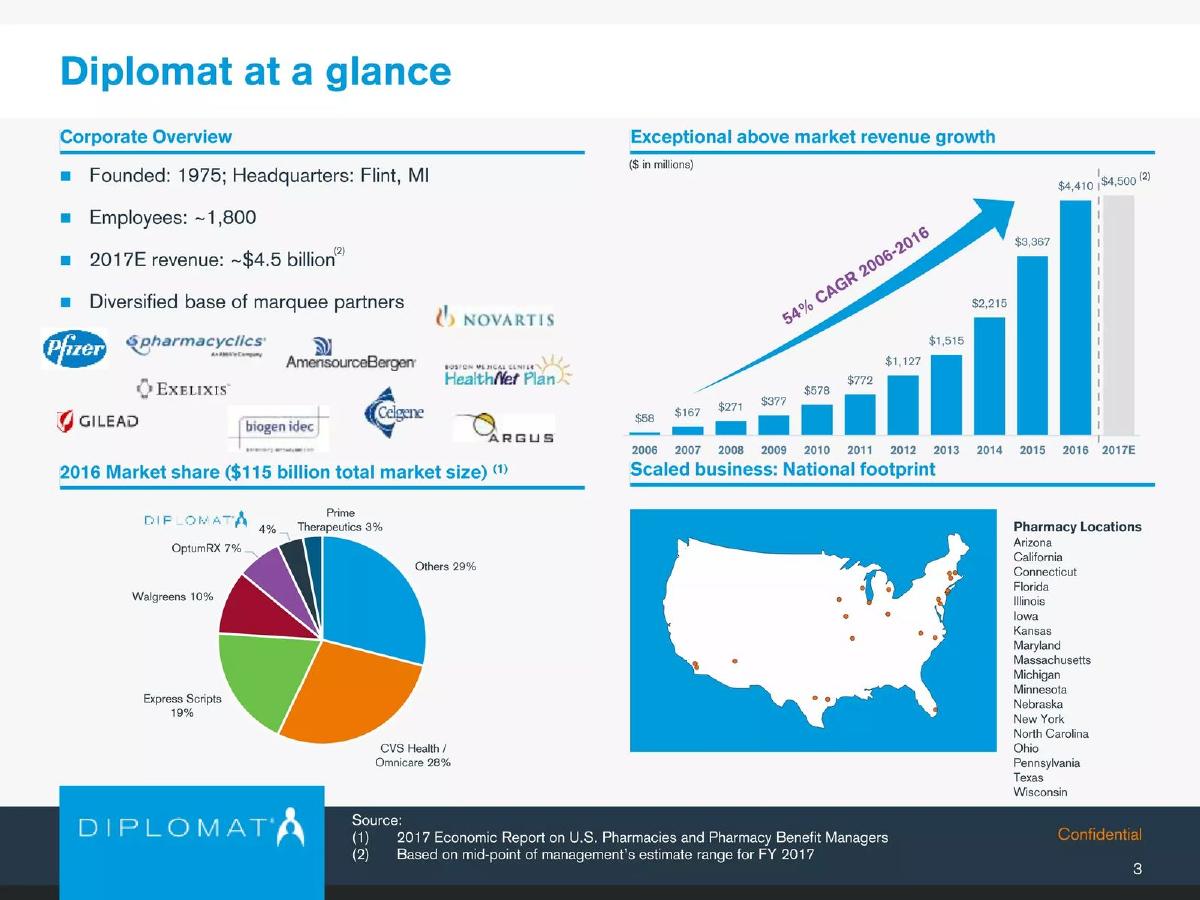
- Diplomat reported a massive 54% CAGR in revenue from 2006 to 2016, reaching $4.41 billion (Slide 3).
- The company positions itself as a 'high-touch' alternative to large PBMs and retail pharmacies like CVS Health and Express Scripts (Slide 9).
- Diplomat controls a 4% share of the $115 billion specialty pharmacy market, trailing only the major PBM-aligned players (Slide 3).
- A core strategy is aggressive M&A, with the deck detailing the acquisition of BioRx for $272 million in 2015 (Slide 24).
- The company maintains access to approximately 100 limited distribution drugs, a key competitive barrier in specialty pharmacy (Slide 21).
- Despite high revenue, the company reported a net loss of $1.1 million in 4Q16, partly due to a $4.7 million impairment expense (Slide 15).
- The revenue base is described as 'annuity-like' due to the chronic nature of the diseases treated (Slide 18).
- Diplomat’s M&A criteria focus on targets that make the company 'better, not just bigger,' emphasizing new therapies and improved manufacturer relationships (Slide 12).
Introduction: The Independent Giant in Specialty Pharmacy
The Diplomat Pharmacy investor deck from March 2017, presented at the Barclays Healthcare Conference, is a comprehensive look at a company in the midst of a massive scaling phase. Founded in 1975 and headquartered in Flint, Michigan, Diplomat evolved from a local pharmacy into the nation’s largest independent specialty pharmacy. This deck is designed to convince institutional investors that Diplomat’s specialized, high-touch model is superior to the broad-market approach of retail giants like CVS and Walgreens.
Slide 1: The Human Element
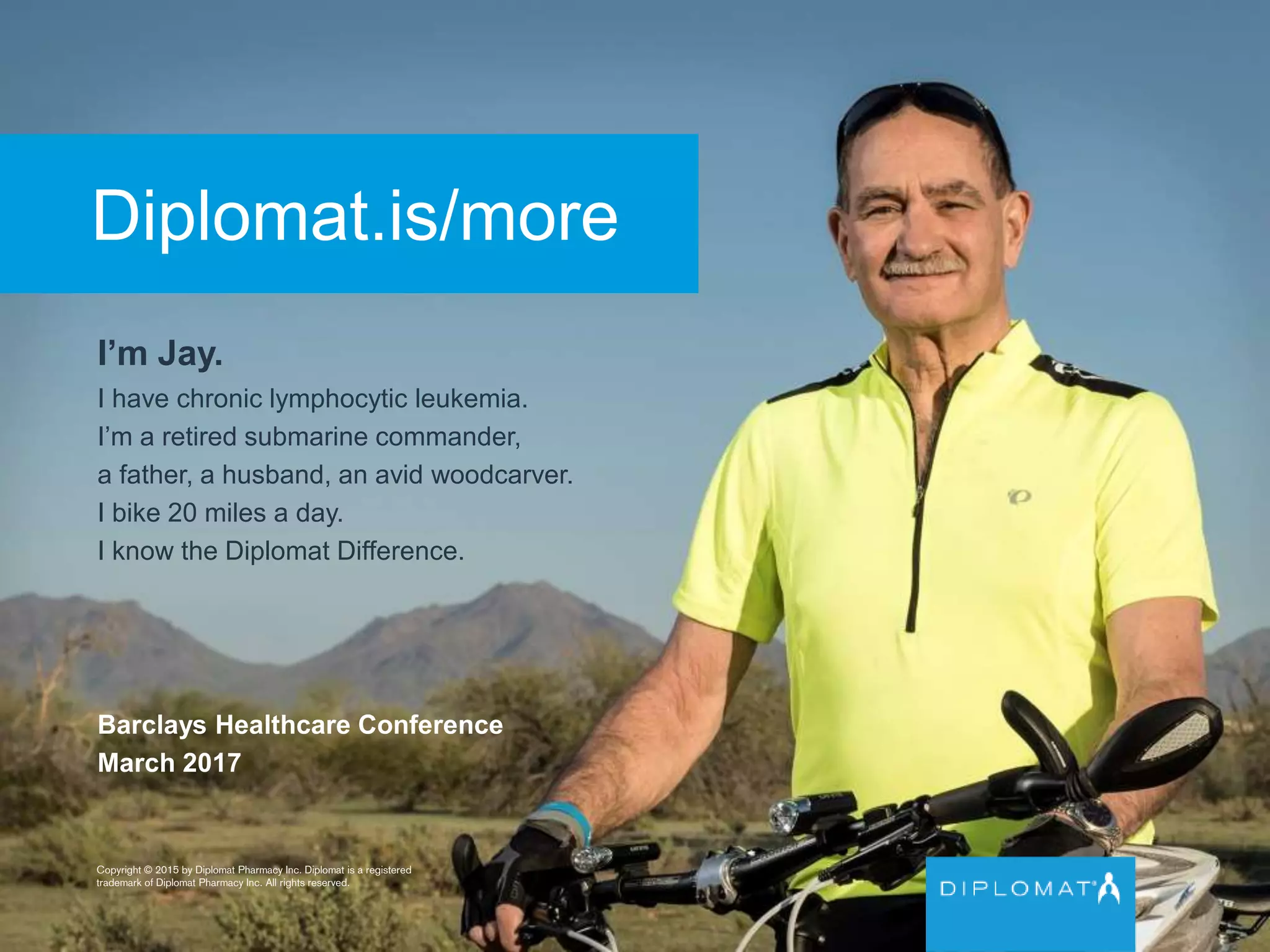
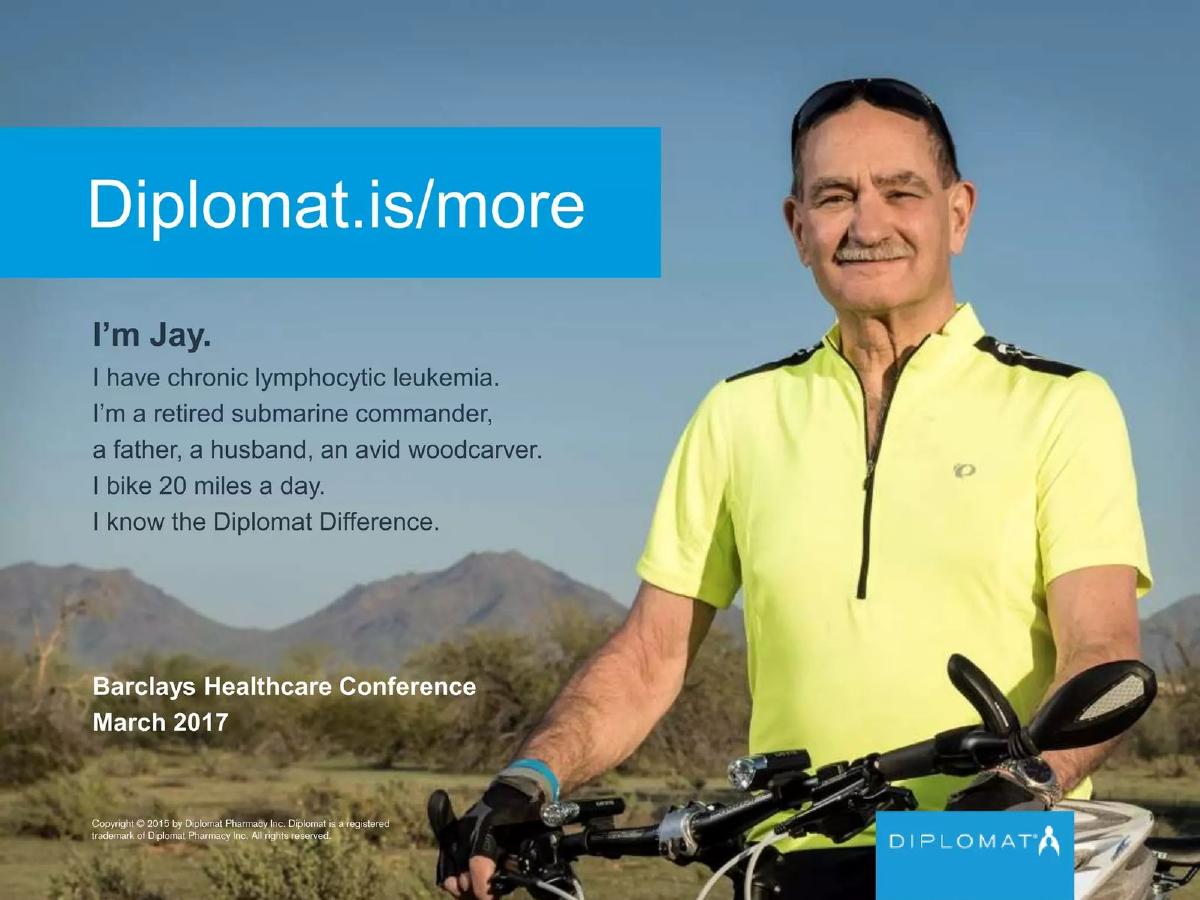
The deck opens not with a chart, but with a patient story. 'Jay,' a retired submarine commander with chronic lymphocytic leukemia, represents the target demographic. By stating 'I know the Diplomat Difference,' the company immediately establishes its brand as patient-centric. This sets the stage for the 'high-touch' service model they will argue is their primary competitive advantage.
Slide 3: Diplomat at a Glance
This is the 'traction' slide, and the numbers are staggering. Diplomat highlights a 54% CAGR from 2006 to 2016, with revenue growing from $58 million to $4.41 billion. The slide also projects 2017 revenue to reach ~$4.5 billion. A market share pie chart shows Diplomat holding 4% of a $115 billion market. While 4% sounds small, the slide clarifies that they are competing against behemoths like Express Scripts (19%) and CVS Health (28%), making Diplomat the largest player not owned by a PBM (Pharmacy Benefit Manager) or a major retail chain. The national footprint map shows pharmacy locations in 19 states, proving they have moved beyond their Michigan roots.
Slide 6: The Patient Journey
Slide 6 illustrates how Diplomat 'controls the journey of a specialty patient.' The circular flow chart shows Diplomat interacting at every stage: monitoring adherence for manufacturers, providing benefit verification and prior authorization for payors, and dispensing drugs to the patient. This visualization is intended to show 'stickiness.' By being involved in the clinical, administrative, and logistical aspects, Diplomat makes itself indispensable to the healthcare ecosystem.
Slide 9: Unique Competitive Position
This is a classic 'us vs. them' slide. Diplomat positions itself in the 'sweet spot' between large PBMs/Retail Pharmacies and smaller specialty pharmacies. They argue that large players are distracted by diversification and are less nimble. Conversely, they claim smaller pharmacies lack scale and are limited to specific disease states. Diplomat claims to offer the best of both worlds: the 'entrepreneurial culture' and 'high-touch model' of a small shop with the 'national reach' and 'scalable infrastructure' of a giant.
Slide 12: Future M&A Criteria
Diplomat is transparent about its growth-by-acquisition strategy. They list seven criteria for M&A, including expanding into new therapeutic areas, gaining access to 'Limited Distribution' drugs, and bringing in new technologies. The most important phrase on this slide is 'Makes DPLO better, not just bigger.' Below the text, a matrix shows how their previous six acquisitions (from AHF in 2013 to Affinity in 2017) have met these criteria, providing a track record of strategic discipline.
Slide 15: Fourth Quarter 2016 Results
This slide provides a reality check on the rapid growth. While revenue was up 16% year-over-year ($1.145 billion vs. $987 million), the bottom line shows signs of strain. Net income dropped from a $3.6 million profit in 4Q15 to a $1.1 million loss in 4Q16. The footnote explains this was due to a $4.7 million impairment expense. Additionally, Adjusted EBITDA margin compressed from 2.8% to 2.3%. For an investor, this slide signals that while the company is great at growing revenue, maintaining margins during rapid expansion is a challenge.
Slide 18: Components of Quarterly Revenue Growth
This bar chart breaks down where the money is coming from. It shows that 'Acquired Revenue' (the orange segments) is a significant driver of growth. However, it also highlights that 'Chronic disease expertise provides an annuity-like revenue base.' The slide notes that price inflation comprised 4% of revenue in 4Q16, a decrease from the 6% seen in previous quarters. This level of transparency regarding organic vs. inorganic growth is essential for healthcare investors who are wary of companies relying solely on drug price hikes.
Slide 21: Investment Highlights
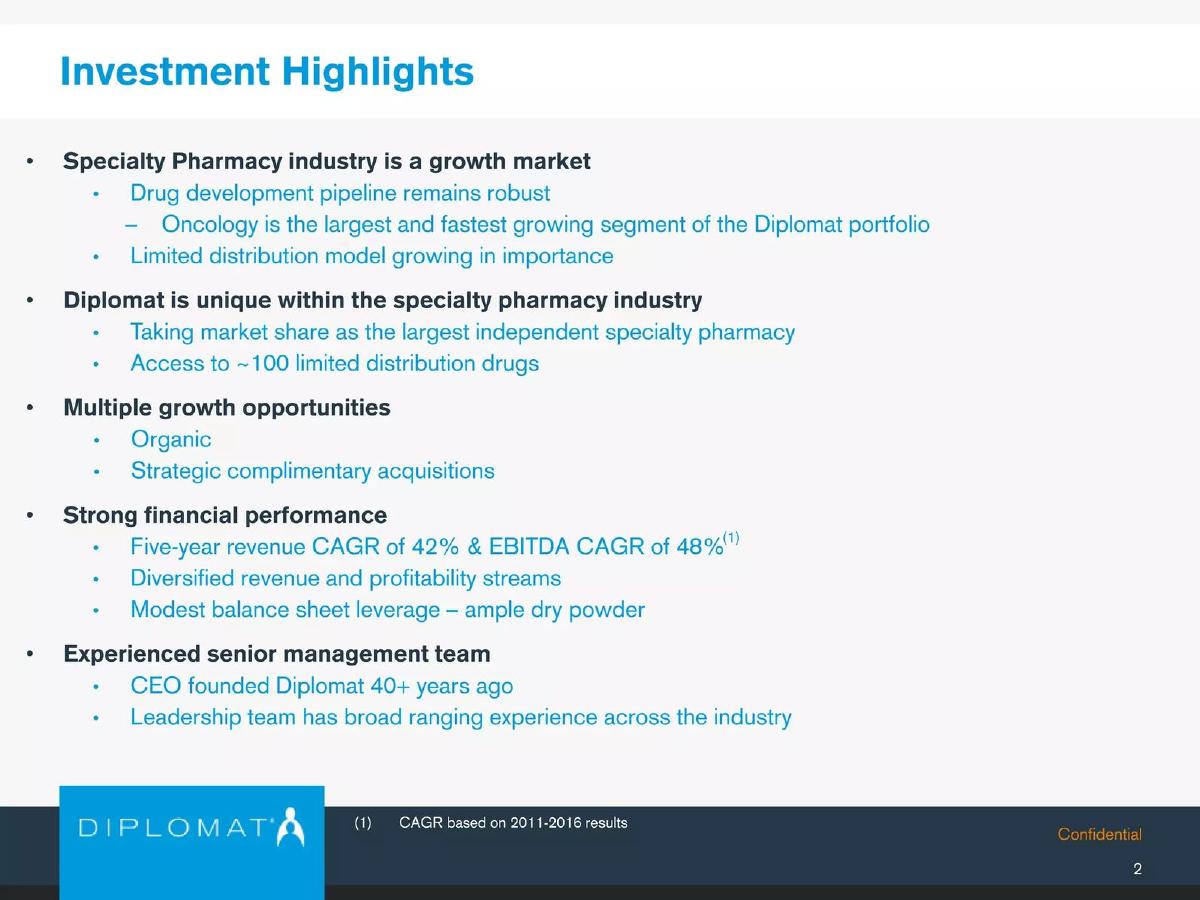
This slide serves as the executive summary. It reiterates that the specialty pharmacy industry is a growth market with a robust drug pipeline, particularly in oncology. It emphasizes Diplomat’s unique position as the largest independent player with access to ~100 limited distribution drugs. The mention of 'ample dry powder' on the balance sheet suggests they are not done with acquisitions.
Slide 24: Recent Acquisitions
The final slide in this selection provides the 'receipts' for their M&A strategy. It details four major deals: Affinity ($20M), TNH ($75M), Burman’s ($87M), and BioRx ($272M). For each, they list the consideration (cash vs. stock) and the strategic rationale. The BioRx deal is particularly notable as it added significant scale to their specialty infusion business and provided the ability to compete for national contracts. This slide proves that Diplomat is an aggressive and capable acquirer.
What Works in This Deck
1. The Growth Narrative: The 54% CAGR chart on slide 3 is the 'hero' metric of the deck. It immediately establishes Diplomat as a high-growth success story rather than a speculative startup.
2. Competitive Moats: The deck does an excellent job of explaining why being 'independent' is a feature, not a bug. By highlighting their access to 100 limited distribution drugs, they show a tangible barrier to entry that prevents larger retail competitors from simply stealing their customers.
3. M&A Transparency: Most companies are vague about their acquisition strategy. Diplomat provides a clear matrix of what they look for and a detailed list of what they paid for previous targets. This builds trust with institutional investors who are funding these deals.
What Is Missing
1. Unit Economics: While the deck shows massive revenue, it glosses over the thin margins. A 2.3% Adjusted EBITDA margin is very tight, and the deck doesn't provide a clear path to how these margins will expand as they scale.
2. Regulatory Risks: The specialty pharmacy industry is highly sensitive to changes in healthcare policy and PBM contracting. The deck mentions PBMs as competitors but doesn't address the risk of these PBMs cutting Diplomat out of their networks.
3. Management Team Details: While slide 21 mentions an 'experienced senior management team,' there are no headshots or bios for the key executives. In a company driven by M&A, the specific track record of the CFO and Head of Corporate Development is as important as the CEO.
Founder Takeaways
Own Your Niche: Diplomat didn't try to be a better CVS; they tried to be the best specialty pharmacy. If you are competing against giants, you must define your 'high-touch' or 'specialized' advantage as something the giants are structurally incapable of replicating.
Show the 'Why' Behind M&A: If your strategy involves buying other companies, don't just show a list of logos. Show a matrix (like slide 12) that explains exactly how each acquisition adds a specific capability or market access that you didn't have before.
Humanize the Data: Starting with 'Jay' on the cover slide reminds investors that behind the $4.5 billion in revenue are actual patients. In healthcare, this isn't just 'fluff'—it's a reminder of the clinical outcomes that drive the entire business model.
Frequently asked questions
- What is Diplomat Pharmacy's core value proposition?
- Diplomat positions itself as a 'high-touch' specialty pharmacy that manages the entire patient journey, from clinical intervention to drug dispensing. Unlike large retail pharmacies that are diversified across many sectors, Diplomat is 'singularly focused on specialty,' allowing for more flexible and nimble operations that cater specifically to patients with complex, chronic conditions like leukemia or oncology needs.
- How does Diplomat handle competition from giants like CVS and Walgreens?
- Diplomat argues that the massive scale of PBMs and retail pharmacies actually works against them in the specialty space. According to slide 9, these large competitors suffer from 'diversification distracts' and are 'less flexible.' Diplomat uses its independent status to act as a consolidator of smaller specialty pharmacies while maintaining a national reach that smaller local players cannot match.
- What role does M&A play in Diplomat's growth strategy?
- M&A is central to Diplomat's expansion. The deck highlights a consistent track record of acquisitions (AHF, MedPro Rx, BioRx, Burman's, TNH, and Affinity) to gain access to new therapeutic areas, geographic regions, and limited distribution drugs. They specifically look for acquisitions that provide 'revenue synergy opportunities' and 'proprietary technology' to leverage across their existing platform.
- Why did Diplomat report a net loss in 4Q16 despite growing revenue?
- Slide 15 shows that while revenue grew from $987 million in 4Q15 to $1.145 billion in 4Q16, the company recorded a net loss of $1.1 million. This was primarily driven by a $4.7 million impairment expense related to 'Physician Resource Management.' This indicates that while the top-line growth is robust, the costs of integrating acquisitions and managing specific business units can impact short-term profitability.
- What are 'Limited Distribution' drugs and why are they important?
- Limited Distribution (LD) drugs are specialty medications that manufacturers only allow a select few pharmacies to dispense. Slide 21 notes that Diplomat has access to approximately 100 LD drugs. This is a critical competitive advantage because it prevents patients needing these specific medications from going to a standard retail pharmacy, effectively locking in a high-value patient base.