Dubhub v2e proposes a legal marketplace for crowdsourced movie translations, targeting the global film industry's language barriers. The deck identifies a problem in the 'long-tail' of movies that lack localized audio tracks, leading to piracy and lost revenue for studios. Their solution involves a three-sided platform where consumers request dubs, independent dubbers provide them for a fee, and studios receive a percentage of the transaction. The deck is highly visual, relying on collages and metaphors rather than dense text. It projects rapid growth, starting from $250,000 in 2011 and scali…
Key takeaways
- The company identifies a significant revenue loss in Hollywood due to piracy and lack of localized content, citing a $2 billion cost for bootleg DVDs on slide 1.
- Dubhub positions itself as a 'Legal Marketplace' that combines crowdsourced dubbing with an open-source plugin for media players on slide 13.
- The business model relies on a fee-based system where consumers pay for dubs, and revenue is split between producers, studios, and Dubhub as shown on slide 15.
- Revenue projections are extremely aggressive, forecasting a jump from $250,000 in 2011 to over $215 million by 2015 on slide 16.
- The platform intends to integrate with existing major streaming and hardware providers like Netflix, Hulu, iTunes, and Google TV, illustrated on slide 14.
- The deck emphasizes the 'long-tail' opportunity, specifically mentioning Hindi translations for films like 'Turner & Hooch' on slide 8.
- There is no specific 'Ask' slide detailing the amount of capital being raised or the intended use of funds.
- The team is listed by name only—Gordon Gus, Christopher Rae, and Adrienne Pierre—without professional titles or bios on slide 2.
Executive Summary: The Global Translation Gap
Dubhub v2e presents a vision for a world where language is no longer a barrier to media consumption. The deck focuses heavily on the untapped potential of the 'long-tail' of cinema—movies that are not blockbusters and therefore rarely receive professional dubbing for international markets. By creating a legal marketplace for crowdsourced audio tracks, Dubhub aims to monetize a segment of the market currently dominated by piracy.
Slide 1: The Industry Context
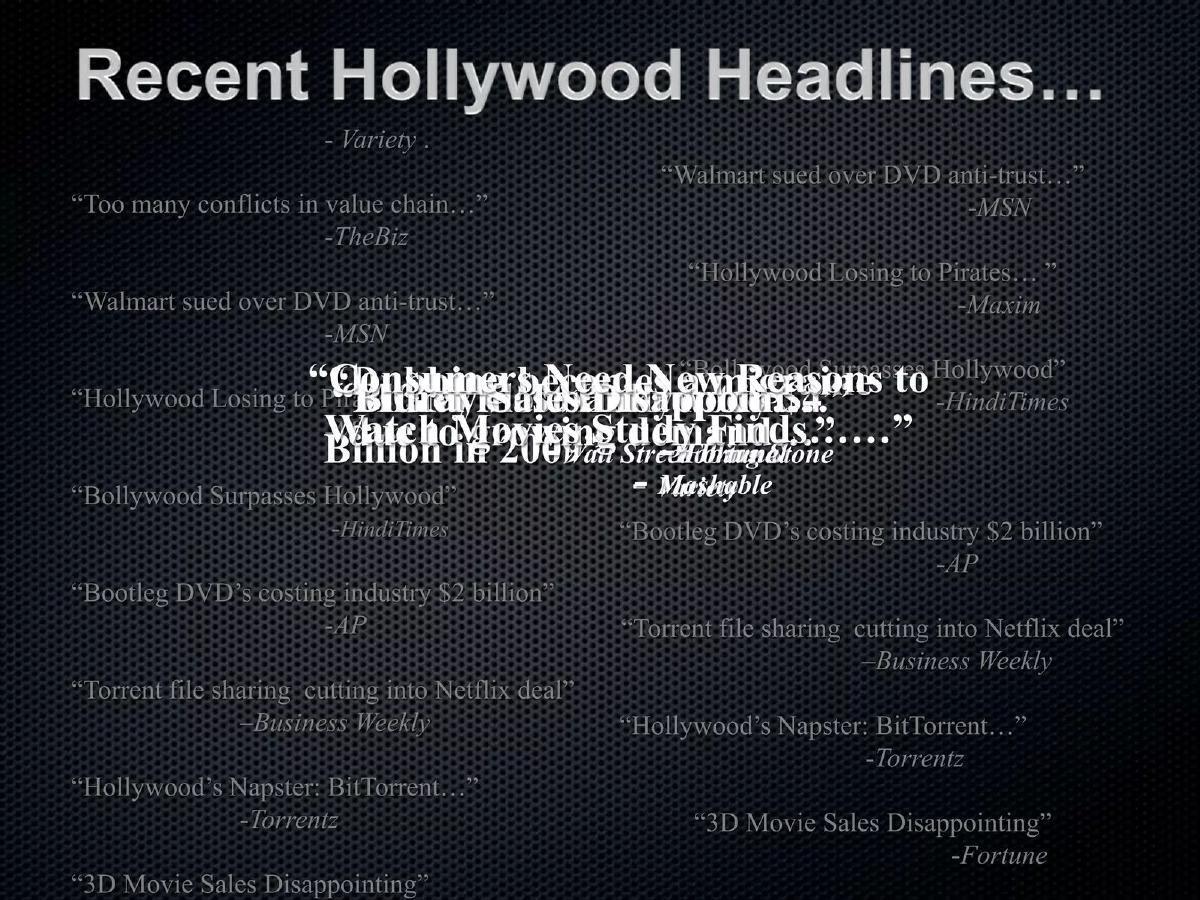
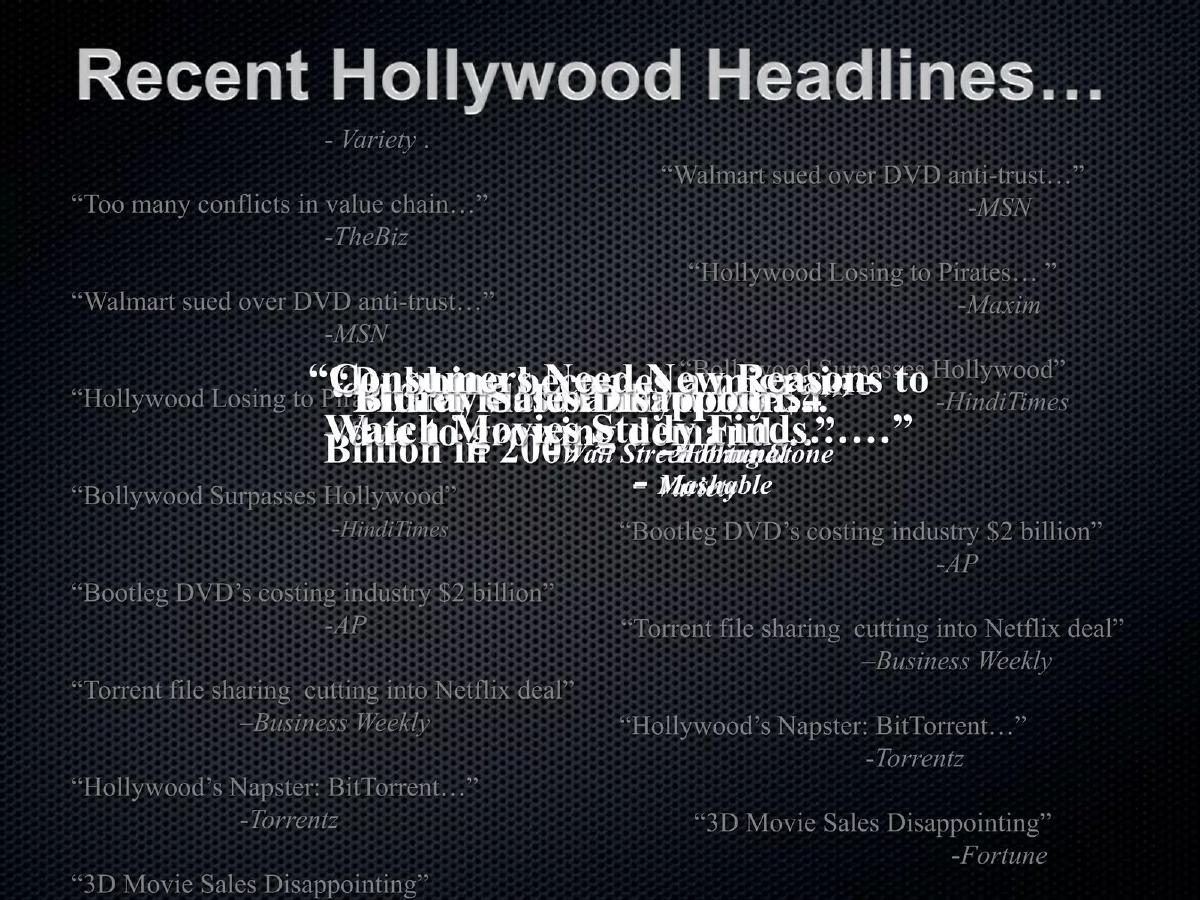
The deck opens with a collage of headlines highlighting the struggles of the traditional film industry. Key quotes include 'Hollywood Losing to Pirates' from Maxim and 'Bootleg DVD’s costing industry $2 billion' from the AP. The central thesis, quoted from Mashable, is that 'Consumers Need New Reasons to Watch Movies.' This slide establishes the 'Why Now' by pointing to a failing status quo in content distribution.
Slide 2: Title and Team
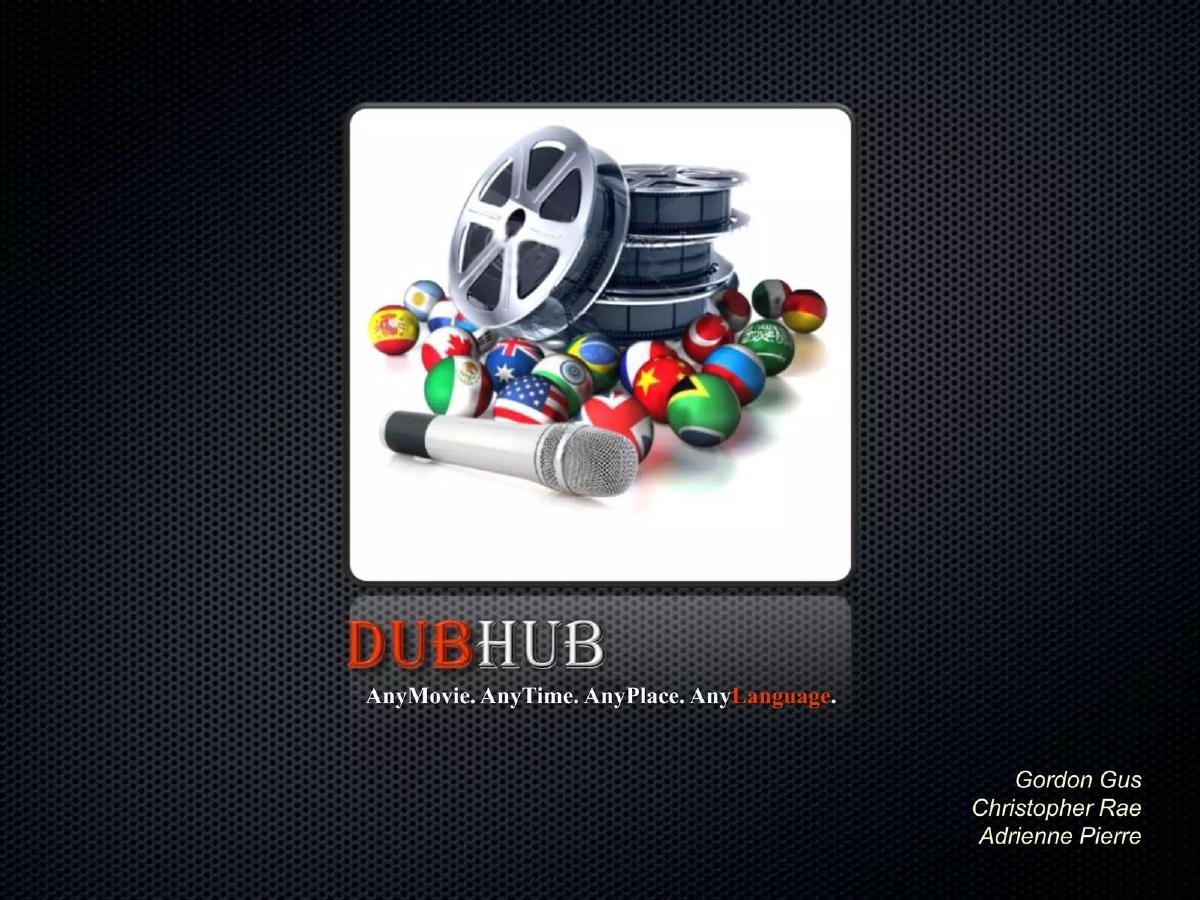
The title slide introduces the brand 'DUBHUB' with the tagline: 'AnyMovie. AnyTime. AnyPlace. AnyLanguage.' The imagery features film reels surrounded by globes, reinforcing the international focus. Three names are listed at the bottom right: Gordon Gus , Christopher Rae , and Adrienne Pierre . Notably, there are no titles, roles, or biographical information provided for these individuals.
Slides 3-5: The Problem Visualized
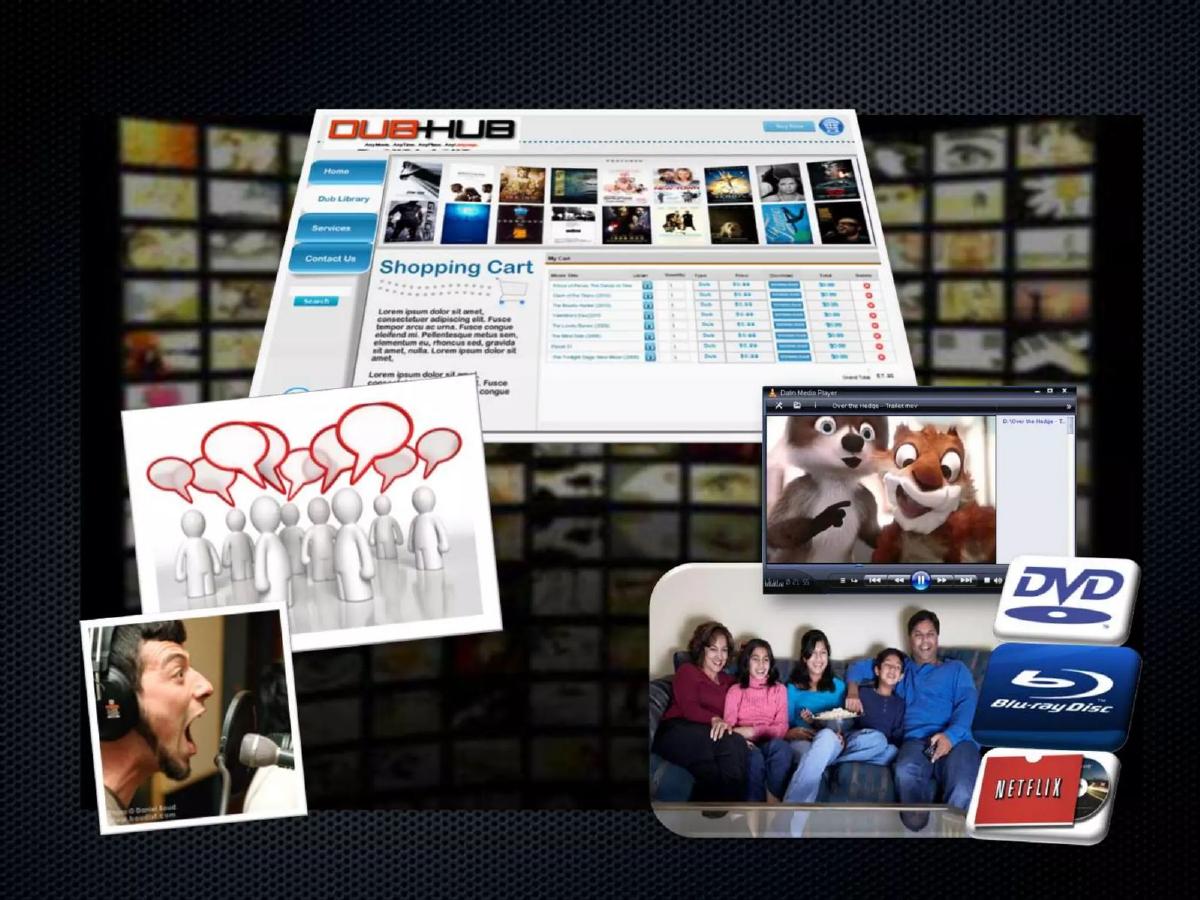
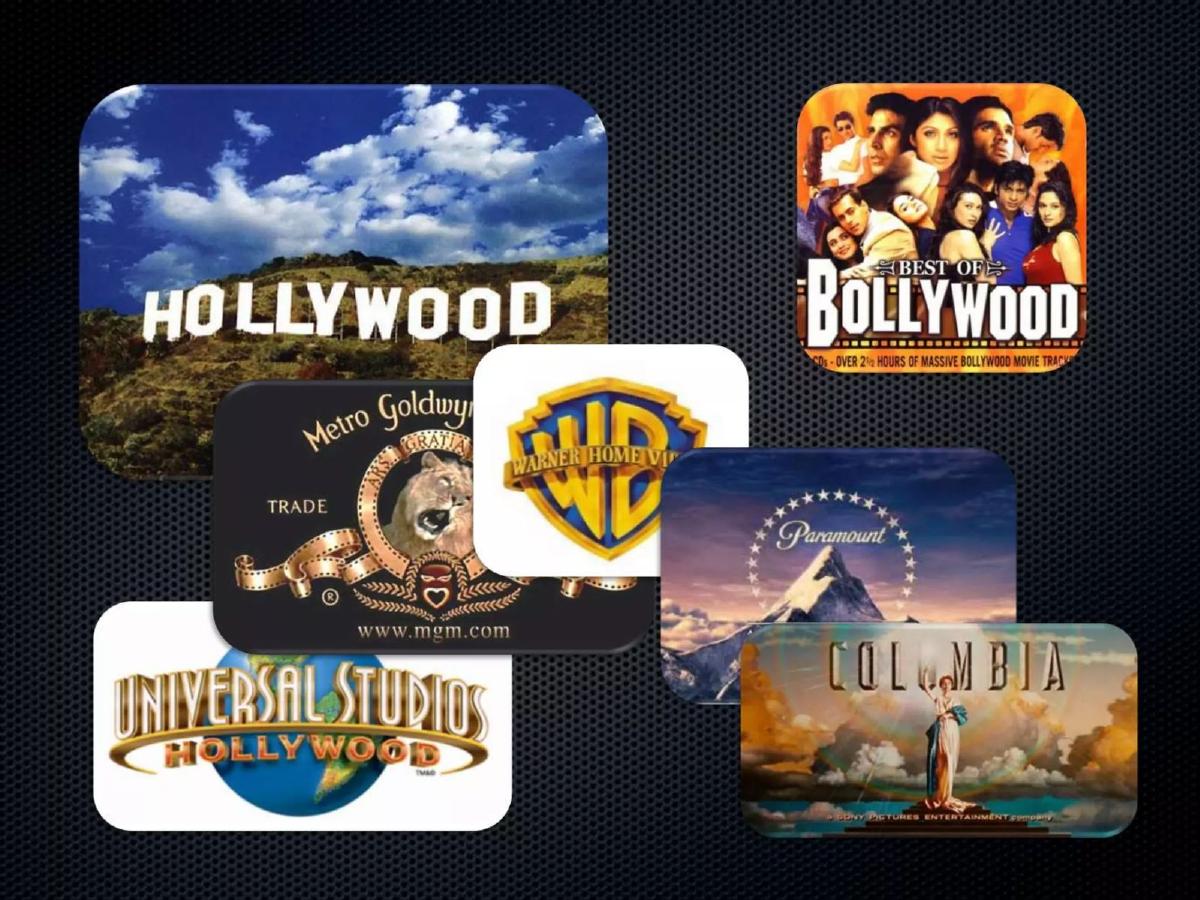
Slide 3 uses a stock photo of a family on a couch surrounded by 'Lost in Translation' text in multiple languages, alongside logos for DVD, Blu-ray, and Netflix. Slide 4 shows a mockup of a 'Shopping Cart' interface for dubs, a man in a recording booth, and people with speech bubbles. Slide 5 displays logos for major studios like MGM, Warner Home Video, Paramount, and Universal, alongside 'Best of Bollywood.' These slides collectively argue that while content is global, the audio is not, leading to a fragmented user experience.
Slides 6-7: The Monetization Question
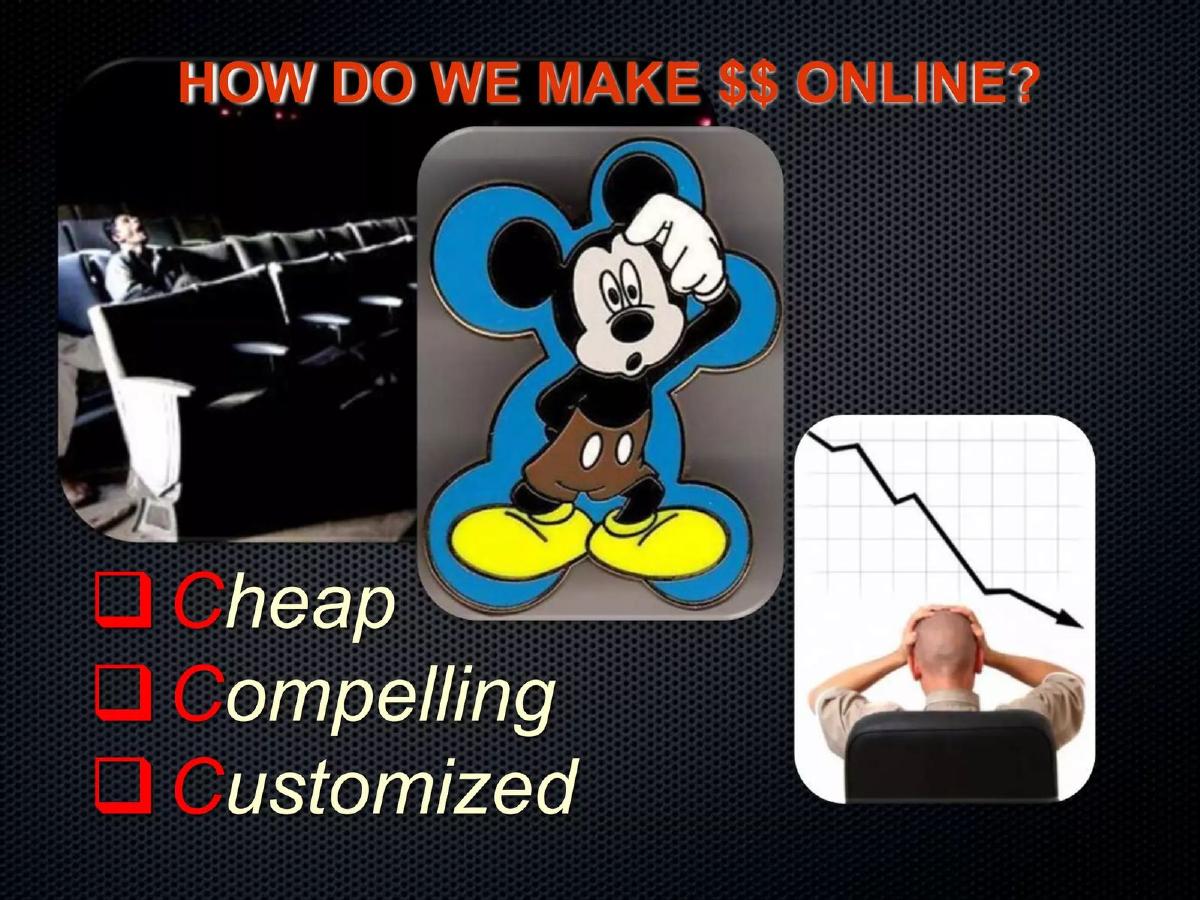
Slide 6 asks, 'HOW DO WE MAKE $$ ONLINE?' and offers three criteria: Cheap, Compelling, and Customized. It uses a downward-trending graph and an image of Mickey Mouse looking confused to represent the industry's current struggle to monetize digital content. Slide 7 uses images of classic cinema (Clint Eastwood, samurai films) to suggest that iconic content is being left behind in the digital transition due to language barriers.
Slides 8-9: The Solution - The Bengal Theater
Slide 8 uses a marquee metaphor. The 'Bengal Theater' lists 'Long-Tail Movies' and specifically 'Turner & Hooch in Hindi,' ending with the phrase 'DUBHUB DOES THE NEEDFUL.' Slide 9 uses the movie 'Lost in Translation' as a literal example, showing the poster replicated in dozens of different languages, suggesting that Dubhub can provide this localization at scale.
Slides 10-12: Overcoming Barriers
Slide 10 illustrates the 'red tape' of the industry, featuring images of copyright symbols, piracy warnings, and a man literally wrapped in red tape. Slide 11 and 12 transition to the solution, showing the 'Dubhub Toolkit' and an 'Approved' stamp over a shopping cart. The imagery suggests that Dubhub provides the legal and technical framework to bypass traditional distribution bottlenecks.
Slides 13-14: The Platform and Integration
Slide 13 defines the 'DUBHUB PLATFORM' as a triangle consisting of a 'Legal Marketplace,' 'Crowdsource Dubbing,' and an 'Opensource Plugin.' It features logos for XBMC and VLC. Slide 14 shows a puzzle piece labeled 'DUBHUB' being slotted into a wall of major media brands, including Discovery Channel, BBC, Comcast, NBC, Hulu, Walmart, Netflix, iTunes, and Google TV. This implies a B2B2C strategy where Dubhub acts as an additive layer to existing services.
Slide 15: The Business Model
This is the most functional slide in the deck, titled 'How It works...' It breaks down the process into three rows:
Demand: Consumers search for dubs, Dubhub alerts demand, and Dubhub posts a transcript. · Supply: Dubbers submit dubs for a fee, consumers buy dubs for a fee, and consumers rate dubs (creating virality). · Split: Dubhub pays producers a percentage, pays studios a percentage, and 'Keeps Net.'
Slide 16: Financial Projections
The deck presents an extremely aggressive revenue ramp. The figures are:
2011: $250,000 · 2012: $2,340,000 · 2013: $12,840,000 · 2014: $57,120,000 · 2015: $215,340,000
The slide also features logos for Netflix (Wii), Hulu, DivX, Apple TV, and XBMC, suggesting these platforms will drive the growth.
Slides 17-20: Conclusion and Contact
Slide 17 uses the 'Success Kid' meme and images of studio logos to signal a winning outcome. Slide 18 shows a man holding a massive stack of money and diverse faces with the caption '...now you're talking their language.' Slide 19 features a still from 'Fight Club' with a speech bubble saying, 'First Rule of DUBHUB is... Nobody Reads!'—a nod to the preference for dubbed audio over subtitles. The final slide provides the contact email invest@DubHub.org .
What Works / What is Missing
What Works: The deck is very clear about the specific niche it wants to own: the long-tail of movie translations. By framing it as a 'Legal Marketplace,' the founders address the primary concern of any media startup—copyright. The 'How It Works' slide is a concise explanation of a complex three-sided marketplace.
What is Missing: The deck is critically light on data and team credentials. There is no mention of current traction, user numbers, or pilot programs. The financial projections lack any context regarding customer acquisition costs (CAC) or the number of dubs required to reach a $215 million run rate. Most importantly, the 'Ask' is missing; an investor has no idea how much capital is being sought or what the valuation expectations are. The team slide is also insufficient, providing only names without any evidence of their ability to execute this technically and legally complex plan.
Founder Takeaways
Use metaphors wisely: The 'Bengal Theater' and 'Puzzle Piece' slides are effective at communicating the vision without using walls of text. Founders should aim for this level of visual clarity.
Don't hide the team: Simply listing names is not enough. Investors invest in people. If you have experience in media, translation, or marketplace dynamics, that needs to be front and center.
Be realistic with projections: Forecasting a jump from $250k to $215M in four years requires extraordinary evidence. Without showing the math or the growth levers, these numbers can look like 'spreadsheet engineering' rather than a viable business plan.
Include a clear Ask: Every pitch deck should end with a clear statement of what you need. 'We are raising $X million to achieve Y and Z' is the standard for a reason.
Frequently asked questions
- What is the core problem Dubhub is trying to solve?
- Dubhub addresses the lack of localized audio tracks for the 'long-tail' of global cinema. They argue that Hollywood loses billions to piracy because consumers in non-English speaking markets cannot access movies in their native languages. By crowdsourcing translations, they aim to make any movie accessible in any language, thereby creating a new legal revenue stream for studios.
- How does the Dubhub revenue model work?
- The model is a three-way split marketplace. Consumers search for and request dubs. Independent 'dubbers' submit audio tracks for a fee. Once a consumer buys a dub, the revenue is distributed: a percentage goes to the audio producer, a percentage goes to the original film studio, and Dubhub retains the net balance. This is detailed in the 'How It Works' flowchart on slide 15.
- What are the projected financials for the company?
- The deck provides a five-year revenue forecast starting in 2011. The projections are: $250,000 (2011), $2,340,000 (2012), $12,840,000 (2013), $57,120,000 (2014), and $215,340,000 (2015). These figures represent a massive scaling effort, though the deck does not explain the underlying assumptions or unit economics required to reach these totals.
- Which platforms does Dubhub intend to support?
- Slide 14 and 16 show logos for a wide variety of digital media players and services, including Netflix (specifically for Wii), Hulu, iTunes, Comcast, Amazon Unbox, Google TV, and open-source platforms like XBMC and VLC. The goal appears to be a cross-platform plugin that allows users to overlay crowdsourced audio onto existing video streams.
- Is there a clear investment opportunity presented in the deck?
- No. While the final slide provides an investment contact email (invest@DubHub.org), the deck lacks a formal 'Ask' slide. It does not state how much money the company is looking to raise, the valuation they are seeking, or what specific milestones the funding will help them achieve. It functions more as a vision statement than a structured investment proposal.