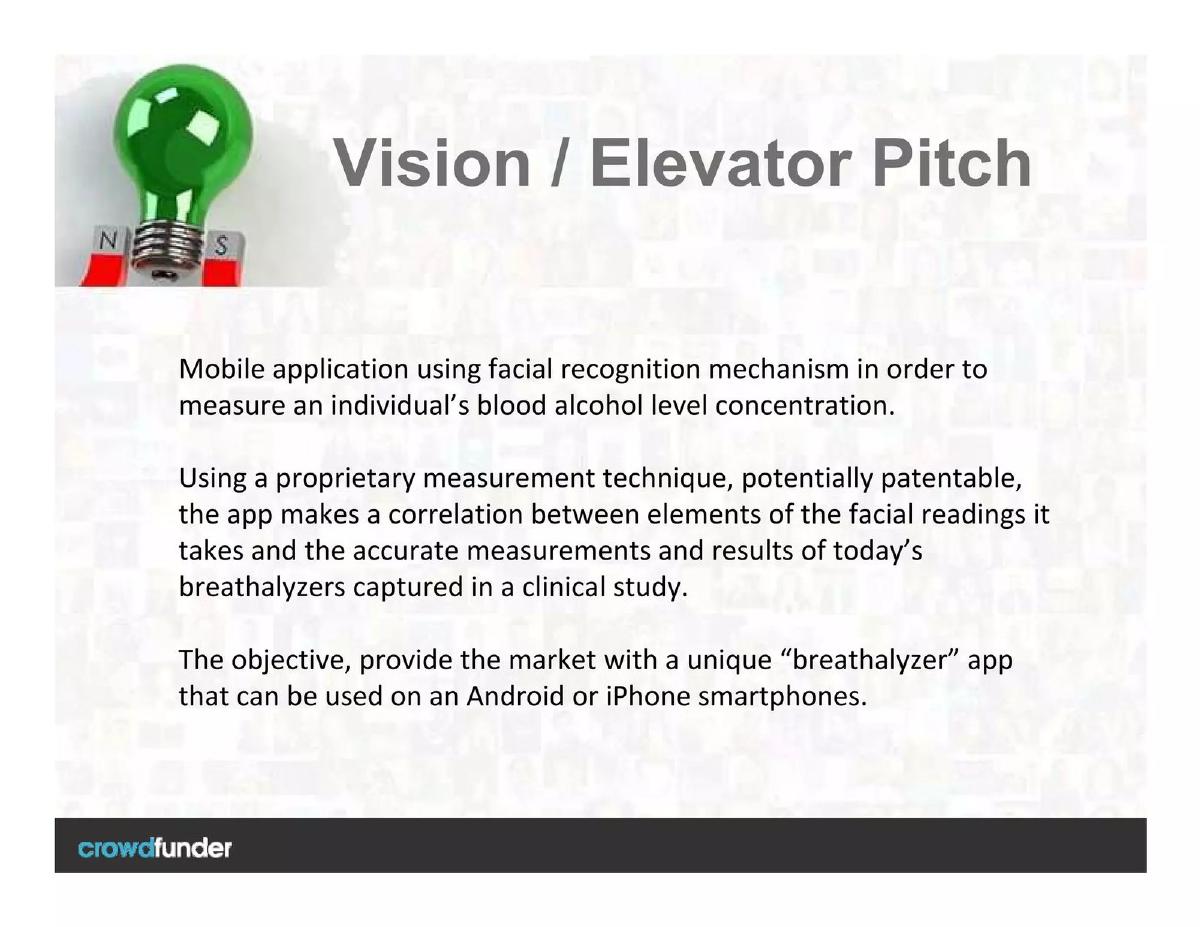
The DUI App pitch deck is a conceptual pre-seed presentation by Sylvain Cardinal, an 'Invention Designer.' The project aims to solve the portability and social stigma issues associated with traditional breathalyzers by moving the functionality to a mobile application. At the time of the deck's creation, the company was in the concept stage, having completed software requirements and UI wireframes but lacking a functional prototype. The financial projections are highly optimistic, targeting 1 million users by year three with a 40% conversion rate to paid status. While the deck clearly identifi…
Key takeaways
- The company is at the concept stage, with only software requirements and UI wireframes completed (Slide 2).
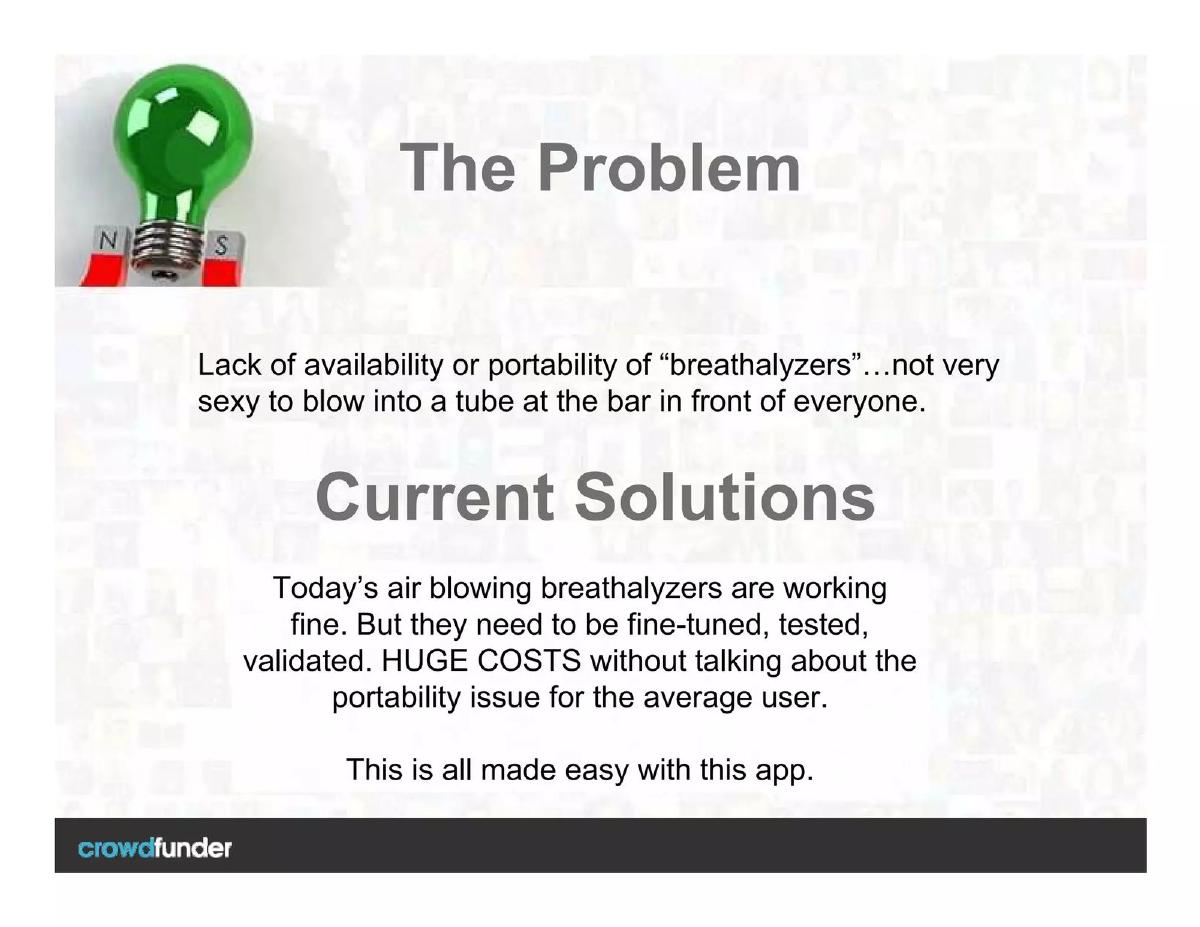
- The founder identifies the 'social stigma' of blowing into a tube at a bar as a primary pain point (Slide 3).
- Revenue models are undecided, fluctuating between a $10 lifetime fee or a per-use token system (Slide 4).
- Financial goals include reaching 1 million users by mid-year 3, with 40% of those being paid users (Slide 5).
- The investment ask is $250,000 USD for a pre-seed round to be raised by fall 2016 (Slide 6).
- A significant portion of the raise (25%) is earmarked for founder and project management salary (Slide 6).
- The deck mentions a 'Clinical study' as a use of proceeds, accounting for 15% of the budget (Slide 6).
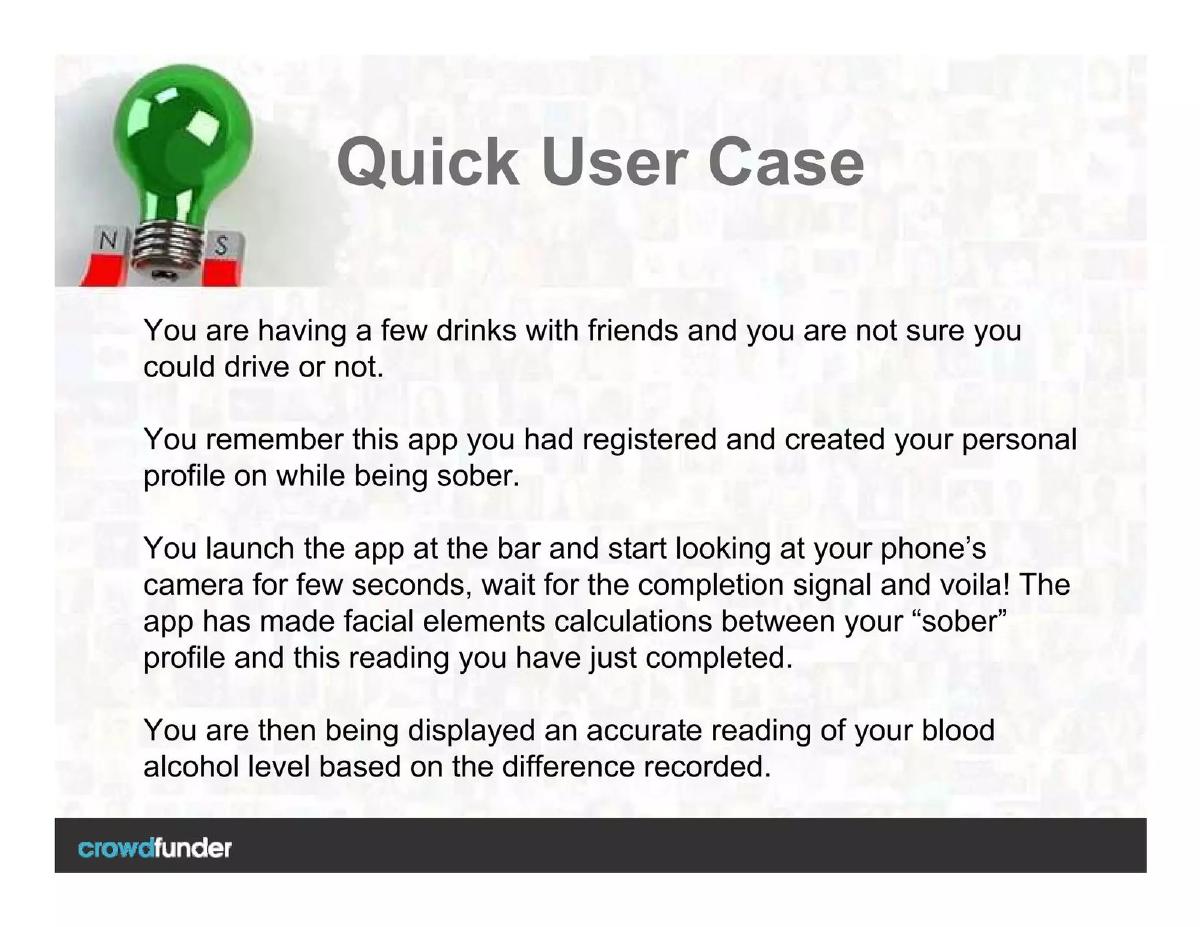
- There is no mention of the underlying technology or how a phone hardware-only solution would measure BAC (Slide 3).
DUI App Pitch Deck Teardown
Slide 1: Title Slide
The deck opens with a title slide identifying the project as the DUI Mobile App Project Pitch Deck . It prominently features the name Sylvain Cardinal , described as an Invention Designer . The visual branding includes a green lightbulb being held by a magnet, a generic stock image often used to represent 'ideas' or 'innovation.' There is no corporate logo or specific branding for the app itself on this slide.
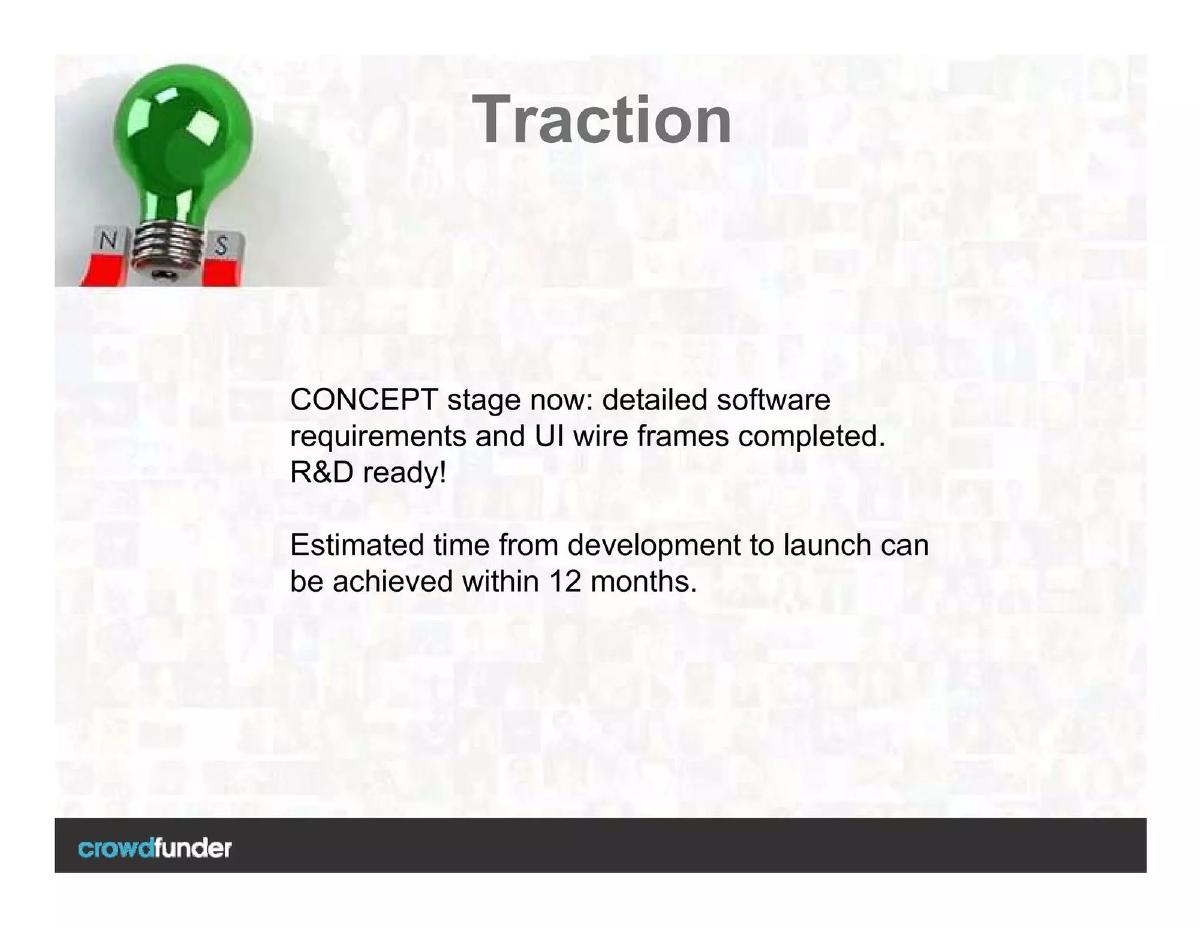
Slide 2: Traction
Slide 2, titled Traction , clarifies the current status of the venture. It states the company is in the CONCEPT stage now . The specific progress cited includes detailed software requirements and UI wire frames completed . The slide claims the project is R&D ready! and provides a timeline estimate, stating that development to launch can be achieved within 12 months . In the context of startup fundraising, 'traction' usually refers to users, revenue, or partnerships; here, it is used to describe the completion of initial design documents.
Slide 3: The Problem and Current Solutions
This slide addresses the market pain point. The Problem is defined as a lack of availability or portability of breathalyzers . Crucially, the founder highlights a social barrier: it is not very sexy to blow into a tube at the bar in front of everyone . Under Current Solutions , the slide acknowledges that existing air-blowing breathalyzers work fine but suffer from HUGE COSTS and portability issues for the average user. The slide concludes with the claim: This is all made easy with this app . However, the slide does not explain the mechanism by which the app replaces the physical hardware of a breathalyzer.
Slide 4: Revenue Model
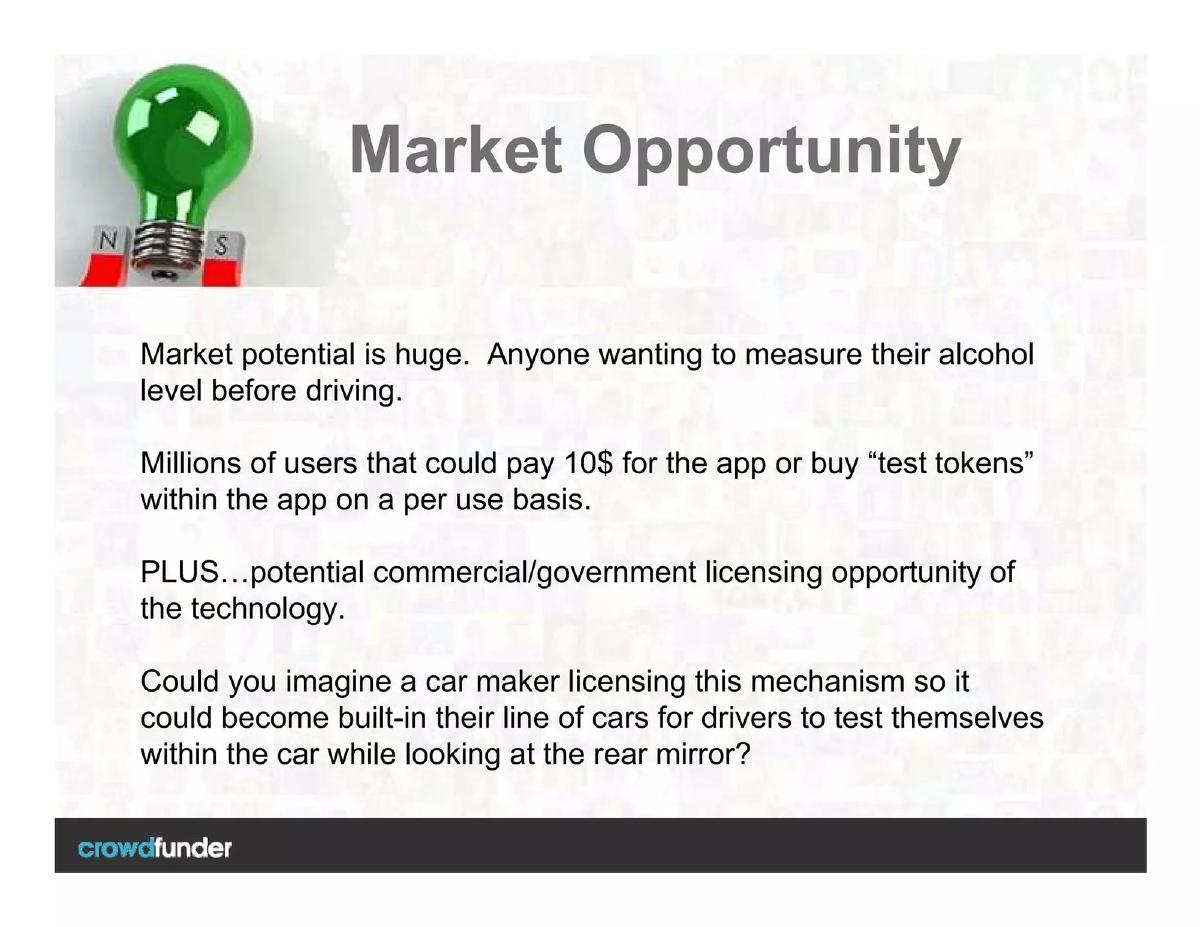
The Revenue Model slide presents two potential paths, noting that they still need to be validated . The first option is a lifetime exclusive and unlimited use model where users buy the app for around 10$ . The second option is a per use basis where users buy test tokens . The slide does not provide a preference for either model or data supporting which might be more effective for the target demographic.
Slide 5: Financials
The Financials slide provides a three-year roadmap rather than a detailed P&L statement. Year 1 is dedicated to Development and Testing . Year 2 marks the Launch and start selling app . By Mid Year 3 , the goal is to recoup the original investment . This is predicated on a strong user base of at least 1 million users with 40% paid users . Achieving a 40% conversion rate from free to paid is an extremely high benchmark in the mobile app industry, where standard conversion rates typically hover between 1% and 5%.
Slide 6: Investment
The final slide in this set, Investment , outlines the ask. The founder is Looking for 250K$ USD against equity in the company . The round is labeled as a PRE-SEED round with a target closing date of fall of 2016 . The Key Use of Proceeds is broken down by percentage: 25% for Founder and acting Project/Product management salary , 15% for R&D (overseas dev.) , 15% for a Clinical study , 35% for Launch and marketing , and 10% for Operations . The allocation of a quarter of the pre-seed round to the founder's salary is a specific detail that would likely be scrutinized by investors at this stage.
What Works
Clear Problem Identification: The founder correctly identifies the 'social friction' of using a breathalyzer in public. This is a legitimate behavioral barrier that a well-designed app could theoretically solve. · Honesty Regarding Stage: The deck does not attempt to hide that it is in the concept stage. By explicitly stating that only wireframes and requirements are done, it sets an accurate expectation for the level of risk involved. · Specific Use of Proceeds: Providing a percentage breakdown of how the $250,000 will be spent gives investors a clear view of the founder's priorities, even if those priorities (like the salary) are debatable.
What is Missing
Technical Explanation: This is the most glaring omission. Measuring blood alcohol content typically requires a fuel cell sensor or infrared spectrometry. The deck does not explain how a smartphone—which lacks these sensors—will provide an accurate or legally defensible reading. · Competitive Landscape: There are no mentions of existing smartphone-connected breathalyzers (like BACtrack) or other alcohol-tracking apps. An investor needs to know why this 'invention' is superior to what is already on the market. · Team Slide: While Sylvain Cardinal is mentioned on the title slide, there is no information regarding his background, technical expertise, or previous successes. A pre-seed investment is largely a bet on the team, and that team is not described here. · Legal and Liability Considerations: An app that tells someone they are 'safe' to drive carries immense legal liability. The deck mentions a 'clinical study' but does not address the regulatory hurdles or the insurance/legal framework required for such a product.
What a Founder Should Copy
The 'Social Stigma' Angle: Identifying the 'unsexy' nature of a current solution is a great way to frame a disruptor. Founders should look for these emotional or social pain points in their own industries. · Simple Revenue Options: Presenting two clear, understandable revenue models (one-time vs. per-use) is a good way to start a conversation about monetization, even if they aren't yet validated. · Milestone-Based Financials: Instead of a wall of spreadsheets, the three-year high-level roadmap (Slide 5) is easy to digest and communicates the founder's vision for the company's trajectory.
Frequently asked questions
- What is the core technology behind DUI App?
- The deck does not explicitly state how the app measures blood alcohol content (BAC). Slide 3 mentions that current solutions involve 'air blowing breathalyzers' and that this app makes it 'easy,' but it fails to explain if it uses external hardware, camera sensors, or behavioral analysis. This is a significant technical gap in the presentation.
- What stage of development is the company in?
- According to Slide 2, the company is in the 'CONCEPT stage.' They have completed detailed software requirements and UI wireframes. The slide notes they are 'R&D ready' and estimate a 12-month timeline from the start of development to the actual product launch.
- How does the founder plan to make money?
- Slide 4 outlines two potential revenue models that 'still need to be validated.' The first is a one-time purchase price of approximately $10 for lifetime unlimited use. The second is a micro-transaction model where users purchase 'test tokens' on a per-use basis.
- What are the projected growth milestones?
- Slide 5 sets a goal for Year 3 to recoup the original investment. The founder projects a user base of at least 1 million people, with a 40% paid user conversion rate. This implies a target of 400,000 paying customers within three years of starting the project.
- How will the $250,000 investment be spent?
- Slide 6 breaks down the use of proceeds: 25% for founder/management salary, 15% for overseas R&D, 15% for a clinical study, 35% for launch and marketing, and 10% for general operations. The inclusion of a clinical study suggests a need for medical or legal validation.