Impossible Kicks successfully raised $3M in a 2022 Series A round to expand its physical retail footprint in the competitive sneaker and streetwear resale market. While many competitors focus on digital marketplaces, Impossible Kicks leans heavily into the 'bricks and mortar' experience, citing an average annual per-store sales figure of $4 million on Slide 2. The deck emphasizes a 'high-end merchandise mix' featuring brands like Jordan, Yeezy, and Off-White, supported by a robust social media presence generating 3 million monthly impressions. By combining high-touch physical store design wit…
Key takeaways
- The company reports an average annual per-store sales volume of $4 million, positioning them as a category leader in physical retail (Slide 2).
- Impossible Kicks claims to be cash flow positive with $2 million cash in the bank prior to the raise (Slide 2).
- The business model relies on a 'high-end merchandise mix' of exclusive, sold-out products from the past 18 months (Slide 7).
- Social media is a primary driver, with 168,000+ followers and 3 million monthly impressions across platforms (Slide 8).
- The deck utilizes significant third-party market validation, citing Cowen Research data projecting a $30 billion sneaker resale market by 2030 (Slide 9).
- Celebrity social proof is a core marketing pillar, featuring high-profile shoppers like Antonio Brown and Lexi Rabe to validate brand status (Slide 10).
- The deck lacks a formal team slide, omitting the backgrounds and experience of the founding and executive leadership.
- There is no explicit 'Ask' slide in the provided materials detailing the specific use of the $3M raised.
Impossible Kicks: A Physical Play in a Digital Resale World
Impossible Kicks represents a counter-intuitive trend in the venture-backed world: the return to physical retail. While the sneaker resale market has been dominated by digital giants like StockX and GOAT, Impossible Kicks raised $3M in 2022 (as reported by Business Insider) to double down on the mall experience. Their deck is a masterclass in using high-volume retail metrics and celebrity social proof to justify a brick-and-mortar expansion strategy.
Slide 1-2: The Value Proposition and Differentiation
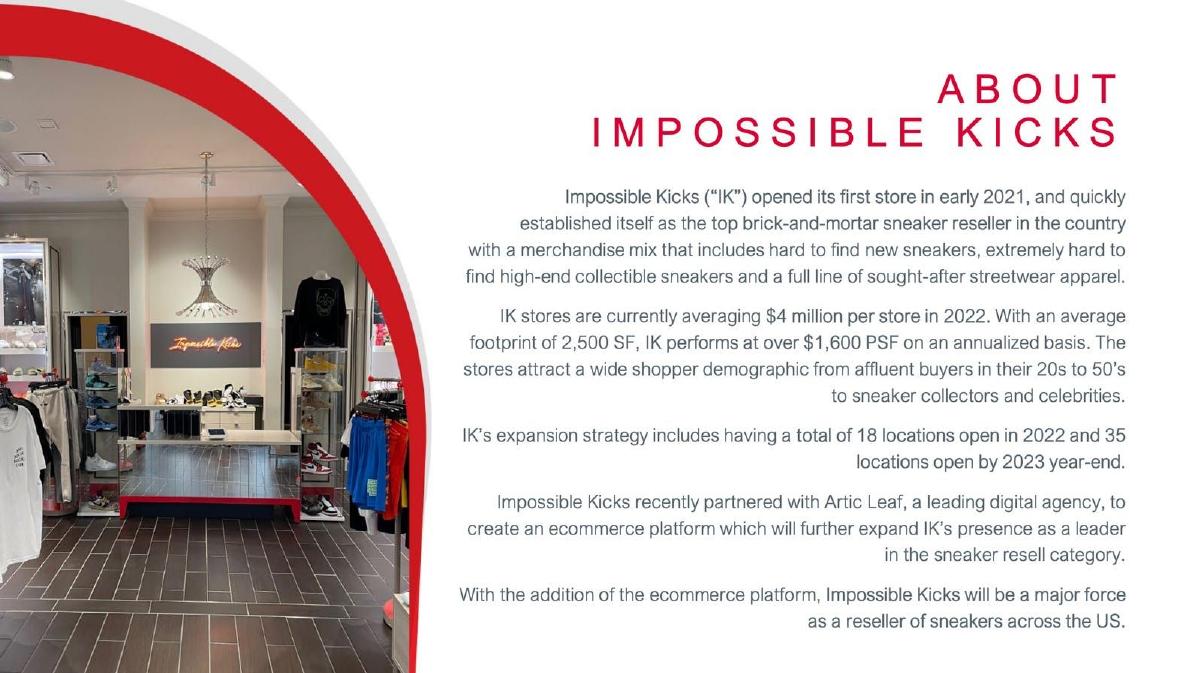
The deck opens with a clean, brand-focused cover before moving immediately into the 'What Differentiates Impossible Kicks' slide. This is a high-impact slide that addresses the 'Why Now' and 'Why Us' questions simultaneously. The company leads with a staggering figure: $4 million in average annual per-store sales . For a retail concept, this is a powerful metric that suggests high inventory turnover and strong consumer demand.
Slide 2 also highlights that the company is "Capitalized for Growth" with no debt and $2 million cash in the bank . This is a strategic inclusion for a Series A deck; it tells investors that the company isn't raising out of desperation, but rather to accelerate a machine that is already cash-flow positive. The mention of a "best refund policy in this category" is a direct jab at digital marketplaces, which often have notoriously difficult return processes due to the nature of secondary market authentication.
Slide 3-5: The Physical Footprint
Slides 3, 4, and 5 are visual-heavy, showcasing the actual stores. In retail fundraising, the 'vibe' of the store is a proxy for brand equity. Slide 4 shows a high-traffic mall entrance with clean lines, wood accents, and bright lighting. Slide 5 reinforces this with a look at the interior merchandising. By showing these images, the founders are proving that they can execute a premium retail environment that competes with primary luxury brands, not just 'mom and pop' sneaker shops.
Slide 6-7: The Merchandise Strategy
Slide 7, titled "High-End Merchandise Mix," explains the inventory engine. The company focuses on exclusive products from the "past 18 months." This is a critical detail because it defines their inventory risk; they aren't just selling old vintage shoes, but rather the most liquid, high-demand releases. The list of brands—including Adidas, Dior, Jordan, Nike, Supreme, and Yeezy —covers the entire spectrum of the 'hype' economy. This slide serves to reassure investors that the company has the 'extraordinary buying power' mentioned on Slide 2 to keep shelves stocked with products that are technically 'sold out' elsewhere.
Slide 8: Social Media Connectivity
Despite being a physical retailer, Impossible Kicks views itself as a digital-first marketer. Slide 8 quantifies their reach: 168,000+ followers and 3 million impressions per month . The most interesting metric here is the "300 square miles marketing reach per store." This suggests a sophisticated understanding of local SEO and geo-fenced social media advertising, showing how they bridge the gap between a digital scroll and a physical store visit.
Slide 9: Market Validation
Slide 9 leans on third-party authority to validate the total addressable market (TAM). Citing a 2020 Cowen Research Equity study , the deck notes that the global sneaker resale market could reach $30 billion by 2030 . It also highlights that sneakers are now considered an "emerging alternative asset class." This framing is essential for venture investors who might otherwise view sneakers as a fickle fashion trend; by calling them 'assets,' the company aligns itself with the broader fintech and collectibles boom.
Slide 10: The Celebrity Engine
The final slide in this sequence, "Celebrity Shopper Base," is pure social proof. It features photos of actress Lexi Rabe , athlete Antonio Brown , and YouTube influencer Stephen Sharer shopping at Impossible Kicks. In the streetwear world, proximity to 'cool' is a currency. This slide demonstrates that the brand has successfully integrated itself into the cultural zeitgeist, which acts as a moat against competitors who may have similar inventory but lack the 'destination' status.
What Impossible Kicks Does Well
The deck excels at quantifying retail success . Most retail decks focus on 'the dream,' but Impossible Kicks focuses on the $4 million per store reality. By leading with profitability and cash-on-hand, they de-risk the investment significantly. They also do an excellent job of visual storytelling . The store photos aren't just filler; they are evidence of operational excellence and brand positioning.
Furthermore, the market framing on Slide 9 is very effective. By quoting Cowen and Yahoo Finance, they move the conversation from 'selling shoes' to 'capturing a piece of a $30 billion alternative asset market.' This is the kind of language that triggers Series A interest.
What is Missing from the Deck
The most glaring omission is a Team Slide . In a $3M Series A round, investors are betting on the operators. Who is managing the complex supply chain? Who is negotiating the mall leases? Without a team slide, we don't know if the founders have 20 years of retail experience or if they are newcomers to the space.
Additionally, the deck lacks Unit Economics . While $4M in sales is impressive, we don't see the margins. Sneaker resale margins can be thin, and mall rents are high. A slide detailing the CAC (Customer Acquisition Cost) vs. LTV (Lifetime Value) or a breakdown of the Four-Wall EBITDA would have made the financial case much stronger.
Finally, there is no Roadmap or Ask . The deck shows where the company is, but not exactly where the $3M will go. How many new stores will be opened? Is there a plan for a proprietary app? The lack of a forward-looking strategy leaves the 'why now' for the investment slightly unanswered.
Founder Takeaways
Lead with your strongest metric: If you have a store that does $4M in a category where others do $1M, put that on Slide 2. Don't bury your lead. · Use social proof as a moat: In industries driven by hype, showing that celebrities and influencers organically use your product is more valuable than a thousand words of marketing copy. · Bridge the digital-physical gap: If you are a physical business, show how digital tools (like the 300-square-mile marketing reach) drive your physical success. · Leverage institutional research: Don't just say the market is big; cite a reputable research firm like Cowen to prove it. It adds a layer of professionalism and due diligence to your claims.
Frequently asked questions
- What is the core business model of Impossible Kicks?
- Impossible Kicks operates as a brick-and-mortar retail reseller of high-end streetwear and luxury sneakers. They focus on sourcing exclusive, sold-out inventory from brands like Nike, Jordan, and Yeezy, then selling them through premium physical storefronts in high-traffic areas, supported by aggressive social media marketing.
- How does the company differentiate itself from online marketplaces like StockX?
- According to Slide 2, the company differentiates through 'Extraordinary Customer Service,' a best-in-class refund policy, and a high-end physical store design. They emphasize the 'bricks and mortar' experience, allowing customers to see and touch products immediately rather than waiting for shipping and authentication from digital platforms.
- What are the key financial metrics mentioned in the deck?
- The deck highlights three primary financial proof points on Slide 2: average annual sales of $4 million per store, a cash-flow positive operational status, and a pre-raise cash balance of $2 million. These metrics are intended to show that the business is already proven and sustainable.
- How does the company acquire its customers?
- The strategy is two-fold: social media and celebrity influence. Slide 8 notes 3 million monthly impressions and a 300-square-mile marketing reach per store. Slide 10 showcases a 'Celebrity Shopper Base,' indicating that high-profile visits drive both brand prestige and organic social buzz.
- What information is missing from the Impossible Kicks deck?
- The deck is notably missing a Team slide, which is standard for a Series A raise to show executive capability. It also lacks a detailed 'Use of Funds' slide and a specific breakdown of unit economics beyond the top-line $4 million per store sales figure.