Anam’s 18-slide Seed deck is a masterclass in positioning a deep-tech solution within a crowded AI market. By identifying 'natural responsiveness' and 'expressivity' as the primary technical hurdles, the company differentiates itself from existing text-to-video competitors who struggle with real-time interaction. The deck relies on a strong team pedigree, featuring alumni from Synthesia and Google, to validate their claim of building a custom diffusion model. While the deck is light on business model specifics and current traction, it excels at visualizing the product's versatility through se…
Key takeaways
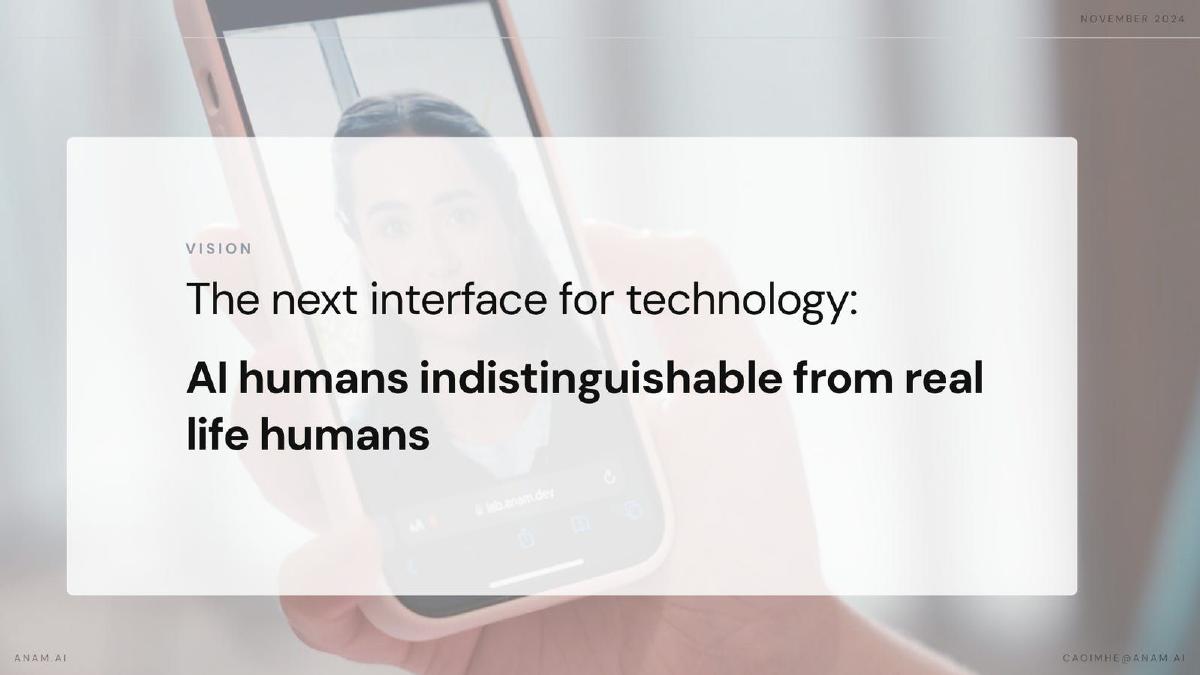
- The deck positions AI humans as the 'next interface for technology,' moving beyond simple text or voice interactions (Slide 2).
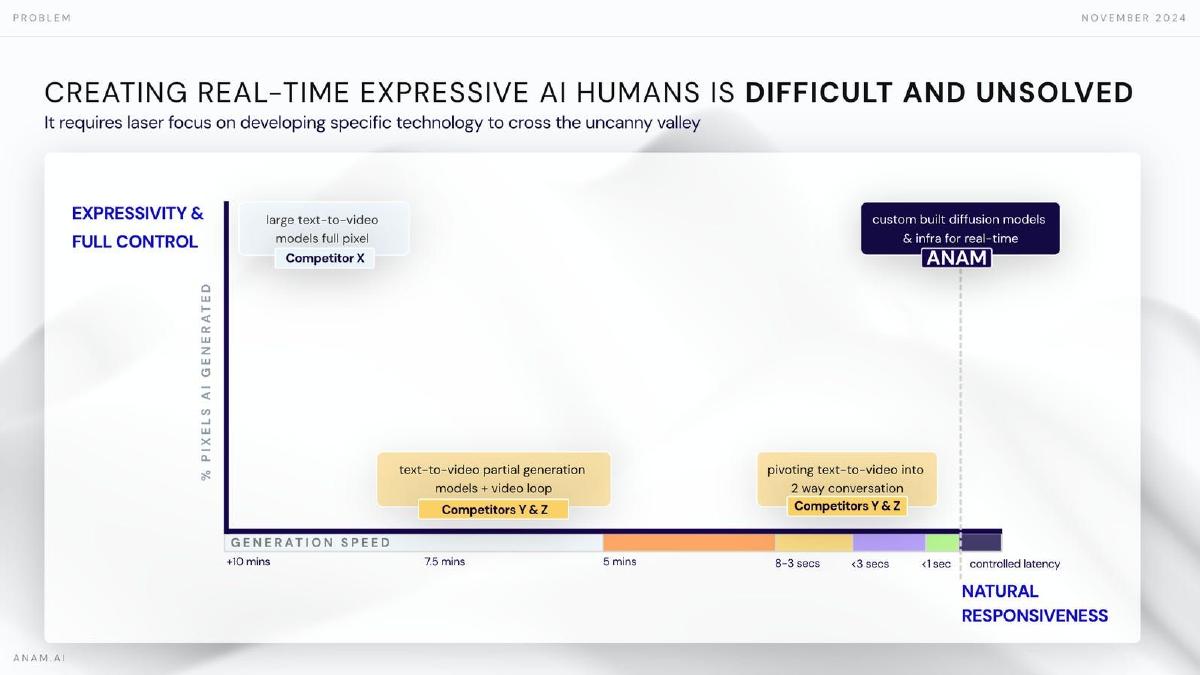
- Anam differentiates itself on 'Natural Responsiveness,' claiming to achieve sub-1 second latency where competitors take minutes or seconds (Slide 5).
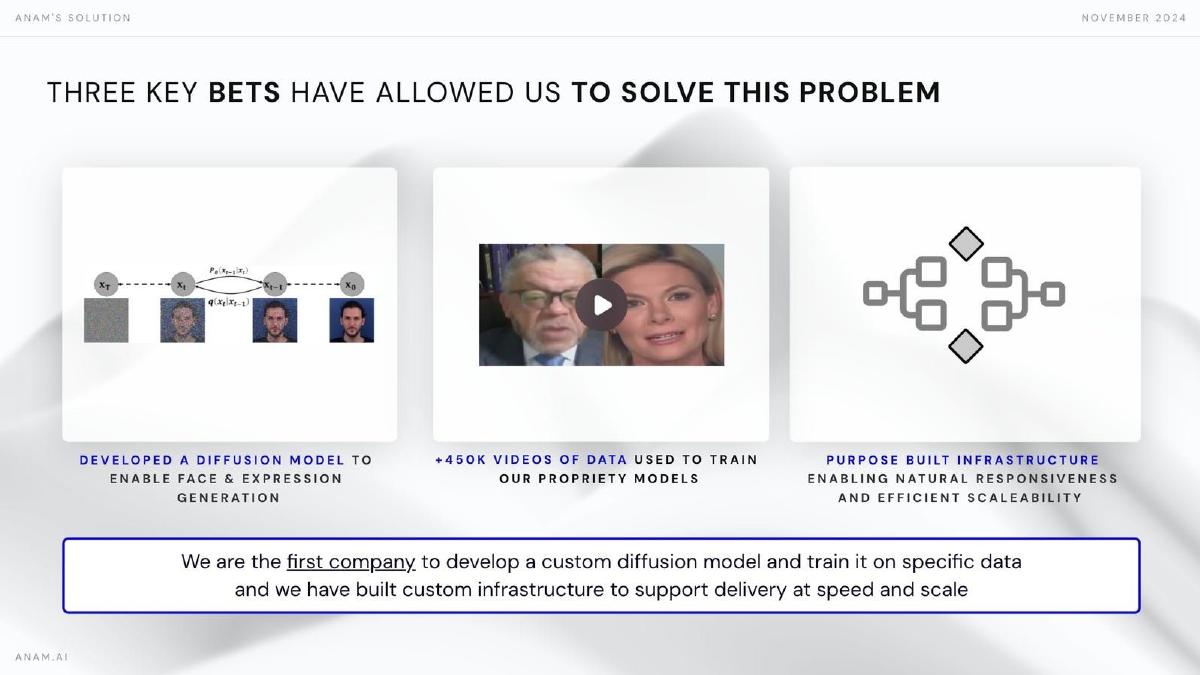
- The technical moat is defined by three 'bets': a custom diffusion model, specific training data, and custom infrastructure for speed (Slide 6).
- The founding team includes deep expertise in the sector, specifically citing experience at Synthesia, Google, and Imperial College London (Slide 8).
- The product aims to cross the 'uncanny valley' by focusing on expressive control and real-time latency (Slide 9).
- Use cases are segmented into categories like Educational, Administrative, and Sales, showing a broad horizontal market approach (Slides 12-18).
- A specific claim is made that better-trained sales reps using their AI personas can increase win rates by 28% (Slide 16).
- The deck omits a traditional 'Ask' slide, financial projections, and a detailed go-to-market strategy, focusing instead on vision and tech.
The Vision: A Human Face for Technology
Slides 1-3: The Hook and The Vision
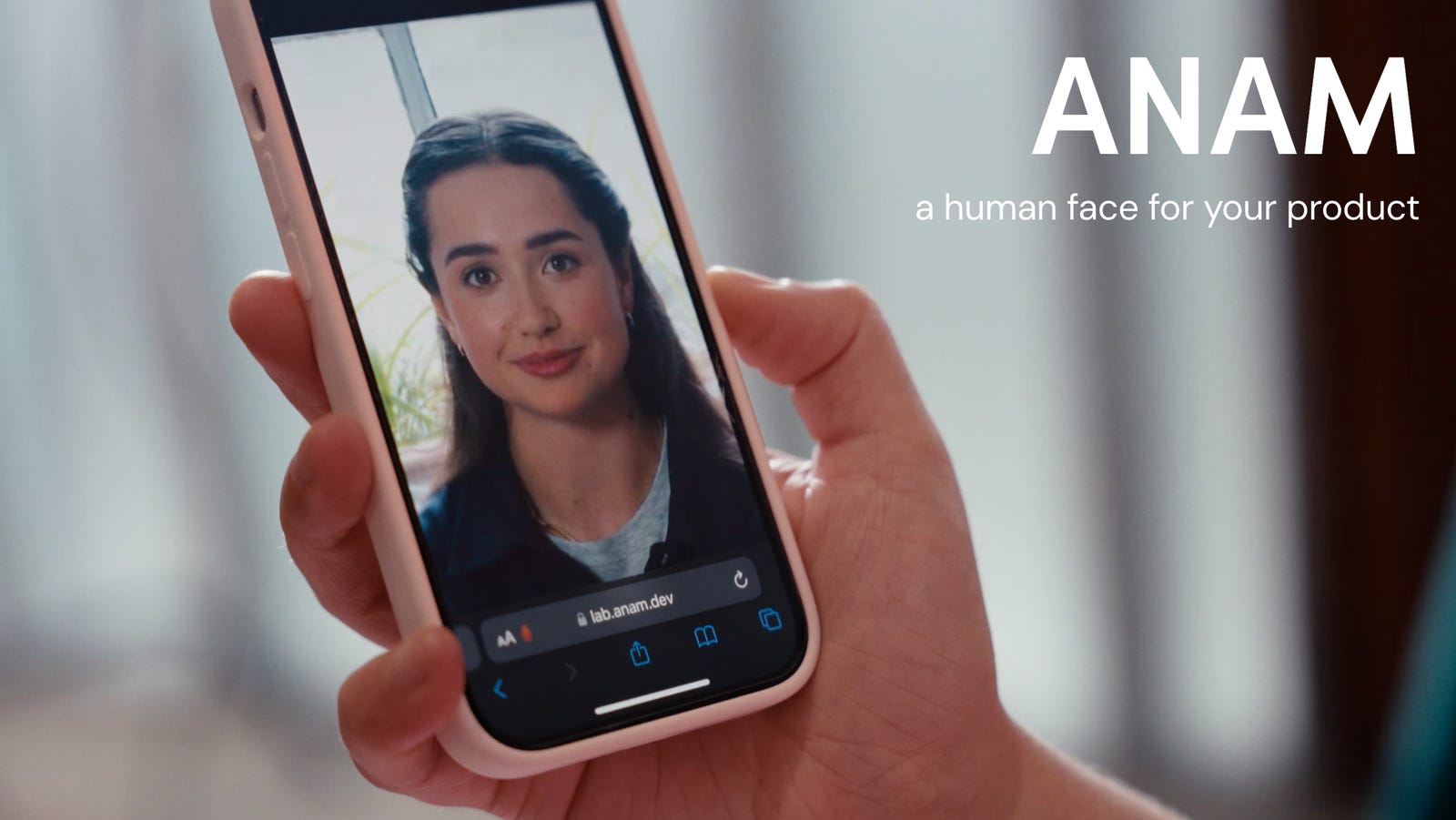
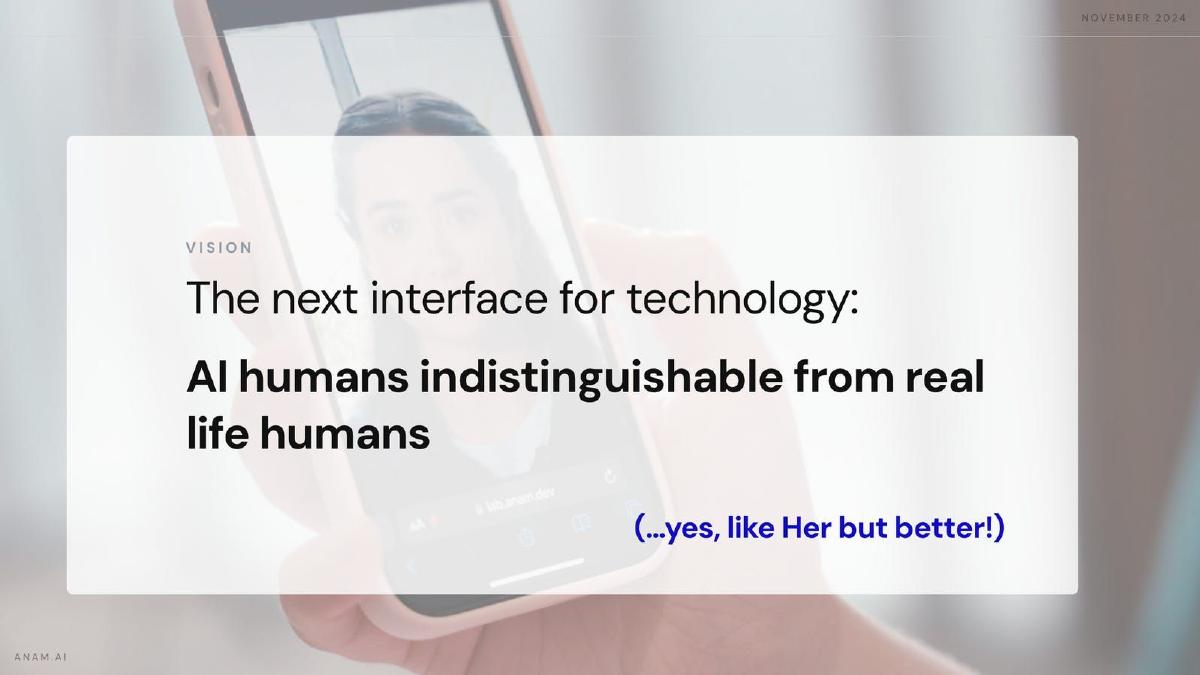
Anam opens with a high-fidelity visual of an AI persona on a smartphone. The tagline, "a human face for your product" (Slide 1), immediately establishes the company's purpose. Unlike many AI startups that focus on backend efficiency, Anam is selling the frontend experience. Slide 2 elevates this to a grander scale, calling AI humans "The next interface for technology." The bold claim that these personas are "indistinguishable from real life humans" sets a high bar for the technical slides to follow. Slide 3 adds a touch of cultural relevance with a nod to the movie Her , suggesting a future of intimate, seamless digital interaction, but with the added layer of a visual presence.
The Technical Challenge: Crossing the Uncanny Valley
Slides 4-6: The Problem and The Bets
The deck quickly pivots to the technical hurdles. Slide 5 defines the problem: "Creating real-time expressive AI humans is difficult and unsolved." It specifically mentions the "uncanny valley," the psychological phenomenon where near-human robots or animations cause revulsion in viewers. Anam argues that solving this requires "laser focus" on specific technology. Slide 6 introduces their competitive advantage, visualized on a graph comparing "Expressivity & Full Control" against "Generation Speed." While "Competitor X" (likely high-end text-to-video) has high expressivity but slow speeds (+10 mins), and "Competitors Y & Z" have faster speeds but lower control, Anam claims the top-right quadrant: high expressivity with "controlled latency" under 1 second. They attribute this to three bets: a "custom diffusion model," "specific data," and "custom infrastructure."
The Team: Pedigree in Generative Video
Slides 7-8: World Class Talent
For a Seed round, the team is often the most critical factor. Slide 8 (labeled Slide 7 in the text) showcases a team with significant experience in the exact niche they are attacking. CEO Caoimhe Murphy and CTO Ben Carr are both listed as former employees of Synthesia , a leader in the AI video space. The team also includes talent from Google , HubSpot , and Imperial College London . By highlighting two PhDs and engineers from high-growth tech companies, Anam validates their claim that they have the "world class team" necessary to solve the complex latency and rendering issues described in the previous section.
The Solution: Proprietary Architecture
Slides 9-10: Technical Differentiation
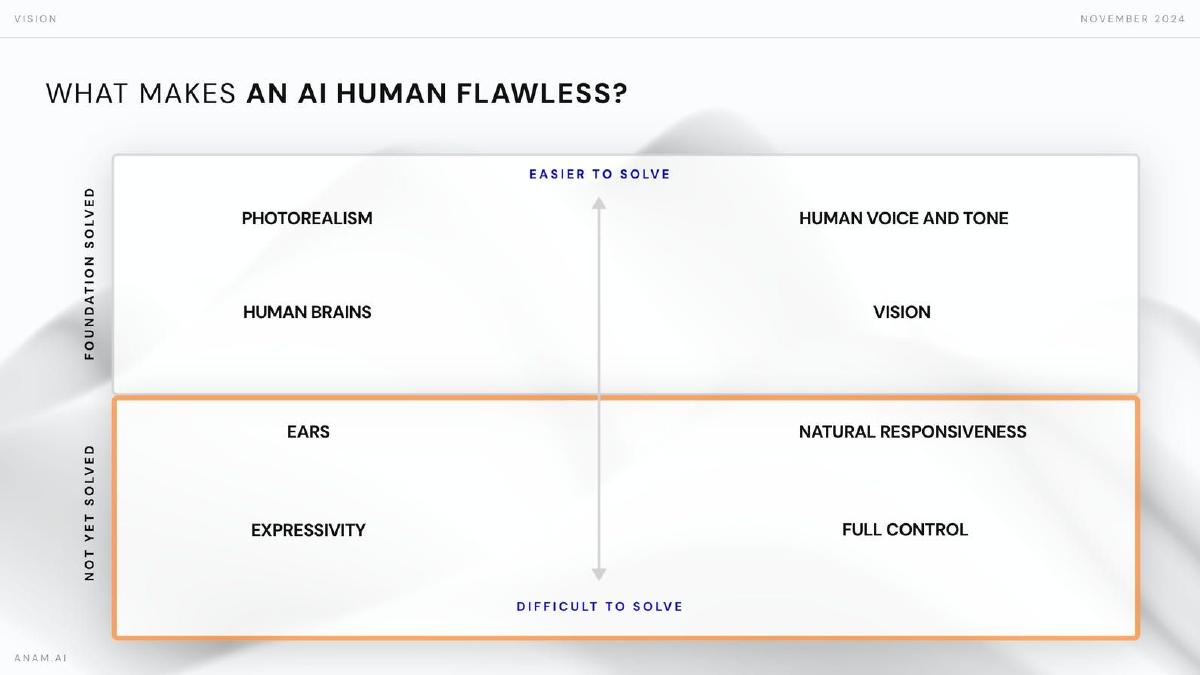
Slide 10 (labeled Slide 9 in the text) breaks down the components of an AI human. They categorize these into "Photorealism," "Human Voice and Tone," "Human Brains," and "Vision." Anam claims their specific focus—their "bets"—are on "Ears," "Natural Responsiveness," "Expressivity," and "Full Control." This is a sophisticated way of saying they aren't trying to build the LLM (the brain) or the voice (the tone) from scratch, but are instead building the "proprietary diffusion model" and "turn-taking prediction model" that allows the AI to react like a human in a live conversation. This indicates a modular approach where they can plug into existing LLMs while owning the interaction layer.
Market Application: The Use Case Gallery
Slides 11-18: Horizontal Versatility
The final half of the deck is a rapid-fire tour of potential applications. Slide 12 introduces the "Interview assistant," suggesting the tech can be used for practice or even conducting interviews. Slide 14 (labeled Slide 13) presents the "Learning Co-Pilot," where an AI persona summarizes text on a screen (shown as a Wikipedia page in the mockup). Slide 16 (labeled Slide 15) focuses on "Perfect your pitch," claiming a "28% increase in win rate" for sales reps who use AI personas to mimic prospects in a risk-free environment. Slide 18 (labeled Slide 17) moves into "AI scheduling" for healthcare or service industries, showing a mockup of a salon booking interface. Finally, Slide 18 (the last slide) discusses "Influence at scale," allowing creators to engage hundreds of community members simultaneously. This section demonstrates that while the technology is deep-tech, the market is broad and horizontal.
What Anam Does Well
Technical Positioning: The deck does an excellent job of identifying a specific, high-value problem (latency in expressive AI) and positioning the company as the only one solving it. By using a quadrant graph, they clearly articulate why existing market leaders aren't suitable for real-time interaction.
Visual Proof: The use of high-quality mockups across different devices (mobile on Slide 1, laptop on Slide 14) helps investors visualize the product as a finished commodity rather than just a research project. The UI in the mockups is clean and professional, reinforcing the 'premium' feel of the brand.
Team Credibility: Leveraging the Synthesia connection is a powerful move. In the AI space, investors look for founders who have already seen the 'inside' of a successful category leader. It reduces the perceived risk of the technical execution.
What is Missing from the Anam Deck
The Ask: There is no slide detailing how much money is being raised or how it will be spent. While we know from publisher reports that they raised $9M, a standard pitch deck usually includes a slide outlining the milestones the funding will help achieve (e.g., 'Scale to 50 enterprise pilots').
Business Model: The deck is silent on how Anam intends to make money. Is it a SaaS subscription? A per-minute API fee? A seat-based model for sales teams? Without this, it's hard to judge the scalability of the business.
Traction and Roadmap: There are no mentions of current customers, pilot programs, or a timeline for product release. The deck feels very much like a 'Day 0' or 'Day 1' pitch where the focus is entirely on the vision and the team's ability to build the tech.
Competitive Landscape: While they mention 'Competitor X, Y, and Z,' they don't name them. In a fast-moving field with players like HeyGen, Tavus, and Hume AI, a more direct competitive analysis would have helped clarify their unique moat.
Founder's Guide: What to Copy
The 'Three Bets' Framework: If you are building in a crowded space, don't just say you are 'better.' Use Slide 6's approach: identify the three specific technical or strategic choices you are making that others are not. It makes your 'secret sauce' feel tangible.
Use Case Segmentation: Anam doesn't just list industries; they show the product in action for each one. Copy the way they use mockups to tell a story—from a sales rep practicing a pitch to a student using a learning co-pilot. This helps investors who might not understand the tech to understand the utility .
Focus on the 'Hardest Components': Slide 10 is a great template for deep-tech founders. By acknowledging the parts of the problem you aren't solving (like the 'brain' or 'voice'), you show maturity and focus. It signals to investors that you aren't trying to boil the ocean, but rather dominate a specific, critical piece of the value chain.
Pedigree Mapping: If your team has worked at relevant industry giants, don't just list the company names. Use logos and specific roles to create an immediate visual association with success, as seen on Slide 8.
Frequently asked questions
- What is Anam's core value proposition?
- Anam aims to provide a 'human face' for digital products by creating AI humans that are indistinguishable from real people. Their core value lies in achieving real-time, expressive conversations, which they claim is a currently unsolved problem due to high latency and the 'uncanny valley' effect in existing AI video technologies.
- How does Anam differentiate itself from competitors like Synthesia?
- While the founders have roots at Synthesia, the deck differentiates Anam by focusing on 'Natural Responsiveness' and 'Full Control.' Slide 5 shows that while competitors might take minutes to generate video, Anam targets sub-1 second latency, enabling two-way, real-time conversation rather than just asynchronous video generation.
- What industries is Anam targeting?
- The deck outlines a horizontal strategy targeting several sectors. These include Sales (pitch practice and sales agents), Education (learning co-pilots and mentors), Healthcare/Admin (scheduling and check-ups), and Community Engagement (influencing at scale). They position the technology as a versatile interface applicable to any customer-facing role.
- What are the 'Three Key Bets' mentioned in the deck?
- According to Slide 6, Anam's technical strategy relies on three pillars: developing a custom diffusion model, training that model on specific proprietary data, and building custom infrastructure to support high-speed delivery. This suggests they are not just wrapping existing APIs but building a full-stack proprietary solution.
- Is there any evidence of product-market fit in the deck?
- The deck is primarily vision- and tech-focused. It lacks a slide dedicated to current traction, revenue, or specific pilot partners. However, it does cite a '28% increase in win rate' for sales reps on Slide 16, though it is unclear if this is a result of their specific pilot or a general industry statistic they aim to hit.