Everphone’s Series C deck is a sophisticated example of how to pitch a capital-intensive business by emphasizing software-enabled efficiency and superior unit economics. Raising $200M in 2021, the Berlin-based startup successfully framed the transition from device leasing to 'Phone-as-a-Service' as an inevitable shift similar to the rise of cloud computing. The deck excels at demonstrating 'stickiness' through churn analysis and highlights a 31% EBT margin based on 2023 cohort projections. By positioning their circular economy approach as both a sustainability win and a profitability driver,…
Key takeaways
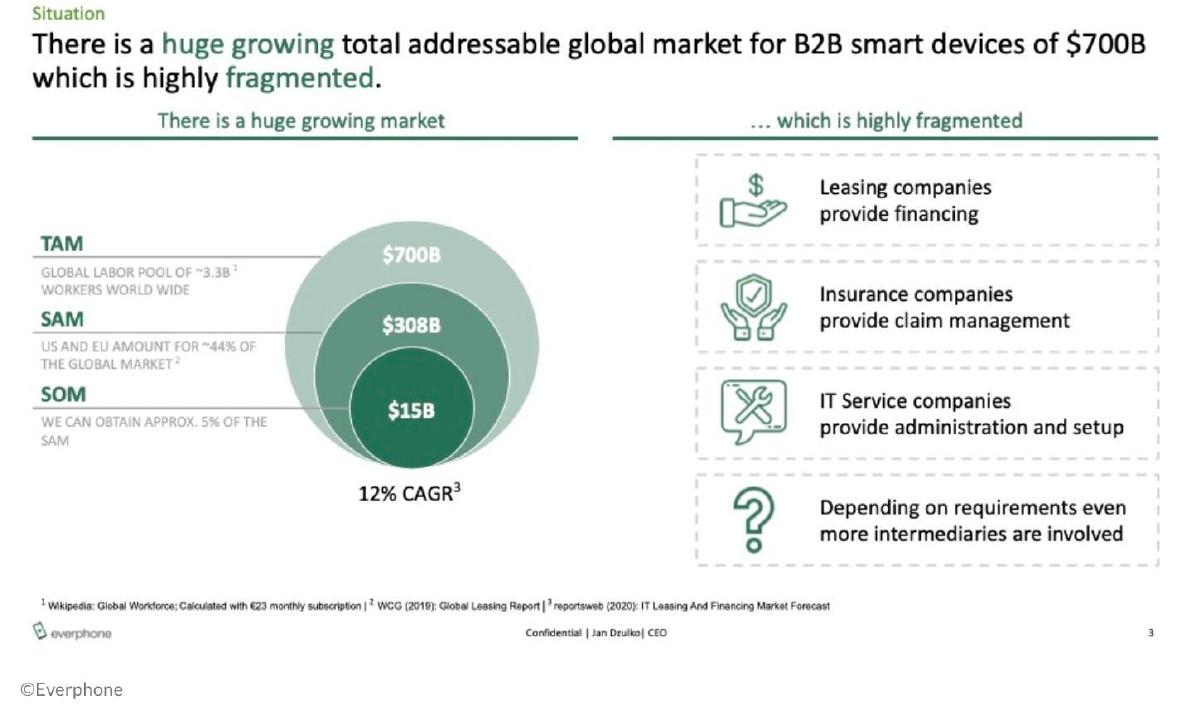
- The deck identifies a $700B total addressable market for B2B smart devices, growing at a 12% CAGR (Slide 3).
- Everphone positions itself as the 'cloud for smartphones,' claiming to be 4 years ahead of managed hosting competitors (Slide 7).
- The company emphasizes its 'software-enabled' nature, showing that the majority of its team is focused on analytics, tech, and operations rather than just sales (Slide 9).
- Unit economics are highly detailed, projecting a 31% EBT margin based on a €728 rental revenue and €184 residual value per device (Slide 11).
- Customer retention is exceptionally high, with only 2% churn out of 600+ customers, primarily due to client insolvencies rather than competition (Slide 13).
- The circular economy model is cited as a profitability driver, with 58kg of CO2 savings per refurbished device (Slide 15).
- The deck leverages high-profile social proof by featuring investors like Kevin Ryan (Founder of MongoDB) and Dr. Henrich Blase (Founder of CHECK24) (Slide 17).
- A notable omission is the lack of a dedicated internal management team slide, focusing instead on external board members and investors (Slide 17).
Slide 1-2: Title and Branding
The deck opens with a clean, professional cover slide establishing the brand identity. The tagline 'Phone-as-a-Service for Companies' immediately categorizes the business model. The date, June 2021, aligns with the reported Series C timing. The imagery of a smartphone with the company logo reinforces the product focus without unnecessary clutter.
Slide 3: The $700B Market Opportunity
Everphone sets the stage by defining a massive, fragmented market. They cite a Total Addressable Market (TAM) of $700B for B2B smart devices, calculated based on a global labor pool of 3.3 billion workers. The Serviceable Addressable Market (SAM) is narrowed to $308B (US and EU markets), and their Serviceable Obtainable Market (SOM) is a conservative $15B, representing 5% of the SAM. The slide highlights a 12% CAGR, indicating a growing tailwind. Crucially, the right side of the slide lists the 'fragmented' status quo: leasing companies, insurance, and IT service providers acting as disconnected intermediaries.
Slide 4-5: The Solution - Unclogging IT
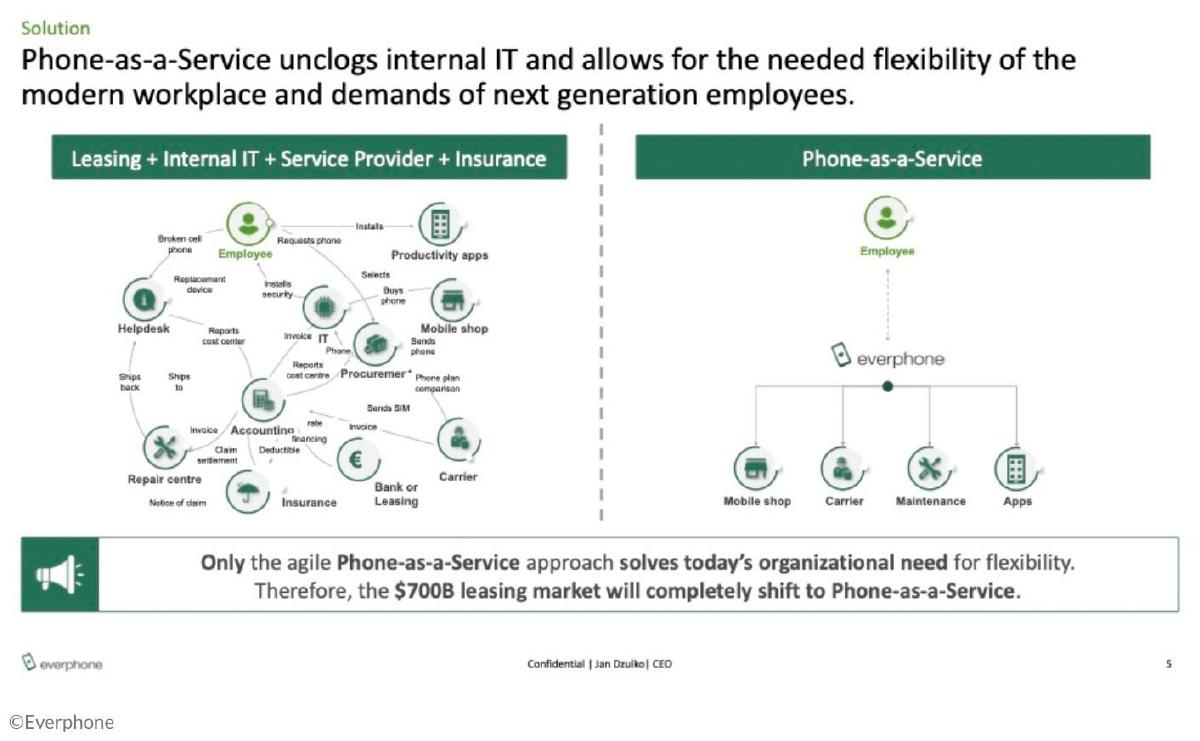
Slide 5 is a pivotal 'Before vs. After' visualization. The 'Leasing + Internal IT + Service Provider + Insurance' side shows a chaotic web of interactions involving employees, helpdesks, repair centers, and banks. In contrast, the 'Phone-as-a-Service' side shows Everphone as the central hub, streamlining all these functions. The slide explicitly states that the $700B leasing market will 'completely shift' to this agile service model, positioning Everphone as the primary beneficiary of this transition.
Slide 6-7: Timing and the Cloud Analogy
Everphone uses a powerful analogy on Slide 7: comparing the shift in smartphones to the shift in server hosting. They argue that just as cloud computing made server leasing obsolete in 2006 by offering flexibility and lower Total Cost of Ownership (TCO), Everphone is doing the same for mobile devices. They claim to be '4 years ahead of the competition,' which they define as managed hosting providers who still rely on traditional leasing structures. This framing elevates the business from a logistics play to a 'Cloud for Smartphones' tech play.
Slide 8-9: The Deep Moat of Software
To defend their valuation, Slide 9 argues that Everphone is a 'software-enabled company.' A donut chart shows that the majority of their focus is on 'Analytics, Product Innovation, Tech, and Operations' rather than just Sales and Marketing. They showcase their fully digitized service through mobile app screenshots and data visualizations. The 'Deep Moat' is their proprietary backend, which they claim makes the back office efficient and uses Business Intelligence (BI) to ensure they always have the best price information for devices.
Slide 10-11: Unit Economics and Profitability
Slide 11 is arguably the most important slide for a Series C round. It provides a granular breakdown of unit economics based on their 2023 cohort. For a single device, they project €728 in rental revenue plus €184 in residual value. Against a €490 CAPEX, they show a 46% gross margin (A1). After subtracting repairs (€55), CAC (€20), OPEX (€40), and Interest (€20), they arrive at a 31% EBT (Earnings Before Tax) margin. This level of transparency is designed to prove that the business scales profitably despite the high upfront costs of purchasing hardware.
Slide 12-13: Stickiness and Churn Analysis
Slide 13 addresses the 'Stickiness' of the service. With 600+ customers acquired, they report a remarkably low 2% churn rate. A flow chart breaks down the 13 churned customers: 12 were due to insolvencies (unintended) and only 1 was due to cost-cutting. This suggests that once a company integrates Everphone into their IT workflow, they rarely leave. They use EY (Ernst & Young) as a case study, noting that the client stayed beyond their 24-month contract into month 30 because reversing the integration would be too expensive for their IT department.
Slide 14-15: The Circular Economy and Sustainability
Slide 15 connects environmental impact with financial performance. Their business model is 'built upon circularity,' involving resource-saving procurement, lifetime extension, and reselling. They cite 58kg of CO2 savings per refurbished device. The 'kicker' on this slide is the note that major customers like EY actually want to keep equipment longer to meet their own CO2 reduction goals. This is a rare instance where a sustainability goal perfectly aligns with the startup's profitability, as longer rental periods on depreciated assets yield higher margins.
Slide 16-17: The Investors and Social Proof
Slide 17 showcases the 'amazing investors' supporting the company. Instead of a standard team slide featuring the founders' CVs, Everphone highlights its board and backers. This includes heavy hitters like Kevin Ryan (MongoDB founder) and Dr. Henrich Blase (CHECK24 founder), alongside institutional VCs like DTCP and Signals.vc. This slide serves to de-risk the investment by showing that sophisticated operators have already performed due diligence and committed capital.
Slide 18: Closing
The deck concludes with a simple contact slide, maintaining the green and white brand aesthetic established at the beginning.
What Everphone Does Well
Everphone excels at narrative reframing . By comparing their business to the rise of cloud computing (Slide 7), they move the conversation away from 'hardware rental' (a low-multiple business) toward 'infrastructure-as-a-service' (a high-multiple business). This is a critical distinction for a $200M round where valuation multiples are under intense scrutiny.
The unit economics transparency on Slide 11 is a masterclass in building investor confidence. They don't just show revenue; they show the entire lifecycle of the asset, including residual value and interest costs. This demonstrates that the management team has a firm grasp on the levers of their business and isn't just chasing top-line growth at the expense of margins.
Finally, the integration of ESG (Environmental, Social, and Governance) on Slide 15 is not just 'greenwashing.' They explicitly link CO2 savings to increased profitability. By showing that customer sustainability requirements lead to longer rental durations, they turn a potential liability (old hardware) into a high-margin asset.
What is Missing from the Deck
The most glaring omission is a Management Team slide . While Slide 17 shows impressive investors and board members, there is no information on the actual executive team running the day-to-day operations. Investors typically want to see the pedigree of the CTO, COO, and Head of Product, especially in a 'software-enabled' company.
There is also a lack of a detailed roadmap . While the unit economics are based on a 2023 cohort, the deck doesn't explicitly state what the $200M will be used for. Is it for international expansion, R&D for the software platform, or simply a massive CAPEX facility to buy more phones? A 'Use of Funds' slide is standard and missing here.
Lastly, the competitive landscape is addressed only vaguely. They mention 'managed hosting' and 'leasing companies' as the status quo, but they do not name specific competitors or provide a feature-by-feature comparison. In a Series C, investors usually expect to see how a company defends its territory against specific rivals.
What Founders Should Copy
Founders should emulate Everphone's 'Before and After' solution visualization (Slide 5). It takes a complex, multi-stakeholder problem and reduces it to a simple visual that anyone can understand. If your startup simplifies a messy process, this is the most effective way to communicate value.
The churn breakdown on Slide 13 is another excellent tactic. By showing that almost all churn was due to external factors (insolvencies) rather than dissatisfaction or competition, they prove 'product-market fit' more effectively than a simple retention percentage ever could.
Finally, the analogy-led timing slide (Slide 7) is a powerful tool for startups in 'unsexy' industries. If you are disrupting a traditional sector (like hardware leasing), finding a historical parallel in a 'sexy' sector (like cloud computing) helps investors visualize the scale and inevitability of your success.
Frequently asked questions
- What is Everphone's primary value proposition?
- Everphone offers 'Phone-as-a-Service,' which simplifies the procurement, management, and repair of mobile devices for companies. According to Slide 5, they replace a fragmented ecosystem of leasing companies, insurers, IT service providers, and carriers with a single, software-enabled platform that 'unclogs internal IT' and provides flexibility for employees.
- How does Everphone justify its unit economics?
- On Slide 11, the company breaks down its 2023 cohort assumptions. They generate €728 in rental revenue and €184 in residual value against a €490 CAPEX cost. After accounting for repairs (11% of CAPEX), CAC (4%), and OPEX (8%), they claim a 38% gross margin and a 31% EBT margin, demonstrating a sustainable path to profitability.
- What is the 'Deep Moat' mentioned in the deck?
- The moat is defined on Slide 9 as 'software and process automation.' Everphone presents itself as a software-enabled company rather than a hardware rental firm. Their proprietary backend handles BI for price information and automates the back office, which they claim ensures availability and efficiency that competitors cannot match.
- How does the company address sustainability?
- Slide 15 outlines a circular economy approach where devices are refurbished and reused. They cite 58kg of CO2 savings per device. Crucially, they note that customers like EY want to keep equipment longer to reduce their footprint, which directly increases Everphone’s profitability by extending the revenue-generating life of the asset.
- Who are the key investors backing Everphone?
- Slide 17 lists several prominent figures and firms, including Kevin Ryan (Founder of MongoDB), Dr. Henrich Blase (Founder of CHECK24), Jens Lapinski (CEO of Angel Invest Ventures), and institutional backers like DTCP and Signals.vc. This high-level social proof was likely critical for their $200M Series C round.