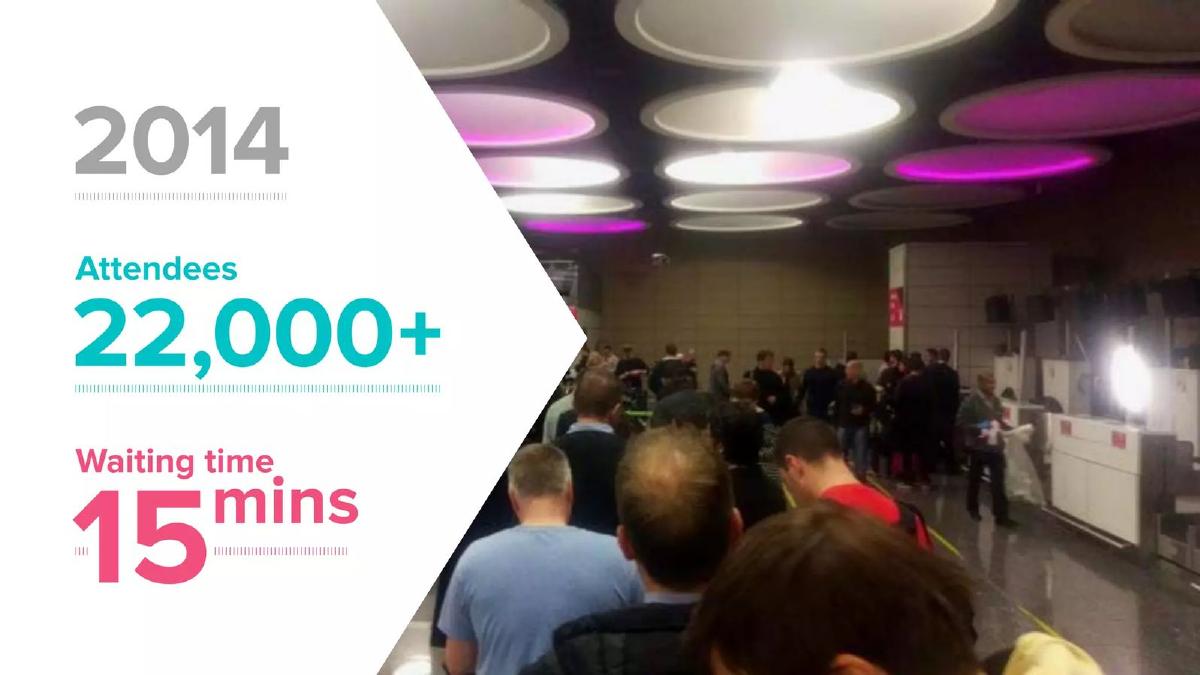
EventX's 2017 seed deck is a masterclass in visual storytelling and momentum. By utilizing a dramatic 'before and after' sequence—contrasting a 15-minute registration wait time in 2014 with a 15-second wait in 2015—the founders made the value proposition undeniable. The deck supports this narrative with aggressive financial data, specifically a 36% month-over-month growth rate and a roster of prestigious clients including Apple, Facebook, and Alibaba. While the deck lacks a formal team slide and detailed unit economics, its focus on massive market inefficiency (75% of the $5.4B market still u…
Key takeaways
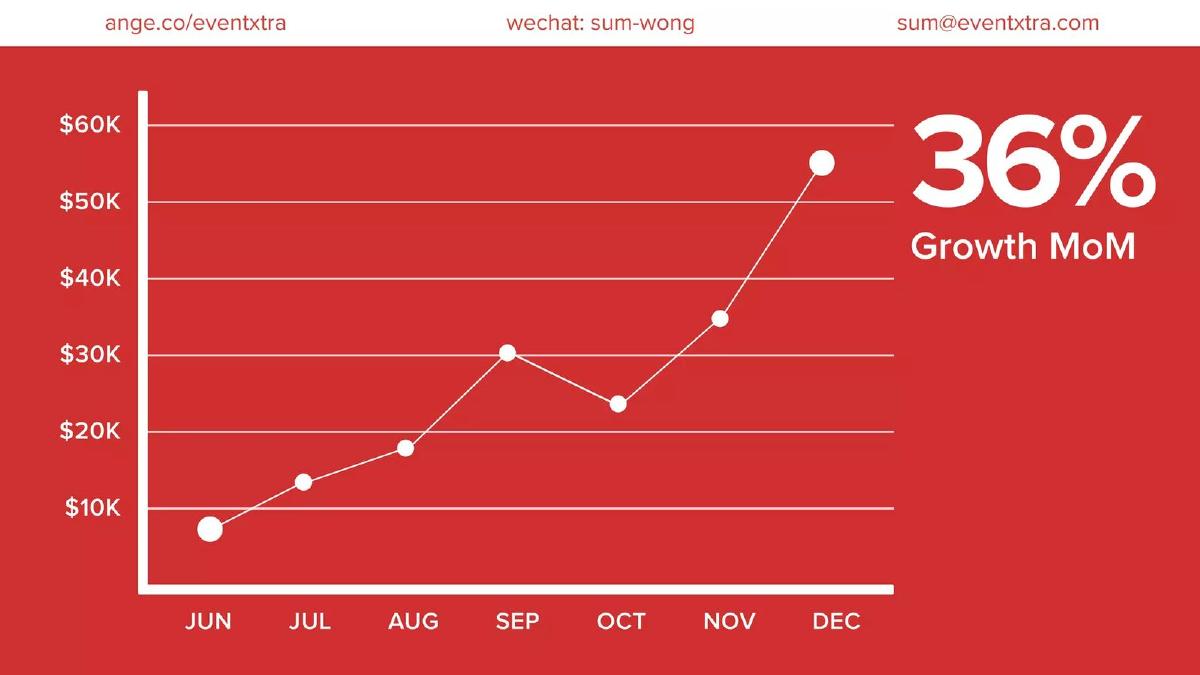
- The deck opens with a high-momentum traction slide showing 36% Month-over-Month growth (Slide 2).
- A visceral 'Problem vs. Solution' narrative is established by comparing a crowded 2014 registration line to an efficient 2015 setup (Slides 4-8).
- The product is positioned as a 'One-Stop' platform covering Pre-Event, In-Event, and Post-Event workflows (Slide 9).
- Market sizing highlights a $5.4B Global Event Software Market, noting that 75% of the industry still uses manual processes (Slides 11-12).
- Social proof is exceptionally strong, featuring logos from Apple, Facebook, Yahoo, and Alibaba (Slide 13).
- The deck quantifies its impact with specific metrics: 100+ companies, 1,000+ events, and 500,000+ attendees (Slides 14-16).
- There is a notable absence of a dedicated team slide, which is unusual for a seed-stage deck.
- No specific 'Ask' or use of funds slide is included in this version of the presentation.
The Hook: Leading with Momentum
Slide 1: Title Slide
The deck opens with a simple, high-contrast title slide. The logo for EventXtra (now EventX) is centered over a red-tinted photograph of a corporate event. The tagline, "We Make Corporate Events Simple and Impactful," immediately defines the target audience (Corporate) and the value proposition (Simplicity and Impact).
Slide 2: Traction and Growth
Unusually, EventX moves straight to traction. Slide 2 features a line graph showing revenue or usage growth from June to December. The headline metric is "36% Growth MoM" (Month-over-Month). The graph shows a steady climb from under $10K to over $50K. By placing this second, the founders are signaling that they have already found product-market fit and are in a scaling phase. Contact details for Sum Wong are included in the header, a recurring element throughout the deck.
The Problem: A Visceral Demonstration
Slide 3-4: The Setting
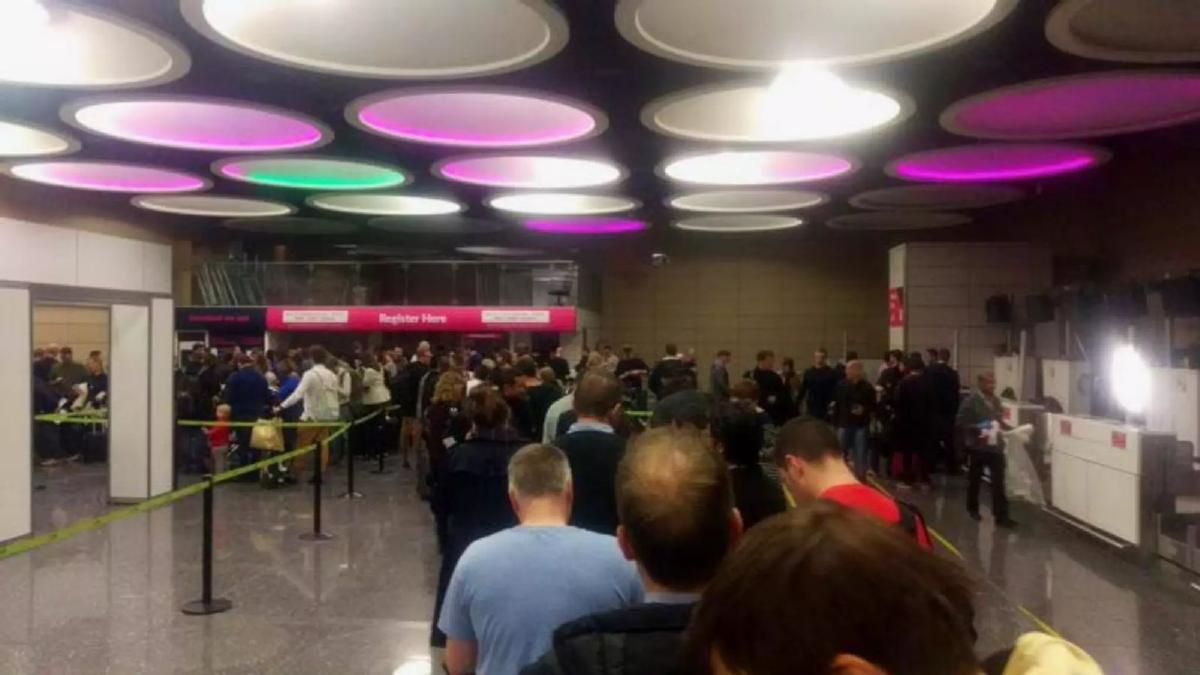
Slide 3 identifies Web Summit as the "BIGGEST Tech Event In Europe." Slide 4 is a full-bleed photograph of a massive, disorganized queue at a registration desk. There is no text on Slide 4, allowing the visual of the 'pain point'—the long line—to speak for itself.
Slide 5-6: Quantifying the Pain
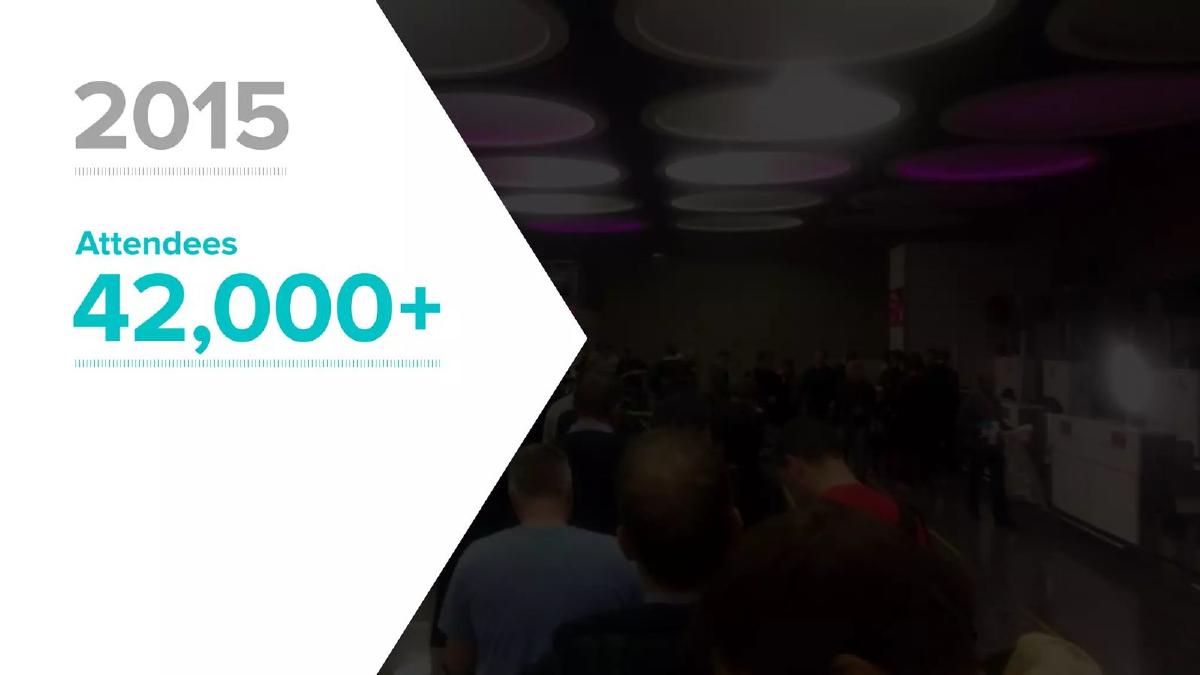
Slide 5 adds data to the visual: "2014 | Attendees 22,000+ | Waiting time 15 mins." This establishes the baseline problem. Slide 6 shows the growth of the event to "42,000+" attendees in 2015, implying that the problem of long wait times would naturally worsen as the event scales.
Slide 7-8: The Solution in Action
Slide 7 shows a new photograph: a clean, organized registration area with empty stanchions and efficient staff. Slide 8 provides the 'After' metrics: "2015 | Attendees 42,000+ | After using EventXtra Waiting time 15 secs." This is a powerful 60x improvement in efficiency. By using a real-world, high-profile example like Web Summit, EventX proves its software can handle extreme scale.
The Product: A Comprehensive Ecosystem
Slide 9: One-Stop Platform
Slide 9 moves from the specific registration use case to the broader platform. It labels EventX as a "One-Stop Event Management Platform." It breaks the event lifecycle into three phases: Pre-Event, In-Event, and Post-Event. Visuals show the software running on a desktop (analytics dashboard), a tablet (check-in list), and a mobile phone, alongside a hardware badge printer. This positions the company as a full-stack solution rather than a single-feature tool.
The Market: The Digital Transformation Opportunity
Slide 10-11: Market Size
Slide 10 notes there are "5M Corporate Events Worldwide, Annual." Slide 11 quantifies the financial opportunity as a "$5.4B Global Event Software Market." These are standard TAM (Total Addressable Market) slides that establish the ceiling for the business.
Slide 12: The Inefficiency Gap
Slide 12 is the 'Why Now' slide. It uses a pie chart to show that while the market is $5.4B, "75% Still using manual process." This is the core of the investment thesis: EventX isn't just fighting for existing software spend; it is capturing the massive transition from paper and spreadsheets to digital workflows.
Social Proof and Scale
Slide 13: The Logo Wall
Slide 13 is a high-density logo wall. It includes global giants like Apple, Facebook, Yahoo, Alibaba Group, Bloomberg, McKinsey & Company, and Deloitte. For a seed-stage company, this level of enterprise adoption is exceptional and serves as the primary de-risking mechanism for investors.
Slide 14-16: Cumulative Impact
The deck concludes with a build-up of total traction. Slide 14 claims "100+ Companies," Slide 15 adds "1000+ Events," and Slide 16 hits the final big number: "500,000+ Attendees." This progression demonstrates that the Web Summit success wasn't a one-off, but a repeatable result across a large customer base.
Slide 17: Closing
The final slide repeats the tagline and provides contact information for Sum Wong, including an email and WeChat ID. It also directs investors to their AngelList profile.
What EventX Does Well
Visual Storytelling: The use of photography to show the 'before and after' of a registration line is far more effective than a bulleted list of features. It makes the problem visceral and the solution's impact obvious.
Momentum: Leading with 36% MoM growth (Slide 2) sets a high-energy tone for the rest of the deck. It tells the investor that the 'train is leaving the station.'
Enterprise Validation: The logo wall on Slide 13 is elite. Having Apple and McKinsey as users for a seed-stage startup suggests a product that meets very high security and professional standards.
What is Missing from the Deck
The Team Slide: This is the most glaring omission. In a seed round, investors are primarily betting on the founders. This deck provides no information on the founders' backgrounds, previous exits, or technical expertise.
Business Model and Unit Economics: While we know from catalogue facts that this is a SaaS model, the deck does not explain the pricing tiers, Average Contract Value (ACV), or Customer Acquisition Cost (CAC). Investors would need to see how that 36% growth translates into long-term profitability.
The Ask: The deck does not state how much money is being raised or how the funds will be allocated (e.g., 50% engineering, 30% sales). This information was likely reserved for the verbal pitch or a follow-up data room.
Competition: There is no competitive landscape slide. The events space is crowded (Cvent, Eventbrite, etc.), and failing to address how EventX differentiates from these incumbents is a missed opportunity to define their 'moat.'
Founder's Guide: What to Copy
The 'Before and After' Slide: If your product solves a physical or visible inefficiency, use photos. Showing a 15-minute wait vs. a 15-second wait is an unarguable value proposition.
The Inefficiency Pie Chart: Slide 12 is brilliant. Don't just show the market size; show how much of that market is still 'stuck in the stone age.' Investors love 'analog-to-digital' plays because the value add is clear.
Header Contact Info: Including the founder's email and WeChat on every single slide header ensures that no matter where an investor stops or takes a screenshot, they know how to reach the lead.
Frequently asked questions
- How much did EventX raise with this deck?
- According to catalogue facts from failory.com, EventX raised $1.12M in a Seed round in 2017. The deck itself does not state the amount being raised, which is common in decks shared publicly after a round closes.
- What is the most effective part of the EventX deck?
- The 'Before and After' sequence (Slides 4-8) is the most effective. It uses real photography of event registration lines to show that their software reduced wait times from 15 minutes to 15 seconds. This provides a tangible, emotional hook for investors.
- Who are EventX's primary customers?
- The deck targets the B2B corporate event market. Slide 13 showcases a high-tier client list including McKinsey & Company, Deloitte, Bloomberg, and The Economist, indicating a focus on enterprise-level corporate clients.
- Is there a team slide in the EventX pitch deck?
- No. This specific 17-slide deck omits a team slide. While the contact information for Sum Wong is provided on the final slide, the lack of founder backgrounds is a significant omission for a seed-stage teardown.
- What market opportunity does EventX identify?
- EventX identifies a $5.4B Global Event Software Market (Slide 11). Crucially, Slide 12 points out that 75% of the market is still using manual processes, representing a massive opportunity for digital transformation.