Eureka Health’s 12-slide seed deck presents a compelling case for centralizing the fragmented world of patient-reported health outcomes. By aggregating data from public forums like Reddit and building proprietary communities for conditions like Long Covid and ME/CFS, the company aims to create a high-fidelity data engine for the pharmaceutical industry. The deck successfully bridges the gap between a consumer-facing community product and a B2B data play, leveraging the personal narrative of the CEO’s mother to ground the mission. While the deck is light on specific financial projections or cu…
Key takeaways
- The platform aggregates data from public communities like Reddit to kickstart insights for underserved chronic conditions (Slide 5).
- A significant market opportunity is identified by the fact that 51% of US adults have at least one chronic disease (Slide 7).
- The business model focuses on generating $100M ARR by creating large-scale real-world data (RWD) for safety and efficacy studies (Slide 9).
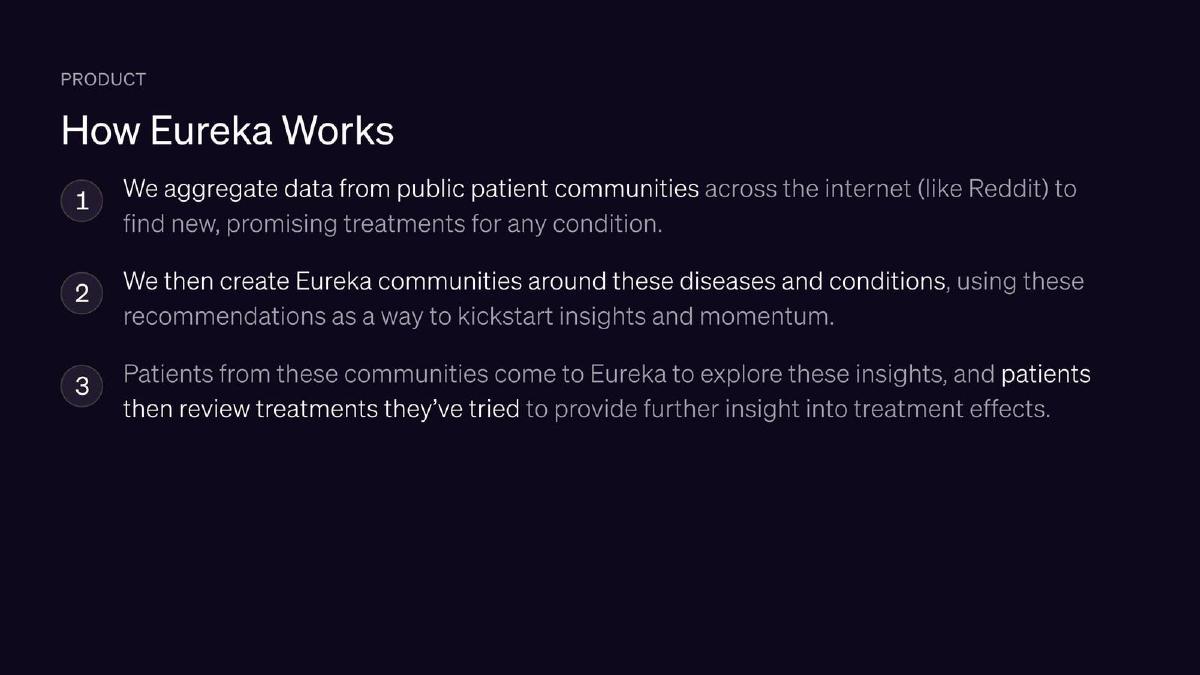
- The product strategy involves a three-step loop: aggregate public data, create Eureka communities, and facilitate patient reviews (Slide 5).
- The founding team highlights a mix of consumer product experience (Bumble, FB) and deep healthcare expertise (Slide 10).
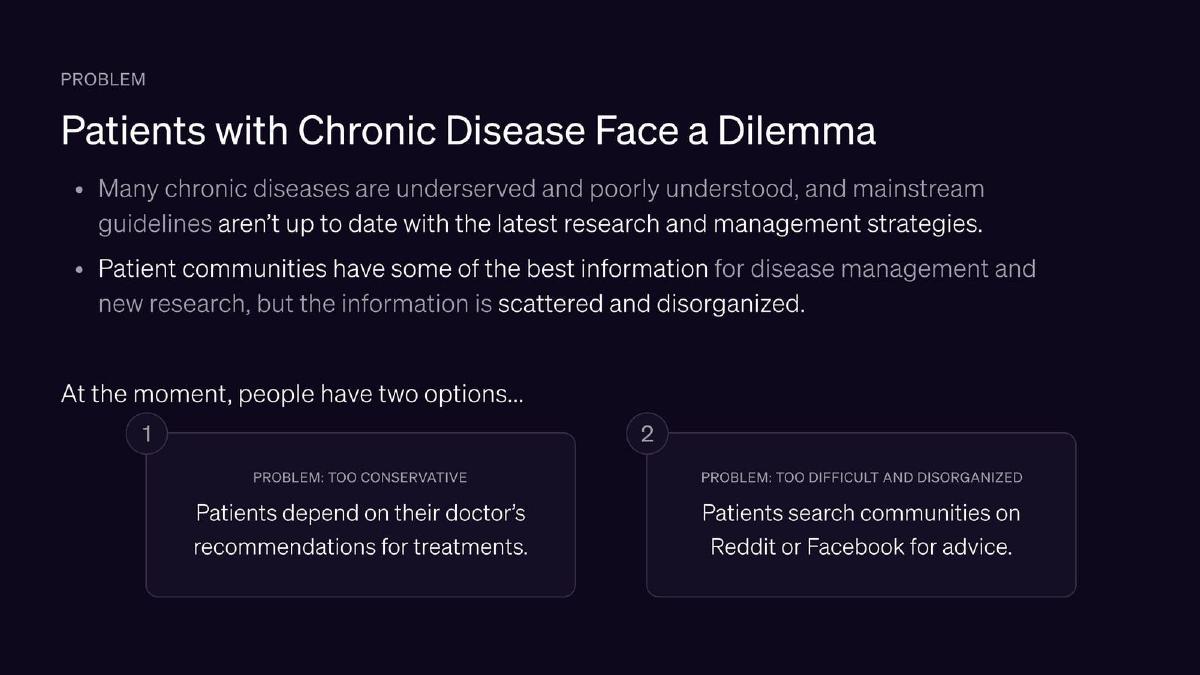
- The deck identifies a 'dilemma' where patients currently choose between conservative doctor recommendations or disorganized social media advice (Slide 3).
- Eureka positions itself as a 'privacy-first' platform to build trust within sensitive patient communities (Slide 8).
- The 'Why Now' is driven by the personal experience of the CEO’s mother being diagnosed with Multiple System Atrophy (Slide 7).
The Strategy of Structured Sentiment
Eureka Health’s pitch deck is a masterclass in identifying a 'gray market'—in this case, the millions of patients seeking medical advice on Reddit—and proposing a way to institutionalize it. The deck, used to raise a $7M Seed round in 2023, moves quickly from a personal 'Why' to a massive 'How,' positioning the company as a data bridge between patient experience and pharmaceutical research. In a healthcare landscape often dominated by rigid clinical trials, Eureka argues that the most valuable data is currently scattered across disorganized social forums.
Slide 1: The Product Vision
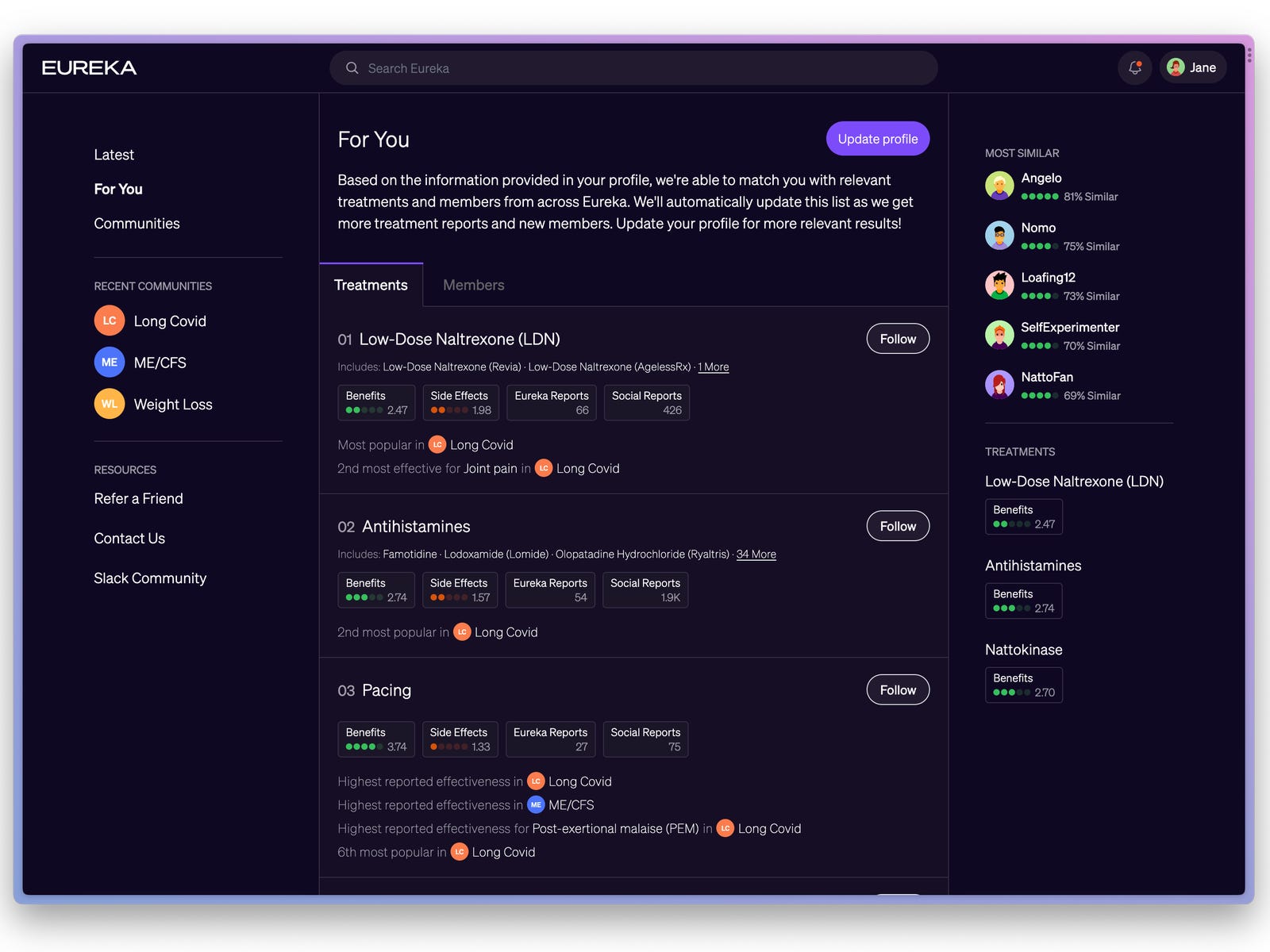
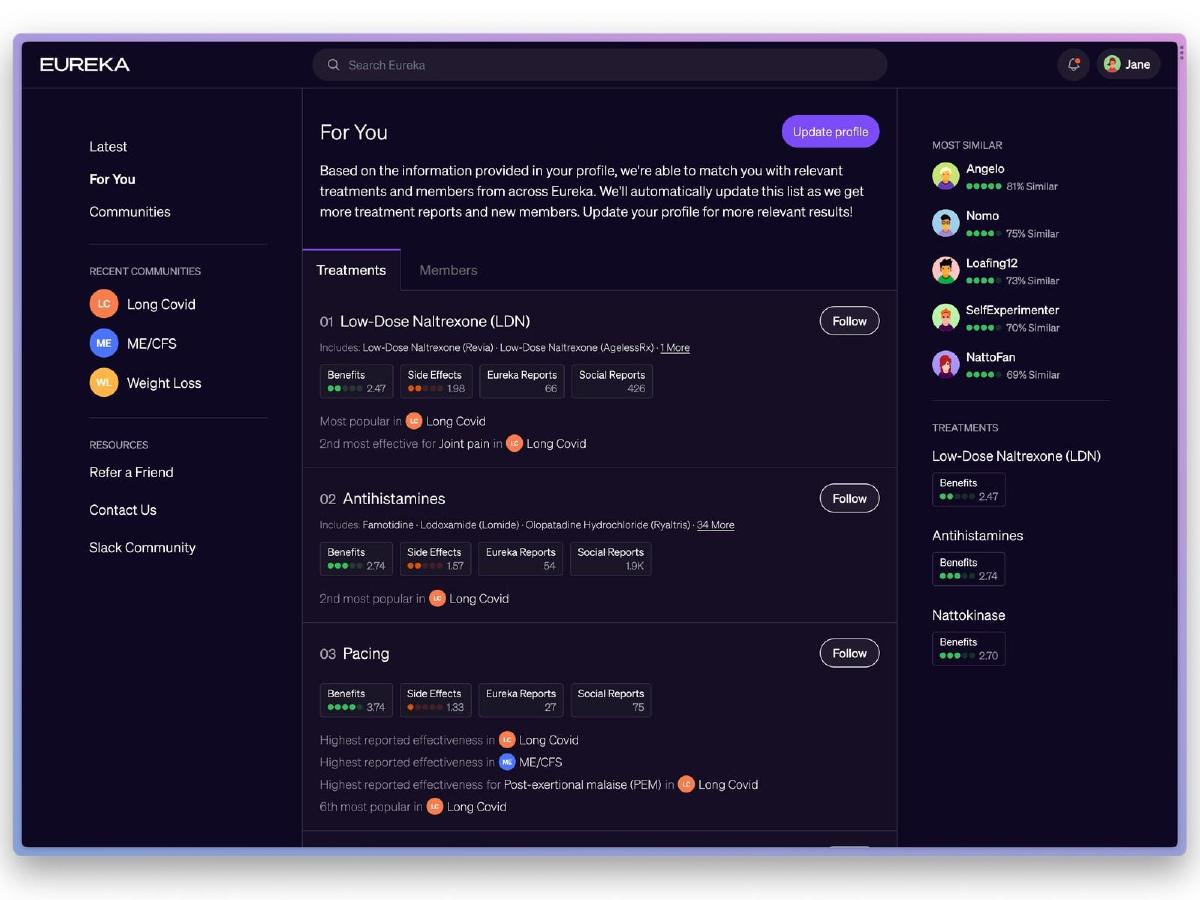
The deck opens with a high-fidelity mockup of the Eureka platform. This 'For You' page immediately communicates the product's value proposition: personalization. It shows a list of treatments like Low-Dose Naltrexone (LDN) and Antihistamines, ranked by 'Benefits' and 'Side Effects' scores. Crucially, it displays 'Eureka Reports' alongside 'Social Reports,' signaling that the platform is already aggregating external data. The sidebar showing 'Most Similar' members introduces the social proof element, suggesting an algorithmic approach to patient matching.
Slide 2 & 3: The Chronic Disease Dilemma
Slide 2 serves as the formal title, while Slide 3 dives into the core problem. The 'dilemma' is framed as a binary choice: doctors who are 'too conservative' and out of sync with the latest research, or social media groups that are 'too difficult and disorganized.' By framing the problem this way, Eureka creates a vacuum that only a structured, AI-powered platform can fill. It acknowledges that patient communities have the 'best information' but lacks the infrastructure to make that information actionable.
Slide 4 & 5: The Solution and Mechanism
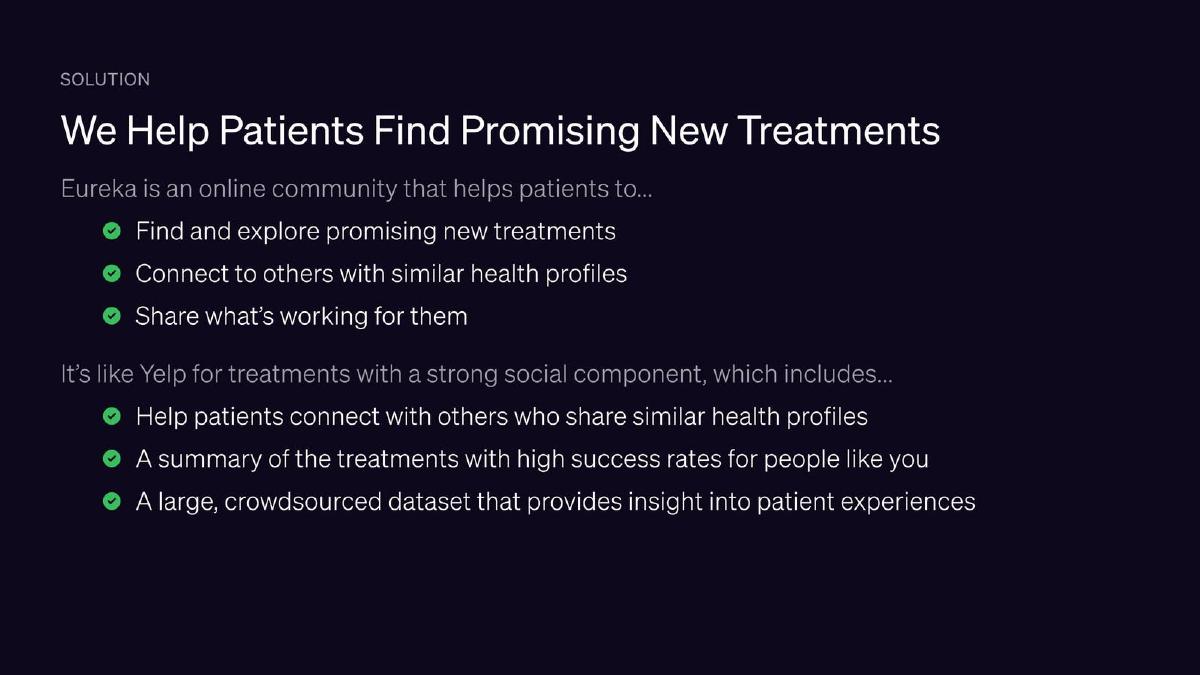
Slide 4 is a simple transition slide stating the mission: helping patients find promising new treatments. Slide 5, titled 'How Eureka Works,' is the most important operational slide in the deck. It outlines a three-step flywheel: 1) Aggregate public data from Reddit to find treatments, 2) Create Eureka-specific communities to kickstart momentum, and 3) Have patients review treatments to provide deeper insights. This 'cold start' strategy—using scraped data to build the initial value—is a clever way to bypass the typical chicken-and-egg problem of new social networks.
Slide 6: The AI-Powered Community
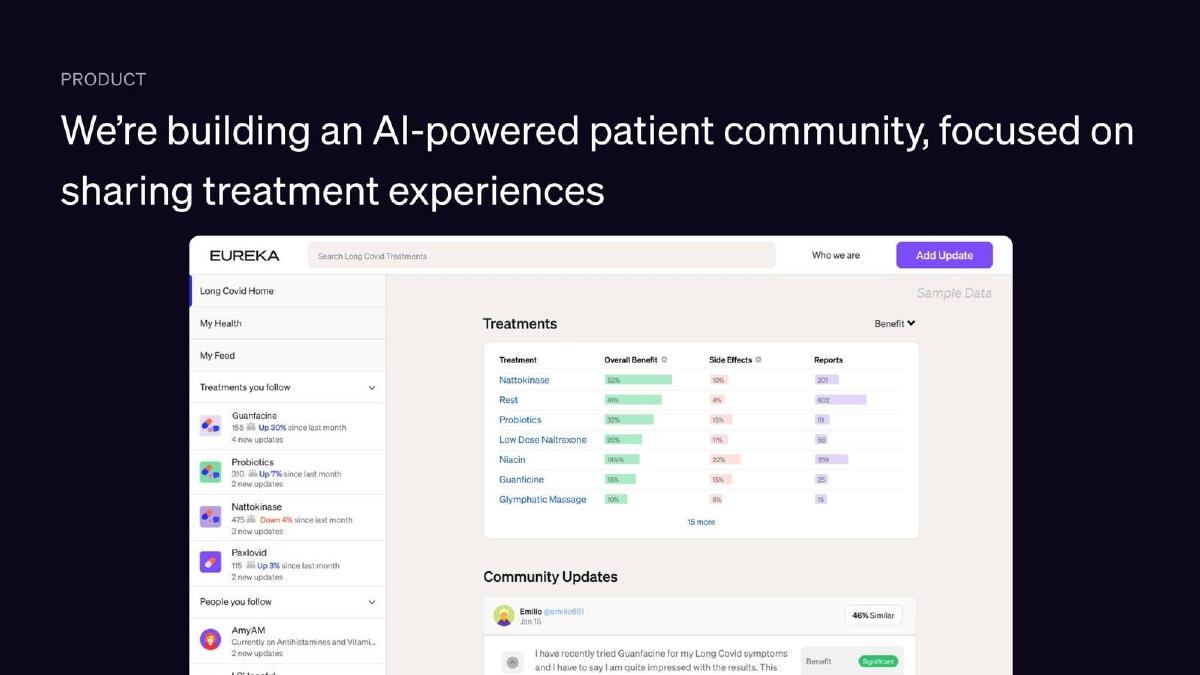
This slide reinforces the 'AI-powered' nature of the community. While it doesn't go into technical detail about the LLMs or data processing involved, it emphasizes the goal: sharing treatment experiences. The focus here is on the transition from a passive data aggregator to an active, proprietary community where the data quality is higher because it is structured from the point of entry.
Slide 7: The 'Why Now' and Personal Narrative
Slide 7 grounds the business in a personal story. The CEO, Zain, mentions his mother’s diagnosis with Multiple System Atrophy (MSA). This adds emotional weight to the mission, which is often necessary in healthcare investing to demonstrate founder-market fit. The slide also provides a critical macro statistic: 51% of US adults have at least one chronic disease, and 27% have two or more. This justifies the scale of the 'underserved' market Eureka is targeting.
Slide 8: The Trust Factor
In healthcare tech, privacy is the primary hurdle for user adoption. Slide 8 addresses this head-on with the mantra 'patient-first. privacy-first. forever.' While it lacks specific details on HIPAA compliance or data encryption methods, the inclusion of this slide is a strategic necessity to reassure investors that the founders are aware of the regulatory and ethical risks associated with patient data.
Slide 9: The Path to $100M ARR
Slide 9 is the 'Big Company' slide. It moves the conversation from a consumer app to a B2B data powerhouse. The three pillars of monetization are: 1) Large-scale real-world data (RWD) for safety and efficacy, 2) Direct patient engagement for surveys and focus groups, and 3) Clinical trial recruitment. This is a standard but effective roadmap for healthtech startups, showing that the 'free' consumer community is actually a supply-side engine for high-value pharmaceutical contracts.
Slide 10 & 11: Team and Advisors
The team slides are designed to project competence across two disparate worlds: consumer tech and deep medicine. Slide 10 highlights 'consumer product and healthcare expertise,' while Slide 11 lists the specific pedigree. With alumni from Harvard Med, Oxford, and Y-Combinator, plus design experience from high-growth apps like Bumble, the team appears uniquely qualified to build a product that is both medically sound and highly engaging. The advisors from UC Davis and Tempus add the necessary clinical 'gravitas' to the pitch.
Slide 12: Contact Information
The deck concludes with a simple contact slide for the CEO. It is a standard, clean ending to a deck that prioritizes clarity and narrative flow over dense data tables.
What Eureka Health Does Well
The deck excels at narrative framing . By positioning the current state of patient research as a 'dilemma' between two bad options, they make their solution feel inevitable. The use of a flywheel strategy on Slide 5 is also a highlight; it shows investors that the company has a plan to generate value on day one by scraping public data, rather than waiting for a million users to sign up and post content. Furthermore, the monetization slide (Slide 9) clearly connects the dots between a 'community' and a 'big company,' which is often where social-impact startups fail to convince venture capitalists.
What is Missing from the Deck
The most notable omission is traction metrics . While the deck shows what the product can do, it doesn't state how many users are currently on the platform, the volume of data already aggregated, or any early engagement stats from the Long Covid or ME/CFS communities. Additionally, there is no financial ask or use-of-funds slide. While we know from external reports that they raised $7M, a standard pitch deck usually specifies what that capital will buy (e.g., '18 months of runway to reach 50k active users'). Finally, there is a lack of competitive analysis . Companies like PatientsLikeMe have attempted similar models in the past; explaining why Eureka’s AI-first approach will succeed where others struggled would have strengthened the case.
Founder's Guide: What to Copy
Use a 'Cold Start' Slide: If you are building a community or marketplace, copy Slide 5. Show how you will generate value before you have a massive user base. Using public data to 'kickstart insights' is a great way to show immediate utility. Balance Emotion with Economics: Follow the example of Slide 7 and Slide 9. Use a personal story to explain why you care, but immediately follow it up with a slide explaining how you will make $100M. Investors need to see both the heart and the spreadsheet. Pedigree Mapping: If your team has diverse backgrounds, use Slide 10’s approach. Group your team by 'expertise types' (e.g., 'Consumer Product' vs. 'Healthcare') rather than just a list of names. This tells a story about the collective 'brain' of the company and how it covers all necessary bases for the specific industry.
Frequently asked questions
- How does Eureka Health plan to make money?
- According to Slide 9, the company aims to reach $100M ARR by monetizing the data generated by its communities. This includes creating large-scale real-world data on treatment safety and efficacy, engaging patients for surveys and focus groups to inform new products, and providing opportunities for patients to enroll in clinical trials and research studies.
- What specific chronic conditions does Eureka Health target?
- While the deck mentions the platform can work for 'any condition,' the mockups and text specifically highlight Long Covid, ME/CFS (Myalgic Encephalomyelitis/Chronic Fatigue Syndrome), Weight Loss, and Multiple System Atrophy (MSA). Slide 1 shows a community interface specifically tailored for these high-intent, underserved patient groups.
- What is the 'dilemma' Eureka Health claims to solve?
- Slide 3 defines the dilemma as a choice between two suboptimal options: depending on doctors whose guidelines are often not up to date with the latest research, or searching disorganized communities on Reddit and Facebook for advice. Eureka aims to be the middle ground that provides structured, research-backed patient insights.
- Who are the key people behind Eureka Health?
- The team includes CEO Zain (whose personal story is featured), Head of Ops Sina Hartung (Oxford/Harvard Med), Lead Engineer George Hosu (Ex-YC), and Design Lead Cassius Kiani (Bumble/FB). Advisors include faculty from UC Davis and executives from Tempus and Cancer Commons, as shown on Slide 11.
- Does the deck include a financial 'Ask' or valuation?
- No. The 12-slide deck provided does not include a slide detailing the amount of capital being raised, the valuation, or the specific use of funds. However, publisher-reported facts indicate the company successfully raised a $7M Seed round in 2023 following this presentation.