Etymo is a discovery platform designed to help researchers navigate the overwhelming volume of AI literature. The deck emphasizes a technical solution to the 'information overload' problem, citing that over 500 papers are published weekly in the field. By utilizing a ranking algorithm that incorporates social data and links papers without relying solely on traditional citation metrics, Etymo attempts to outperform generalist tools like Google Scholar. The deck is notably heavy on academic credentials, featuring a team primarily composed of PhDs from Manchester, Oxford, and Cambridge. However,…
Key takeaways
- The problem is defined by the volume of AI research, specifically citing '> 500 papers per week' on Slide 2.
- The platform claims to have indexed over 30,000 AI papers with daily updates, according to Slide 7.
- Etymo differentiates itself from Google Scholar by focusing on 'newly available papers' rather than historical archives (Slide 5).
- The technical core involves linking papers without citation data and using a 'powerful ranking algorithm' (Slide 4).
- The team is highly academic, featuring three PhDs in Applied Mathematics and one Master's in Applied Mathematics (Slide 8).
- The deck includes a visual product demo showing a 'Different view of a paper' through a node-based visualization (Slide 6).
- There is no mention of a business model, pricing, or how the company intends to generate revenue.
- The deck omits a 'The Ask' slide, leaving the desired investment amount and valuation unknown.
Slide-by-Slide Analysis
Slide 1: Title Slide
The deck opens with the Etymo logo and the tagline: "The best platform for discovering AI research." It includes the URL etymo.io . The design is minimalist, using a dark background with blue and white text. It clearly defines the niche (AI research) but does not provide a broader vision statement.
Slide 2: The Problem (Volume)
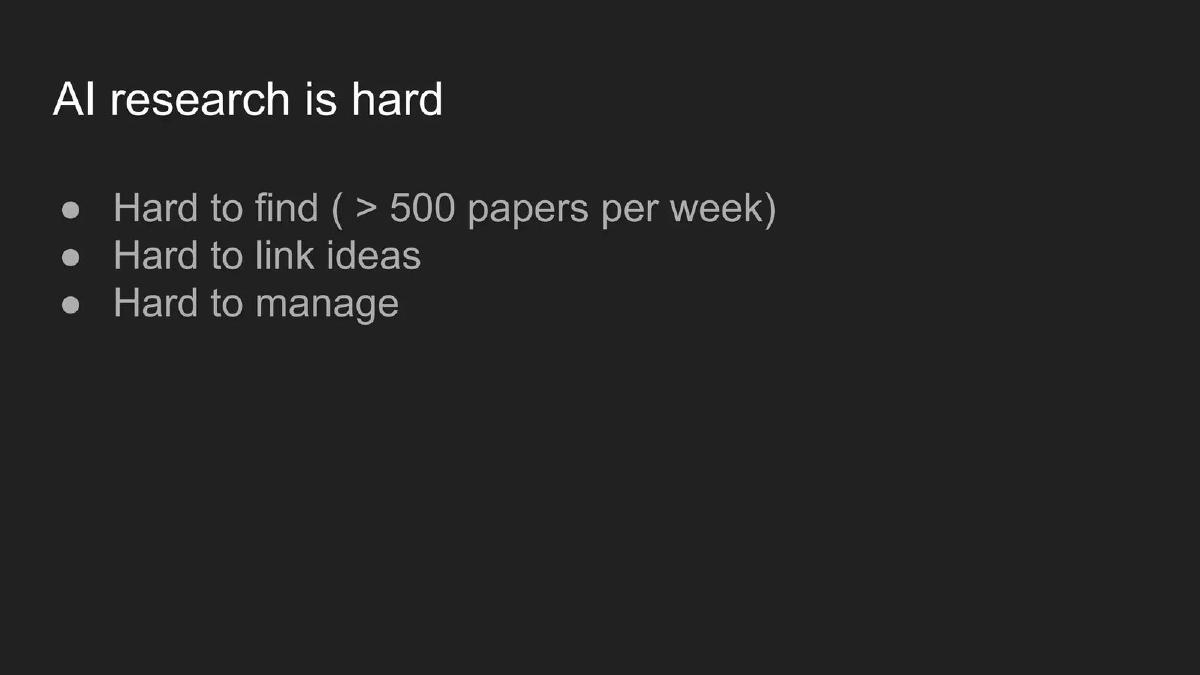
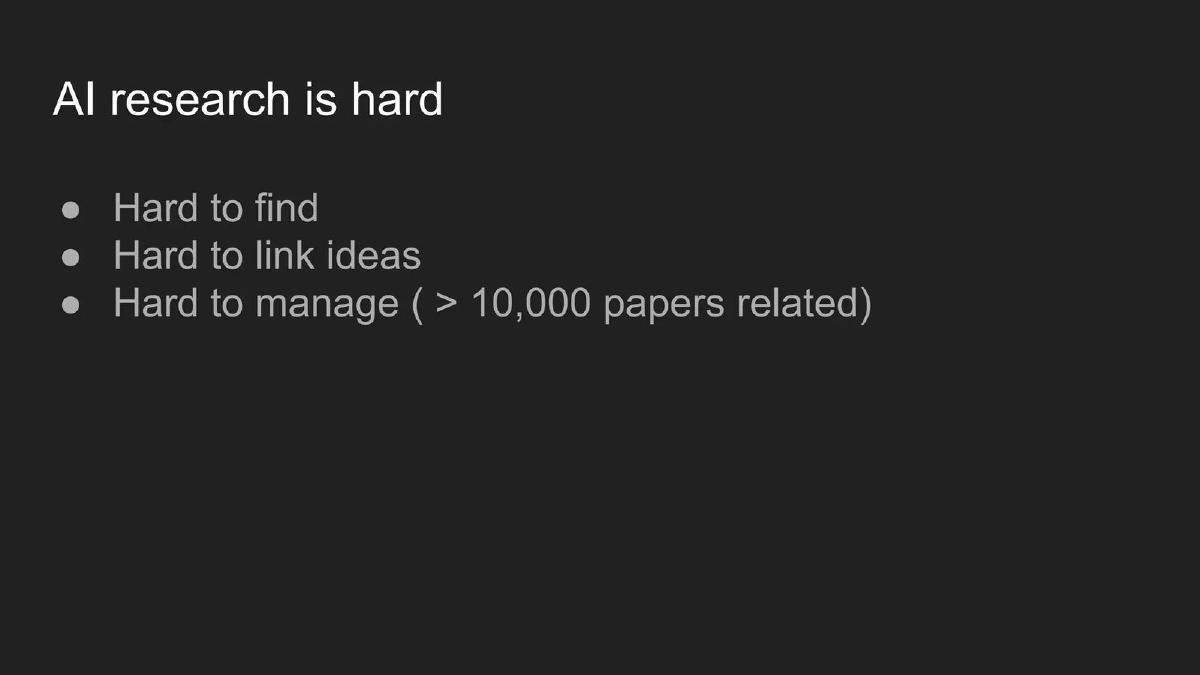
Titled "AI research is hard," this slide identifies three pain points: "Hard to find," "Hard to link ideas," and "Hard to manage." It provides a specific metric for the discovery problem: "> 500 papers per week." This establishes the 'information overload' narrative common in specialized search startups.
Slide 3: The Problem (Scale)
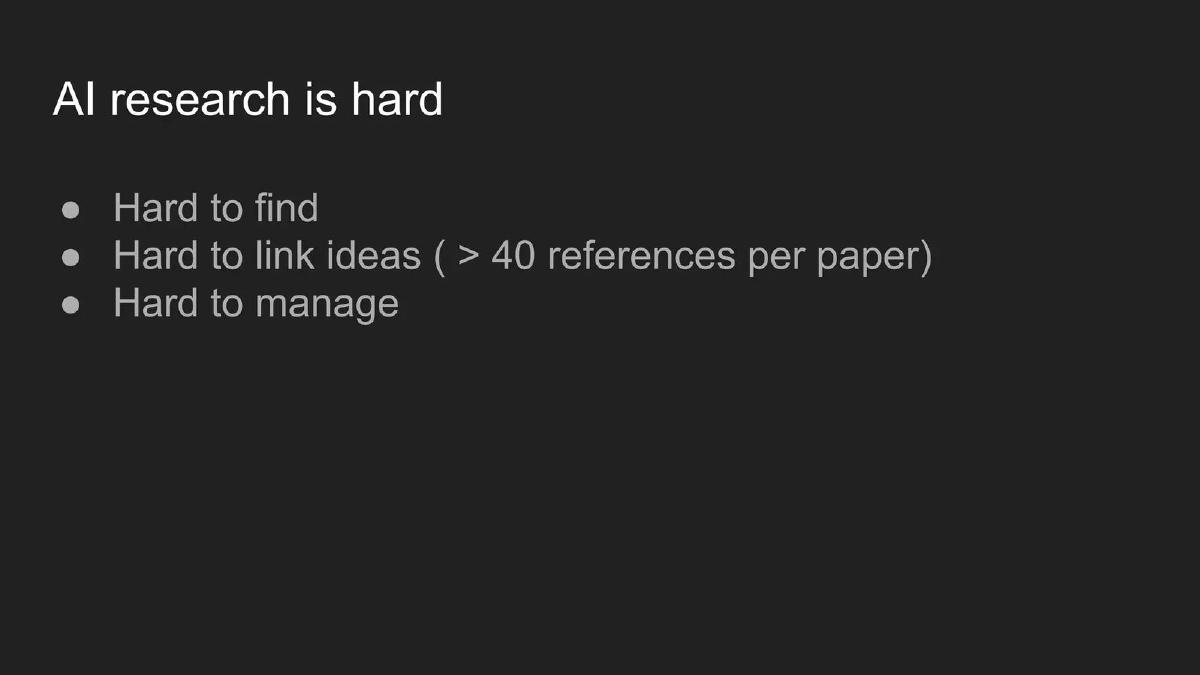
This slide is a near-duplicate of Slide 2, but updates the third bullet point to quantify the management difficulty: "> 10,000 papers related." The repetition is likely intended to emphasize the sheer scale of the literature researchers must navigate, though in a professional pitch, these two slides would typically be consolidated.
Slide 4: Technical Insight
This is the 'secret sauce' slide. It lists three technical pillars: "Link papers without citation data," "Powerful ranking algorithm using links," and "Incorporate user and social data." The slide includes screenshots of three academic papers, presumably the theoretical foundation for their algorithms. One visible title is "Quantifying and suppressing ranking bias in a large citation network." This slide targets a technical audience, emphasizing that their value prop is algorithmic rather than just a better UI.
Slide 5: Competitive Comparison
Etymo compares its output to Google Scholar . The slide claims Etymo focuses on "1 year" of data to "Rank newly available papers," whereas Google Scholar is labeled with "13 years." The visual comparison shows Etymo surfacing recent papers (dated 2017-07-20 and 2017-08-04) while implying Google Scholar's results are less optimized for immediate trending discovery. The exact figures for the papers shown include "87" and "10" stars/likes on the Etymo side.
Slide 6: Product Interface
This slide shows the Etymo dashboard. It features a split screen: a list of papers on the left and a node-based visualization map on the right. A callout box notes a "Different view of a paper," pointing to a specific node in a cluster. The UI includes filters for "CV" (Computer Vision), "NLP" (Natural Language Processing), "RL" (Reinforcement Learning), and "CNN" (Convolutional Neural Networks). This demonstrates that the tool is built specifically for the machine learning taxonomy.
Slide 7: Progress and Roadmap
The "Progress" slide provides three data points: "Indexed over 30,000 AI papers, update every day," "Live at etymo.io," and "Etymo beta is coming soon! (Better UI and run-time visualization)." This confirms the project is beyond the ideation phase and has a working crawler and indexer, though the 'beta coming soon' indicates the current version is likely a prototype.
Slide 8: Team
The team slide is the strongest part of the deck regarding 'founder-market fit.' It lists four members with heavy academic pedigree: Weijian Zhang (PhD Applied Maths, Manchester; MIT CSAIL), Jonathan Deakin (PhD Applied Maths, Manchester; BA Cambridge), Ernest Li (Masters Oxford), and Steven Elsworth (PhD Applied Maths, Manchester). The logos for MIT, Cambridge, Oxford, and Manchester are displayed prominently at the bottom. The expertise is clearly skewed toward the mathematical side of network theory and clustering.
Slide 9: Contact
The final slide is a simple "Thank you!" with a contact email ( weijian@etymo.io ) and a link to a Mattermost chat ( chat.etymo.io ). It lacks a call to action or a summary of the investment opportunity.
What Works
Specific Problem Quantification: By citing the 500 papers per week figure, the founders move the problem from a vague feeling of 'busyness' to a concrete data-processing challenge. · Technical Credibility: The team slide is excellent for a deep-tech or academic tool. Having three PhDs from the same Applied Maths department suggests a long-standing working relationship and deep domain expertise in the underlying algorithms. · Clear Differentiation: The comparison with Google Scholar (Slide 5) clearly articulates their niche: recency and trend-spotting versus archival search.
What is Missing
Business Model: There is no mention of how Etymo will make money. Is it a SaaS for labs? A recruiting tool for big tech? A freemium model for students? The deck is silent on monetization. · Market Size: The deck fails to define the Total Addressable Market (TAM). While AI research is a growing field, the deck doesn't quantify how many researchers, labs, or companies would pay for such a tool. · The Ask: A pitch deck is a tool to raise capital. This deck does not state how much money is being raised, what the valuation is, or what the specific milestones are for the next 18 months. · Unit Economics and Traction: While they have indexed 30,000 papers, there are no metrics on user growth, retention, or daily active users (DAU).
Founder Takeaways
Focus on the 'Why Now': Etymo does a good job of explaining why this is a problem (the explosion of AI research), but founders should ensure they also explain why the business is viable now. Avoid Duplicate Slides: Slides 2 and 3 are virtually identical. In a high-stakes pitch, every slide must earn its place. Consolidate these to make room for a business model slide. Bridge the Gap from Academic to Commercial: This deck feels like a research project presentation. To attract venture capital, the team needs to translate their technical 'Technical Insight' (Slide 4) into a 'Commercial Advantage.' How does linking papers without citation data lead to a billion-dollar company? That link is missing here.
Frequently asked questions
- What is the primary problem Etymo is trying to solve?
- Etymo addresses the difficulty of managing AI research due to high volume. Slide 2 and 3 highlight that finding papers is hard because over 500 are published weekly, and managing them is difficult because there are over 10,000 related papers in the ecosystem. The platform aims to make discovery and idea-linking more efficient for researchers.
- How does Etymo's technology differ from traditional search engines?
- According to Slide 4, Etymo links papers without relying on citation data, which is a common lag-factor in academic publishing. It uses a ranking algorithm that incorporates user and social data. Slide 5 specifically contrasts Etymo's ability to rank new papers (1 year) against Google Scholar's 13-year historical focus.
- What is the current stage of the product based on the deck?
- Slide 7 indicates the product is live at etymo.io and has indexed over 30,000 papers. However, it also notes that a 'beta is coming soon' which will feature a better UI and run-time visualization, suggesting the current version is a functional MVP or alpha release.
- What are the team's qualifications?
- The team is exceptionally academic. Slide 8 lists four members: Weijian Zhang (PhD Applied Maths, Manchester; MIT CSAIL), Jonathan Deakin (PhD Applied Maths, Manchester; BA Cambridge), Ernest Li (Experience in Cyber Security; Masters Oxford), and Steven Elsworth (PhD Applied Maths, Manchester). Their expertise is centered on network theory and computational physics.
- What critical information is missing for an investor?
- The deck is missing almost all commercial metrics. There is no mention of a revenue model, no target customer profile (e.g., enterprise vs. individual), no market size data, and no financial projections. Most importantly, it lacks an 'Ask' slide detailing how much capital they are raising and what the milestones for that capital would be.