Ethic’s 8-slide pitch deck is a study in minimalism and emotional resonance. Founded in 2015, the New York-based tech-driven asset manager successfully raised $98,800,000 by identifying a massive disconnect in the $2.5 trillion passive investment market. The deck avoids the typical clutter of financial services presentations, opting instead for high-impact imagery and bold data points. It effectively bridges the gap between 'doing good' and 'doing well,' citing a 4.8% annual outperformance for sustainable companies. While the deck lacks traditional slides like a detailed business model, compe…
Key takeaways
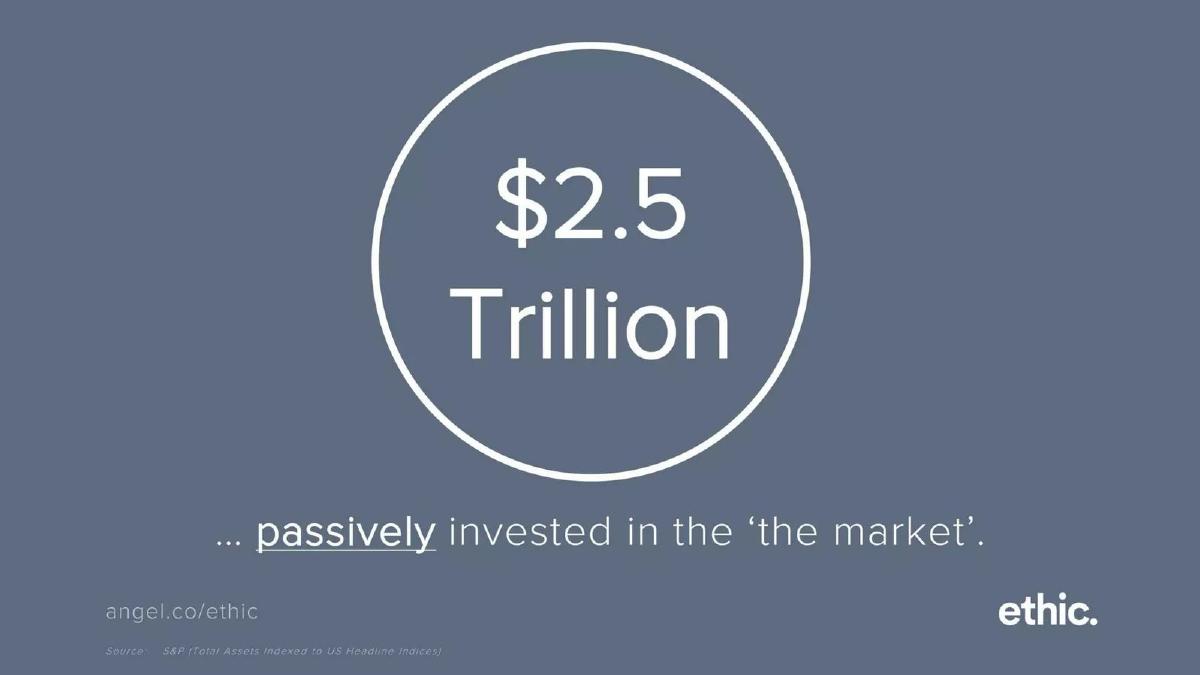
- The deck identifies a $2.5 trillion market currently 'passively' invested in standard indices on Slide 2.
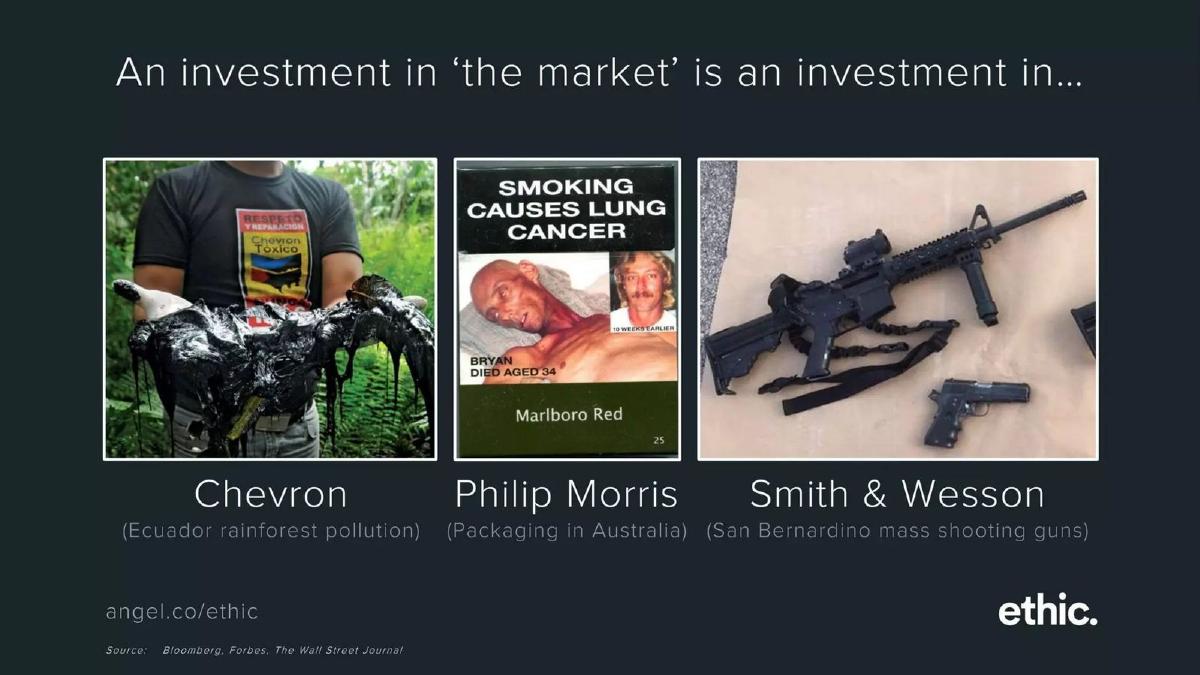
- Slide 3 uses visceral imagery of pollution, lung cancer, and firearms to illustrate the ethical cost of index investing.
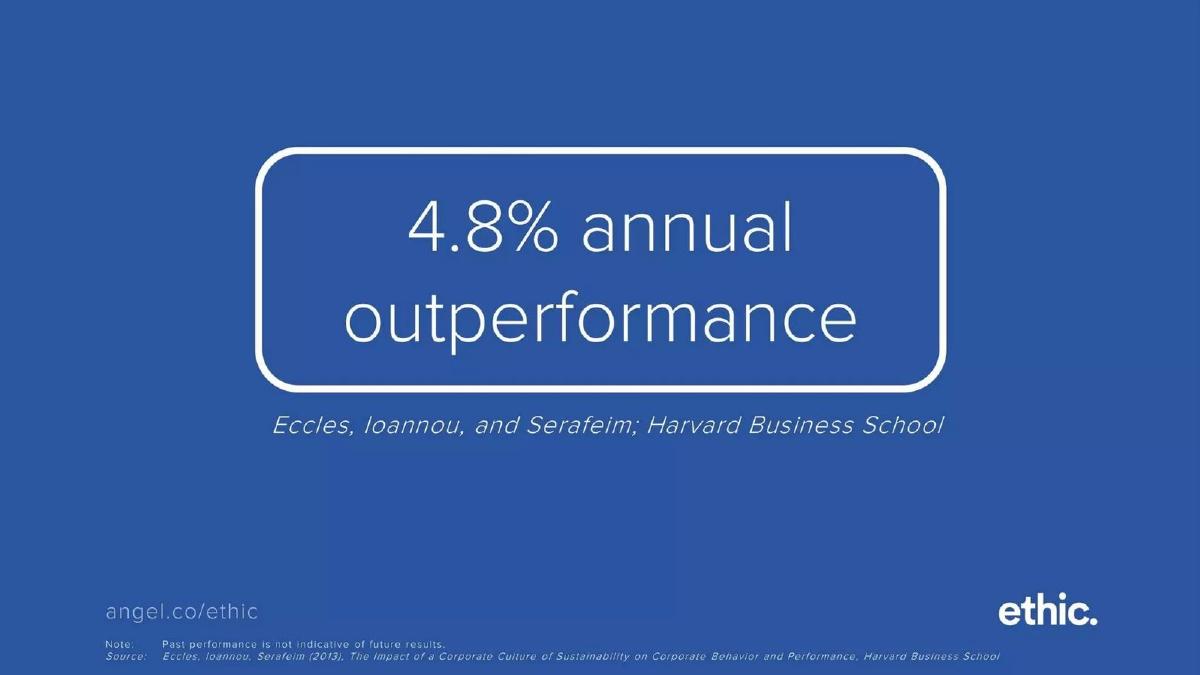
- Ethic presents a financial incentive for sustainability, citing a Harvard Business School study showing 4.8% annual outperformance on Slide 4.
- The team slide (Slide 5) leverages massive brand equity from Deutsche Bank, Goldman Sachs, J.P. Morgan, BlackRock, and Fidelity.
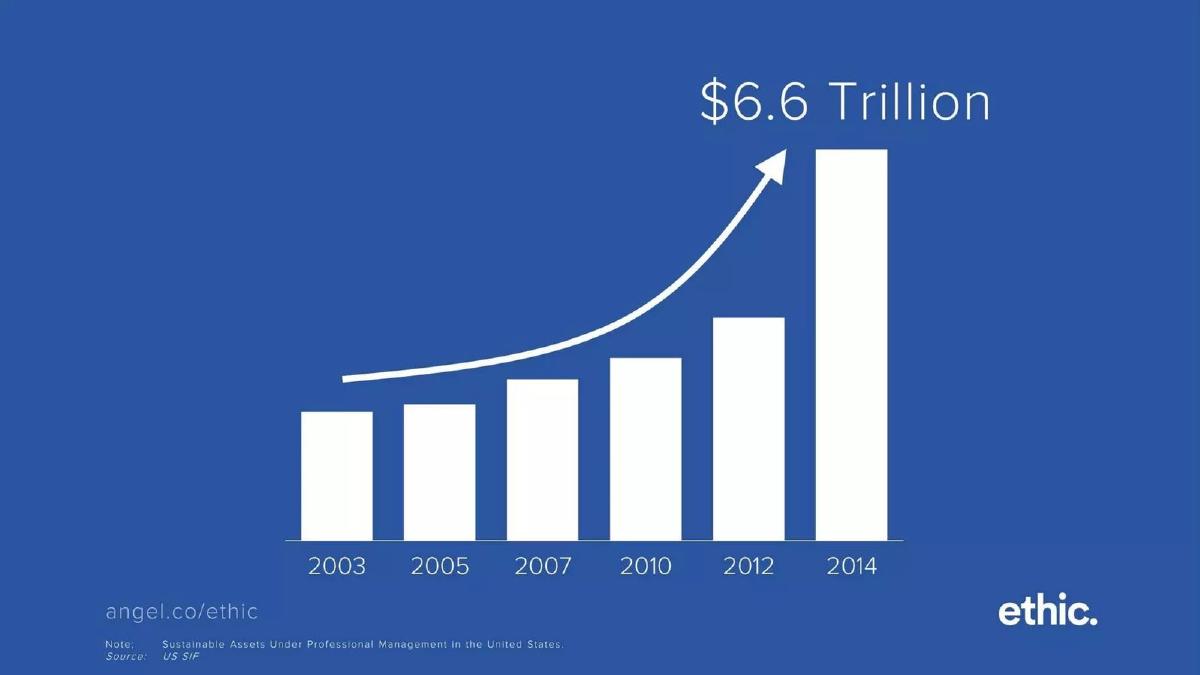
- Market momentum is demonstrated on Slide 6 with a bar chart showing sustainable assets under management reaching $6.6 trillion by 2014.
- The product status is clearly defined on Slide 7 as being an SEC Registered Investment Advisor with a private beta live.
- The deck completely omits a business model, pricing structure, or specific fundraising 'ask'.
- The visual design is extremely consistent, using a limited color palette and minimal text to maintain focus on core messages.
The Minimalist Power of Ethic
Ethic’s pitch deck is an outlier in the world of fintech and asset management. Typically, decks in this sector are dense with regulatory disclosures, complex fee structures, and technical back-testing data. Ethic took the opposite approach. With only 8 slides, they focused on a singular narrative: the world of passive investing is broken, and there is a massive financial and moral opportunity in fixing it.
The company, founded in 2015 and headquartered in New York, positions itself as a tech-driven asset manager. Their goal is to allow investors to create separately managed accounts (SMAs) that track the market while aligning with specific sustainability criteria. The following teardown examines how they used a lean visual style to raise $98.8 million.
The Hook and the Problem (Slides 1-3)
Slide 1: Title The deck opens with a clean, blue background and the company logo. The tagline is simple: "Bringing sustainable investing mainstream." This sets the stage for a mission-driven pitch. The inclusion of an AngelList URL (angel.co/ethic) suggests this version of the deck was used during early-stage outreach or on a public-facing platform.
Slide 2: The Market Size Instead of a traditional TAM/SAM/SOM slide, Ethic uses a single, massive number: "$2.5 Trillion." The text at the bottom clarifies that this is the amount "passively invested in 'the market'." By putting the number in a large circle, they emphasize the scale of the opportunity. This is a classic 'big pond' opening—showing that even a small disruption in this space represents a significant business.
Slide 3: The Visceral Problem This is the most impactful slide in the deck. It defines 'the market' not as an abstract financial concept, but as a collection of real-world outcomes. It features three graphic images: an oil-covered bird (Chevron/Ecuador pollution), a lung cancer warning on a cigarette pack (Philip Morris), and an assault rifle (Smith & Wesson/San Bernardino). By linking passive index investing to these specific tragedies, Ethic creates a sense of urgency and moral friction. It moves the conversation from 'alpha' to 'ethics' instantly.
The Solution and Evidence (Slides 4-6)
Slide 4: The Financial Justification Ethic anticipates the primary objection to sustainable investing: that it leads to lower returns. They counter this with a bold claim of "4.8% annual outperformance." Crucially, they cite their source: a 2013 Harvard Business School study. This provides the 'intellectual cover' for institutional investors to move toward sustainability without violating their fiduciary duty to maximize returns.
Slide 5: The Team In fintech, the team is the product. Slide 5 features the three founders—Doug, Jay, and Johny—but the real weight comes from the logos below them. By displaying logos for Deutsche Bank, Goldman Sachs, J.P. Morgan, BlackRock, and Fidelity, Ethic signals that the founders aren't just 'activists'; they are industry insiders who understand the plumbing of Wall Street. This builds the trust necessary to handle millions (and eventually billions) of dollars in assets.
Slide 6: Market Momentum This slide uses a bar chart to show the growth of sustainable assets under professional management in the U.S. The chart shows a steady climb from 2003, culminating in a "$6.6 Trillion" figure for 2014. This proves that Ethic isn't trying to create a market from scratch; they are catching a massive, existing wave of capital reallocation.
Product Status and Vision (Slides 7-8)
Slide 7: The Offering This is the closest the deck gets to a product slide. It lists three core pillars: Globally diversified, Low-cost, and Value-based. Below these, it provides a crucial status update: "SEC Registered Investment Advisor" and "Private beta live." For a 2015 startup, being an SEC-registered advisor is a significant hurdle cleared, indicating that the company is ready for immediate operation.
Slide 8: Conclusion The deck ends as it began, with the logo and contact information. There is no 'ask' slide, no 'use of funds' breakdown, and no 'milestones' timeline. This suggests the deck was designed to be a conversation starter—a high-level narrative meant to secure a meeting where the technical details could be discussed in person.
What Works
Emotional Resonance: Slide 3 is a masterclass in using imagery to create a problem. It makes the status quo (passive indexing) feel unacceptable. · Credibility by Association: The team slide does not list titles or degrees; it simply lists the most powerful names in finance. This is highly effective for a Series-stage raise. · Simplicity: The deck contains fewer than 100 words in total. This ensures that the investor stays focused on the presenter (or the core message) rather than reading dense bullet points. · Data-Backed Claims: By citing Harvard Business School and S&P, the deck grounds its emotional appeal in rigorous academic and market data.
What is Missing
Business Model: There is no mention of how Ethic makes money. Do they charge a percentage of Assets Under Management (AUM)? Is it a SaaS fee for the technology? This is a major omission for a fundraising deck. · Competition: The deck ignores the existence of other ESG (Environmental, Social, and Governance) funds or robo-advisors. It positions Ethic as the only alternative to 'the market.' · Technology/Product Detail: The 'tech-driven' aspect of the asset manager is never explained. Investors don't see the platform, the algorithm, or the user experience. · The Ask: The deck does not state how much money is being raised or what the valuation expectations are. While common in 'teaser' decks, a full pitch usually requires a clear call to action.
What a Founder Should Copy
The 'Big Number' Opening: Start with the scale of the problem in a way that is impossible to ignore. · The 'Moral Friction' Slide: If your startup solves a problem with a social component, don't just describe the problem—show the human or environmental cost of the status quo. · Logo Soup for Credibility: If your team has worked at top-tier firms, let the logos do the talking. It creates an immediate 'halo effect' of professionalism. · Minimalist Design: Use a consistent color palette and high-quality typography. Ethic’s deck looks like a premium brand, which is essential when asking people to trust you with their money.
Frequently asked questions
- How much did Ethic raise with this deck?
- According to the catalogue facts, Ethic raised a total of $98,800,000. This deck supported their journey as they scaled from their 2015 founding to becoming a major player in the sustainable asset management space.
- What is the primary problem Ethic is solving?
- Ethic targets the 'passive' nature of the $2.5 trillion index fund market. They argue that by buying the market, investors are inadvertently funding companies involved in rainforest pollution, tobacco, and firearms, as shown on Slide 3.
- Does the deck show the actual product interface?
- No. The deck is entirely conceptual and narrative-driven. It describes the product as 'globally diversified, low-cost, and value-based' on Slide 7, but it does not include screenshots or technical architecture diagrams.
- How does Ethic justify the performance of sustainable investing?
- On Slide 4, the deck cites a Harvard Business School study by Eccles, Ioannou, and Serafeim (2013) that found a 4.8% annual outperformance for companies with a high culture of sustainability compared to those without.
- What is missing from the Ethic pitch deck?
- The deck is missing several standard components: a business model slide (how they make money), a competitor analysis, a detailed roadmap, financial forecasts, and a specific slide detailing the use of funds or the 'ask'.