Blink Charging (Nasdaq: BLNK) presents a robust case for the scalability of EV infrastructure by moving beyond simple hardware sales. The deck, dated 2020, centers on a massive market tailwind—projecting a $567B global market by 2026—and positions Blink as a vertically integrated player that designs, manufactures, and operates. The standout slide is the 'Business Model Options' matrix, which outlines four distinct ways the company generates revenue, ranging from turnkey ownership to subscription-based 'Blink as a Service.' With 180,000+ registered members and 23,000+ stations already deployed…
Key takeaways
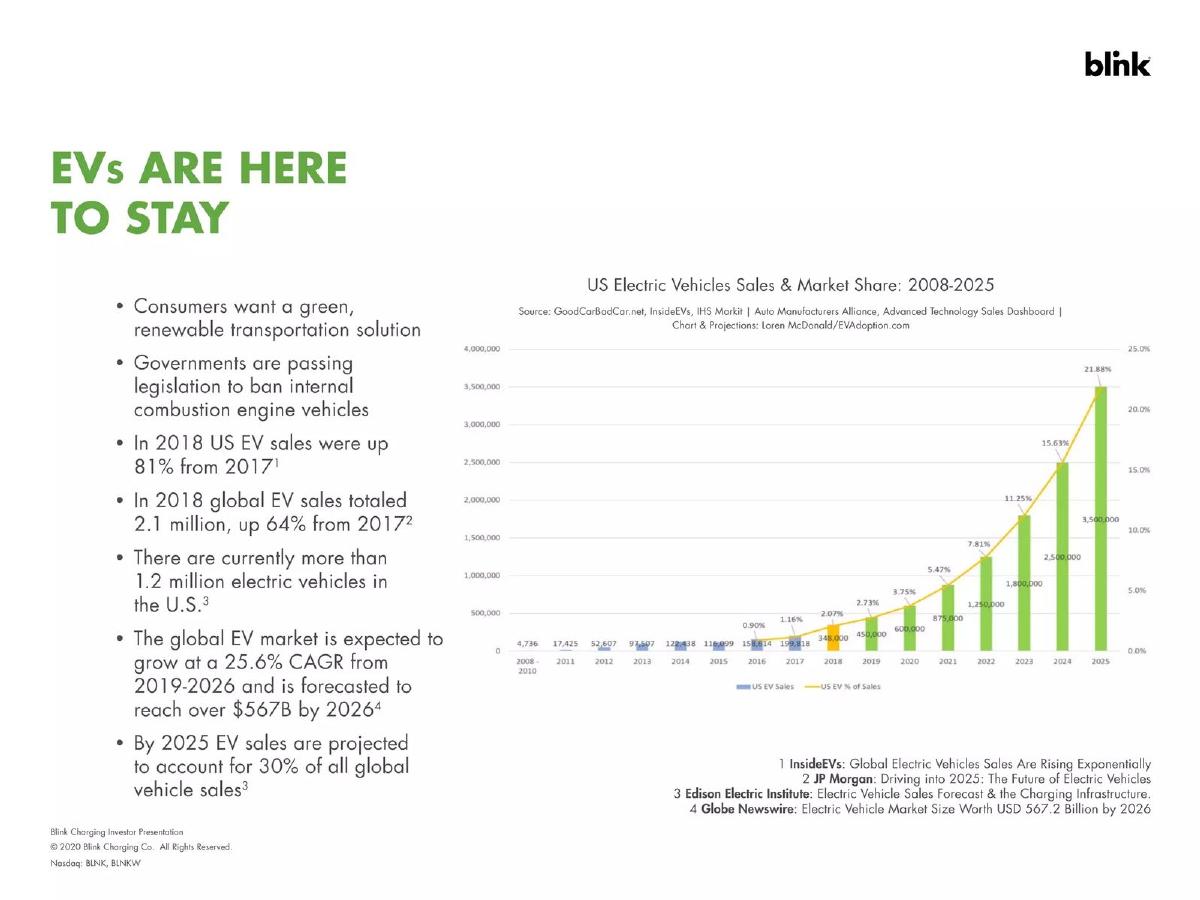
- The global EV market is forecasted to reach over $567B by 2026 with a 25.6% CAGR (Slide 2).
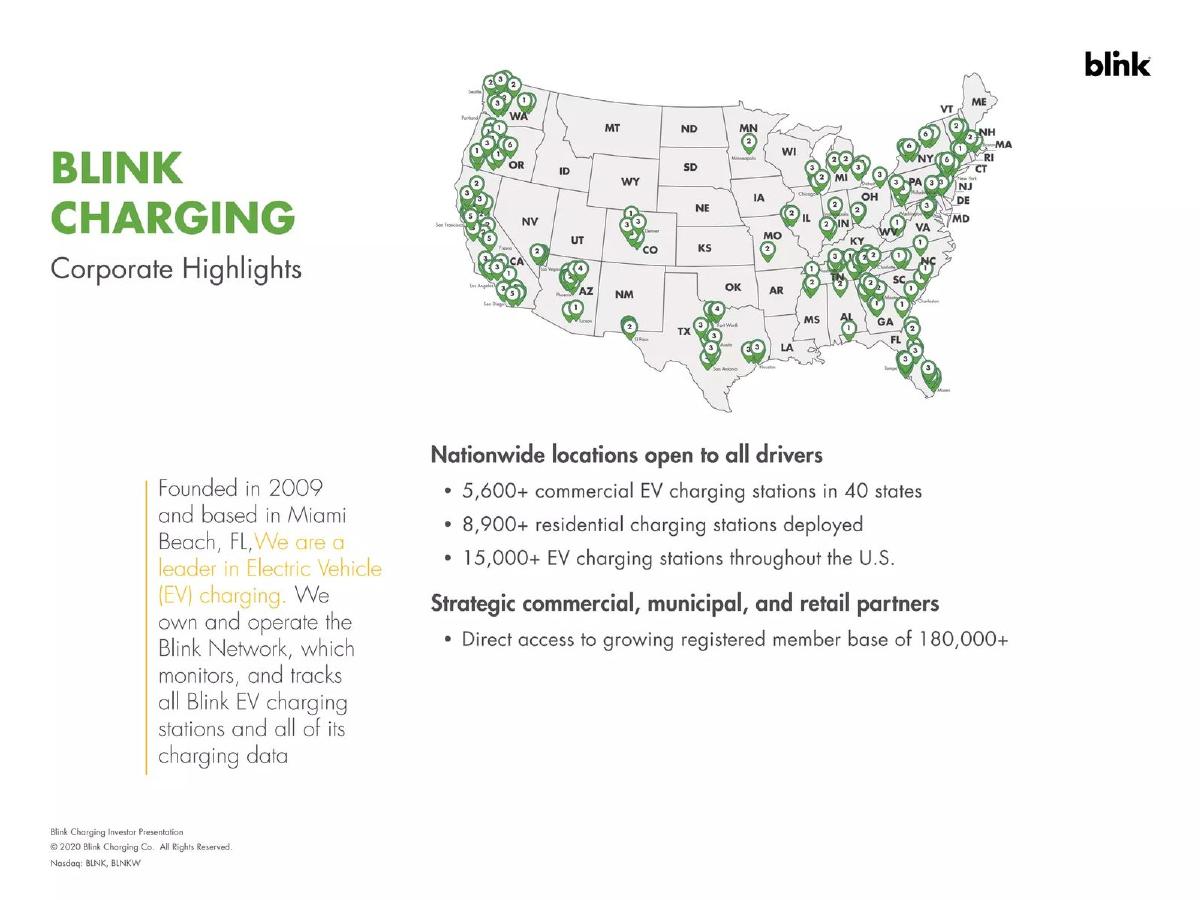
- Blink has achieved significant scale with 180,000+ registered members and 23,000+ charging stations deployed (Slide 3).
- The product line covers both commercial (IQ 200) and residential (HQ 100) needs, with the IQ 200 offering up to 80 Amps of charging (Slides 4-5).
- Software is a core differentiator, featuring a cloud-based platform for real-time monitoring, payment processing, and load management (Slide 6).
- The business model is highly flexible, offering four tiers: Blink Owned, Hybrid Owned, Host Owned, and Blink as a Service (Slide 7).
- Blink charges a standard 8% transaction fee across all business model tiers (Slide 7).
- Strategic partnerships with Google Maps and Hubject are used to solve the 'discovery' problem for EV drivers (Slide 8).
- The leadership team features deep industry experience, including a COO with 30 years of automotive experience from Electrify America and EVgo (Slide 9).
Executive Summary: A Public Market Infrastructure Play
The Blink Charging investor presentation from 2020 is a clinical example of how to pitch a capital-intensive infrastructure business. Rather than focusing solely on the 'green' mission, the deck focuses on the mechanics of scale, the diversity of revenue streams, and the technological moat created by their software network. By the time this deck was circulated, Blink was already a Nasdaq-listed company (BLNK), and the slides reflect a level of operational maturity expected of a public entity, particularly in the detailed breakdown of their business models and partnership ecosystem.
Slide 1: Title and Branding
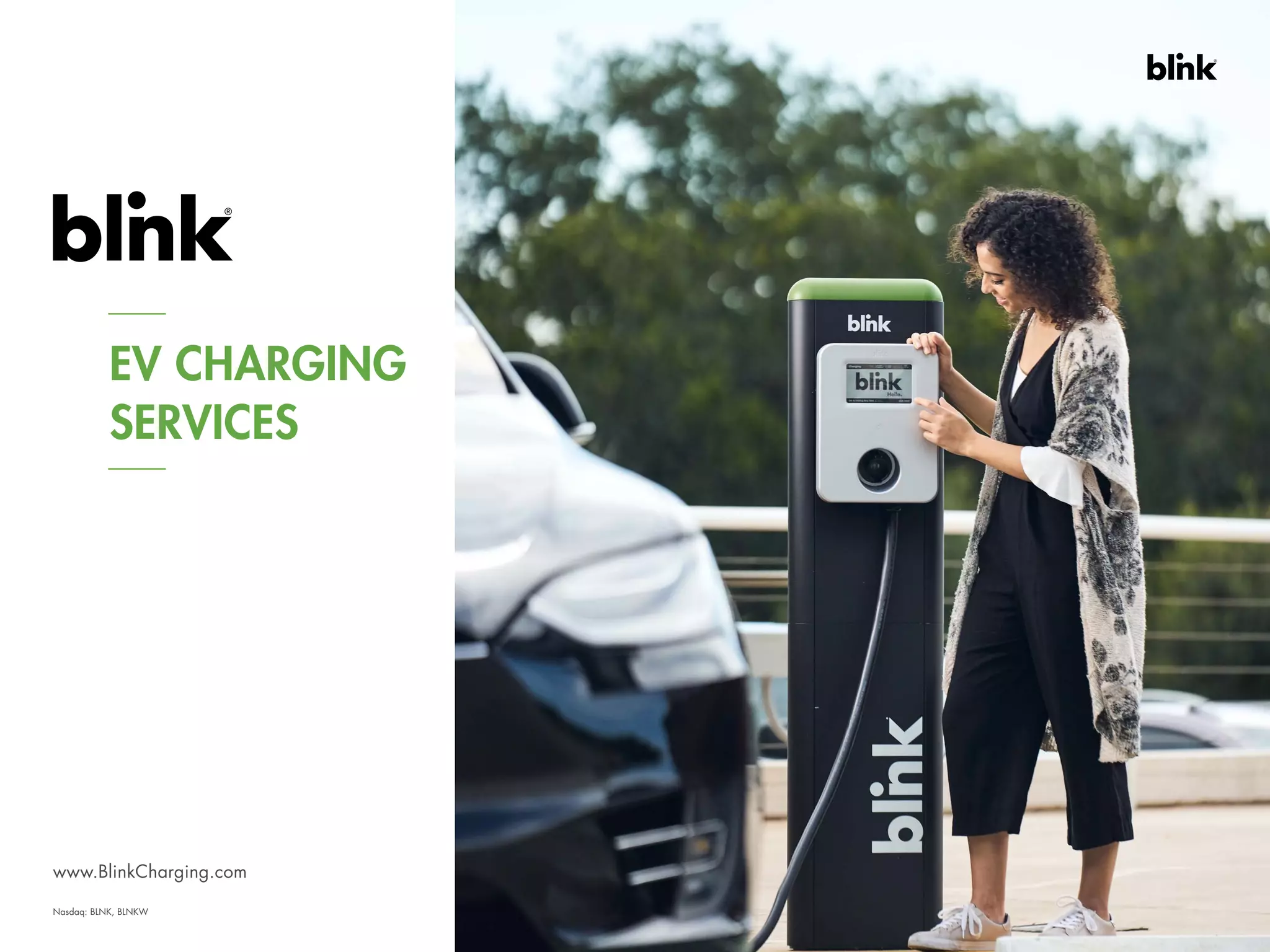
The cover slide is minimalist, featuring the Blink logo and the clear descriptor 'EV CHARGING SERVICES.' It includes the company's website and Nasdaq tickers (BLNK, BLNKW). The imagery—a woman interacting with a sleek, branded charging station next to a Tesla—immediately establishes the target demographic and the premium nature of the hardware. It sets a professional tone without unnecessary clutter.
Slide 2: Market Opportunity and Macro Trends
Blink uses Slide 2 to establish the 'Why Now?' factor. The slide cites a 25.6% CAGR for the global EV market from 2019-2026, with a projected market size of $567B by 2026 . Crucially, it provides a bar chart of US EV sales and market share from 2008 to 2025, showing an exponential curve. By citing sources like JP Morgan and the Edison Electric Institute, Blink anchors its growth projections in credible third-party data. The takeaway is clear: the transition to EVs is no longer theoretical; it is an accelerating reality.
Slide 3: The Value Proposition and Traction
Slide 3, titled 'What We Do,' defines Blink as a vertically integrated player. They design, manufacture, sell, deploy, own, operate, and maintain charging stations. This vertical integration is a key selling point for investors looking for margin control. The slide highlights two massive traction metrics: 180,000+ registered members and 23,000+ stations deployed . This establishes Blink not as a startup looking for a pilot, but as an incumbent looking to expand.
Slide 4: Commercial Hardware - The IQ 200
Hardware specifications matter in infrastructure. Slide 4 introduces the Blink IQ 200 Level 2 AC charging station. The key differentiator mentioned is that it is the 'Fastest Level 2 charging available,' delivering up to 80 Amps (19.2kW). The slide lists various form factors (Wall Mount, Pedestal, Kiosk), signaling that the company can service diverse property types, from parking garages to retail centers. It also mentions support for OCPP v1.5 and v1.6J, which are critical industry standards for network interoperability.
Slide 5: Residential Hardware - The HQ 100
Recognizing that much of EV charging happens at home, Slide 5 focuses on the HQ 100. It emphasizes a 30 Amp output that charges 4x faster than a standard Level 1 cord . The slide lists practical benefits like a start-delay function to optimize utility rates and an 18 ft. cable. This demonstrates that Blink is pursuing a 'total wallet share' strategy, following the EV driver from the workplace/retail (Level 2) to the home.
Slide 6: The Software Moat
Slide 6 shifts the focus from 'dumb' hardware to 'smart' networks. The 'Blink Network' is described as a cloud-based platform offering real-time views of station locations, remote monitoring, and streamlined payment processing. For property owners, the 'Flexibility and Control' section is vital: it mentions local load management and fleet management controls. This slide argues that Blink isn't just selling chargers; they are selling a management ecosystem that makes charging stations easier to own and operate.
Slide 7: The Four-Tiered Business Model
This is arguably the most important slide in the deck. Blink outlines four ways to engage with their services: Blink Owned (Turnkey), Hybrid Owned (Shared Revenue), Host Owned (Purchase), and Blink as a Service (Subscription). The matrix clearly defines who pays for equipment, installation, and electricity, and how the revenue is split. Notably, Blink maintains an 8% transaction fee across all models, ensuring they capture a piece of every electron sold, regardless of who owns the hardware. The 'Blink as a Service' model at $99/month is a clever way to lower the barrier to entry for hosts while securing recurring revenue.
Slide 8: Strategic Partnerships
Slide 8 addresses the discovery problem. By teaming up with Google Maps , Blink ensures its stations are searchable by millions of drivers. The partnership with Hubject is equally strategic, providing 'interoperability'—meaning drivers from other networks can use Blink chargers seamlessly. These partnerships serve as a force multiplier for their 23,000-station footprint, making the network more valuable to the end-user.
Slide 9: Leadership and Governance
The final slide in this selection introduces the 'Leaders in the EV Industry.' The team is led by Founder and CEO Michael D. Farkas. The inclusion of COO Brendan Jones is significant, as he brought 30 years of experience from Electrify America and EVgo. The slide also lists a full Board of Directors, which is a requirement for a public company but also serves to reassure investors of the oversight and corporate governance in place. The bios emphasize 'decades of experience,' a common trope in infrastructure pitches where operational reliability is paramount.
What Works Well
The deck excels at clarity of business logic . The business model matrix on Slide 7 is a gold standard for companies with complex go-to-market strategies. It removes ambiguity about how the company makes money and how it partners with property owners. Furthermore, the use of third-party data on Slide 2 builds a strong macro case that feels objective rather than promotional. The vertical integration narrative (Slide 3) is also well-supported by the subsequent hardware and software slides, showing that the company controls the entire user experience.
What Is Missing
While this is a strong presentation, there are notable omissions in these nine slides. There is no mention of unit economics —specifically, the cost to manufacture a unit versus the lifetime value of the transaction fees it generates. There is also no competitive landscape slide ; in a crowded market with ChargePoint, EVgo, and Tesla, failing to address the competition directly is a missed opportunity to define their unique edge. Finally, there is no financial performance slide (revenue growth, EBITDA, or burn rate), which is surprising for a public company deck, though these may be present in the remaining 18 slides of the full 27-slide deck.
Founder Takeaways
Founders should copy the Business Model Matrix . If your startup offers multiple ways for customers to buy (SaaS, hardware, licensing), a single comparison table is the most efficient way to explain it to an investor. Additionally, the 'Why Now' slide (Slide 2) is a perfect example of how to use external validation to justify your market's growth. Finally, notice how Blink uses partnerships as a proxy for scale ; even if you don't have 23,000 units, showing that you are integrated into the platforms your customers already use (like Google Maps) builds immediate credibility.
Frequently asked questions
- What are the primary revenue streams for Blink Charging?
- According to Slide 7, Blink generates revenue through four main channels: hardware sales (Host Owned), shared charging revenue (Blink/Hybrid Owned), network fees ($18/month), and transaction fees (8% of gross revenue). They also offer a 'Blink as a Service' subscription model priced at $99 per month, providing a predictable recurring revenue stream alongside variable usage fees.
- How does Blink differentiate its hardware from competitors?
- Blink emphasizes speed and flexibility. Slide 4 highlights the IQ 200 Level 2 charger as the 'fastest available' at 19.2kW (80 Amps). For residential use, Slide 5 notes the HQ 100 charges four times faster than standard Level 1 cords. The hardware is also designed for versatility, supporting various mounting options like wall, single pedestal, and dual pedestal.
- What is Blink's strategy for user acquisition and discovery?
- Blink relies on strategic software integrations to drive traffic. Slide 8 details a partnership with Google Maps that allows users to search for 'EV charging' and find Blink stations directly. They also partner with Hubject, a multi-network interchange platform, which allows members from other networks to use Blink chargers without separate registration, effectively expanding their potential user base.
- What does the 'Blink as a Service' model entail?
- As shown on Slide 7, 'Blink as a Service' is a subscription-based model. Blink retains ownership of the equipment, while the host pays a $99 monthly subscription fee and covers installation and electricity costs. In this model, 100% of the charging revenue goes to the host, but Blink collects the subscription fee and an 8% transaction fee.
- How large was Blink's network at the time of this presentation?
- Slide 3 states that Blink had deployed over 23,000 EV charging stations since its inception. Additionally, the company boasted a user base of more than 180,000 registered Blink members, indicating a significant footprint in the U.S. charging infrastructure market at the time the deck was produced.