Ethnobotanica (PotDeli) seeks Series A/B funding to scale its organic cannabis operations in California. The deck emphasizes operational efficiency, citing current yields of 42 grams per square foot against an industry average of 32, with projections reaching 56 grams. The company aims to expand its flowering space from 2,250 to 5,400 square feet and establish a 100% self-distribution model to address a perceived gap in the organic cannabis market. Financial projections are aggressive, showing revenue scaling from near-zero in 2020 to over $2 billion by 2024. While the deck provides specific…
Key takeaways
- The company plans to expand flowering space from 2,250 sq ft to 5,400 sq ft (Slide 3).
- Ethnobotanica claims to outperform the average cultivator yield (32g/ft2) with a current yield of 42g/ft2 (Slide 5).
- The strategy includes 100% self-distribution and branding of third-party products (Slide 3).
- Revenue projections show a steep climb to over $2,000,000,000 by 2024 (Slide 6).
- The deck highlights local recognition, winning 'Best of SLO County' in 2013, 2014, and 2015 (Slide 2).
- A 14-month ROI chart projects reaching positive net income by month 7 after project completion (Slide 7).
- The market opportunity is defined by a lack of an organic distribution chain in California's legal network (Slide 4).
- The deck omits a team slide, specific use of funds, and a detailed competitive analysis (Slides 1-8).
Ethnobotanica Pitch Deck Analysis
Ethnobotanica, branded as PotDeli, presents a pitch deck focused on the transition from a boutique local cultivator to a scaled organic cannabis distributor in the California market. The deck is heavily oriented toward operational metrics and high-level financial projections, emphasizing the 'organic' niche as a primary market differentiator.
Slide 1: Title Slide
The title slide introduces the brand 'PotDeli' with a logo that emphasizes 'Organic Cannabis.' The design uses a vibrant pink and teal spiral pattern, which is visually striking but leans more toward consumer retail branding than a traditional corporate Series A/B deck. It identifies the round as 'Series A/B,' suggesting the company is looking for significant growth capital to scale existing operations.
Slide 2: Awards and Social Proof
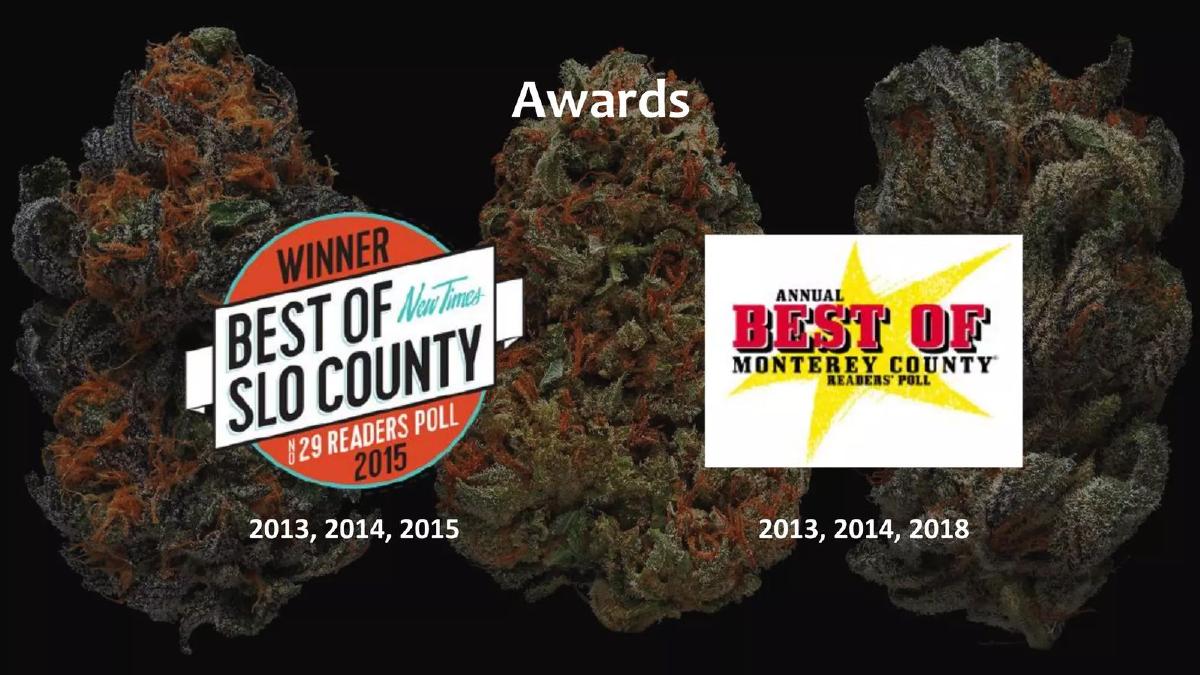
Slide 2 serves as the primary validation for product quality. It displays three high-resolution images of cannabis flower alongside award badges. The company cites winning 'Best of SLO County' (San Luis Obispo) in 2013, 2014, and 2015 via the New Times Readers Poll. It also lists 'Best of Monterey County' wins in 2013, 2014, and 2018. This establishes a track record of consumer preference in the Central Coast region of California over a five-year span.
Slide 3: The Solution - Organic Focused Expansion
This slide outlines the operational roadmap. The core 'solution' is not a new technology, but a scale-up of existing success. Key points include:
Expansion of flowering space from 2,250 ft2 to 5,400 ft2. · Increasing cultivation efficiencies. · Ensuring building, fire code, and cannabis regulatory compliance. · Moving to 100% self-distribution. · Beginning to brand 3rd party products. · Investing in sales and marketing for brand recognition.
This indicates a vertical integration strategy where the company controls the product from seed to the retail distribution point.
Slide 4: Market Opportunity
The market opportunity is framed narrowly around the 'Organic' label. The slide claims, 'There is currently NO organic distribution chain in California’s legal Cannabis network.' By positioning themselves as the first mover in organic distribution, Ethnobotanica seeks to capture the premium segment of the market. The slide uses a large 'Organic Natural Product' stamp to reinforce this branding, though it does not provide specific TAM (Total Addressable Market) or SAM (Serviceable Addressable Market) figures in dollars.
Slide 5: Data Backed Yields
This is the most technical slide in the deck, focusing on cultivation performance. It compares 'Grams / FT2' across four categories:
Average Cultivator: 32g · Maximum Potential: 60g · EB Current (including bad rooms): 42g · EB Current High/Projected: 56g
The second chart shows 'Annual Yields (lbs),' projecting a jump from approximately 1,500 lbs to over 5,000 lbs. The source for the industry average is cited as 'Measuring Yield, CBT, Oct 6, 2016.' This slide is intended to prove that the management team knows how to grow efficiently and that their projections are based on historical performance rather than guesswork.
Slide 6: 5 Year Revenue and Profits
Slide 6 presents a line graph showing revenue and profit from 2020 to 2024. The revenue curve is extremely steep, starting near zero in 2020 and 2021, then accelerating to approximately $500 million in 2023, and finally spiking to over $2,000,000,000 (2 billion) in 2024. Profit follows a similar upward trajectory but at a much lower scale, appearing to reach roughly $300-400 million by 2024. The scale of these numbers is massive compared to the 5,400 sq ft expansion mentioned on Slide 3, suggesting the revenue model relies heavily on the 'branding 3rd party products' and 'distribution' mentioned earlier, rather than just their own cultivation.
Slide 7: 14 Month R.O.I.
This slide provides a more granular look at the immediate impact of the investment. It tracks Revenue, Net Income, Income Accrual, and ROI over 14 months post-project completion. The ROI line (white) starts at approximately -$800,000 and dips to -$1,500,000 by month 6, indicating the period of heavy capital expenditure. It then trends upward, crossing the break-even point around month 13 or 14. Net income (pink) is projected to turn positive by month 7. This slide is crucial for investors interested in the payback period of the specific expansion project.
Slide 8: Contact Slide
The final slide shows the finished product: three jars of PotDeli organic cannabis (Sativa, Hybrid, and Indica) with the 'Clean Green' organic certification logo visible. It provides contact information for Ryan Booker, including a phone number and a PotDeli.org email address. The visual reinforces the retail-ready nature of the business.
What Works in This Deck
Specific Operational Metrics: The inclusion of yield per square foot (Slide 5) is excellent. It moves the conversation from 'we grow good weed' to 'we are more efficient than the industry average by 10 grams per square foot.' This is the kind of data-driven argument that appeals to Series A/B investors who are looking for operational excellence.
Clear Niche Identification: By focusing exclusively on the 'Organic' gap in the California distribution market (Slide 4), the company avoids competing directly with the massive, general-market MSOs (Multi-State Operators) on price alone. They are carving out a premium territory.
Social Proof: The list of awards on Slide 2, spanning multiple years, demonstrates that the company isn't a 'pop-up' operation. They have a history of producing a product that consumers actually like, which de-risks the brand-building portion of the investment.
What Is Missing from This Deck
The Team Slide: This is a major omission. In a Series A/B round, investors are betting on the management's ability to scale. There is no information about the founders' backgrounds, their experience in large-scale agriculture, or their history in logistics/distribution. Only one name, Ryan Booker, appears at the end.
The Ask: The deck identifies as a 'Series A/B' but never states how much money is being raised. Investors need to know if the company is looking for $5 million or $50 million to evaluate if the ROI projections on Slide 7 make sense.
Competitive Landscape: While the deck claims there is 'NO organic distribution chain,' it doesn't acknowledge existing large-scale distributors (like CannaDistribution or Flow Distribution) who might easily add an organic line. A competitive matrix would help explain why Ethnobotanica's vertical integration is a defensible moat.
Financial Disconnect: There is a significant gap between the physical expansion mentioned (5,400 sq ft) and the $2 billion revenue projection. Without a slide explaining the volume of 3rd party products they intend to distribute, the $2 billion figure feels like an unsubstantiated 'hockey stick' graph.
Founder Takeaways
Use Industry Benchmarks: If you are in a commodity or semi-commodity business like cultivation, follow Ethnobotanica's lead by citing industry averages (Slide 5). Showing you are 30% more efficient than the average player is a powerful way to justify a higher valuation.
Focus on Vertical Integration: The strategy of moving to '100% Self Distribution' (Slide 3) is a strong selling point in the cannabis industry, where distribution margins are often high and reliability is low. Founders should highlight how controlling the supply chain protects their margins.
Balance Branding with Data: While the 'trippy' visuals of the title slide might fit the product, the meat of the deck should remain as data-heavy as Slide 5 and Slide 7. Ethnobotanica does a good job of transitioning from consumer-facing visuals to investor-facing data, though they could benefit from a more professional design aesthetic for the charts themselves.
Be Transparent About Revenue Drivers: If your revenue is going to jump 400% in one year, you must explain where that growth comes from. If it's from 3rd party partnerships, those partners or the pipeline for those partnerships should be mentioned to give the projections credibility.
Frequently asked questions
- What is the primary growth lever for Ethnobotanica?
- The primary growth lever is physical expansion and yield optimization. According to slide 3, the company is moving from 2,250 to 5,400 square feet of flowering space. Slide 5 further details an efficiency play, where they aim to increase their yield from 42 grams per square foot to a projected 56 grams, significantly higher than the cited average cultivator yield of 32 grams.
- How does the company differentiate itself in the California cannabis market?
- Ethnobotanica differentiates through its 'Organic' focus. Slide 4 explicitly states that there is currently no organic distribution chain in California's legal cannabis network. By combining organic cultivation with 100% self-distribution (Slide 3), they aim to own the premium, natural segment of the market that they believe is currently underserved by existing distributors.
- Are the financial projections realistic based on the provided slides?
- The projections on slide 6 are exceptionally aggressive, showing revenue jumping from under $500 million in 2023 to over $2 billion in 2024. Given the expansion is only to 5,400 square feet of flowering space (Slide 3), achieving $2 billion in revenue would require a massive contribution from third-party branding or a significant unstated expansion in later years, as cultivation alone at that scale cannot support such figures.
- What evidence of product quality does the deck provide?
- The deck relies on local reader polls as social proof of quality. Slide 2 lists 'Best of SLO County' awards for 2013, 2014, and 2015, as well as 'Best of Monterey County' awards for 2013, 2014, and 2018. This suggests a long-standing reputation in the Central Coast region of California prior to their Series A/B push.
- What critical information is missing from this pitch deck?
- The deck is missing several standard components: a team slide detailing founder experience, a clear 'ask' (how much capital is being raised), a breakdown of how the funds will be spent, and a competitive matrix. It also lacks a slide on unit economics (COGS per gram) which is vital for a cultivation-heavy business model.