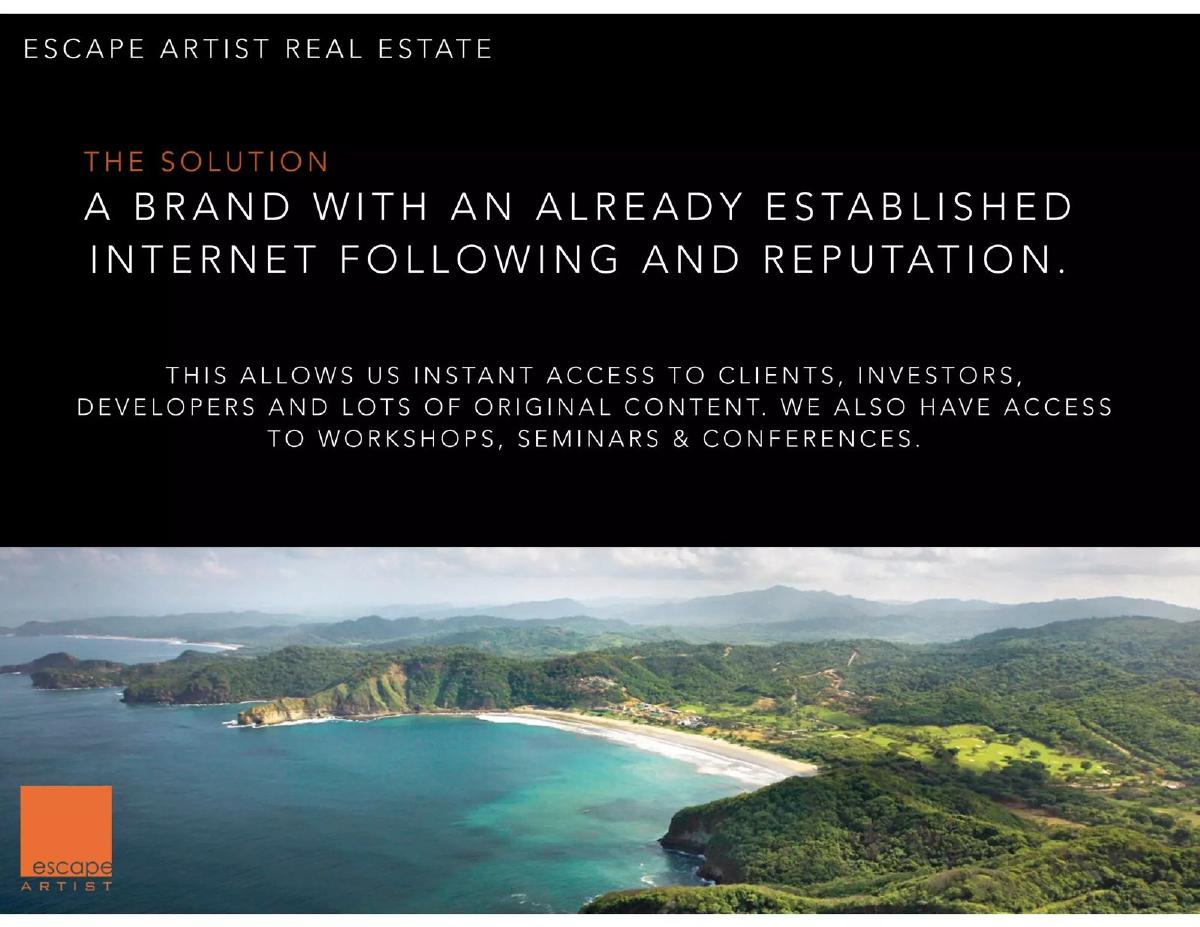
Escape Artist Real Estate presents a pitch deck focused on modernizing the real estate franchisor model, specifically for the expat demographic. The company identifies a 'pre-internet age framework' in current industry leaders and proposes a centralized digital ecosystem where all franchisee websites feed off a single hub. Beyond simple property transactions, the deck outlines a 'one-stop shop' strategy including visas, medical tourism, and banking. While the visual presentation is high-quality, utilizing aspirational lifestyle imagery, the deck lacks critical financial data, a specific fundi…
Key takeaways
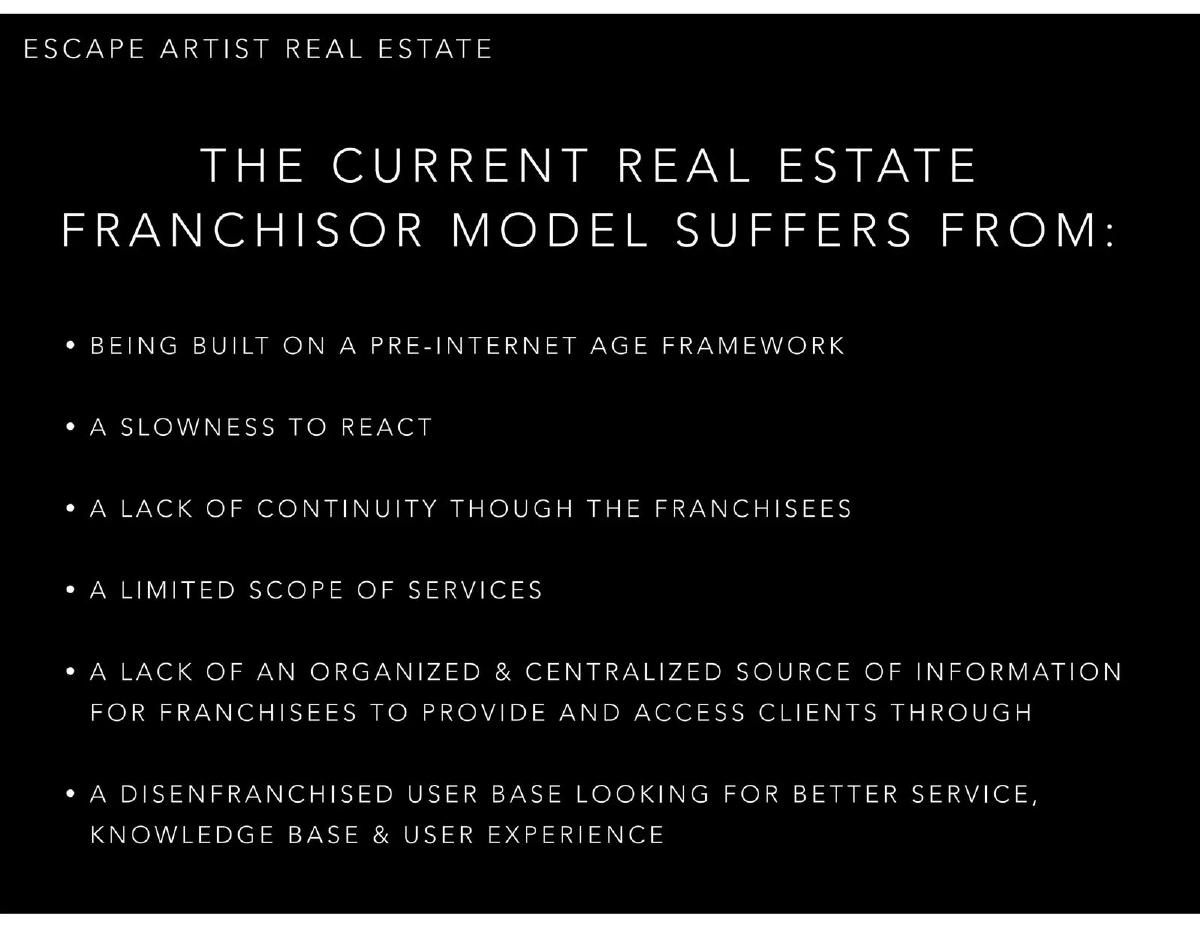
- The company identifies six core failures of the current real estate franchisor model, including a lack of continuity and limited service scope (Slide 2).
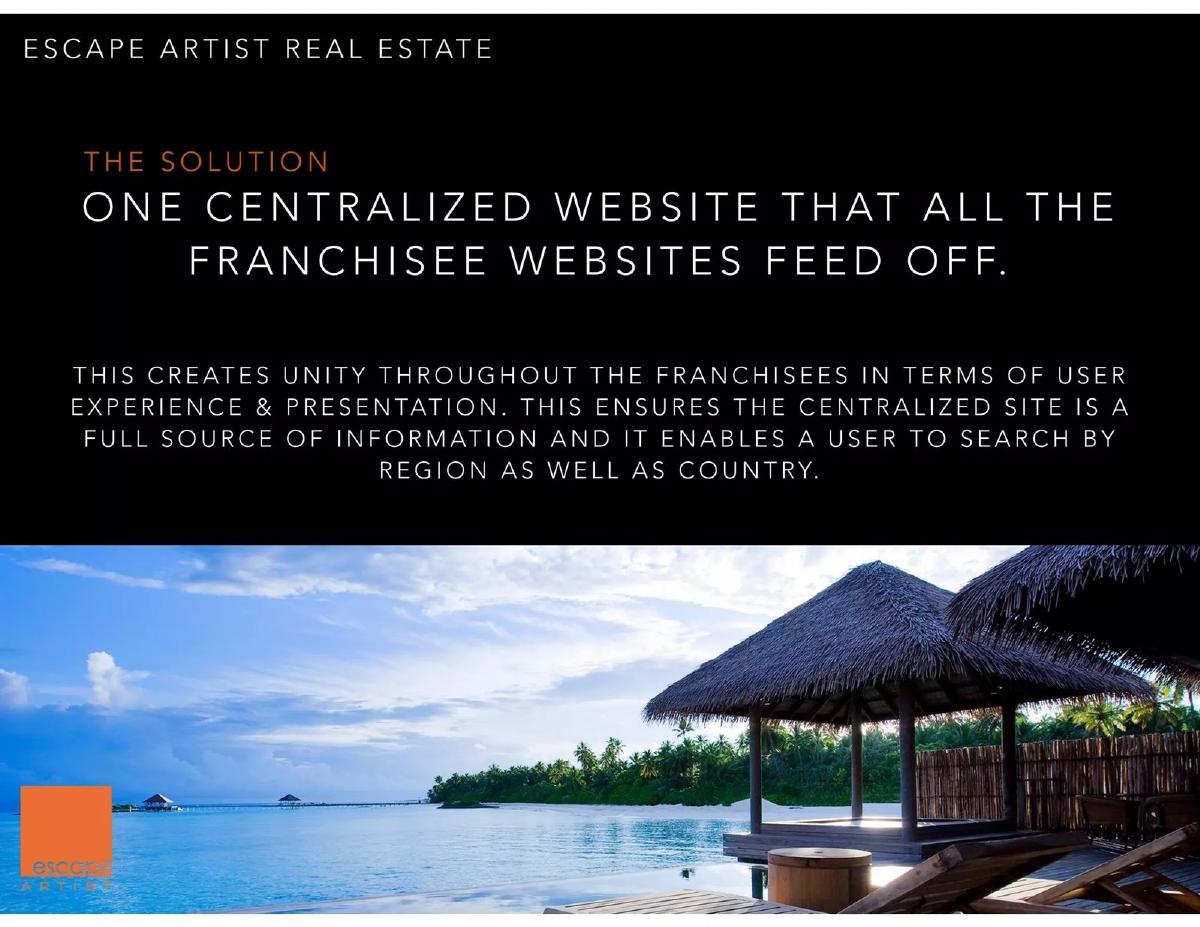
- A centralized website architecture is proposed as the primary technical solution to ensure brand unity and regional search capabilities (Slide 3).
- The business model expands beyond real estate into expat-specific services like medical tourism, asset protection, and banking (Slide 4).
- The service offering is broad, encompassing capital markets, franchise sales, and property management (Slide 5).
- The deck lists 14 major global competitors, including CBRE, Century 21, and Savills, without a direct comparison matrix (Slide 6).
- The brand positioning relies on a lifestyle quote from Domingo Silvas: 'Be at home, no matter where in the world you are' (Slide 7).
- There is a complete absence of unit economics, historical revenue, or growth projections in the provided slides.
- The deck does not include a team slide or a specific capital requirement (ask) for investors.
Escape Artist Real Estate: The Expat-Centric Franchise Model
The Escape Artist Real Estate pitch deck is a study in lifestyle branding and niche market targeting. By focusing on the global expat community, the company attempts to carve out a space between traditional residential real estate and specialized relocation services. However, the deck leans heavily on aspirational imagery and high-level strategy, leaving significant gaps in the underlying business mechanics.
Slide 1: Title and Visual Identity
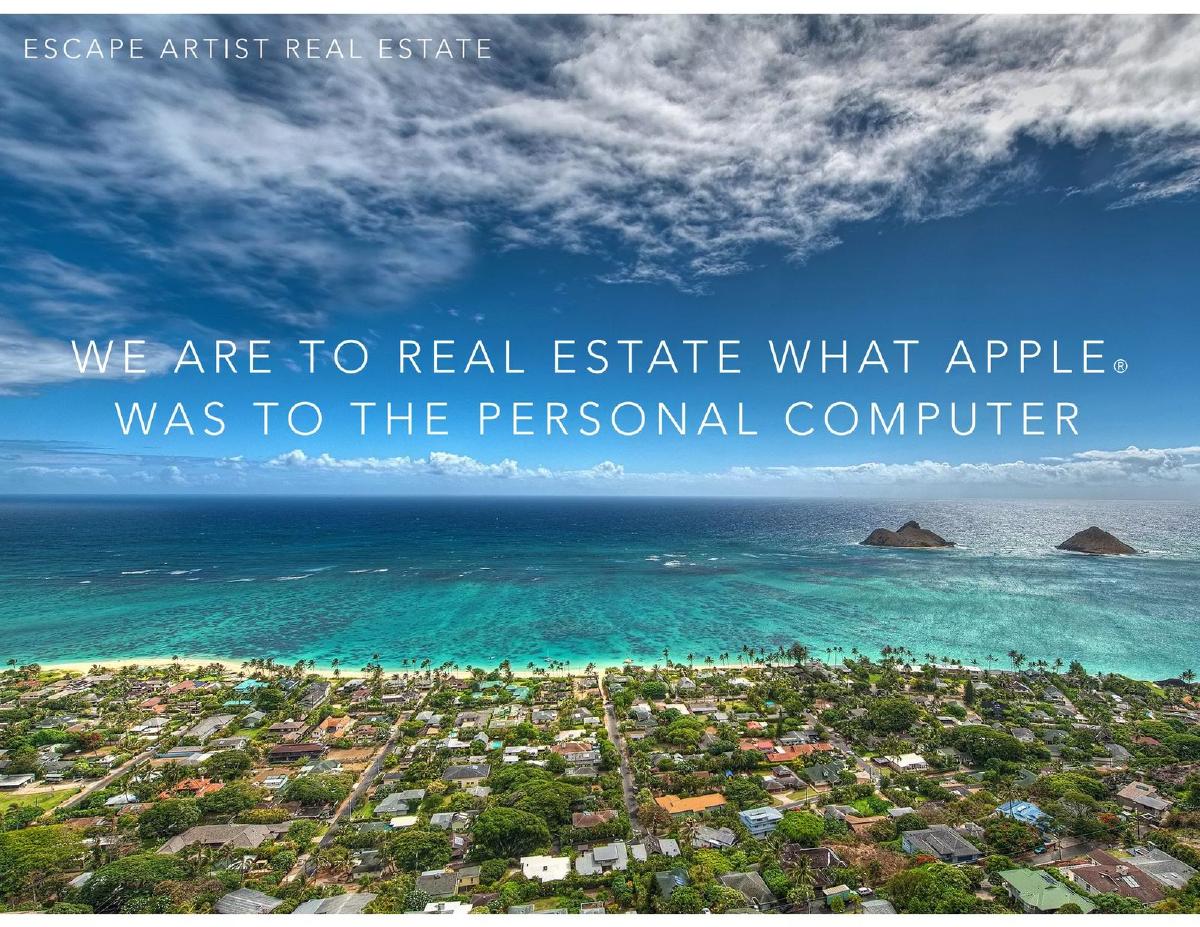
The cover slide sets a clear tone for the brand. It features a high-resolution image of a luxury tropical resort pool with the company name in a clean, sans-serif white font. The 'Escape Artist' logo in the bottom right corner uses a distinct orange square. This slide establishes the company not just as a real estate firm, but as a lifestyle provider for those looking to 'escape' to premium international locations.
Slide 2: The Problem with Legacy Franchisors
Slide 2 serves as the 'Problem' slide, outlining six specific pain points in the current real estate franchisor model. The company claims the industry is 'built on a pre-internet age framework' and suffers from a 'slowness to react.' Most notably, they highlight a 'lack of continuity through the franchisees' and a 'limited scope of services.' This sets the stage for a solution that is both more technologically integrated and more service-oriented than the status quo.
Slide 3: The Technical Solution
The first 'Solution' slide addresses the technical deficiencies mentioned previously. The company proposes 'one centralized website that all the franchisee websites feed off.' The goal is to create unity in user experience and presentation. According to the slide, this centralized hub allows users to search by both region and country, ensuring the site acts as a 'full source of information' rather than a fragmented collection of local office pages.
Slide 4: The Service Solution
Slide 4 expands the value proposition beyond real estate transactions. It positions the company as a 'one stop shop' for the expat community. The slide lists four specific ancillary service areas: visas, medical tourism, asset protection, and banking needs. This is a significant pivot from the traditional real estate model, suggesting that the company intends to capture revenue from the entire relocation lifecycle, not just the property commission.
Slide 5: The Service Menu
This slide lists the specific operational offerings of the company. The list includes:
Capital Markets · Franchise Sales · Franchise Operations · Asset Management Services · Developer Services · Property Management · Expat Services · Training · Accounting Administration
This list suggests a highly centralized corporate structure that provides heavy back-office support to its franchisees, contrasting with the 'lack of continuity' identified in Slide 2.
Slide 6: The Competitive Landscape
Slide 6 displays the logos of 14 major competitors. The list is exhaustive, covering residential giants like Keller Williams, RE/MAX, and Century 21, as well as commercial firms like CBRE and Cushman & Wakefield. While it acknowledges the scale of the competition, the slide lacks a comparison matrix or a 'Blue Ocean' chart to visually demonstrate where Escape Artist Real Estate sits in relation to these incumbents.
Slide 7: Brand Philosophy
The final slide in this set features a quote from Domingo Silvas: 'Be at home, no matter where in the world you are...' set against a backdrop of a city marina at dusk. This reinforces the 'expat' focus and the emotional appeal of the brand. However, as a concluding slide for a pitch, it lacks a call to action or contact information, which are standard for closing a presentation.
What Works in This Deck
Niche Clarity: The deck is very clear about who it is for. By targeting expats specifically, the company avoids the trap of trying to be everything to everyone in the massive global real estate market. The inclusion of services like medical tourism and asset protection shows a deep understanding of the expat pain points.
Visual Consistency: The use of high-quality, full-bleed photography creates a premium feel that aligns with the luxury real estate and expat lifestyle. The branding is consistent across all slides, using the same font and logo placement, which reflects the 'continuity' they claim the industry lacks.
Clear Problem Identification: The 'Problem' slide is well-structured. It doesn't just say the industry is 'old'; it identifies specific operational failures like the lack of a centralized information source and the fragmented franchisee experience.
What Is Missing from This Deck
The Team: There is no mention of the founders, their backgrounds, or their experience in either real estate or the expat market. In early-stage fundraising, the team is often more important than the idea itself. Without this, investors cannot assess the 'execution risk.'
Financials and Unit Economics: The deck contains zero figures. There is no mention of franchise fees, royalty percentages, projected revenue, or historical sales data. An investor needs to know how the 'one-stop shop' model actually translates into higher LTV (Lifetime Value) or better margins compared to a standard brokerage.
The Ask: The deck does not state how much money the company is looking to raise, what the valuation is, or how the funds will be allocated. A pitch deck without an 'Ask' slide is a marketing brochure, not a fundraising tool.
Traction: There is no evidence of existing franchisees, current web traffic for the 'centralized website,' or partnerships with the medical tourism or banking providers mentioned. Without traction, the 'Solution' remains purely theoretical.
What a Founder Should Copy
The 'One-Stop Shop' Strategy: Founders in crowded markets should look at how Escape Artist attempts to widen their 'moat' by adding ancillary services that their larger competitors ignore. For a real estate company, providing visa and banking help is a powerful way to lock in a customer early in their journey.
Centralized Infrastructure as a Selling Point: If you are building a franchise or a multi-location business, emphasizing a unified digital backbone is a strong way to appeal to potential franchisees who are tired of managing their own tech stacks. The promise of 'continuity' is a legitimate competitive advantage in fragmented industries.
Lifestyle Branding: For B2C or high-end B2B services, using aspirational imagery that reflects the result of the service (the tropical pool, the sunset marina) rather than the process of the service (paperwork, legal meetings) is an effective way to build brand desire.
Frequently asked questions
- What is the core problem Escape Artist Real Estate is trying to solve?
- According to Slide 2, the company believes the current real estate franchisor model is outdated, suffering from a 'pre-internet age framework.' They argue that existing franchises lack continuity, have a limited scope of services, and fail to provide a centralized source of information for franchisees to access and serve clients effectively.
- How does the company plan to differentiate itself from traditional real estate firms?
- The differentiation is two-fold: technical and service-based. Slide 3 highlights a centralized website infrastructure for all franchisees. Slide 4 and 5 detail a 'one-stop shop' approach for expats, offering non-traditional services such as visa assistance, medical tourism, asset protection, and banking needs, which traditional firms typically do not handle.
- Who are the primary competitors mentioned in the deck?
- Slide 6 identifies a wide range of global real estate heavyweights as competition. These include residential-focused firms like Keller Williams, RE/MAX, and Century 21, as well as commercial and diversified giants like CBRE, Cushman & Wakefield, Colliers International, and Knight Frank.
- What is the target demographic for this business model?
- The deck explicitly targets the 'expat community' (Slide 4). The entire value proposition is built around the needs of individuals moving between countries, requiring specialized services like international banking and residency visas alongside property acquisition.
- What critical information is missing from this pitch deck?
- The deck is missing several fundamental components required for a professional investment round. There is no team slide to establish credibility, no financial projections or historical performance data, no explanation of the franchise fee structure, and no 'ask' slide detailing how much capital is being raised or how it will be used.