Equity Endeavor is a crowdfunding platform targeting the 'missing middle' of small business finance. Unlike Kickstarter or Indiegogo, which focus on creative projects or global products, Equity Endeavor centers on local storefronts needing capital for renovations or equipment. The deck, dating back to a 2013-2014 timeline, outlines a dual-sided marketplace connecting 'Business Owners' with 'Community Builders.' The presentation is notable for its granular unit economics, projecting a $400 revenue per project against a $180 acquisition cost, yielding a 55% gross margin. However, the model reli…
Key takeaways
- Small businesses represent 99% of U.S. firms and 64% of new private sector jobs, yet struggle to find capital for basic storefront needs (Slide 9).
- The platform differentiates itself from Kickstarter and Indiegogo by focusing on localized small business needs rather than creative or non-localized projects (Slide 13).
- The crowdfunding process involves a five-step flow for both owners (Realization to Raise) and community members (Search to Enjoy) (Slide 17).
- A case study for RedBird Pilates & Fitness targets a $10,000 campaign goal for a business owner with 20 years of experience (Slide 21).
- The company planned a phased rollout starting in Austin and New Orleans (NOLA) between June 2013 and April 2014 (Slide 25).
- Revenue is generated through a 1% front-end fee and a 6% success fee, totaling an average of $400 per project (Slide 29).
- The estimated Customer Acquisition Cost (CAC) is $180, though the deck admits this is based on a 'small amount of data' (Slide 29).
- At the time of the deck, the company was not yet charging fees, despite discussing the structure with customers (Slide 29).
Equity Endeavor: Localizing the Crowdfunding Model
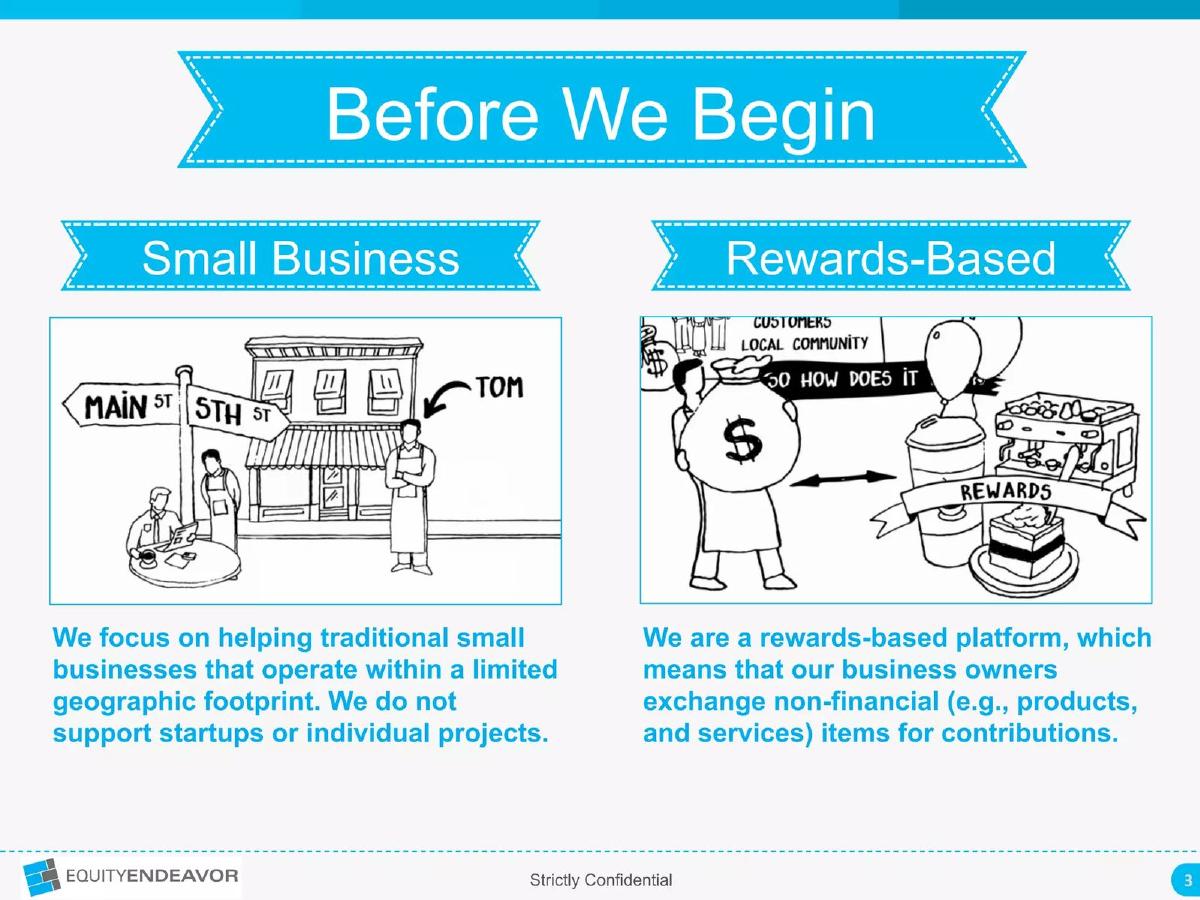
Equity Endeavor presents a platform that attempts to bridge the gap between local community support and small business capital requirements. While the name suggests 'equity' crowdfunding, the mechanics described in the deck lean heavily toward a rewards-based model similar to Kickstarter, but with a strictly local, brick-and-mortar focus. The deck is structured to highlight a massive market opportunity—the millions of U.S. small businesses—and then narrow down to a specific, pilot-tested execution plan in two American cities.
Slide 1: Title and Branding
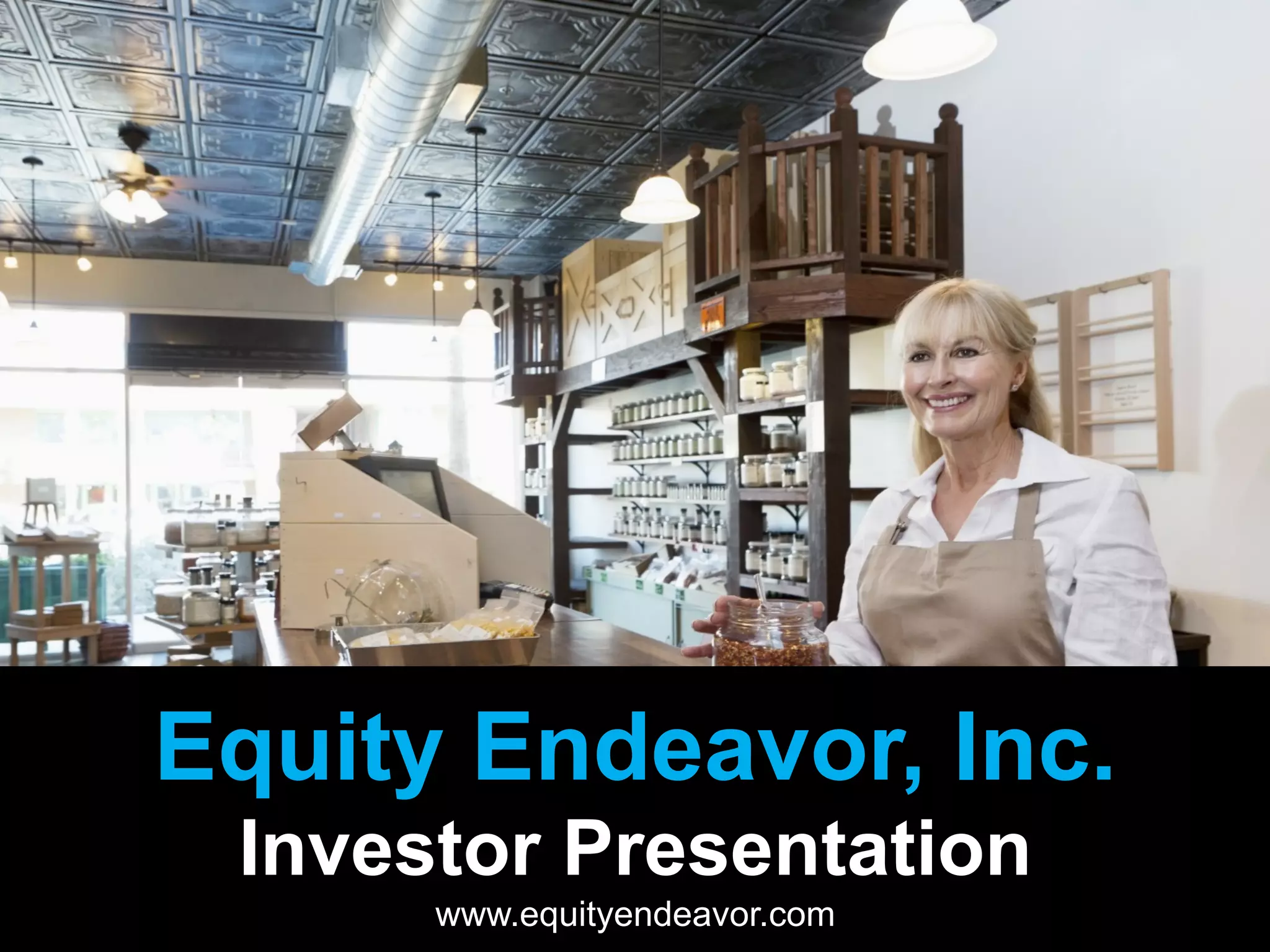
The cover slide features a high-quality photograph of a small business owner in a spice or specialty food shop. This immediately anchors the presentation in the 'local business' theme. The company name, Equity Endeavor, Inc., is prominent, though the URL provided is the primary call to action. The aesthetic is professional, using a clean blue and black color palette that persists throughout the deck.
Slide 5: The Problem Statement
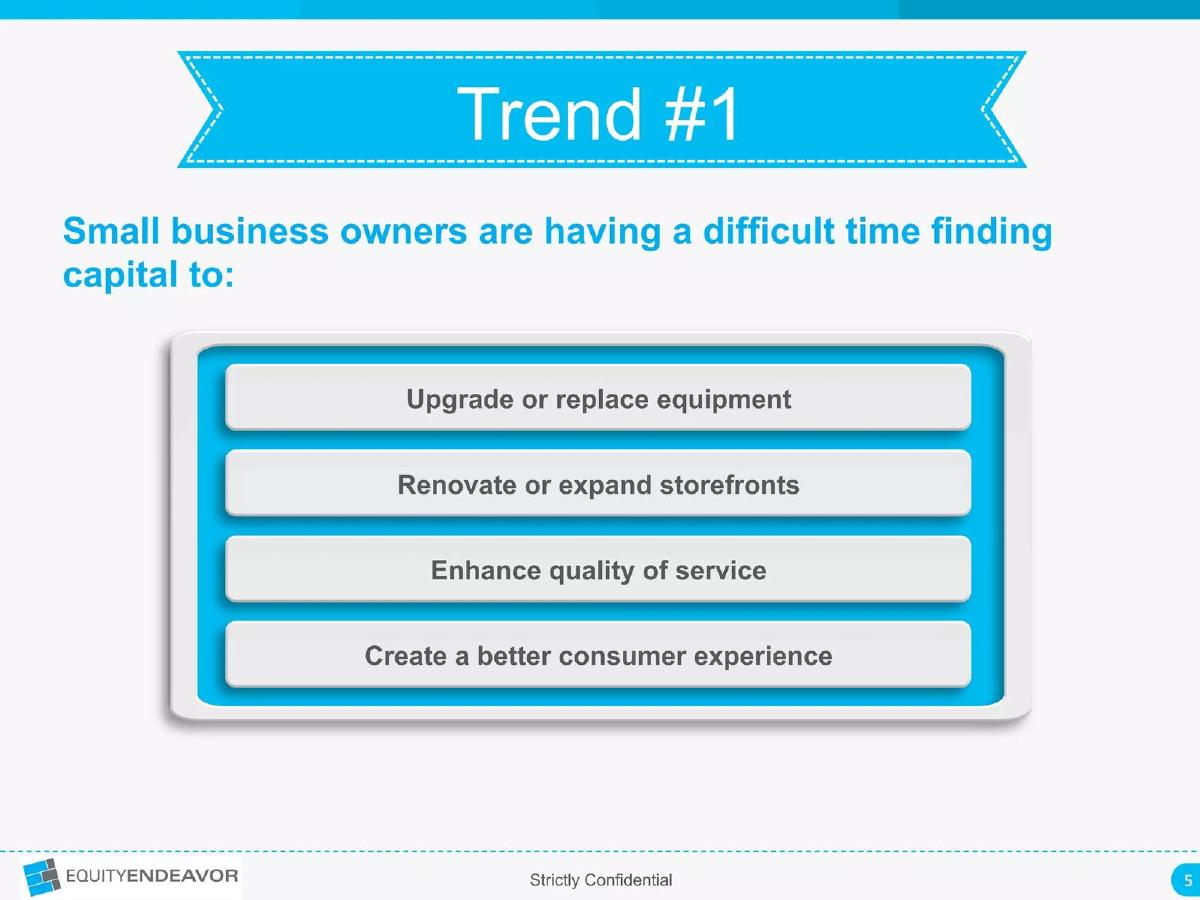
Slide 5 identifies 'Trend #1,' which is the difficulty small business owners face when seeking capital for operational improvements. The deck lists four specific use cases for the funds: upgrade or replace equipment , renovate or expand storefronts , enhance quality of service , and create a better consumer experience . By listing these, the company is positioning itself as a utility for growth rather than a last-resort lender for distressed businesses.
Slide 9: Market Macro-Dynamics
To justify the 'big deal' nature of the business, Slide 9 uses U.S. economic data. It cites that small businesses account for 64% of new private sector jobs , represent 77 million American jobs , and make up 99% of U.S. firms . This slide is intended to show investors that while the individual loans or raises might be small ($10,000 averages), the total addressable market is the backbone of the entire economy.
Slide 13: Competitive Landscape and Differentiation
Slide 13 directly addresses competitors. It claims Kickstarter focuses on 'individual creative projects' and leaves out local small businesses. It suggests Indiegogo is 'not localized,' leading to 'suboptimal situations.' Interestingly, it mentions the American Jobs Act , stating that equity crowdfunding is not a viable option for the majority of small businesses. This is a crucial distinction; Equity Endeavor seems to be positioning itself as a simpler, rewards-based alternative to the complexities of actual equity issuance under the JOBS Act, despite its name.
Slide 17: The Process Flow
This slide provides a side-by-side comparison of the user journey for 'Business Owners' and 'Community Builders.' For owners, the steps are: Project Realization , Campaign Creation , Campaign Review , Launch Campaign , and Raise Funds . For the funders (Community Builders), the steps are: Search , Choose , Pledge , Receive , and Enjoy . The 'Enjoy' phase is emphasized as reaping the benefits of local improvements, suggesting a social or community-pride incentive for the funders.
Slide 21: Case Study - RedBird Pilates & Fitness
The deck uses a real-world example to ground the concept. RedBird Pilates & Fitness, owned by Lee Vallely, is presented with a $10,000 campaign goal . The slide highlights the owner's 20 years of experience, which serves to de-risk the investment in the eyes of the community. This slide demonstrates the typical 'persona' of an Equity Endeavor client: an established local expert looking for a modest capital injection.
Slide 25: The Execution Timeline
The timeline spans from June 2013 to 'April 2014 +'. It shows a phased rollout strategy:
June - Aug 2013: Define MVP and begin pilot studies in Austin and NOLA (New Orleans), enrolling 4 SMBs per city. · Sept - Mar 2014: Complete the pilot, adapt the offering based on feedback, and enroll ~10 additional businesses per city. · Apr 2014 +: Expand presence within Austin and NOLA, add features like a 'talent exchange,' and expand to additional cities.
This geographic focus suggests the company understood the importance of 'density' in a localized marketplace model.
Slide 29: Unit Economics
Slide 29 is the most data-dense slide in the set. It breaks down the 'Economics of a project' based on a $10,000 average raise and a 50% success rate :
Revenue Per Project: $400 (derived from a 1% front-end fee and a 6% success fee). · Acquisition Cost (CAC): $180 (estimated). · Gross Profit: $220. · Gross Margin: 55%.
The slide includes a candid disclaimer: 'We are not currently charging a fee, though we have discussed the fee structure with all customers, and have undoubtedly seen a willingness to pay.' This indicates the company was in a pre-revenue, validation stage at the time of the pitch.
What Equity Endeavor Does Well
The deck excels at defining a very specific niche. By distancing itself from the 'creative' focus of Kickstarter, it carves out a territory in the 'boring but essential' world of small business renovations. The use of a specific case study (RedBird Pilates) makes the abstract concept of 'community building' tangible. Furthermore, the inclusion of Slide 29 shows a level of financial discipline often missing in early-stage decks; they have a clear theory on how they will make money, even if they haven't turned the switch on yet.
Omissions and Weaknesses
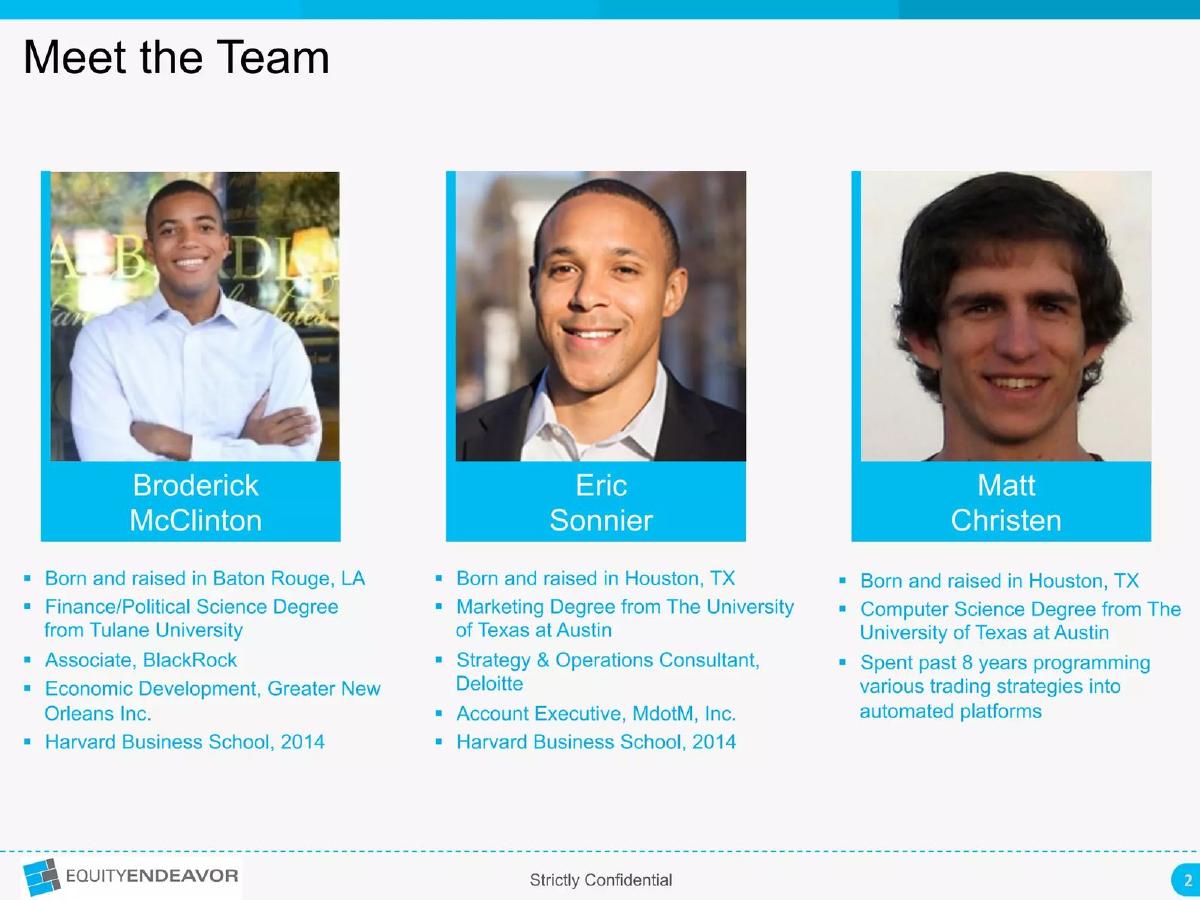
The most glaring omission in the provided slides is the Team Slide . Without knowing who is building this, it is impossible to judge the operational capability to manage local pilots in two different states (Texas and Louisiana). Additionally, there is no Ask Slide in the provided selection, leaving the reader unclear on how much capital is being raised or what the valuation expectations are. The 50% success rate assumption on Slide 29 is also quite high for crowdfunding, where many platforms see lower success rates for first-time campaigners. Finally, the name 'Equity Endeavor' is confusing given that the process slide (Slide 17) describes a rewards-based system ('receive rewards') rather than an equity-based investment system.
Founder's Lessons
Founders should look at Slide 29 as a model for how to present unit economics. Even if your data is limited, showing the math behind your revenue—including how success rates and fees interact—demonstrates a professional grasp of the business model. The hyper-local rollout strategy (Slide 25) is also a wise approach for marketplace startups; trying to be everywhere at once often leads to 'empty' platforms. By focusing on Austin and NOLA, Equity Endeavor attempted to build the necessary density to make the 'Community Builder' side of the marketplace viable.
Frequently asked questions
- What is the primary problem Equity Endeavor aims to solve?
- According to Slide 5, small business owners struggle to find capital for four specific areas: upgrading equipment, renovating storefronts, enhancing service quality, and improving the consumer experience. The deck argues that traditional crowdfunding platforms like Kickstarter are too focused on creative projects to serve these local brick-and-mortar needs effectively.
- How does the company generate revenue?
- Revenue is based on a two-tier fee structure detailed on Slide 29. They charge a 1% front-end fee on the average $10,000 raise ($100) and a 6% success fee. When adjusted for a projected 50% campaign success rate, the average revenue per project is calculated at $400.
- What was the initial geographic focus for the platform?
- The timeline on Slide 25 indicates a hyper-local strategy. The pilot study and initial awareness campaigns were launched in Austin, Texas, and New Orleans (NOLA). The plan was to enroll 4 SMBs per city initially, expanding to 10 additional businesses per city by early 2014.
- Who are the two main user groups on the platform?
- Slide 17 defines the marketplace participants as 'Business Owners' and 'Community Builders.' Business owners create campaigns and offer rewards, while community builders search for local campaigns, pledge funds, and eventually 'reap the benefits' of the local business improvements.
- What are the projected unit economics for a single project?
- Slide 29 breaks down the 'Economics of a project' with specific figures: $400 in Revenue, $180 in Acquisition Cost, and $220 in Gross Profit. This results in a 55% Gross Margin. The deck notes that the $180 CAC is an estimate based on limited early data.