EquitySim’s 2016 Series A deck is a study in minimalist, narrative-driven fundraising. With only 13 slides, the company successfully secured $3.1 million by focusing on a high-value niche: the financial markets. The deck avoids dense text, opting instead for bold visual statements and a clear three-step 'How it works' flow. Its strength lies in its traction slide, which reports $430k in ARR just four months after monetization, and a powerful testimonial from Credit Suisse that validates the product's ability to eliminate the need for physical campus recruiting. While the deck is light on comp…
Key takeaways
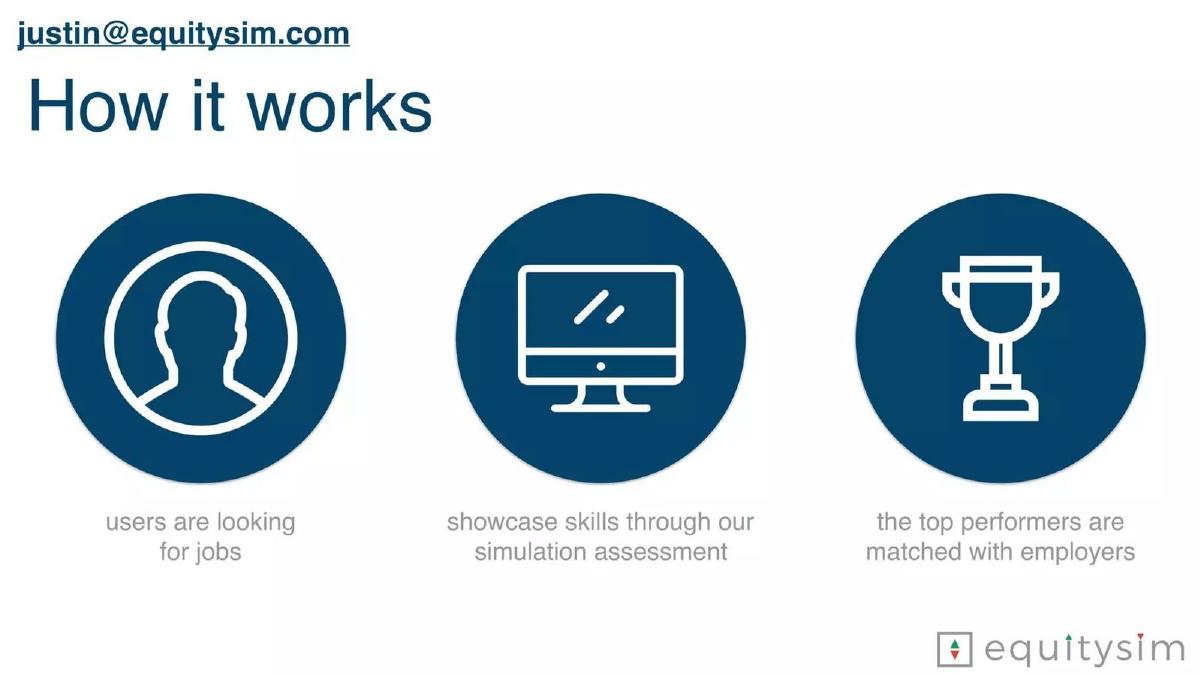
- The deck uses a progressive 'How it works' sequence across slides 2, 3, and 4 to explain the user journey from job seeking to employer matching.
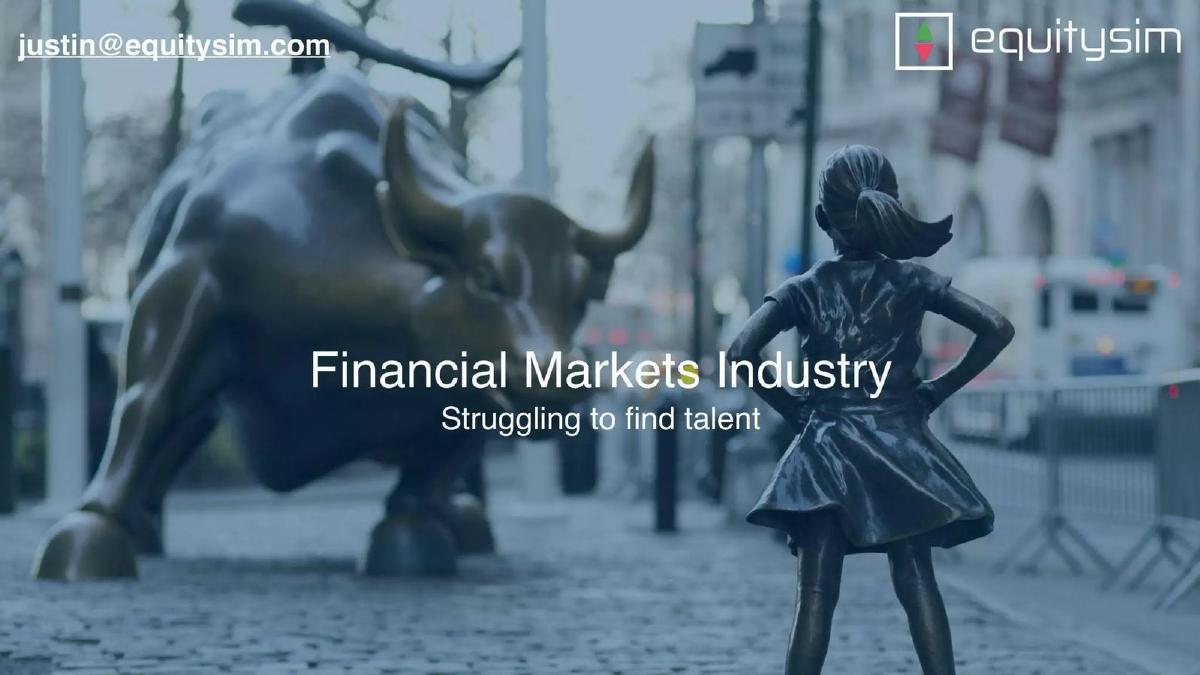
- EquitySim identifies the 'Financial Markets Industry' as its initial target market on slide 6, framing it as a sector struggling to find talent.
- A high-impact testimonial on slide 7 from Credit Suisse provides enterprise-level social proof for the platform's efficacy.
- The company reports significant early financial success on slide 8, citing $430k in ARR despite having only monetized four months prior.
- The platform claims to capture '100,000’s Data Points per candidate' through its simulations (slide 9).
- The total addressable market is defined broadly as a '$500 BN recruiting industry' on slide 10.
- The deck concludes with a vision for an 'Equitable Future' where all hiring is simulation-based (slide 11).
- Crucial investor information, including the specific funding ask, team backgrounds, and a detailed roadmap, is entirely absent from the slides.
The Narrative of Data-Driven Hiring
The EquitySim pitch deck from 2016 is a lean, 13-slide presentation that prioritizes vision and early traction over granular operational detail. At its core, the deck argues that the traditional recruitment process—built on resumes and interviews—is fundamentally broken, especially in high-stakes environments like the financial markets. By replacing subjective measures with objective simulation data, EquitySim positions itself as both a productivity tool for recruiters and an equalizer for candidates. This teardown explores how the company used a minimalist aesthetic and a single massive enterprise win to justify a $3.1 million Series A.
Slides 1-4: The Hook and the Process
Slide 1: Title Slide The deck opens with a high-angle shot of a city skyline, likely Chicago or New York, establishing the corporate and financial context of the business. The tagline is direct: "Using Simulation to change the way people are hired." Justin Adam Ling is the only name listed, with a contact email provided in the upper left corner—a recurring element on every slide.
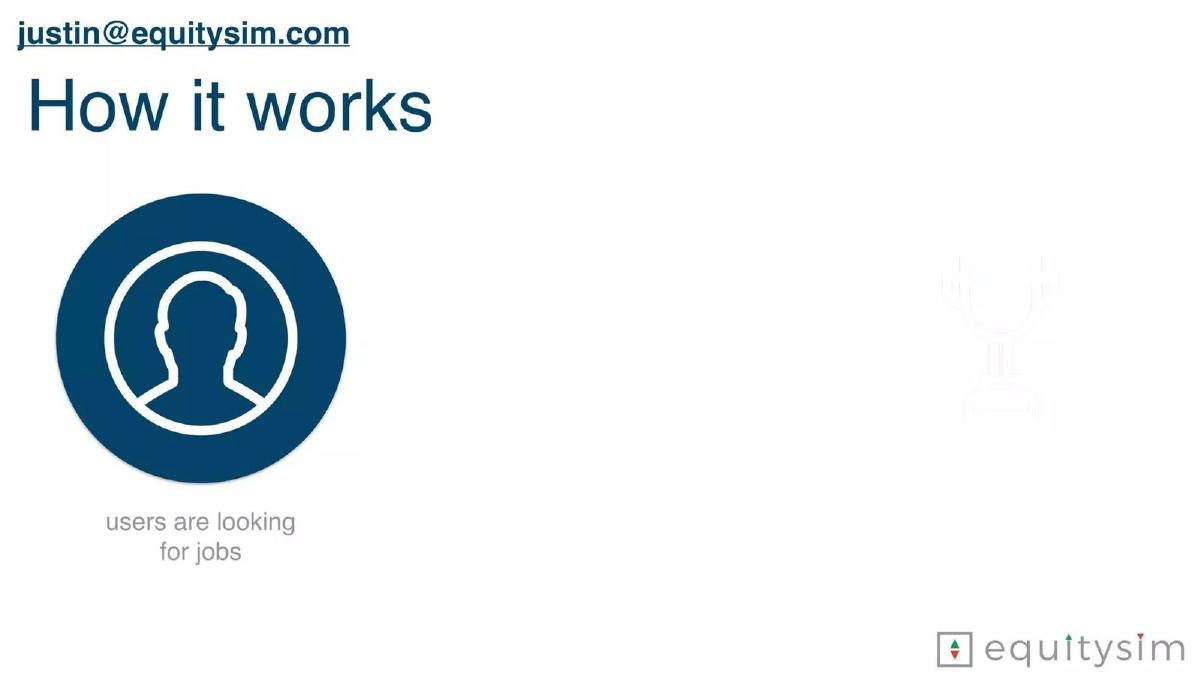
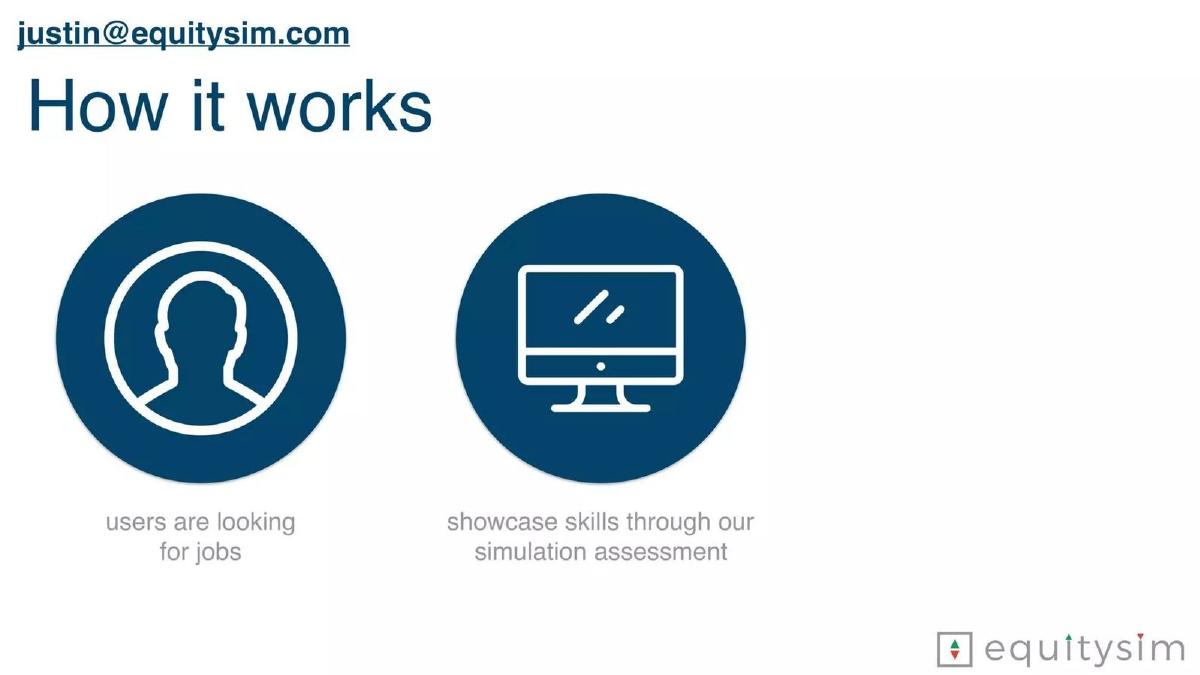
Slides 2, 3, and 4: How it works EquitySim uses a three-slide build to explain its value proposition. This is a common technique used to keep the audience focused on one step of the process at a time. Slide 2 introduces the user ("users are looking for jobs"). Slide 3 adds the middle step ("showcase skills through our simulation assessment"). Slide 4 completes the loop ("the top performers are matched with employers"). The use of simple icons—a person, a computer, and a trophy—distills a complex algorithmic process into a digestible three-step workflow. By the end of slide 4, the investor understands the platform is a marketplace fueled by proprietary assessment data.
Slides 5-7: The Problem and the Validation
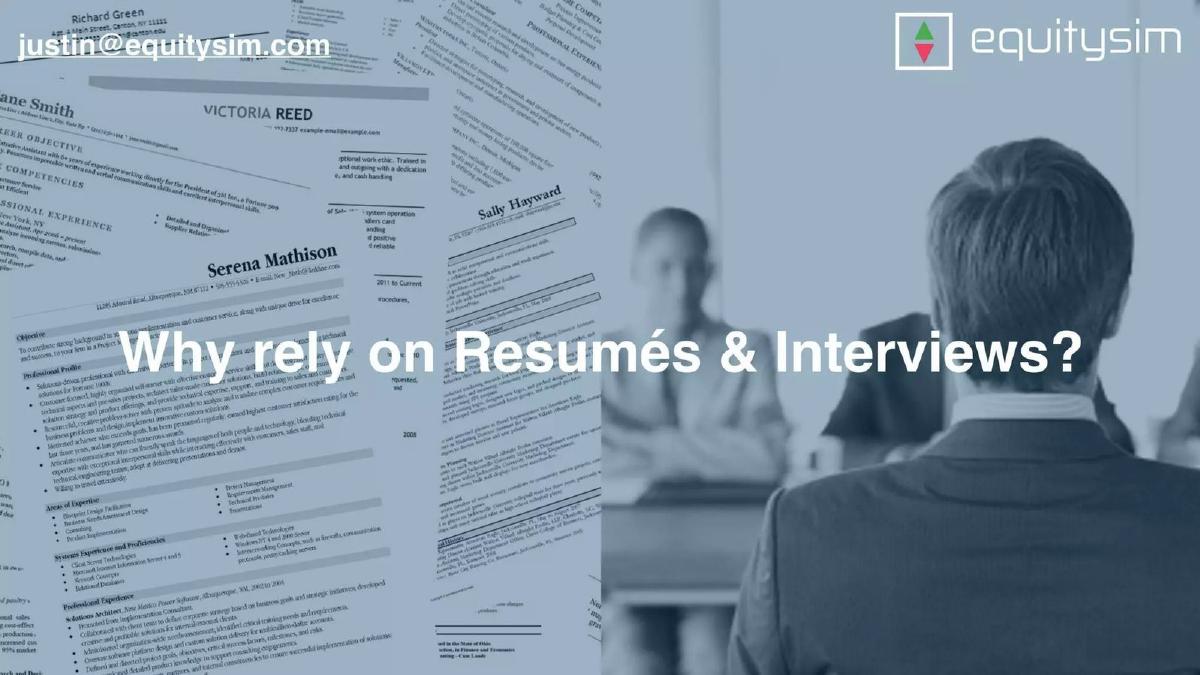
Slide 5: The Problem Statement The deck pivots to the 'Why.' Over an image of a person buried in resumes, the text asks: "Why rely on Resumés & Interviews?" This slide challenges the status quo, implying that these traditional methods are inefficient or inaccurate. It sets the stage for a data-driven alternative.
Slide 6: Industry Focus EquitySim narrows its lens to the "Financial Markets Industry," which it describes as "Struggling to find talent." The use of the iconic Wall Street bull imagery reinforces that they are solving a problem for a specific, high-value vertical rather than trying to boil the ocean of general recruitment immediately.
Slide 7: Enterprise Validation This is arguably the strongest slide in the deck. It features a testimonial from a Credit Suisse representative: "We no longer have to go to college campuses to recruit talent." For a startup in the HR-tech space, proving that a major global bank is willing to abandon traditional campus recruiting in favor of your software is a massive signal of product-market fit. It validates that the simulations are trusted by the highest level of enterprise buyers.
Slides 8-10: Traction and Market Size
Slide 8: Market Traction The company presents three key metrics: they monetized 4 months ago, they have reached $430k in ARR, and they have placed 300+ candidates. The $430k ARR figure is particularly impressive given the short four-month window since monetization. This suggests a high contract value (ACV) and a sales process that resonates quickly with financial firms.
Slide 9: The Data Advantage To explain the 'moat,' slide 9 highlights that they capture "100,000’s Data Points per candidate" and "understand the candidate BEFORE employers hire them." This emphasizes the depth of their simulation technology compared to a one-page resume. The background imagery of a digital brain and circuit patterns shifts the tone from 'recruitment' to 'deep tech.'
Slide 10: Market Size EquitySim quotes a "$500 BN recruiting industry." While this is a standard 'big number' slide, it serves to show that while they are starting in finance, the technology is horizontally scalable. However, the deck provides no breakdown of how much of that $500 billion is actually serviceable by their specific simulation model.
Slides 11-13: Vision and Closing
Slide 11: The Big Vision The deck moves toward a conclusion with a vision of "An Equitable Future, where ALL Jobs are Hired via Simulation." This slide attempts to elevate the company from a niche tool for banks to a fundamental shift in how global labor markets function. The background image of the Golden Gate Bridge suggests a bridge to a new era of hiring.
Slide 12: Abstract Visual This slide is purely visual, featuring a blue circuit-board pattern forming a keyhole. It likely served as a backdrop for a verbal deep dive into the technology or security of the platform during a live pitch, but it contains no text or data.
Slide 13: Closing The deck ends by repeating the title slide. This brings the presentation full circle, leaving the company name, tagline, and contact information on the screen for the Q&A portion of the meeting.
What Works in This Deck
The EquitySim deck is a masterclass in restraint . By using very little text, the founders ensure that the investor's attention remains on the speaker rather than reading paragraphs of bullet points. The Credit Suisse testimonial on slide 7 is the anchor of the entire pitch; it provides the necessary social proof to make the $430k ARR on the following slide feel like the beginning of a larger trend rather than a fluke. Additionally, the progressive disclosure of the 'How it works' section (slides 2-4) makes the product's utility immediately clear without needing a live demo.
What is Missing
Despite raising $3.1 million, this deck omits several elements that are usually considered mandatory for a Series A. First, there is no Team slide . Investors at this stage are betting heavily on the founders' ability to scale, and the absence of their backgrounds is a notable gap. Second, there is no Competitive Landscape . The deck doesn't mention other assessment tools like Pymetrics or HackerRank, leaving the question of differentiation unanswered. Third, there is no Financial Roadmap or Ask . The deck doesn't state how much they are raising or how they plan to use the capital to grow from $430k ARR to $10M+ ARR. Finally, there is a lack of Unit Economics ; while they mention ARR, they don't disclose the cost to acquire these customers or the churn rates of the candidates placed.
What a Founder Should Copy
Founders should emulate the visual hierarchy used here. Each slide has one clear message. If you are talking about traction, only show traction. If you are talking about the problem, only show the problem. The use of a 'Hero' customer quote is also something every founder should strive for; a quote that claims your product replaces a legacy behavior (like campus recruiting) is far more powerful than a quote saying your product is 'great to use.' Lastly, the consistent branding —using the same fonts, colors, and email contact on every slide—creates a professional, cohesive feel that suggests attention to detail.
Frequently asked questions
- What is EquitySim's core product offering?
- EquitySim offers a simulation-based assessment tool designed to replace or augment traditional resumes and interviews. According to slides 2 through 4, the platform allows job seekers to showcase their skills through digital simulations, which then match top performers with employers based on behavioral data rather than just academic background.
- How much revenue did EquitySim have at the time of this deck?
- On slide 8, titled 'Market Traction,' the company states they have $430k in Annual Recurring Revenue (ARR). Notably, the slide mentions they had only begun monetizing four months prior to the presentation, suggesting a rapid initial sales cycle or high-value contracts.
- Which major companies were using EquitySim?
- Slide 7 prominently features the Credit Suisse logo alongside a quote from a recruitment executive stating, 'We no longer have to go to college campuses to recruit talent.' This indicates that EquitySim had successfully penetrated top-tier financial institutions early in its lifecycle.
- What industry does EquitySim focus on?
- While slide 10 mentions the broader $500 billion recruiting industry, slide 6 explicitly identifies the 'Financial Markets Industry' as their current focus. The imagery of the Wall Street 'Charging Bull' and 'Fearless Girl' statues reinforces this niche positioning.
- What is missing from the EquitySim pitch deck?
- The deck is missing several standard Series A components: there is no team slide detailing the founders' expertise, no competitive landscape analysis, no breakdown of unit economics (CAC/LTV), and no specific 'Ask' slide detailing how the $3.1 million would be spent.