Equipboard’s 12-slide pre-seed deck from 2013 is notable for its extreme brevity and reliance on visual storytelling. The company positions itself as a digital encyclopedia for music gear, leveraging celebrity influence to drive affiliate sales. The deck highlights a strong +40% month-over-month growth rate and high user engagement metrics, such as 5-minute average session durations. While the deck lacks traditional sections like a detailed market size breakdown or a specific financial 'ask' slide, it compensates with a strong roster of early investors and advisors, including 500 Startups and…
Key takeaways
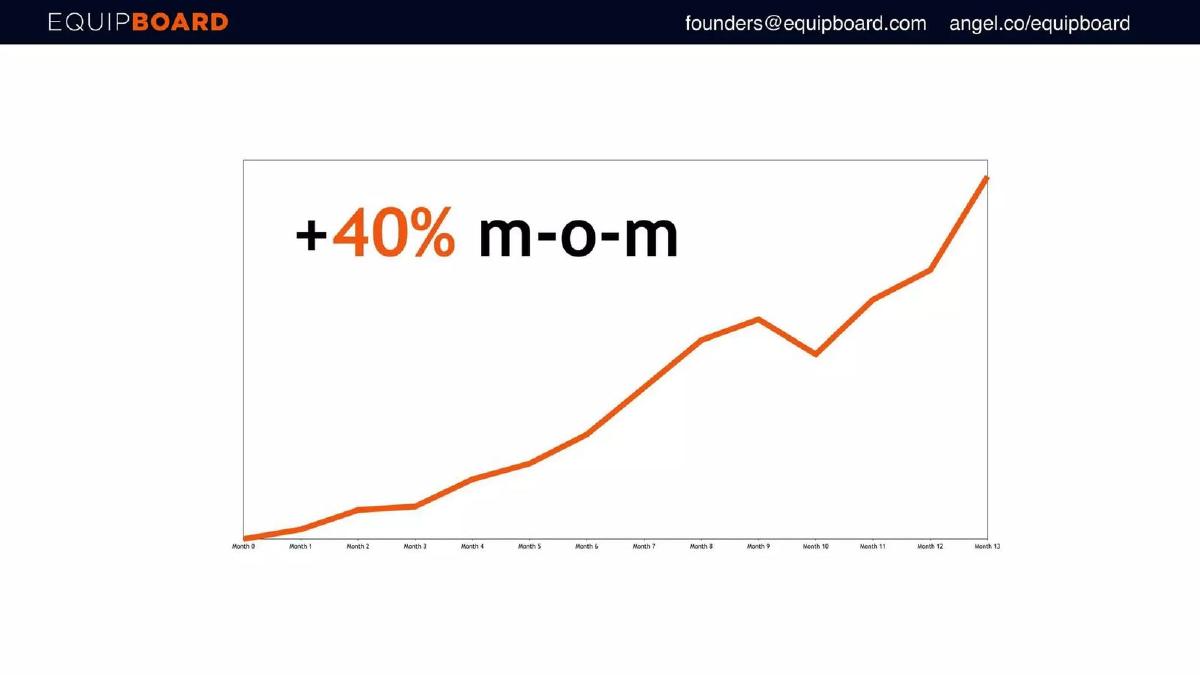
- The deck claims a +40% month-over-month growth rate over a 13-month period on slide 2.
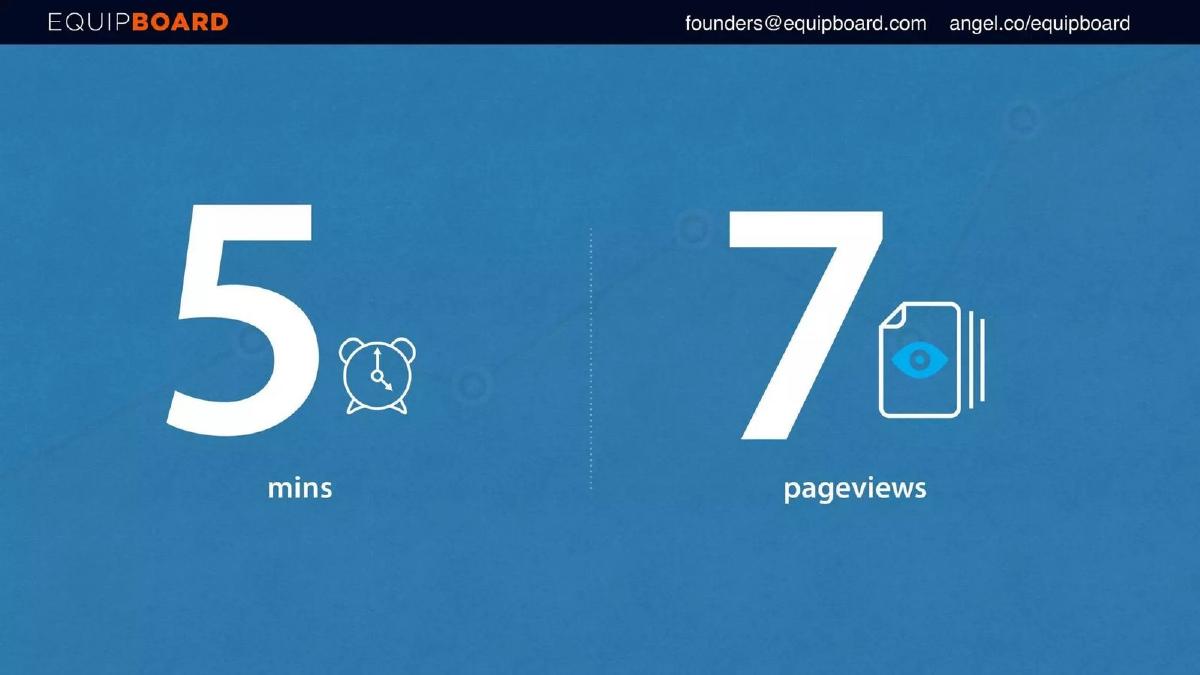
- User engagement is high, with the deck reporting 5-minute session durations and 7 pageviews per visit on slide 6.
- The primary revenue model is affiliate-based, citing an 8% average commission on slide 7.
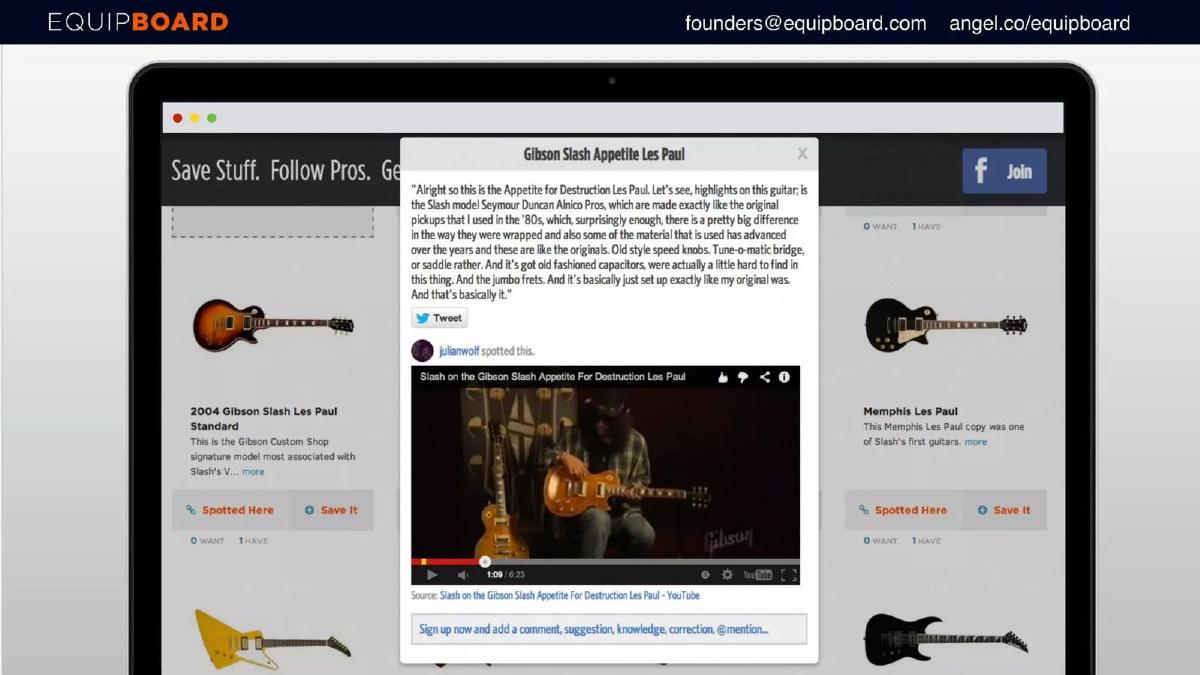
- The platform uses crowdsourced verification, showing a 'spotted here' feature with video evidence on slide 4.
- Market expansion is hinted at through icons representing music ($3B), sports ($5B), and lifestyle ($65B) on slide 8.
- The founders emphasize their long-term partnership with a 'Team Circa 2002' photo on slide 10.
- The deck lists significant early backing from 500 Startups and Silverton Partners on slide 11.
- There is no explicit 'Ask' slide detailing the amount of capital being raised or the valuation.
Introduction: The Minimalist Encyclopedia
Equipboard’s 2013 pitch deck is a fascinating artifact from the early days of community-driven commerce. At just 12 slides, it avoids the dense text blocks typical of modern decks, opting instead for a 'show, don't tell' philosophy. The company describes itself as a music gear encyclopedia, but the deck reveals a much more ambitious goal: capturing a slice of the multi-billion dollar affiliate market by leveraging the aspirational power of professional artists.
The Hook and Traction
Slide 1: Title Slide The deck opens with a clean, dark-themed title slide featuring the Equipboard logo and the tagline: "Discover the products your heroes use." It includes contact information and a link to their AngelList profile, signaling that this deck was likely used for outreach on that platform.
Slide 2: Traction Immediately following the title, Equipboard drops its most compelling data point. A line graph shows 13 months of growth with the headline "+40% m-o-m." While the Y-axis is unlabeled (a common tactic to hide absolute numbers while showing growth velocity), the steady upward trajectory suggests a product that has found early market fit. The dip around Month 10 followed by a sharp recovery indicates resilience or a successful product iteration.
Product and Community Verification
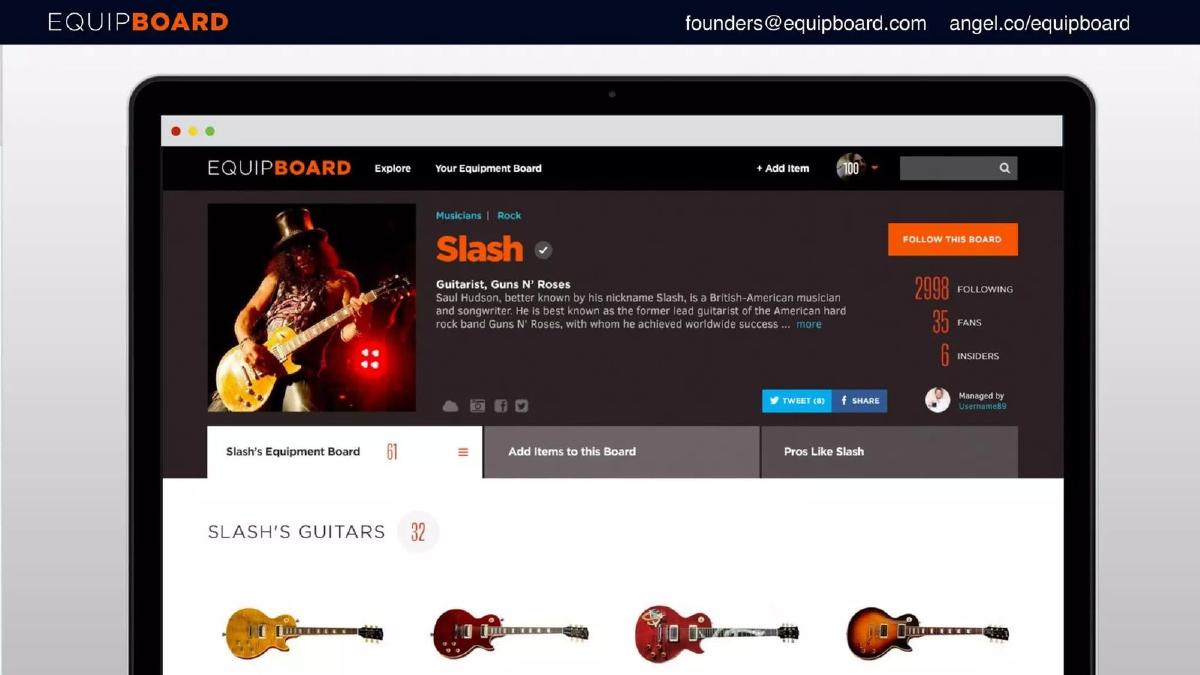
Slide 3: The Product Interface This slide shows a mockup of a profile for Slash, the guitarist for Guns N' Roses. It highlights the 'Equipment Board' concept, showing that Slash has 61 items on his board. The UI is clean, displaying 'Slash's Guitars' with clear product photography. This slide establishes the core value proposition: a centralized place to see exactly what gear a professional uses.
Slide 4: Crowdsourced Verification One of the biggest challenges for an 'encyclopedia' is accuracy. Slide 4 demonstrates how Equipboard solves this through community moderation. A pop-up shows a specific guitar (Gibson Slash Appetite Les Paul) with a 'spotted by' credit to a community member. Crucially, it includes a YouTube embed as proof. This social proof mechanism is what allows the platform to scale without a massive internal editorial team.
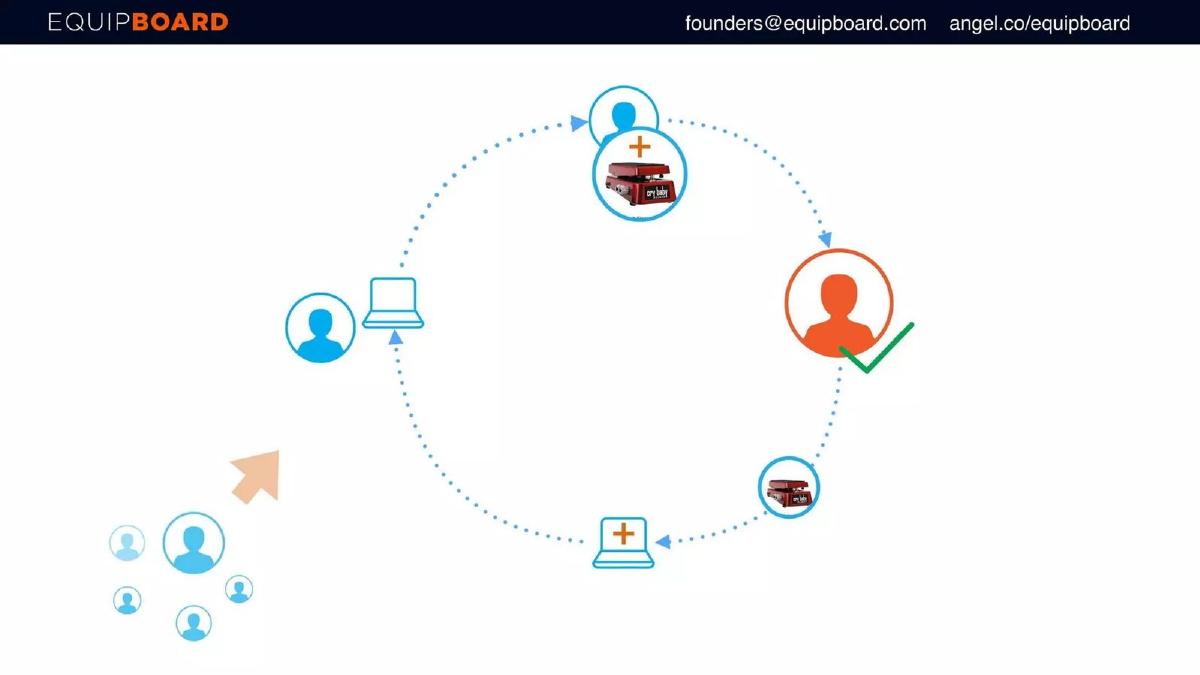
Slide 5: The Viral Loop This slide uses a circular diagram with icons representing users, computers, and gear (a Cry Baby wah pedal). It illustrates the virtuous cycle of the platform: a user discovers gear, adds it to a board, another user verifies it, and the community grows. It’s a standard network effect visualization that explains how the database populates itself.
Engagement and Monetization
Slide 6: Engagement Metrics Equipboard moves from 'how it works' to 'how well it works.' Slide 6 features two large numbers: "5 mins" and "7 pageviews." For a content-heavy site, a 5-minute average session duration is exceptionally high, suggesting that users aren't just bouncing; they are deep-diving into the gear lists. High pageviews per visit are also a strong indicator of a 'rabbit hole' effect, which is ideal for affiliate marketing.
Slide 7: The Revenue Model This is the most critical slide for an investor. It displays "8% average commission" alongside icons of a musician and a brand tag. This confirms that Equipboard is not a subscription service or an ad-supported blog; it is a high-intent lead generator for music gear retailers. By connecting the 'hero' to the 'gear,' they sit at the very bottom of the purchase funnel.
Market Expansion and Team
Slide 8: Market Opportunity Equipboard uses this slide to show their roadmap. They start with a $3B music market (their current niche). They then point toward a $5B sports market and a massive $65B lifestyle market. By using recognizable figures like Tiger Woods and Kim Kardashian, they signal to investors that the underlying technology—the 'Equipment Board'—is vertical-agnostic and can be applied to any industry driven by celebrity influence.
Slide 9: The Founders We are introduced to Michael Pierce (CEO) and Giulio Chiarenza (CTO). The slide is simple, featuring professional headshots and titles. There are no bios or past company logos here, which is a notable omission, but the following slides attempt to build that missing credibility.
Slide 10: Founder History Titled "Team Circa 2002," this slide shows a photo of the two founders from over a decade prior to the deck's creation. This is a classic 'founder chemistry' slide. It tells investors that these two have worked together for a long time and are unlikely to have a partnership breakdown—a leading cause of early-stage startup failure.
Slide 11: The Support Network This slide is a 'who's who' of the Austin tech scene and early-stage venture capital. It lists 10 advisors, including Andrew Chen (a well-known growth expert) and founders of successful companies like Jonathan Coon (1-800 CONTACTS). The inclusion of Silverton Partners and 500 Startups logos provides the final stamp of institutional approval needed for a pre-seed round.
Slide 12: Conclusion A simple "Thank You" slide that mirrors the title slide, repeating the contact email and AngelList URL.
What Works in This Deck
Traction First: Leading with a +40% growth chart is a powerful way to grab attention. It frames the rest of the deck as an explanation of a success already in progress, rather than a hypothetical pitch.
Visual Simplicity: The deck uses very little text. Each slide focuses on one core idea—growth, verification, engagement, or revenue. This makes the deck very easy to digest in under two minutes.
Clear Monetization: Many community-based startups struggle to explain how they will make money. Equipboard is refreshingly direct: they take an 8% commission on sales. There is no ambiguity about the business model.
What Is Missing
The Ask: The most glaring omission is a slide detailing how much money they are raising and what they plan to do with it. While this information might have been in the AngelList description, a standalone deck should usually include a 'Use of Funds' slide.
Market Size Calculation: While slide 8 gives large numbers ($3B, $5B, $65B), it doesn't explain the source of these figures or what percentage of that market is realistically addressable (TAM/SAM/SOM). It feels more like an aspirational goal than a calculated market analysis.
Competitive Landscape: The deck does not mention competitors like Gearslutz (now Gearspace) or Reverb. Investors would want to know how Equipboard differentiates itself from existing gear forums or marketplaces.
What a Founder Should Copy
The 'Spotted' Verification Slide: If you are building a crowdsourced platform, you must prove that the data is reliable. Slide 4 is a perfect example of how to show a complex verification process in a single, easy-to-understand screenshot.
The Founder History Slide: Showing a photo from 10 years ago is a brilliant, low-text way to prove founder alignment. It’s much more effective than writing "We have been friends for a long time" in a bullet point.
Focus on Engagement: Instead of just showing total users, Equipboard showed session duration and pageviews. For a content-driven site, these 'stickiness' metrics are often more important to sophisticated investors than raw traffic numbers, as they indicate a loyal and active user base.
Conclusion
Equipboard’s deck is a product of its time—a lean, AngelList-era presentation that prioritizes momentum and social proof over exhaustive financial modeling. It successfully argues that the founders have built a sticky, growing community with a built-in revenue stream. While it lacks some of the rigor expected in modern Seed or Series A decks, its clarity of purpose remains a strong example for pre-seed founders today.
Frequently asked questions
- What is the core business model of Equipboard according to the deck?
- Equipboard operates as a community-driven affiliate commerce platform. Slide 7 explicitly states an '8% average commission' as the revenue driver. By cataloging the specific gear used by professional musicians (as shown on slide 3 with Slash), the platform creates a high-intent shopping environment where users can discover products and click through to purchase them from third-party brands.
- How does Equipboard verify the gear used by celebrities?
- The platform utilizes a crowdsourced verification model. Slide 4 shows a pop-up interface where a user ('julianwolf') 'spotted' a specific Gibson Slash Appetite Les Paul. This claim is backed by a YouTube video embed and a 'Spotted Here' link, providing social and visual proof to ensure the accuracy of the encyclopedia.
- What growth metrics did Equipboard share in this 2013 deck?
- The deck leads with traction, showing a chart on slide 2 that indicates +40% month-over-month growth. Additionally, slide 6 highlights deep user engagement, noting that the average user spends 5 minutes on the site and views 7 pages per session. These metrics suggest a sticky product with a dedicated community.
- Does the deck address future market expansion beyond music?
- Yes, slide 8 uses three circular images to represent market tiers. It starts with music gear at a $3B valuation (represented by a DJ), moves to sports at $5B (represented by Tiger Woods), and ends with a much larger $65B lifestyle/celebrity market (represented by Kim Kardashian). This suggests the founders viewed the music gear encyclopedia as a proof-of-concept for a broader 'celebrity gear' vertical.
- Who were the key investors and advisors involved in the pre-seed stage?
- Slide 11 features a robust list of 10 individual advisors and two institutional firms. Notable names include Andrew Chen, Joshua Baer, and Jonathan Coon. The institutional logos displayed are Silverton Partners and 500 Startups, indicating strong early-stage institutional support for the Austin-based startup.