EnvoyNow’s seed deck is a masterclass in demonstrating product-market fit through narrow focus. Raising $1,000,000 in 2013, the startup tackled the 'last-mile' problem of college campuses—areas often inaccessible to traditional delivery drivers. The deck leans heavily on traction, showing a staggering >45% month-over-month revenue growth (Slide 4) and a 70% repeat user rate (Slide 6). By positioning their 'dorm access' as a competitive moat against Postmates (Slide 7), EnvoyNow convinced investors that the college demographic was a distinct, high-frequency market worth $21 billion annually. D…
Key takeaways
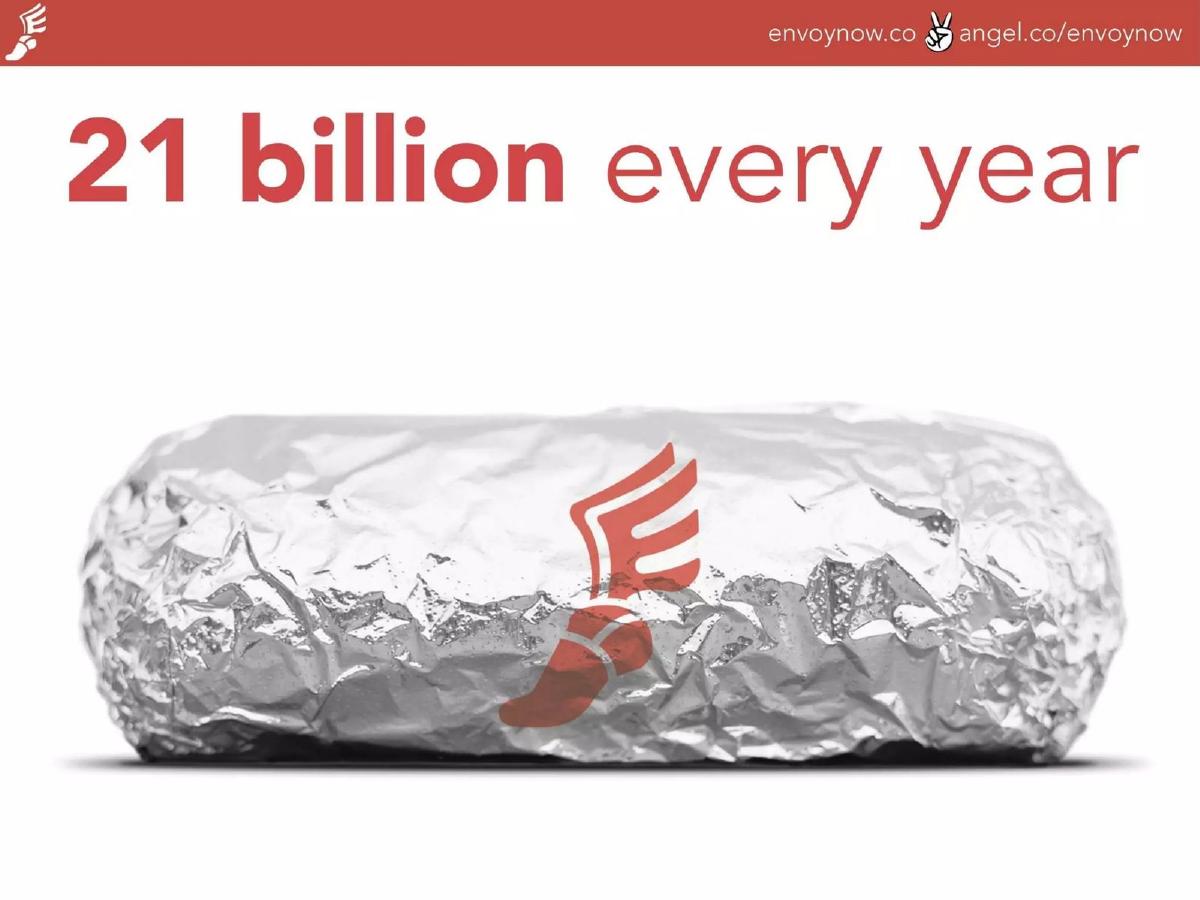
- The deck identifies a $21 billion annual market opportunity specifically within the college ecosystem (Slide 2).
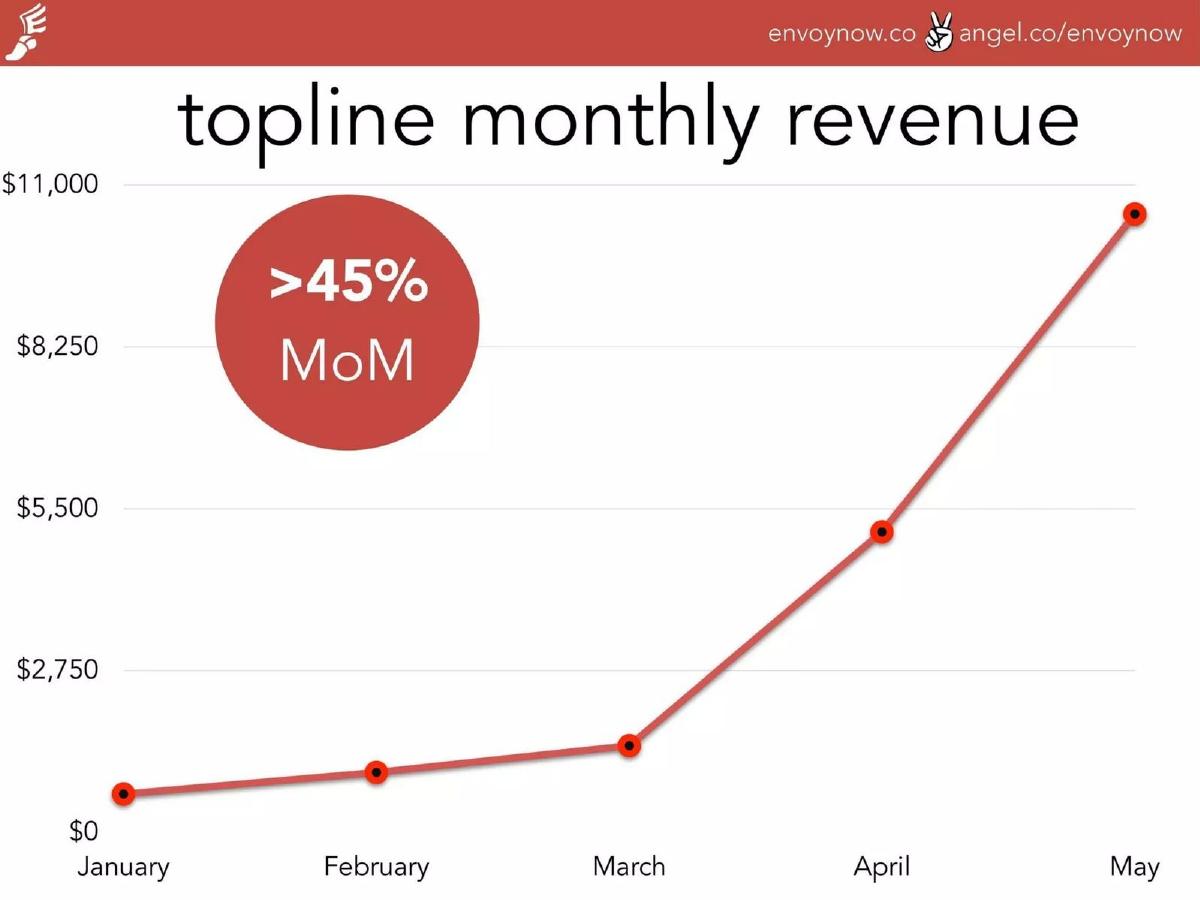
- Revenue growth is the primary hook, showing an upward trajectory from near $0 in January to over $10,000 by May (Slide 4).
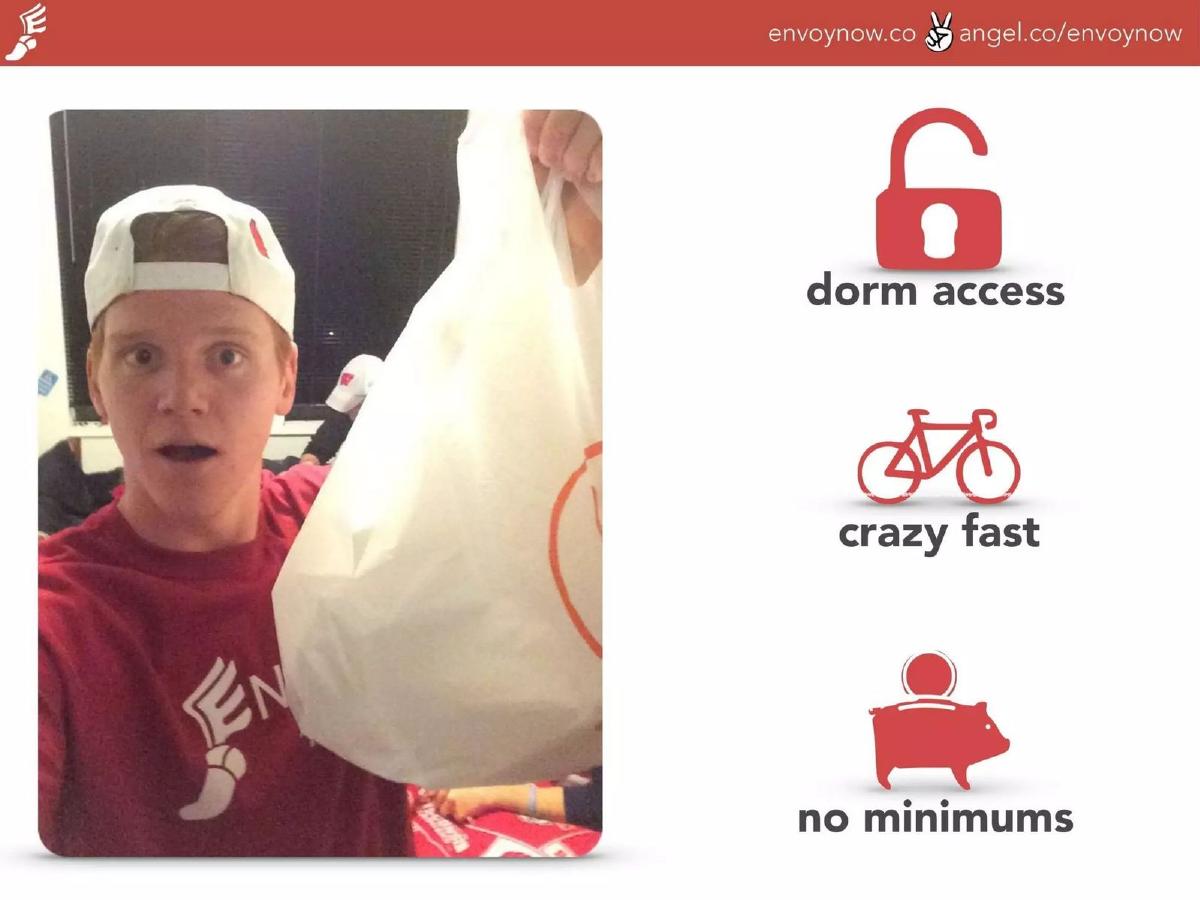
- The service claims a significant speed and access advantage, specifically citing 'dorm access' as a key differentiator (Slide 5).
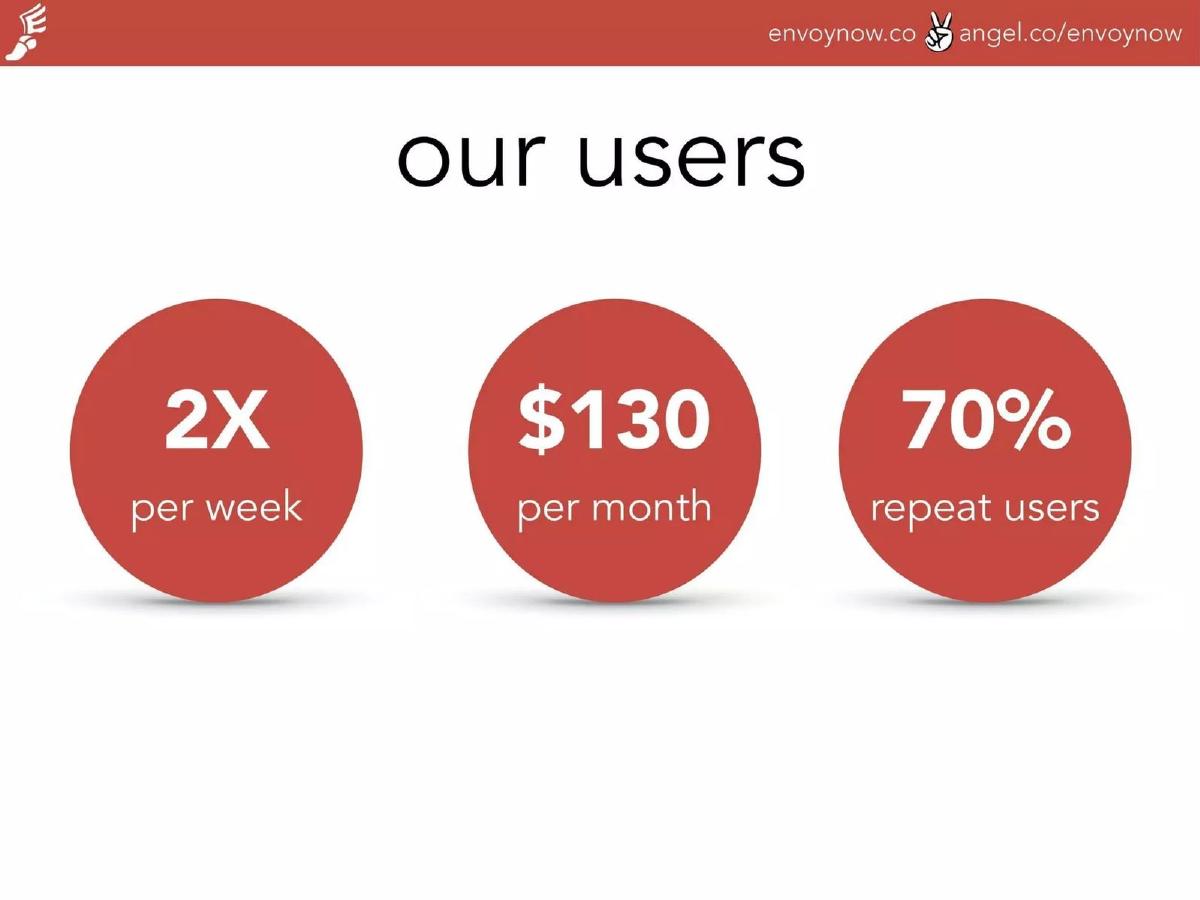
- User engagement metrics are exceptionally high, with the average user ordering 2X per week and spending $130 per month (Slide 6).
- A heat map comparison (Slide 7) visually demonstrates EnvoyNow's density and 'radius' advantage over Postmates in a campus environment.
- Viral growth is proven by the claim that 80% of users come through referrals (Slide 7).
- The team slide uses logos of major competitors (Postmates, DoorDash, GrubHub) to imply industry expertise or relevant benchmarking for each member (Slide 9).
- The deck omits a formal financial 'Ask' or a breakdown of how the $1M seed round would be allocated across the business.
The Power of Hyper-Local Traction
EnvoyNow’s 10-slide deck is a focused narrative on capturing a specific, high-value demographic: college students. In 2013, the food delivery wars were already heating up, but EnvoyNow identified a friction point that the giants couldn't solve: the physical gates of the university. This teardown examines how they used hyper-local data to prove a national opportunity.
Slides 1-2: The Hook and the Market
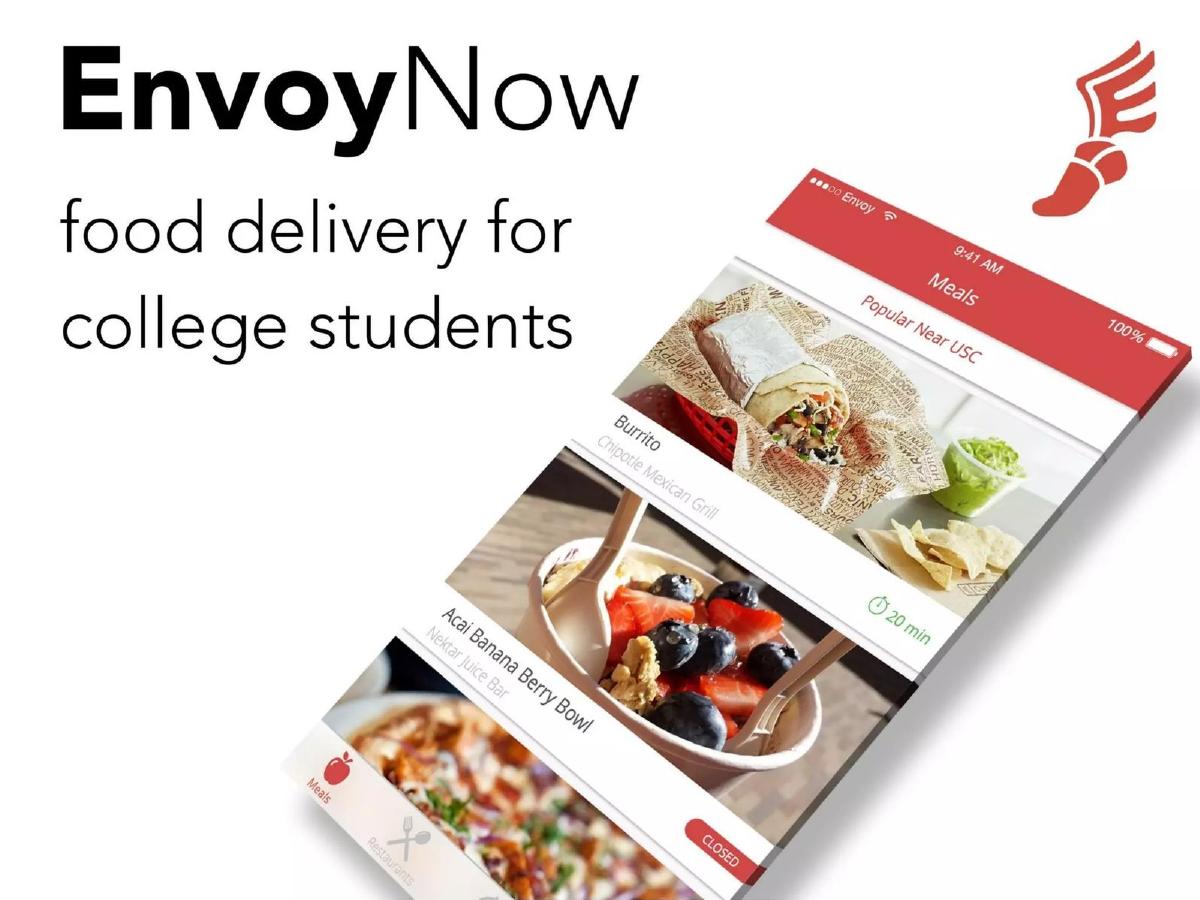
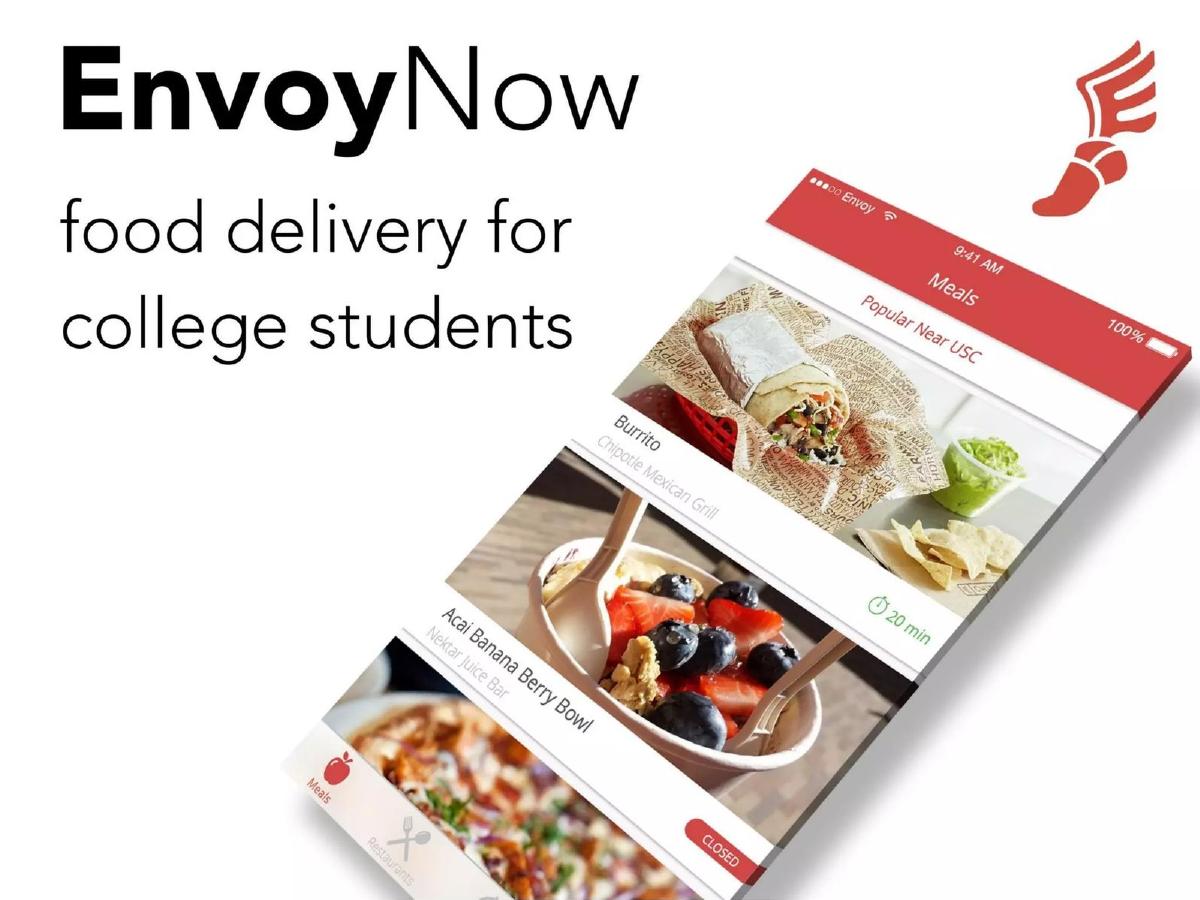
Slide 1: Title The deck opens with a clean, minimalist title slide. The tagline 'food delivery for college students' immediately identifies the niche. The visual of a mobile app interface showing 'Popular Near USC' grounds the product in a real-world use case.
Slide 2: Market Size The company presents a massive figure: '21 billion every year.' While the slide is light on citations, it uses a visual of a foil-wrapped burrito with the EnvoyNow logo to keep the focus on food. This slide establishes that while the niche is specific, the spending power is significant enough to support a venture-scale business.
Slides 3-4: The Human Element and Revenue Growth
Slide 3: The Envoys Instead of showing complex logistics diagrams, Slide 3 shows two photos of actual students making deliveries. This reinforces the 'student-to-student' model which is central to their operational advantage. It humanizes the brand and suggests a low-cost, peer-to-peer workforce.
Slide 4: Topline Monthly Revenue This is the 'money slide.' It shows a revenue graph from January to May. While the absolute numbers are modest (scaling from near $0 to just over $10,000), the slope of the line is the key. The callout '>45% MoM' (Month-over-Month) growth is the primary metric intended to excite seed investors. It proves that the model is working and accelerating.
Slides 5-6: The Product Moat and User Behavior
Slide 5: Value Proposition EnvoyNow identifies three pillars: 'dorm access,' 'crazy fast,' and 'no minimums.' The 'dorm access' point is the most critical. By highlighting a literal lock icon, they are telling investors that they can go where Postmates and GrubHub cannot. This is a physical moat that technology alone cannot solve.
Slide 6: User Engagement The metrics here are impressive for any consumer app: 2X orders per week, $130 spend per month, and a 70% repeat user rate. These numbers suggest that once a student starts using EnvoyNow, it becomes a habitual part of their lifestyle. High frequency and high retention are the two most important indicators of product-market fit in the delivery space.
Slides 7-8: Viral Growth and Geographic Expansion
Slide 7: Competitive Heat Map This slide uses a heat map to compare the 'EnvoyNow Radius' against the 'Postmates Radius.' It visually demonstrates that EnvoyNow is much more concentrated and 'hot' in the center of the campus. The '80% referral' stat in the top left corner is a powerful testament to the organic, viral nature of college marketing.
Slide 8: The Map The deck shows a map of the United States littered with 'U' icons and specific university logos (Wisconsin, Michigan, Michigan State, Ohio State, etc.). This slide is intended to show that the USC pilot is repeatable. It signals that the 'playbook' for taking over a campus is ready to be exported to every major university in the country.
Slides 9-10: Team and Momentum
Slide 9: The Team The team slide features five members: Anthony (Strategy), Parker (Tech), Chad (Growth), Nick (Finance), and Gabe (Operations). Underneath each photo is a logo of a major delivery or tech company (Postmates, Instacart, Seamless/GrubHub, DoorDash, Fluc). This is a clever, if slightly ambiguous, way to signal that the team understands the competitive landscape and is building a 'best-of' version of these services for the college market.
Slide 10: Conclusion The final slide summarizes the core strengths: 45% MoM revenue growth, 30% MoM user base expansion, and 2X weekly usage. It provides a clear contact email and an AngelList link. Notably, there is no 'Ask' slide detailing the $1,000,000 raise mentioned in the catalogue facts, suggesting this deck was used as a teaser or part of a larger presentation where the deal terms were handled separately.
What Works in This Deck
Extreme Focus: By narrowing the market to 'college students,' the founders avoid the 'boil the ocean' trap. They prove they can win one specific, lucrative segment. · Moat Identification: Identifying 'dorm access' as a competitive advantage is brilliant. It turns a logistical hurdle for others into a unique selling point for them. · Traction-First Narrative: The deck doesn't spend time on 'why food delivery is good.' It spends time on 'look how fast we are growing.' · Visual Simplicity: Most slides have fewer than 10 words. This forces the investor to listen to the founder while the slide provides a single, powerful data point as evidence.
What Is Missing
Unit Economics: There is no mention of the take rate, delivery fees, or the cost to acquire a customer (CAC) vs. Lifetime Value (LTV). In the delivery business, growth is easy if you lose money on every order; investors usually want to see the path to profitability. · The Ask: The deck ends without telling the investor how much money is being raised or what it will be used for (e.g., 'hiring 5 engineers' or 'expanding to 50 campuses'). · Operations Detail: While 'dorm access' is mentioned, the deck doesn't explain the legal or logistical framework of how they manage a fleet of student workers across different states.
What a Founder Should Copy
The Heat Map Comparison: If you are a local or niche player, use a visual map to show why 'generalist' competitors are failing in your specific territory. · High-Frequency Metrics: If your product is used multiple times a week, make that the centerpiece of your deck. Investors love high-retention, high-frequency habits. · Logo Benchmarking: Using competitor logos on the team slide to show 'Strategy' or 'Growth' alignment is a great way to show you are a student of your industry, even if you haven't worked at those specific companies.
Frequently asked questions
- How much did EnvoyNow raise with this deck?
- According to the catalogue facts, EnvoyNow raised $1,000,000 in a Seed round in 2013. The deck itself focuses on traction and growth metrics rather than the specific terms of the raise, which is common for decks used in active pitch meetings where the 'Ask' might be discussed verbally or tailored to the investor.
- What was EnvoyNow's main competitive advantage?
- Their primary moat was 'dorm access.' As shown on Slide 5 and Slide 7, traditional delivery services like Postmates often struggle with campus security and navigation. By using student 'Envoys,' the company could deliver directly to dorm rooms, providing a faster and more seamless experience than off-campus competitors.
- What are the key traction metrics highlighted in the deck?
- The deck emphasizes three core metrics: >45% month-over-month revenue growth (Slide 4), a 70% repeat user rate (Slide 6), and the fact that 80% of their growth is driven by referrals (Slide 7). These figures suggest a very low customer acquisition cost and high lifetime value.
- Is there a clear exit strategy or business model mentioned?
- No. The deck does not explicitly state a business model (take rate vs. delivery fee) or an exit strategy. However, the focus on hyper-local density and high-frequency usage made them an attractive acquisition target for larger players in the social-commerce and delivery space, leading to their acquisition by JoyRun.
- Who were the founders and what was their background?
- The company was founded by Anthony Zhang and Chad Massura. Slide 9 shows a five-person leadership team (Anthony, Parker, Chad, Nick, and Gabe) and associates their roles with major industry logos like Postmates and Instacart, though it doesn't specify if they worked there or are simply benchmarking their strategy against them.