The 2014 eProf.com investor deck presents a clear value proposition: providing the technical infrastructure for traditional education businesses to transition to digital commerce. By targeting the 'Education Mid-Market'—ranging from solo tutors to private colleges—eProf aimed to solve the fragmentation of disjointed software tools. The deck emphasizes a 'turnkey' solution including branded websites, eCommerce engines, and integrated teaching tools like Skype and OpenTok. While the deck is strong on product architecture and competitive feature-mapping, it lacks specific financial traction, his…
Key takeaways
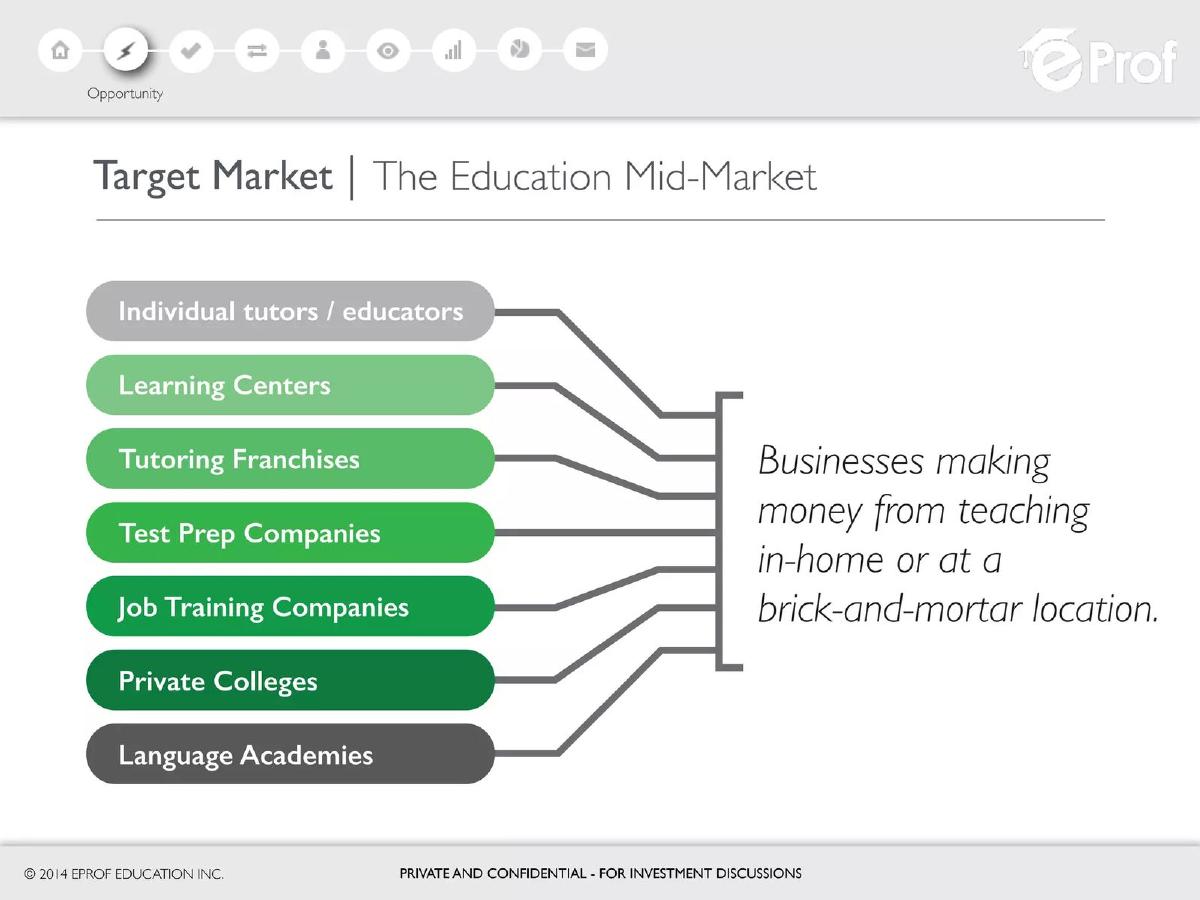
- The company targets the 'Education Mid-Market,' specifically businesses moving from brick-and-mortar to online (Slide 2).
- eProf positions itself as a 'turnkey platform' combining branded websites, eCommerce, and teaching tools (Slide 3).
- The platform utilizes an 'Open Architecture,' integrating third-party tools like Skype, Watchitoo, and OpenTok rather than building everything from scratch (Slide 8).
- Customer acquisition is bifurcated: inbound marketing for solo/SMB tutors and outbound sales for large enterprises (Slide 5).
- The technical foundation is highlighted by a Ruby on Rails application with 350,000 lines of code and two years of development (Slide 7).
- Competitive positioning focuses on offering more 'Online Teaching Venues' (5) and 'Live Video Streams' (20) than competitors like WizIQ or GoToMeeting (Slide 6).
- The deck lacks a specific funding ask, valuation, or use of proceeds slide in the provided sequence.
- Market validation is supported by a quote from an Upfront Ventures investor regarding the growth of US eCommerce to $370 billion by 2017 (Slide 9).
Executive Summary: The Infrastructure for Edu-Commerce
The eProf.com investor deck from April 2014 presents a vision for the professionalization of online education. Rather than building a marketplace where tutors compete on price (like a Fiverr for education), eProf positioned itself as the underlying infrastructure—the 'engine'—that allows established education brands to digitize their existing business models. By focusing on the 'Mid-Market,' eProf sought to capture the transition of brick-and-mortar institutions into the digital age.
Slide 1: Title Slide
The title slide is minimalist, featuring the eProf logo—a green 'e' wearing a mortarboard—and the text 'INVESTOR DECK.' The footer indicates the company is 'EPROF EDUCATION INC.' and marks the document as 'PRIVATE AND CONFIDENTIAL.' It establishes a professional, academic-adjacent brand identity from the outset.
Slide 2: Target Market | The Education Mid-Market
This slide defines the company's sandbox. eProf identifies seven segments: Individual tutors, Learning Centers, Tutoring Franchises, Test Prep Companies, Job Training Companies, Private Colleges, and Language Academies. The unifying characteristic, as stated on Slide 2 , is that these are 'Businesses making money from teaching in-home or at a brick-and-mortar location.' This is a crucial distinction; they are targeting existing revenue streams looking for a more efficient delivery vehicle, rather than trying to create new educators from scratch.
Slide 3: Our Solution | What eProf Provides
eProf describes its product as a 'completely turnkey platform to run an education business online.' The slide lists five core components: Branded Website, eCommerce Engine, World-Class Teaching Tools, Tiered User Architecture, and Logistics Management . The visual aid shows the platform functioning across desktop, tablet, and mobile devices, emphasizing the multi-platform nature of modern education. The term 'turnkey' is the keyword here, suggesting a low barrier to entry for non-technical educators.
Slide 4: Customer Benefits | Why Our Clients Love eProf
This slide translates features into value propositions. It highlights four pillars: Growth (breaking geographical barriers), Independence (ownership of online presence), Logistics (unified software vs. disjointed tools), and Personal (meeting student expectations while maintaining brand recognition). The mention of 'fully automated e-commerce' on Slide 4 addresses a common pain point for small-to-medium education businesses that often rely on manual invoicing.
Slide 5: Customer Acquisition | Conversion Methods
eProf outlines a dual-track Go-To-Market (GTM) strategy. For solo educators and SMBs, they use inbound marketing and a 'self-serve product with automated on-boarding.' For large businesses and enterprises, they employ outbound sales calls, online demos, and custom pricing models. Slide 5 notes that enterprise deals focus on 'annual contracts with upfront payment,' which is a strong signal for cash flow stability, though no specific contract wins are cited.
Slide 6: Competitive Landscape | How Do We Stack Up?
The competitive matrix compares eProf against WizIQ, Electa Live, Tutors Nirvana, and GoToMeeting. eProf claims superiority in technical capacity, citing 5 Online Teaching Venues and 20 Max Live Video Streams , whereas most competitors offer only 1 venue and 6-8 streams. Notably, eProf positions its $49/month starting price at the high end of the market (equal to GoToMeeting), signaling a premium, feature-rich positioning rather than a race to the bottom on price.
Slide 7: Investment Highlights | Strong Product
This slide focuses on technical defensibility. The company claims to have built the 'engine that will power Edu-Commerce.' The 'Technology Spec' includes a Ruby on Rails application with 350,000 lines of code and 2+ years of development . By quantifying the code base and development time, eProf attempts to demonstrate a 'moat' of effort and time that would be difficult for a new entrant to replicate quickly.
Slide 8: Investment Highlights | Open Architecture
eProf clarifies its build-vs-buy philosophy. Rather than reinventing video conferencing or payment processing, they 'forge partnerships with world-class software providers.' Slide 8 lists integrations with Watchitoo, Skype, join.me, and OpenTok . This 'Open Architecture' approach is presented as a strategic choice to bring the 'core technology that edu-businesses need to succeed' into one unified platform without the overhead of maintaining every sub-component in-house.
Slide 9: Investment Highlights | Long Term Outlook
To validate the market opportunity, eProf uses a quote from Greg Bettinelli, an investor at Upfront Ventures. The quote highlights that US online sales were expected to grow from $260 billion to ~$370 billion in 2017 . While this is a general eCommerce stat rather than an EdTech-specific one, it serves to frame eProf as a participant in the broader, unstoppable shift toward digital commerce.
Slide 10: Contact Us
The final slide provides direct contact information for Evan Lewis (CEO) and Andrew Rains (CMO) , including their eprof.com email addresses and phone numbers. This serves as the team slide by proxy, though it lacks the traditional 'Team' slide format that details past exits, education, or relevant industry experience.
What Works in the eProf.com Deck
Clear Market Segmentation: The deck does an excellent job of identifying exactly who the customer is. By listing specific types of businesses (e.g., 'Language Academies,' 'Test Prep Companies'), they move beyond the vague 'everyone who teaches' and show they understand the specific niches within the mid-market.
Technical Specificity: In an era where many EdTech pitches were 'Skype for X,' eProf provided actual technical specs. Citing 350,000 lines of code and a two-year development cycle (Slide 7) gives investors a sense of the product's maturity and the 'sunk cost' of development that a competitor would have to match.
Feature Comparison: The competitive matrix on Slide 6 is well-structured. It doesn't just use checkmarks; it uses hard numbers for 'Teaching Venues' and 'Video Streams,' which are objective metrics that favor eProf's architecture.
What is Missing from the eProf.com Deck
Traction and Revenue: This is the most significant omission. There are no charts showing user growth, monthly recurring revenue (MRR), or the number of active 'Academies' on the platform. Without these, the deck feels like a product pitch rather than a business investment opportunity.
The 'Ask': The provided slides do not include a funding request. An investor needs to know how much capital is being sought, the valuation (or at least the round type), and specifically how the funds will be used to scale the 'engine' they've built.
Team Pedigree: While the CEO and CMO are named, their backgrounds are entirely absent. In early-stage investing, the 'who' is often as important as the 'what.' The deck fails to explain why this specific team is uniquely qualified to dominate the education mid-market.
Unit Economics: While the deck mentions a $49/month starting price, it doesn't discuss Customer Acquisition Cost (CAC) or Lifetime Value (LTV). For a SaaS platform targeting SMBs, these metrics are vital to proving the business can scale profitably.
Founder Takeaways: Lessons from eProf
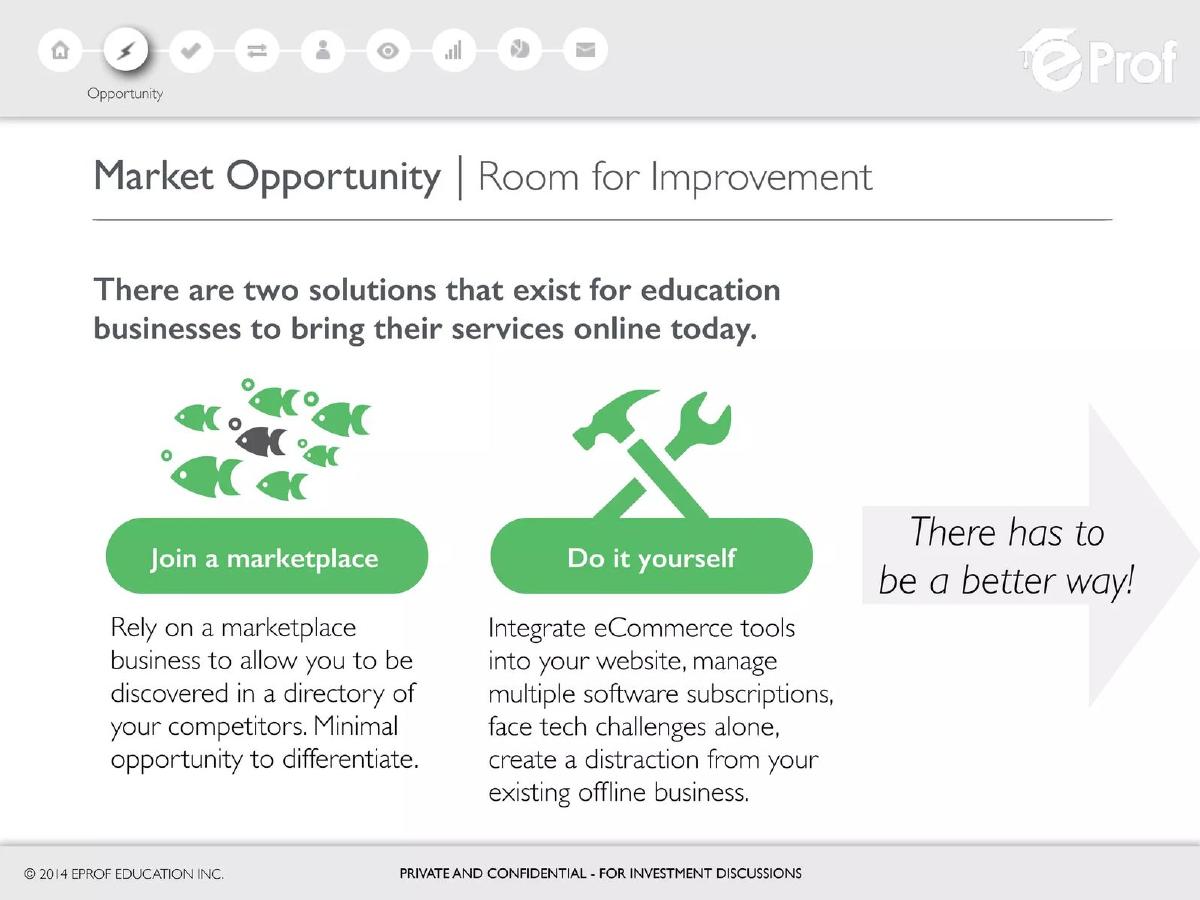
Infrastructure vs. Marketplace: If you are building a tool for businesses, emphasize 'Independence' and 'Branding' as eProf did on Slide 4. Founders should learn that established businesses value their own brand more than being a line item in your marketplace. Position your startup as the 'engine' that empowers them.
Quantify the Build: If you have spent years in 'stealth' or development mode, don't just say 'we have a great product.' Use Slide 7's approach: quantify the lines of code, the hours of testing, and the specific third-party integrations. It turns 'software' into a tangible asset in the mind of the investor.
Visualizing the Multi-Device Experience: Slide 3 uses a simple but effective graphic showing the UI on a monitor, tablet, and phone. For any platform-based startup, this is a non-negotiable visual that communicates 'modern' and 'accessible' without needing a single word of copy.
Strategic Integrations: Don't be afraid to show that you use other people's technology. Slide 8's 'Open Architecture' slide is a masterclass in turning a potential weakness (not owning the video tech) into a strength (leveraging 'world-class' partners). It shows you are focused on the user experience rather than reinventing the wheel.
Frequently asked questions
- What is eProf's primary product offering?
- eProf provides a white-label, turnkey platform for education businesses. According to Slide 3, this includes a branded website, an eCommerce engine, teaching tools, tiered user architecture, and logistics management. It is designed to allow educators to own their online presence and run their business on their own terms rather than being part of a centralized marketplace.
- Who is the target customer for eProf?
- Slide 2 identifies the 'Education Mid-Market' as the primary target. This includes individual tutors, learning centers, tutoring franchises, test prep companies, job training companies, private colleges, and language academies. Specifically, they target businesses currently making money via in-home or brick-and-mortar teaching.
- How does eProf differentiate itself from competitors like GoToMeeting?
- According to the competitive landscape on Slide 6, eProf differentiates through education-specific features. It offers 5 online teaching venues and 20 live video streams, compared to GoToMeeting's 1 venue and 8 streams. eProf also includes curriculum building, eCommerce focus, and offline teaching support, which general conferencing tools lack.
- What is the technical stack behind the platform?
- Slide 7 details the 'Technology Spec,' noting the platform is a Ruby on Rails web application consisting of 350,000 lines of code. It was developed over 2+ years with thousands of hours of testing. The infrastructure is hosted on Rackspace and integrates partners like Kaltura, WePay, and OpenTok.
- What is missing from this pitch deck?
- The provided slides are missing critical financial data, including current revenue, user growth metrics, and unit economics. There is no 'Ask' slide detailing how much capital is being raised or how it will be spent. Additionally, while the CEO and CMO are listed on the contact slide, there is no dedicated team slide detailing their backgrounds.