Equity Engine's 2019 concept deck addresses the impending retirement of 4 million US business owners, a phenomenon it labels the 'Silver Tsunami.' The company proposes a unique hybrid model that combines real estate development with employee ownership transitions. By developing the real estate under a business to its 'highest and best use' and relocating the company to a lower-cost neighborhood, Equity Engine aims to generate the capital necessary to fund buyouts that would otherwise be financially prohibitive due to high taxes and lending constraints. The deck focuses heavily on the Chicago…
Key takeaways
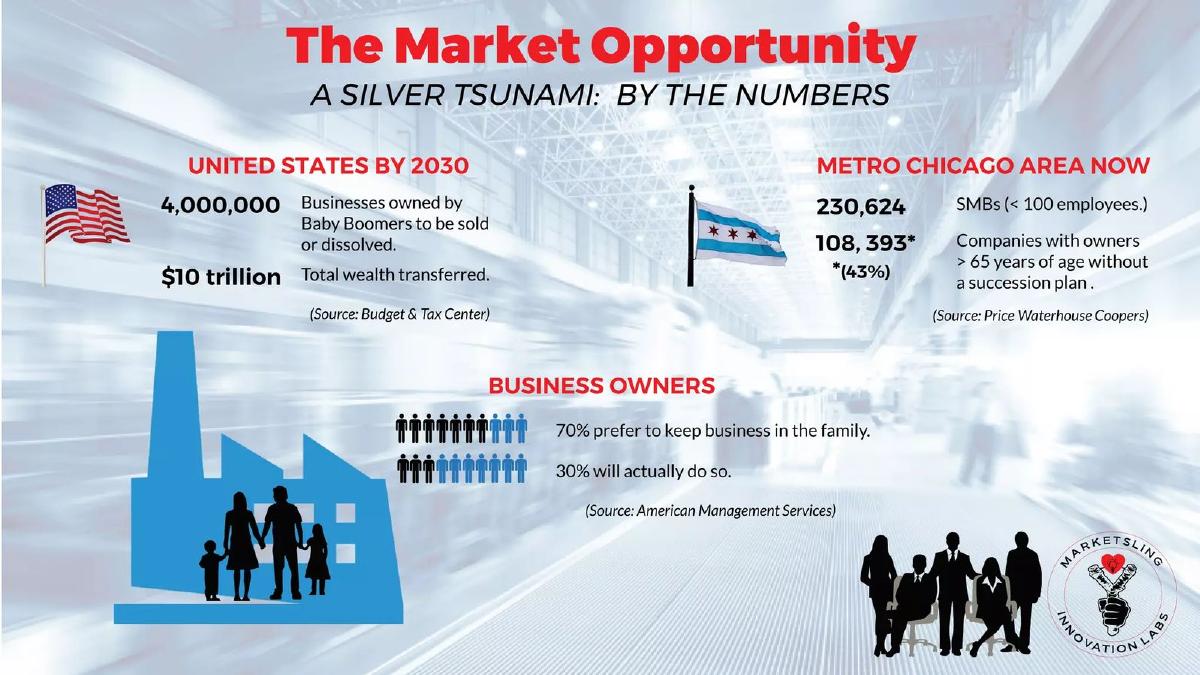
- The deck identifies a $10 trillion wealth transfer opportunity by 2030 as 4 million Baby Boomer-owned businesses face sale or dissolution (Slide 2).
- In Metro Chicago, 43% of SMBs with owners over 65 years old currently lack a succession plan (Slide 2).
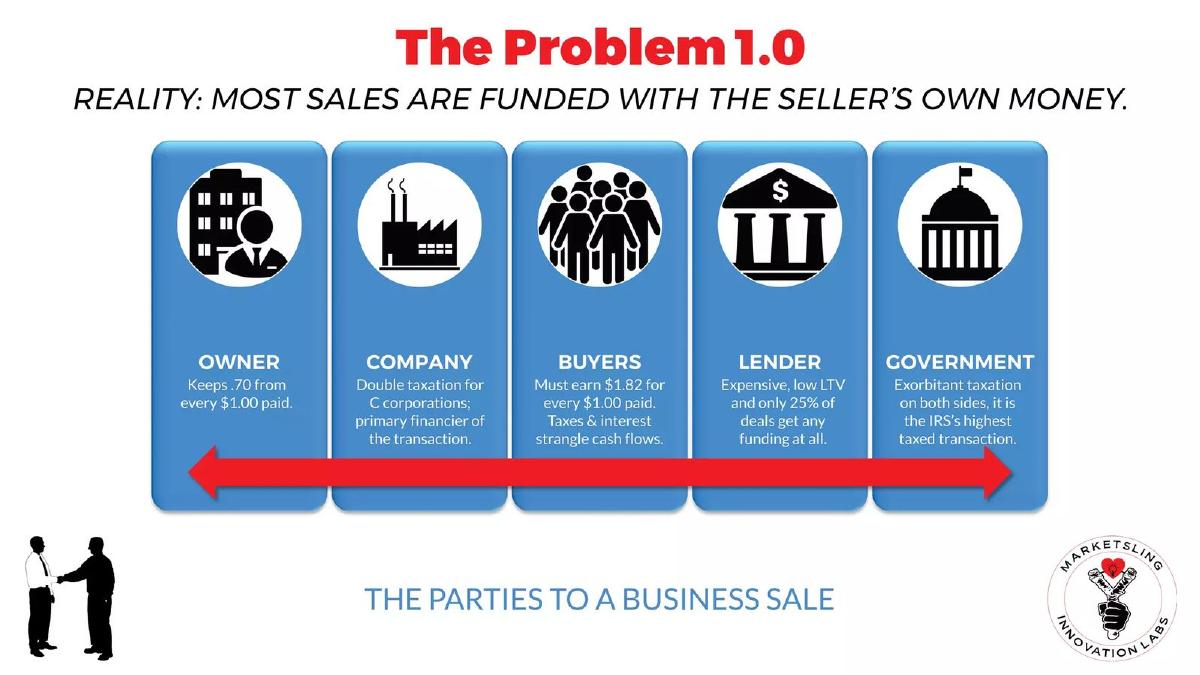
- Traditional business sales are inefficient, with owners only keeping $0.70 for every $1.00 paid due to high taxation (Slide 3).
- The proposed 'New Capital Facility' uses a five-step process involving single premium high cash value life insurance to create tax-free retirement income for the seller (Slide 4).
- Equity Engine's core strategy involves 'inclusive gentrification' by relocating businesses to neighborhoods in need of economic impact (Slide 6).
- The model relies on a capital stack where senior debt covers 60% of construction costs and the owner contributes land for a 10% equity stake (Slide 8).
- The deck omits a dedicated team slide, though Michael Woyan is listed as the primary contact for Marketsling Innovation Labs (Slide 9).
- There is no specific financial ask or use of proceeds slide included in this 9-slide selection.
Executive Summary: The Intersection of M&A and Urban Development
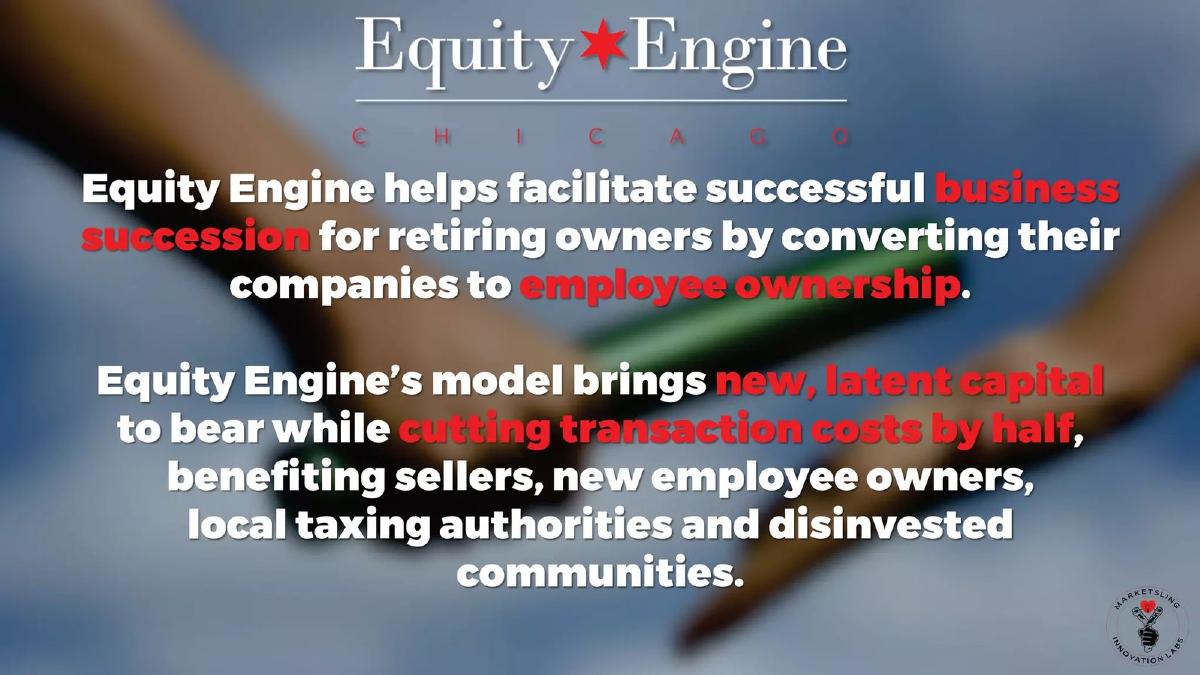
Equity Engine's 'Concept Shaping' deck from April 2019 presents a sophisticated, if complex, solution to the problem of small business succession. Rather than a standard brokerage or private equity approach, Equity Engine positions itself as a development partner that uses real estate arbitrage to fund employee ownership. The deck is heavily rooted in social impact, aiming to prevent the 'bathtub effect' of community wealth leakage by keeping businesses operational under new, local ownership.
Slide 1: Title and Mission
The cover slide introduces Equity Engine Chicago with the tagline 'Facilitating Business Ownership Succession.' It explicitly states a dual purpose: 'Preserving Jobs & Growing Community Wealth via Employee Ownership.' The branding includes the logo for Marketsling Innovation Labs, suggesting Equity Engine may be a project or subsidiary of this entity. The visual of a baton pass reinforces the theme of succession.
Slide 2: The Market Opportunity
This slide establishes the 'Silver Tsunami' as the primary market driver. It provides two scales of data. Nationally, it cites the Budget & Tax Center, noting 4,000,000 Boomer-owned businesses will be sold or dissolved by 2030, totaling $10 trillion in wealth. Locally, it focuses on Metro Chicago, citing Price Waterhouse Coopers data that 43% of SMBs (108,393 companies) have owners over 65 without a succession plan. A critical friction point is noted: while 70% of owners prefer to keep the business in the family, only 30% actually do so, creating a massive gap for third-party intervention.
Slide 3: The Problem 1.0 - Financial Inefficiency
Slide 3 breaks down why traditional business sales fail. It claims 'most sales are funded with the seller's own money' and highlights five pain points: Owner (keeps only $0.70 of every $1.00), Company (faces double taxation), Buyers (must earn $1.82 for every $1.00 paid due to taxes/interest), Lender (low LTV and only 25% deal funding rate), and Government (high taxation on both sides). This slide effectively argues that the current system 'strangles cash flows.'
Slide 4: The New Capital Facility
This is the most technical slide in the deck, outlining a five-step financial structure. Step 1: The company borrows from a lender and lends to the owner at deductible interest. Step 2: The owner buys a single premium high cash value life insurance policy. Step 3: The owner borrows from the policy in year 3 for tax-free retirement income. Step 4: Policy loan interest is kept below 1% AFR. Step 5: The lender is repaid with a tax-free death benefit. This structure is designed to make buyout payments exempt from capital gains, though it relies heavily on specific IRS interpretations of insurance and lending products.
Slide 5: The Problem 2.0 - Disinvestment
Equity Engine shifts from financial mechanics to social impact. Using a 'bathtub' metaphor, it illustrates 'Community Assets' (skills, local employers, homeownership) vs. 'Community Leakages' (unemployment, crime, payday lenders). The argument is that when a business closes due to a lack of succession, the 'water' (wealth) drains out of the community, leading to urban decay.
Slide 6: The Answer to Capital Scarcity
This slide introduces the real estate pivot. The solution is to 'Develop the real estate under the business to highest and best use and relocate the company to a neighborhood in need of the economic impact.' The deck uses the controversial term 'inclusive gentrification,' arguing that this process directs wealth to communities that need it rather than displacing them. This suggests Equity Engine acts as both a real estate developer and a business consultant.
Slide 7: More Capital = More Impact
A comparison slide pits three options against each other: 1. Include property with company sale: (Consequence: High tax basis, new owner likely closes facility). 2. Sell property to a developer: (Consequence: Owner loses back-end upside, company closes, jobs lost). 3. Partner with Equity Engine: (Consequence: Relocation pays for ownership conversion, owner gets more money, employee-buyers get a better cost basis). This slide is the core 'pitch' for their specific business model.
Slide 8: Finance - The Capital Stack
This slide visualizes the funding of a typical project. The 'Total Project Cost' is comprised of: 60% Senior Debt (construction costs), 30% Bridge Loan (relocation and renovation), and 10% Owner Equity (land contribution). The 'Project Profit' is then shared between the original owner and Equity Engine. This clarifies that Equity Engine's revenue model is tied to the success of the real estate development, not just the business transition.
Slide 9: Contact and Conclusion
The final slide provides contact information for Michael Woyan at Marketsling Innovation Labs. It features a Chicago skyline graphic, reinforcing the local focus. No specific call to action or investment amount is listed on this slide.
What Equity Engine Does Well
The deck excels at identifying a massive, looming macroeconomic problem (the Silver Tsunami) and providing a highly specific geographic focus (Chicago). By narrowing the scope, the founders make the problem feel solvable and the data more tangible. The use of a 'bathtub' visual for community wealth is an effective way to communicate social impact to investors who may be more focused on financial returns. Furthermore, the deck does a good job of identifying the 'villain'—inefficient taxation and traditional lending—which makes their 'New Capital Facility' feel like a necessary innovation.
What is Missing from the Deck
The most glaring omission is a Team Slide . While Michael Woyan is listed as a contact, there is no information regarding his background in real estate, finance, or M&A. For a model this complex, investor confidence in the execution team is paramount. Also missing is a Traction or Case Study Slide . The deck is labeled 'Concept Shaping,' which explains the lack of historical data, but even a hypothetical 'Model Deal' with specific dollar amounts would help clarify the 'New Capital Facility.' Finally, there is no Ask Slide . It is unclear if they are looking for equity investors in Equity Engine itself, or LP investors for specific real estate projects.
Founder Takeaways: Real Estate as an Enabler
Founders in the M&A or SMB space can learn from how Equity Engine looks for 'hidden' assets to fund transactions. Many small businesses are 'asset-rich but cash-poor,' often owning the land they sit on. By decoupling the business operations from the real estate, Equity Engine creates a path for ownership that doesn't rely solely on the cash flow of the business. However, founders should be cautious about using terms like 'gentrification'—even when prefixed with 'inclusive'—as it can be a polarizing term for impact investors. A more neutral term like 'urban revitalization' or 'strategic relocation' might serve the same purpose without the negative connotations.
Frequently asked questions
- What is the 'Silver Tsunami' mentioned in the deck?
- The 'Silver Tsunami' refers to the massive wave of Baby Boomer business owners reaching retirement age. According to Slide 2, 4 million businesses are expected to be sold or dissolved by 2030, representing a $10 trillion wealth transfer. Equity Engine views this as a market opportunity to intervene before these businesses close, which would otherwise lead to job losses and community disinvestment.
- How does Equity Engine use real estate to fund business buyouts?
- Equity Engine proposes developing the land currently occupied by a business to its 'highest and best use' (Slide 6). By partnering with the owner to unlock this real estate value, they generate capital. This capital is then used to relocate the business to a more affordable neighborhood and fund the transition to employee ownership, which the deck argues provides a better cost basis for the new employee-buyers (Slide 7).
- What is the 'New Capital Facility' described on Slide 4?
- It is a five-step financial maneuver designed to minimize taxes. The company borrows money to lend to the owner, who buys a high cash value life insurance policy. By year three, the owner borrows against that policy for tax-free retirement income. Eventually, the lender is repaid via the tax-free death benefit, and buyout payments are structured to be exempt from capital gains.
- What geographic area does Equity Engine focus on?
- The deck is highly specific to the Metro Chicago area. Slide 2 cites data from Price Waterhouse Coopers regarding 230,624 Chicago SMBs, and the visual branding throughout the deck features the Chicago skyline and the city's flag. The contact information also uses a Chicago (312) area code.
- What are the primary risks of the Equity Engine model according to the deck?
- While the deck focuses on benefits, it frames the risks of *not* using their model on Slide 7. These include new owners stripping assets and closing facilities, city loss of tax revenue, and the 'zero chance' for original owners to participate in back-end development profits if they sell to traditional developers.