eShares (now Carta) used this 41-slide Series A deck to secure funding by showcasing an incredibly efficient growth engine. Operating with zero sales staff, the company reached $70k in monthly revenue and a 40% month-over-month growth rate within just one year on $1.2M in capital. The deck's strength lies in its transparency; it includes a full financial model expecting to hit $800k/month in 18 months and a clear strategy for 'climbing the food chain' against multi-billion dollar incumbents like Computershare. By positioning themselves as the central repository for private stock data, they il…
Key takeaways
- The company achieved $70K/month in revenue with a 40% monthly growth rate using zero sales people (Slide 5).
- eShares built a platform managing 360+ paying companies and $300M+ in private stock within one year on $1.2M in funding (Slide 5).
- The business model relies on bundling high-margin compliance services like 409A ($159/mo) and SPV administration ($25,000/fund) onto the core cap table product (Slide 3).
- A detailed 18-month financial model projects total monthly revenue growing from $57,783 to $970,492 based on a $6M Series A (Slide 6).
- The 'food chain' slide identifies Computershare ($7.2B market cap) and Broadridge ($5.1B market cap) as the primary long-term targets (Slide 7).
- The strategy involves monetizing the same data set multiple times, charging $500 for a 409A valuation to a corporation and $100 per fund for 'views' into that data (Slide 9).
- Customer testimonials include a specific offer from a user to invest $25,000 in the next round, serving as ultimate social proof (Slide 4).
- The deck explicitly identifies SPV formation as a major revenue driver, citing a $25,000 per fund fee in a case study with Crowdfunder (Slide 8).
Introduction
The eShares (now Carta) Series A pitch deck is a legendary document in the venture capital world. It represents a transition point where a utility tool for cap table management began to realize its potential as a massive financial infrastructure play. The deck is notable for its lack of aesthetic polish, favoring dense spreadsheets and plain-text testimonials that speak to a product-market fit so strong it required no sales team to generate significant revenue.
Slide 1: Title Slide
The deck opens with a minimalist title slide featuring the eShares logo—a padlock combined with a pie chart, symbolizing secure equity management. It explicitly states this is the 'Series A Investor Deck.' The branding is clean, using a simple blue and grey palette that suggests a professional, utility-focused software company.
Slide 2: Product Workflow
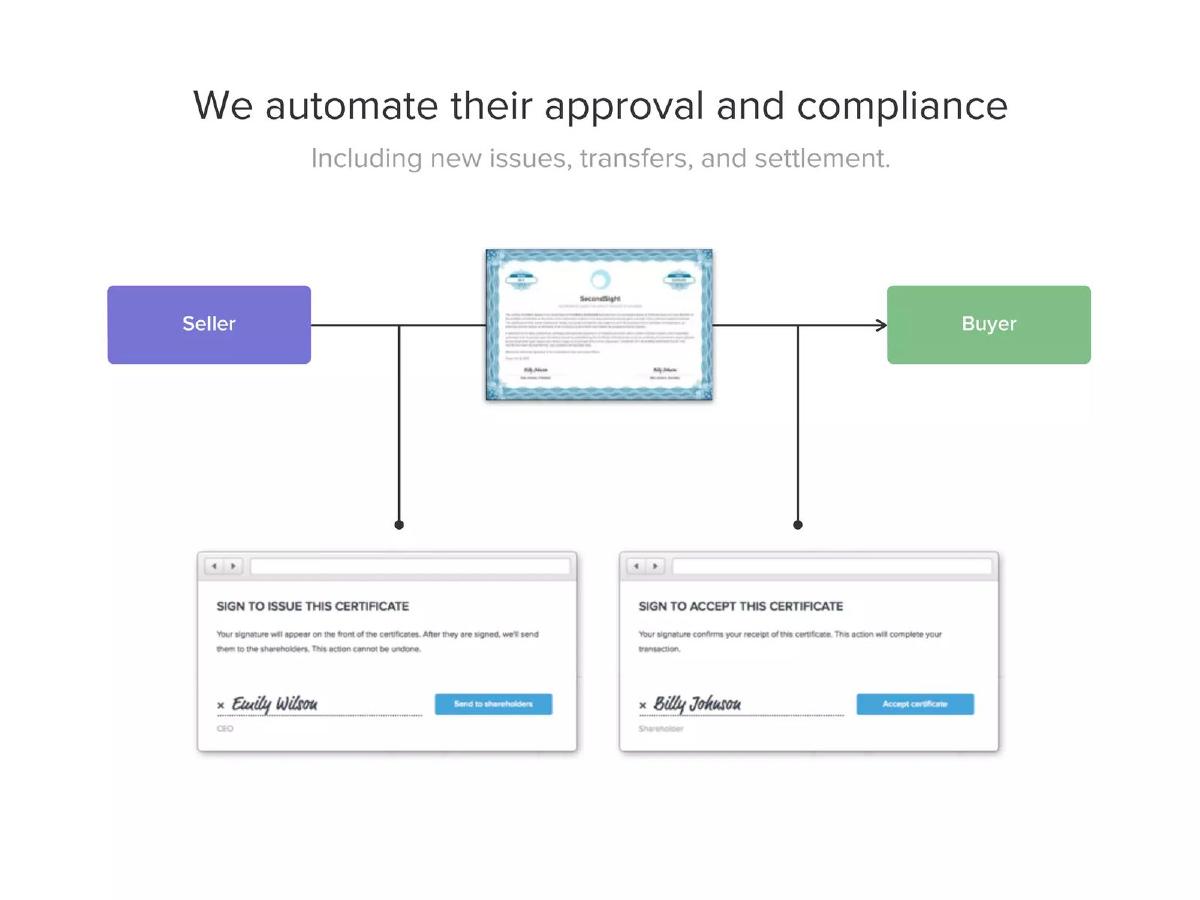
Slide 2, titled 'We automate their approval and compliance,' provides a high-level overview of the product's function. It uses a flow chart to show how a 'Seller' and 'Buyer' interact through a digital certificate. The slide highlights that the platform handles 'new issues, transfers, and settlement.' By showing screenshots of the signature interface for both the CEO (Emily Wilson) and the Shareholder (Billy Johnson), the deck emphasizes the transition from physical paper certificates to a streamlined digital experience.
Slide 3: Monetization and Add-on Services
This slide is critical for demonstrating how eShares moves beyond a simple SaaS subscription. It lists a menu of services: 409A Compliance-as-a-Service at $159/month, FAS123R accounting at $500/year, and SPV Formation at $25,000/fund. This 'bundling' strategy shows investors that the cap table is just the entry point; the real revenue comes from the regulatory and accounting requirements that every private company must fulfill. The 'TBD' for FAS 157 and other investor services suggests a roadmap for future expansion into the venture capital side of the market.
Slide 4: Social Proof and Customer Love
Instead of using standard logos, Slide 4 features actual screenshots of emails from CEOs and founders. The headline 'I mean, they really love us' is supported by quotes from companies like Yerdle, Simple Energy, and Sol Systems. Most notably, Ankur Pansari's email includes an offer to 'write you guys a $25,000 check to invest in your next round.' This is the ultimate form of validation for a Series A investor: customers who are so satisfied they want to become shareholders.
Slide 5: Traction and Efficiency
Slide 5, 'We are lean and mean,' is the 'money slide' of the deck. It lists five powerful bullet points: reaching $70K/month in revenue, 40% monthly growth, 360+ paying companies, and $300M+ in private stock managed. The most striking claim is 'Zero sales people (we want to change this).' This tells investors that the product has natural pull and that the requested capital will be used to pour gasoline on an already burning fire by building a formal sales organization.
Slide 6: The Financial Model
Slide 6 is a dense, unedited spreadsheet titled 'We expect to reach $800K/month in 18 months.' It breaks down revenue into Core Transactions, SPV Formations, and Premium Investor Services. The model assumes a '$6M Series A' and projects growth from September 2014 through March 2016. By including the 'Fully Loaded per Employee Cost' at the bottom ($15,000 for Sales, $12,000 for Operations, $15,000 for Development), the founders demonstrate a granular understanding of their unit economics and hiring needs.
Slide 7: Competitive Landscape
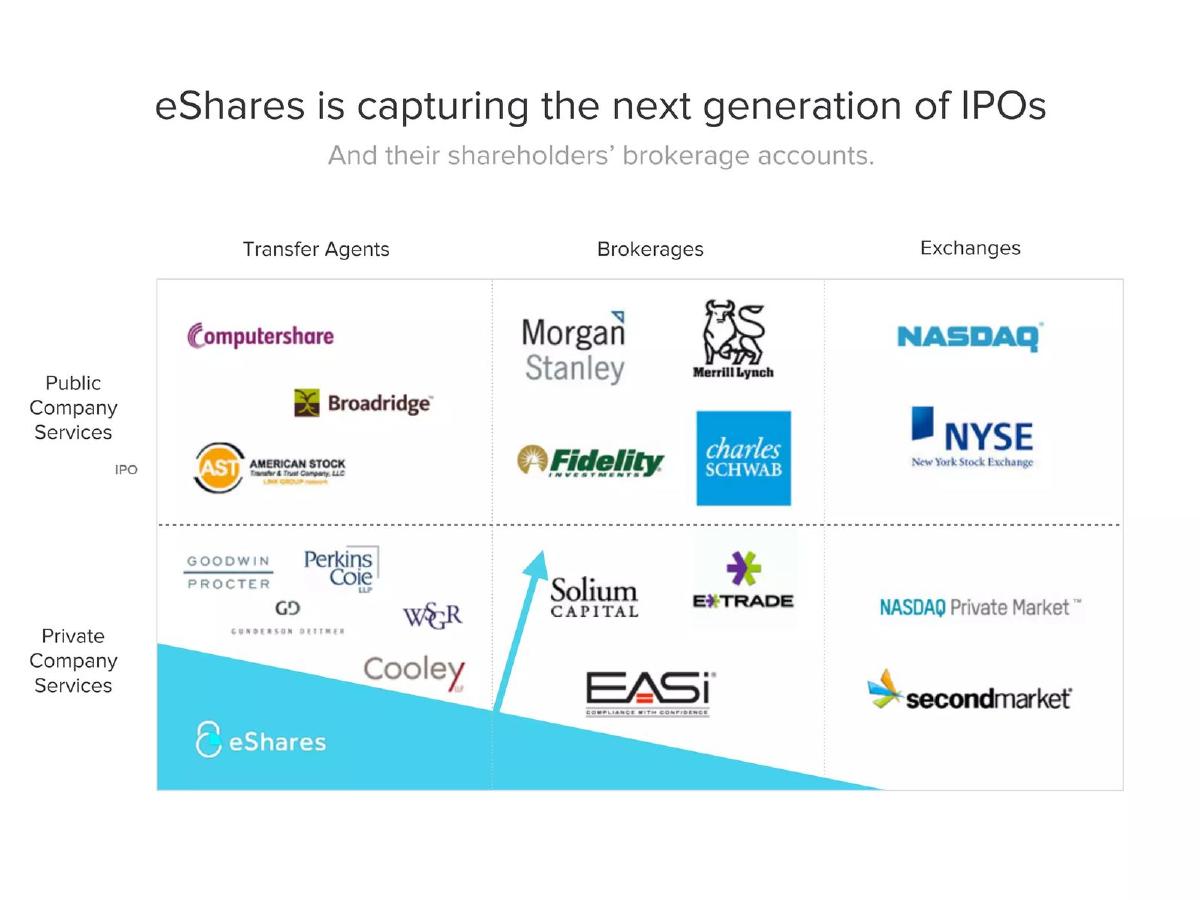
Slide 7, 'This is the food chain we need to climb,' positions eShares against the giants of the transfer agent world. It lists Computershare ($7.2B Market Cap) and Broadridge ($5.1B Market Cap). By including their own logo at the bottom with '-' for revenue and market cap, they frame the opportunity as a massive 'land grab' in a market currently dominated by legacy players. It identifies the target not as other startups, but as the multi-billion dollar incumbents of the public markets.
Slide 8: Case Study - Crowdfunder
Slide 8 provides a specific case study for their SPV (Special Purpose Vehicle) product. It notes that the 'Crowdfunder' platform uses eShares to manage member interests, generating an expected $500K/year in revenue for eShares. They charge $25K per fund to manage the entire lifecycle, from ACH collection to liquidation. This slide proves that eShares isn't just for individual startups; it is infrastructure for other financial platforms.
Slide 9: The Data Monetization Strategy
The final slide in this set, 'One set of data. Multiple customers,' explains the company's unique economic moat. It illustrates how eShares can sell a 409A valuation to a 'Corporation' for $500, and then sell 'views' into that same data to up to 20 different 'Funds' for $100 each. This results in $2,500 of revenue from a single data set. This 'sell once, monetize many times' model is what separates a standard SaaS company from a true financial network.
What eShares Did Well
The eShares deck is a masterclass in transparency. By including a raw financial model (Slide 6), they invited investors to look under the hood and see exactly how they planned to spend the Series A capital. They also excelled at showing, rather than telling, their growth. Claiming 40% month-over-month growth is one thing; showing that you did it with zero sales staff (Slide 5) is a much more powerful indicator of product-market fit.
Furthermore, the 'Food Chain' slide (Slide 7) is a brilliant way to frame the market size. Instead of a generic TAM/SAM/SOM circle chart, they listed specific, multi-billion dollar companies they intended to replace. This gave investors a clear exit comparable and a sense of the scale the founders were aiming for.
What Was Missing
While the deck is strong on metrics, it is light on the 'Why Now?' and the specific 'Team' background in these nine slides. There is no mention of the regulatory changes (like the JOBS Act) that might have been tailwinds for their growth. Additionally, the deck lacks a clear 'Ask' slide in this selection—while the financial model mentions a $6M round, a dedicated slide outlining the use of proceeds and the milestones that capital would unlock is standard and missing here.
What Founders Should Copy
Founders should emulate the 'Lean and Mean' slide. If you have achieved significant milestones with very little capital, highlight that efficiency. It signals to investors that you are a good steward of their money. Also, the strategy of showing customer emails (Slide 4) is far more persuasive than a list of logos. It provides context on why customers love the product, which is often more important at the Series A stage than just knowing that they use it.
Finally, the 'One set of data, Multiple customers' (Slide 9) visualization is a perfect way to explain a complex business model. If your company has a network effect or a way to monetize the same asset across different customer segments, use a simple diagram to make that 'aha!' moment unavoidable for the investor.
Frequently asked questions
- What was the core value proposition of eShares at the Series A?
- The core value proposition was the automation of equity issuance, transfers, and compliance. As shown on Slide 2, they replaced paper certificates with a digital workflow for sellers and buyers. This allowed them to become the 'source of truth' for a company's cap table, which they then leveraged to sell high-margin add-on services like 409A valuations and tax accounting.
- How did eShares plan to compete with massive incumbents?
- Slide 7, titled 'This is the food chain we need to climb,' shows that eShares viewed themselves as a venture-backed disruptor against public giants like Computershare and Broadridge. Their strategy was to start with private companies (where incumbents were weak) and use their lower cost structure and digital-first approach to eventually capture the multi-billion dollar market caps held by traditional transfer agents.
- What were the key financial metrics disclosed in the deck?
- On Slide 5, the company disclosed they were adding 60+ companies per month and had over 2,500 portfolios on the platform. Their revenue was $70k/month, growing at 40% monthly. Most impressively, they achieved this with a total spend of only $1.2M over one year, demonstrating extreme capital efficiency.
- How does their 'One set of data, Multiple customers' model work?
- Slide 9 explains this clearly. By holding the central data for a corporation, they can sell a 409A valuation to the company for $500. Then, they can sell 'views' of that same data to the various investment funds that own shares in that company for $100 each. This turns a single data entry task into a recurring, multi-payer revenue stream.
- What was missing from the provided slides?
- The provided selection lacks a dedicated team slide, though the 'lean and mean' slide alludes to their efficiency. It also omits a specific 'Ask' slide detailing the exact valuation or terms they were seeking, although Slide 6 mentions the model is based on a '$6M Series A.' There is also no slide detailing the specific technology stack or security protocols, which are critical for a fintech platform.