Lumigo’s Series A deck is a masterclass in technical storytelling for a B2B SaaS audience. Founded in 2018 by Check Point veterans, the company addresses the 'inflection point' of cloud-native complexity. The deck highlights a significant market opportunity, projecting a $21.9B market by 2025, while showcasing a product that offers '1-click observability.' Key to their success was demonstrating a 10x ARR growth over 12 months in a featured case study and leveraging a product-led growth (PLG) model. Despite redacting specific financial targets for public release, the deck clearly communicates…
Key takeaways
- The founders leverage a deep pedigree in cybersecurity and cloud infrastructure, specifically citing their history at Check Point (Slide 3).
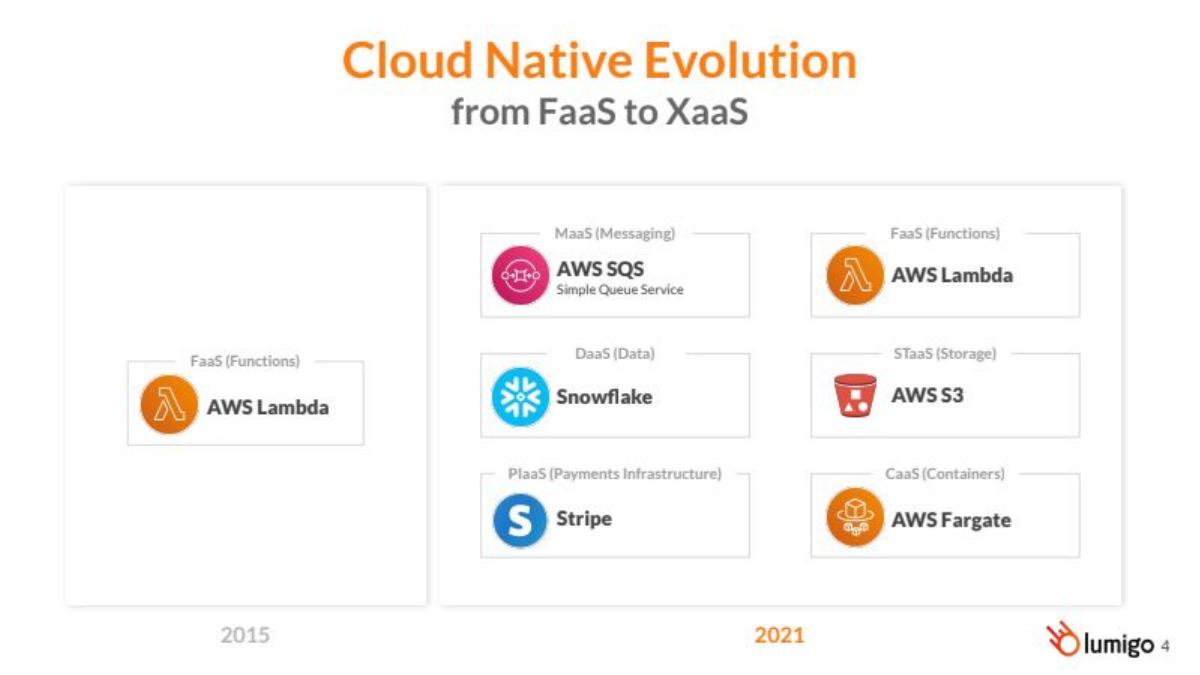
- Lumigo identifies a massive market shift from simple FaaS (2015) to complex XaaS (2021), creating a monitoring vacuum (Slide 4).
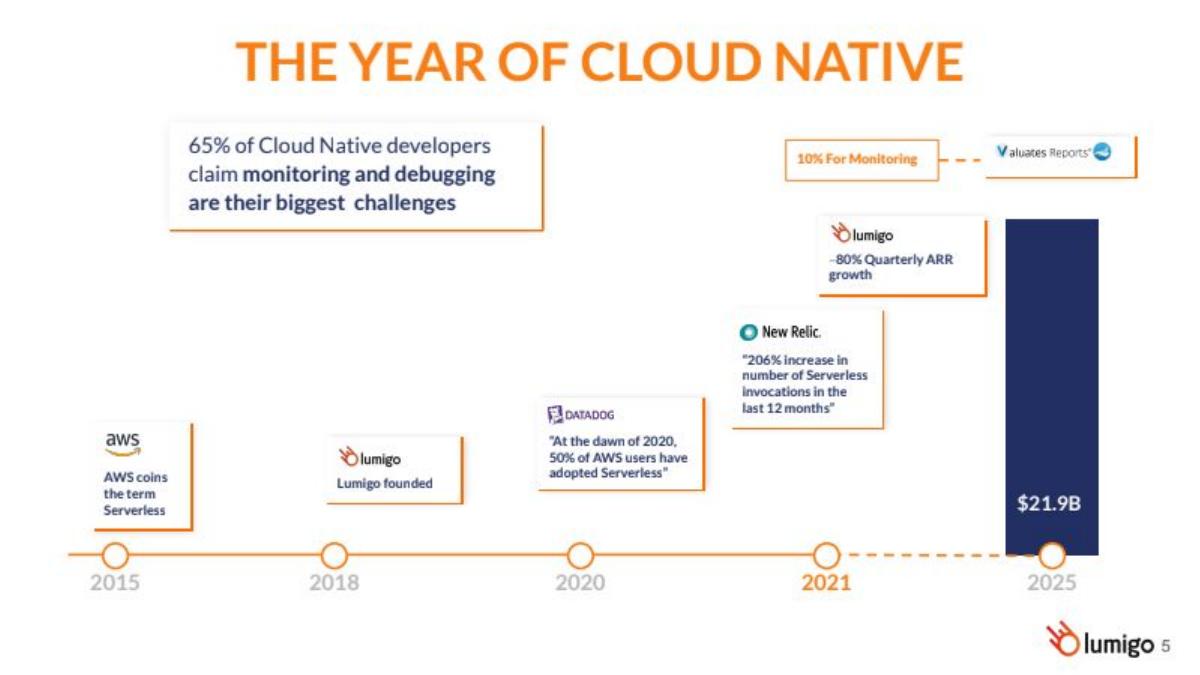
- The deck cites a total addressable market projection of $21.9B by 2025, with 65% of developers struggling with monitoring (Slide 5).
- Product claims include a 95% reduction in incident response time and a 90% reduction in repair time (Slide 7).
- The '100% Automated Distributed Tracing' feature is positioned as the primary solution to 'highly distributed' application complexity (Slide 8).
- A single-customer case study demonstrates vertical growth from 75M to 1B requests and 10x ARR growth in 12 months (Slide 12).
- The Go-To-Market strategy is strictly Product Led Growth (PLG), emphasizing a 100% self-serve, no-credit-card-needed model (Slide 18).
- The Series A ask focuses on three pillars: maintaining cloud superiority, building sales/marketing, and product expansion (Slide 19).
Executive Summary and Intro
Slide 1: Title Slide
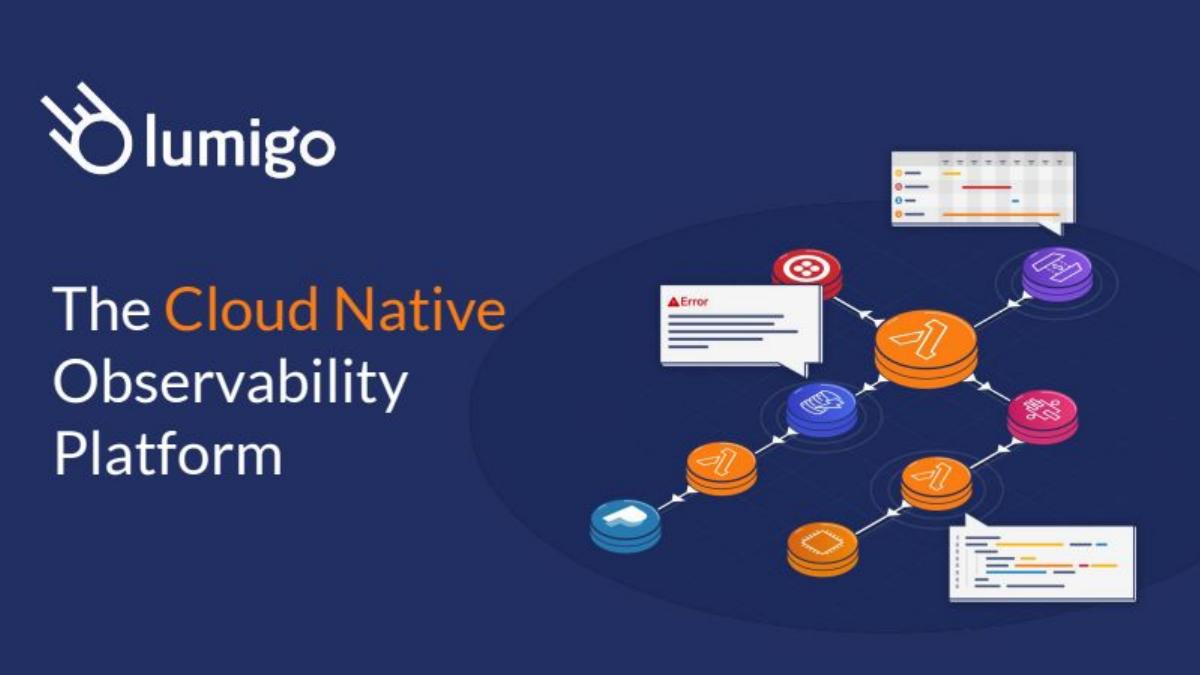
The deck opens with a clean, dark blue title slide featuring the Lumigo logo—a stylized falling star or comet. The tagline is clear: "The Cloud Native Observability Platform." To the right, a technical illustration shows a distributed system map with AWS Lambda icons, a database, and an error notification, immediately signaling that this is a tool for developers and DevOps engineers.
Slide 2: In A Nutshell
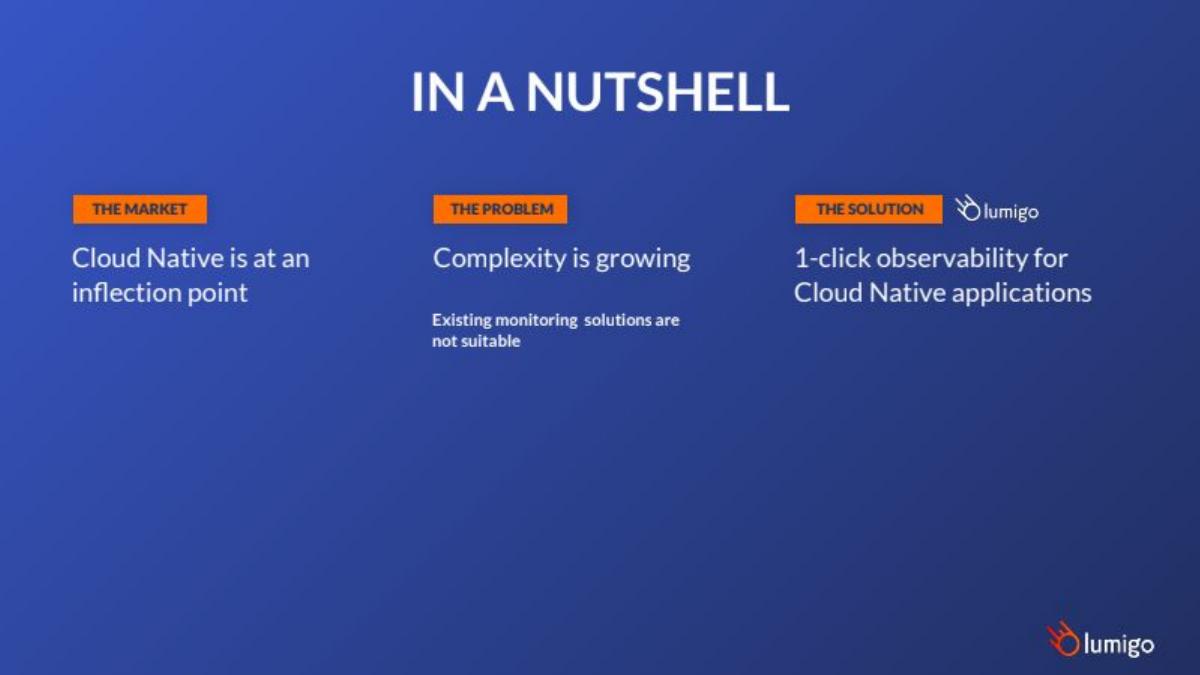
This slide provides a high-level summary of the investment thesis. It breaks the narrative into three pillars: The Market (Cloud Native is at an inflection point), The Problem (Complexity is growing; existing solutions are not suitable), and The Solution (1-click observability for Cloud Native applications). This is a standard but effective way to frame the pitch before diving into details.
The Team and Market Context
Slide 3: Nice To Meet You (Team)
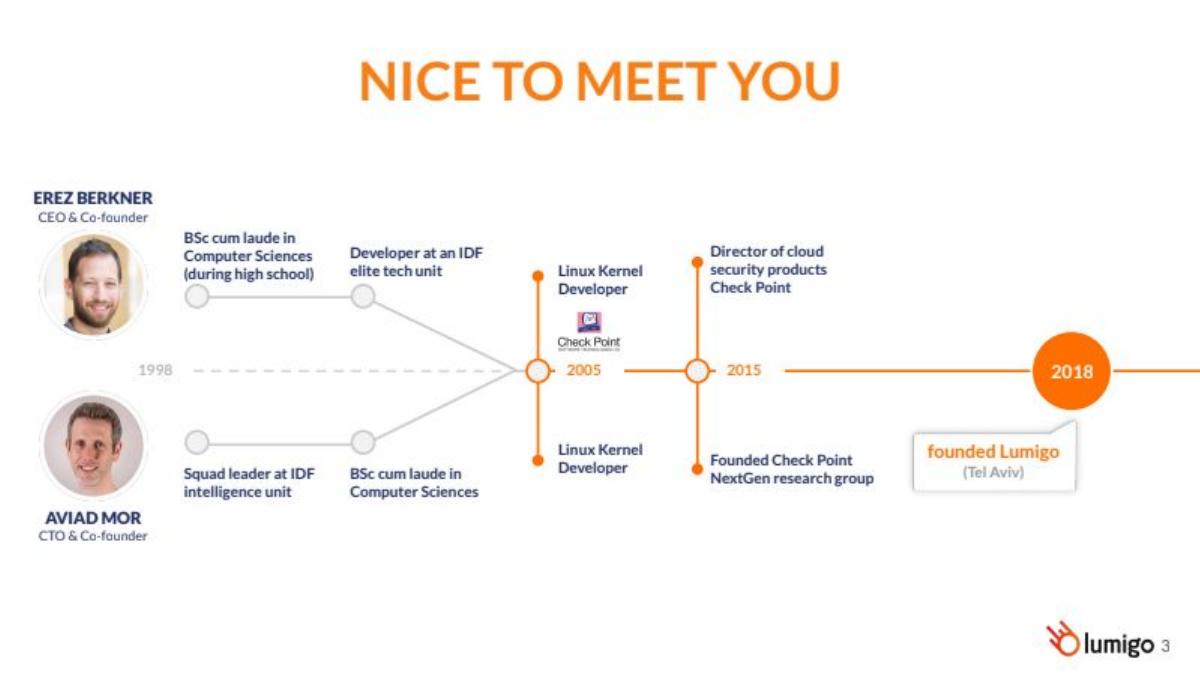
Lumigo leads with its team, which is a strong move given their background. CEO Erez Berkner and CTO Aviad Mor have parallel timelines starting in 1998. Both served in elite IDF tech/intelligence units and were Linux Kernel Developers. Crucially, they held senior roles at Check Point, a major cybersecurity firm. Berkner was the Director of Cloud Security Products, and Mor founded the NextGen research group. They founded Lumigo in Tel Aviv in 2018. This slide establishes deep technical credibility.
Slide 4: Cloud Native Evolution
This slide illustrates the shift in the technical landscape. It compares 2015, where "FaaS (Functions)" was limited to AWS Lambda, to 2021, which features a complex ecosystem of "XaaS" (Everything as a Service). It lists AWS SQS (Messaging), Snowflake (Data), Stripe (Payments), AWS S3 (Storage), and AWS Fargate (Containers). The message is clear: the environment Lumigo monitors has become exponentially more complex.
Slide 5: The Year of Cloud Native
Lumigo uses this slide to quantify the opportunity. It cites that 65% of Cloud Native developers claim monitoring and debugging are their biggest challenges. It shows a timeline of serverless adoption, noting that by 2020, 50% of AWS users had adopted serverless (per Datadog). It highlights Lumigo's own ~80% quarterly ARR growth and concludes with a massive $21.9B market projection for 2025, sourced from Valuates Reports.
Problem and Solution Deep Dive
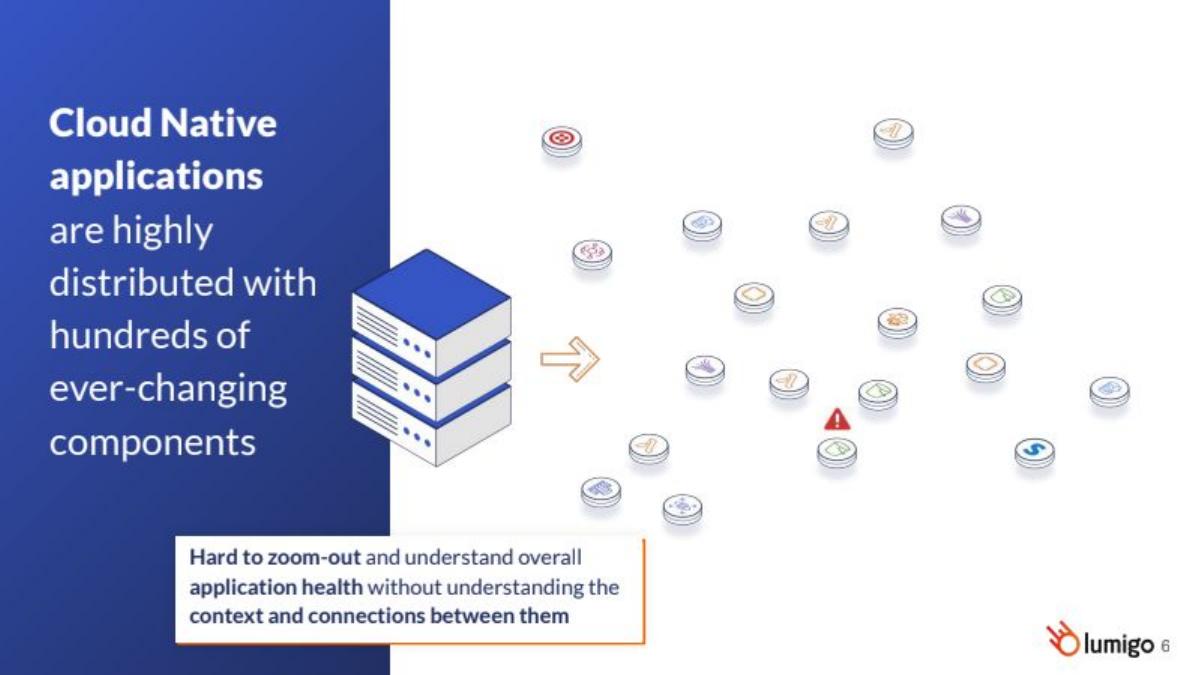
Slide 6: Distributed Complexity
This slide visualizes the "Problem." On the left, a traditional server stack is shown. An arrow points to the right, where the stack has exploded into dozens of small, "ever-changing components." A small text box notes it is "Hard to zoom-out and understand overall application health" without context and connections.
Slide 7: Monitoring and Debugging
Lumigo defines its two primary functions here. Monitoring is about getting visibility and alerts, claiming a 95% reduction in incident response time. Debugging is about solving issues, claiming a 90% reduction in repair time. The background is a dark globe, suggesting a global scale for the solution.
Slide 8: Lumigo's Solution - Tracing
This slide shows the "Before and After" of the product's core technology. On the left, components are scattered and disconnected. On the right, Lumigo has applied "100% Automated Distributed Tracing," connecting the components into a logical flow that leads to a "Customer Facing API." This visualizes how the software makes sense of chaos.
Slide 9: Across Managed Services
Building on the tracing slide, this one emphasizes "Agentless observability." It shows the trace extending across various managed services, highlighting that Lumigo doesn't just monitor the code, but the entire infrastructure path without requiring the installation of heavy "agents" on every service.
Slide 10: Monitoring and Debugging in the Same Tool
This slide addresses the persona shift in modern software development. It shows "Ops" (operations) and "Dev" (developers) merging into "DevOps." The graphic shows a developer now equipped with Lumigo's error reports and system maps, reinforcing the "built for modern developers, by developers" mantra.
Evidence and Validation
Slide 11: Customer Case Study Intro
A transition slide for the case study section. It mentions three key themes: Data Lake & ML for IoT medical devices, Cloud Native Application, and a comparison against a competitor.
Slide 12: Case Study Metrics
This is a high-impact slide. It details a specific customer journey: a 4-week PoC (Proof of Concept) and a 2-month sales cycle. It claims "~10x ARR growth in 12 months" for this specific account. A graph shows the expansion from a single project to horizontal growth (4 projects) and then vertical growth (75M to 1B requests).
Slide 13: Case Study - Before
This slide shows a screenshot of raw logs (likely AWS CloudWatch). It is a wall of text—unreadable, timestamped log lines. This represents the "pain" the customer felt before Lumigo.
Slide 14: Case Study - After
The contrast to Slide 13. It shows the Lumigo "System Map" interface. Instead of text logs, the user sees a visual flow chart of the entire system, making it easy to spot where an error (highlighted in red) is occurring.
Market Positioning and Forecast
Slide 15: Cloud Native Observability Market
This slide is largely redacted for the public version ("Slide Redacted ahead of submission to TechCrunch"). However, the axes remain: "Agentless" vs. "Agent" and "Server" vs. "Cloud Native." This suggests Lumigo positions itself in the top-right quadrant: Agentless and Cloud Native.
Slide 16: Forecast Intro
Slide 17: 2021 EoY Target
This slide is also redacted. It contains a bar chart showing quarterly progress from Q1 '20 to Q4 '21, but the specific numbers and bars are hidden by a black box. The intent was to show a consistent upward trajectory in revenue or user growth.
Slide 18: GTM (Go-To-Market)
Lumigo outlines a Product Led Growth (PLG) strategy. It is broken into three parts: Content-based Marketing (bottom-up, featuring "Serverless Heroes" Efi Merdler and Yan Cui), 100% self-serve (1-click, 5 minutes to value), and Freemium (organic growth, pay as you grow, no credit card needed). This is a standard modern SaaS playbook.
The Ask
Slide 19: Summary and Ask
The final content slide. The summary reiterates that the cloud-native tipping point is now and that Lumigo is the only agentless, no-code solution built specifically for this. The "Ask" is for a "Series A Investment." The use of proceeds is listed as: 1) Maintain cloud native superiority, 2) Build Sales and Marketing operations, and 3) Continue expanding the product.
Slide 20: Thank You
A closing slide mirroring the title slide, with the system map graphic and a "Thank You!" message.
Slide 21: BestPitchDeck.com Promo
A promotional slide for the source of the deck, not part of the original Lumigo presentation.
What Works and What is Missing
What Works
Founder-Market Fit: The team slide (Slide 3) is exceptionally strong. Having two founders who were Linux Kernel developers and senior leaders at a major security firm like Check Point provides immediate confidence in their ability to build complex infrastructure tools. · Visual Problem/Solution: The contrast between the raw logs (Slide 13) and the visual system map (Slide 14) is the most effective part of the deck. It turns an abstract technical problem into a visceral "pain vs. relief" comparison. · Clear GTM: The commitment to PLG (Slide 18) is well-articulated. Identifying specific "Serverless Heroes" as part of their content strategy shows they understand how to influence their target developer audience.
What is Missing
Unit Economics: While the deck mentions 10x ARR growth for one customer, it lacks broader metrics like CAC (Customer Acquisition Cost), LTV (Lifetime Value), or churn rates across the entire user base. · Competitive Landscape: Slide 15 is redacted, but even in its original form, the deck doesn't explicitly name competitors or explain why a giant like Datadog or New Relic couldn't simply build a similar visual tracing tool. · Specific Raise Amount: Slide 19 asks for a "Series A Investment" but does not state the specific dollar amount being sought (though catalogue facts indicate they raised $29M).
What a Founder Should Copy
The "In A Nutshell" Slide: Slide 2 is a perfect executive summary. If an investor only looks at one slide, they understand the market, the problem, and the solution. · The Evolution Narrative: Slide 4 does a great job of explaining "Why Now?" by showing the transition from simple functions to a complex web of managed services. It frames the product as a necessity created by a shift in technology. · The Persona Shift: Slide 10's depiction of the merging of Ops and Dev roles is a smart way to show that the product isn't just a tool, but a facilitator for a broader organizational trend (DevOps).
Frequently asked questions
- What is Lumigo's core value proposition?
- Lumigo provides '1-click observability' for cloud-native and serverless applications. According to Slide 7, the platform aims to reduce incident response time by 95% and repair time by 90% by providing automated distributed tracing across managed services like AWS Lambda, S3, and Fargate.
- How does Lumigo prove market demand?
- The deck uses a combination of third-party data and internal growth metrics. Slide 5 notes that 65% of cloud-native developers find monitoring their biggest challenge and highlights Lumigo's ~80% quarterly ARR growth. It also references a projected $21.9B market size by 2025.
- What is the technical background of the founders?
- The founders, Erez Berkner (CEO) and Aviad Mor (CTO), have a long history in high-end tech. Slide 3 shows both were Linux Kernel developers and held leadership roles at Check Point, with Berkner serving as Director of Cloud Security Products and Mor founding the NextGen research group.
- What does Lumigo's sales model look like?
- Lumigo utilizes a Product Led Growth (PLG) strategy. Slide 18 details a bottom-up, developer-focused approach featuring content-based marketing, a 100% self-serve platform with '5 minutes to value,' and a freemium 'pay as you grow' pricing model that requires no credit card for initial setup.
- What specific metrics are used to show product success?
- Beyond the 10x ARR growth in the case study on Slide 12, the deck emphasizes technical efficiency. Slide 9 highlights 'agentless observability' across managed services, and Slide 8 showcases the transition from a 'messy' distributed system to a clean, automated visual trace.