Lumiform’s pitch deck is a lean, product-centric presentation that successfully secured a $6.5M Series A. The deck identifies a massive €178 billion 'hidden' market currently dominated by inefficient paper-and-pen processes. Rather than relying on dense financial projections, Lumiform devotes half of the 10-slide deck to a step-by-step product walkthrough, emphasizing ease of use and workflow automation. By highlighting a 1,203% ROI over three years and a self-serve model where 80% of customers convert via no-touch or low-touch sales, the deck presents a highly scalable SaaS business. While i…
Key takeaways
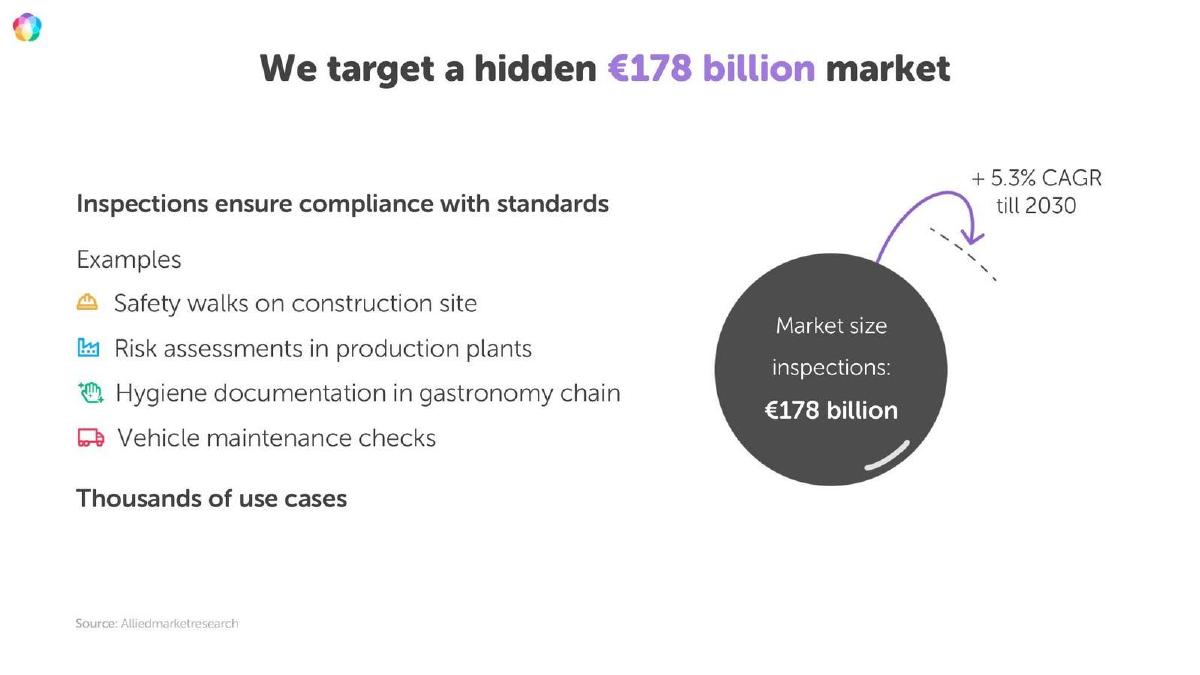
- The deck identifies a €178 billion market for inspections with a projected 5.3% CAGR until 2030 (Slide 2).
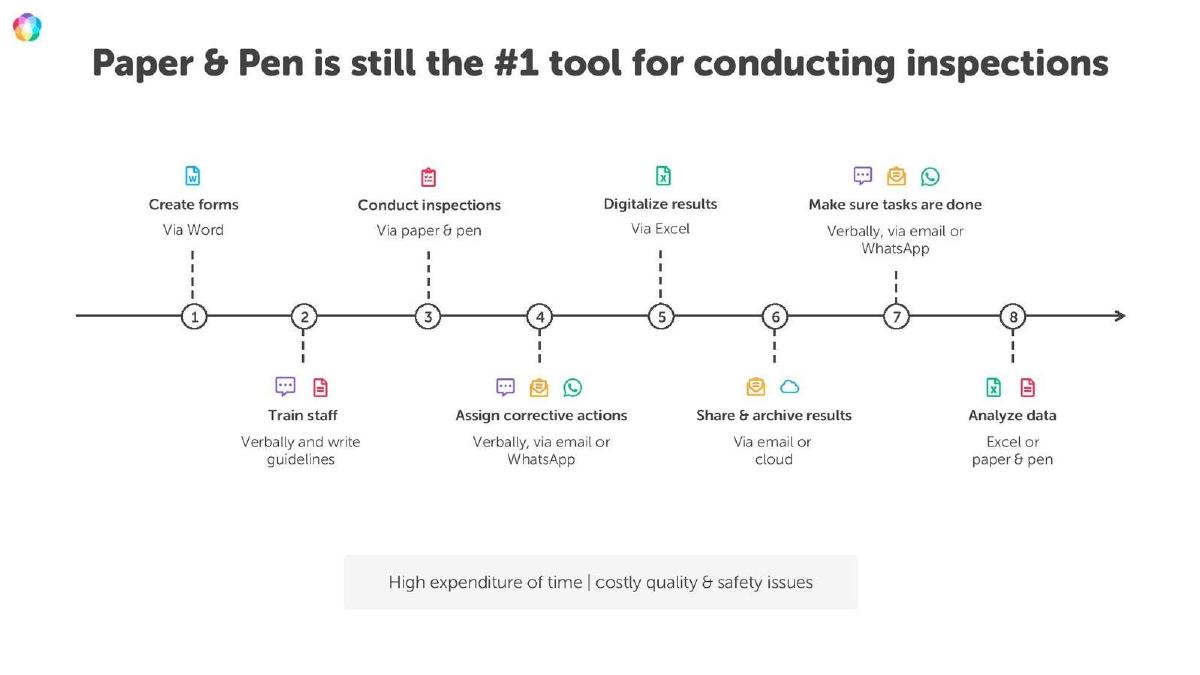
- A detailed eight-step timeline illustrates the inefficiency of current 'Paper & Pen' methods, citing high time expenditure and costly safety issues (Slide 3).
- Lumiform claims a significant 1,203% ROI for customers over a three-year period (Slide 4).
- The product walkthrough spans five slides, detailing the transition from form creation to automated corrective actions (Slides 4-8).
- Workflow automation is a core product philosophy, specifically designed to standardize processes and save time (Slide 9).
- The business model is built on a self-serve approach, with 80% of customers converting through no-touch or low-touch sales (Slide 10).
- Pricing is transparently presented as a freemium model, with a Professional plan at 20€ per user per month (Slide 10).
- The deck completely omits a team slide, competitive landscape analysis, and a specific funding ask, which are atypical for a Series A deck.
Introduction
Lumiform, a Berlin-based enterprise software startup, raised $6.5M in Series A funding in 2024. Their pitch deck is a study in brevity and product-led growth. With only 10 slides, the company manages to articulate a clear problem, a massive market opportunity, and a product that automates away the inefficiencies of manual labor. This teardown examines how they used a product-first narrative to capture investor interest in the safety and audit compliance space.
Slide 1: Title Slide
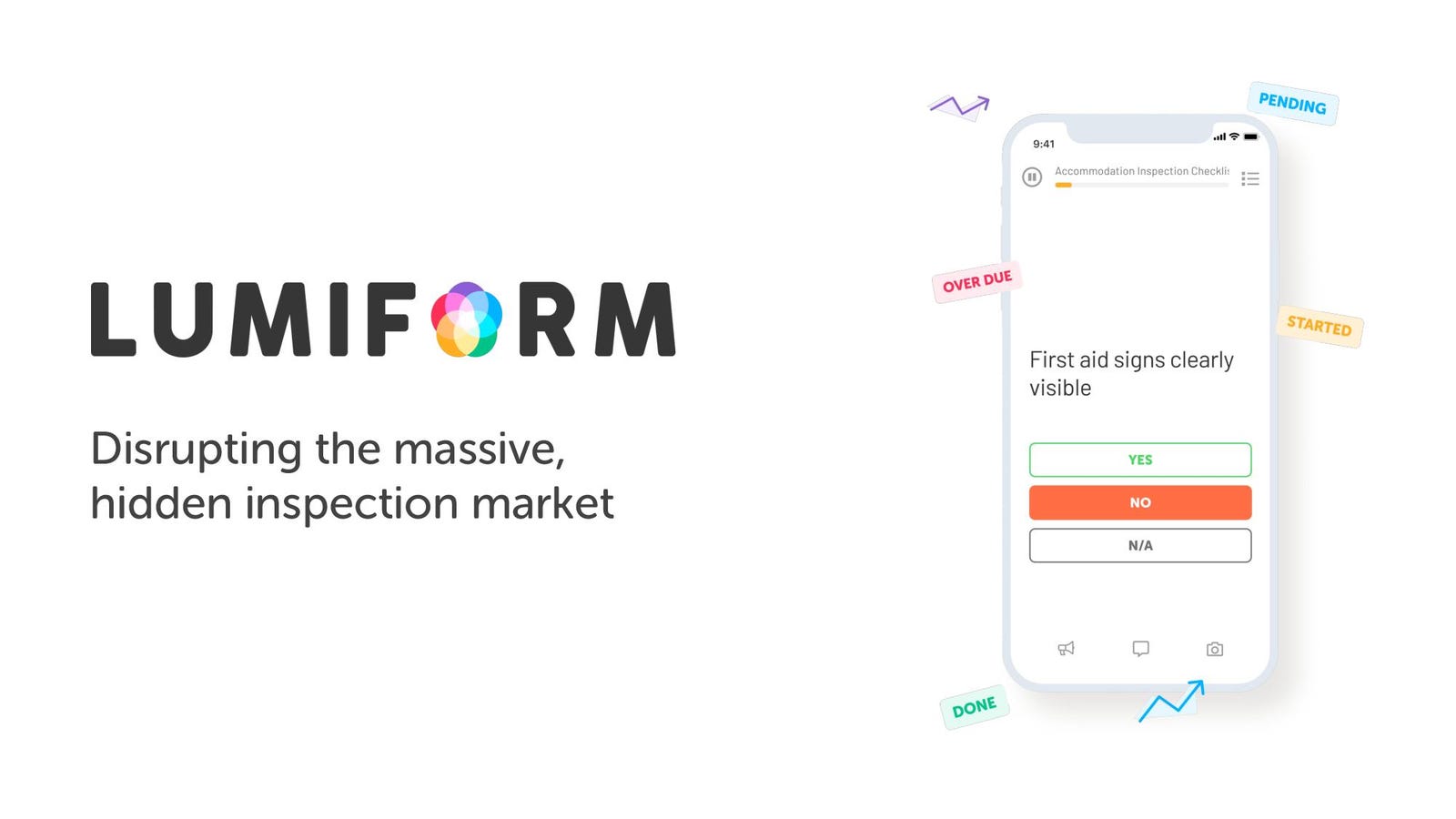
The deck opens with a clean, minimalist title slide. The company name, Lumiform , is accompanied by the tagline: Disrupting the massive, hidden inspection market . A mobile device mockup shows a simple 'Accommodation Inspection Checklist' with 'Yes/No/NA' buttons and status tags like 'Over Due,' 'Started,' and 'Pending.' This immediately establishes the company as a mobile-first solution for field-based inspections.
Slide 2: The €178 Billion Market
Slide 2 addresses the market size. Lumiform targets a hidden €178 billion market . They define 'inspections' broadly, providing examples such as safety walks on construction sites, risk assessments in production plants, hygiene documentation in gastronomy, and vehicle maintenance checks. The slide cites a +5.3% CAGR till 2030 , sourced from Allied Market Research. By framing the market as 'hidden,' they suggest that the opportunity is larger than most investors realize because it is currently fragmented across multiple industries.
Slide 3: The Problem – Paper & Pen
This slide is a highly effective visualization of the status quo. It states that Paper & Pen is still the #1 tool for conducting inspections . A horizontal timeline outlines an eight-step manual process: 1. Create forms (Word), 2. Train staff (Verbal), 3. Conduct inspections (Paper), 4. Assign corrective actions (WhatsApp/Email), 5. Digitalize results (Excel), 6. Share results (Cloud), 7. Ensure tasks are done (Email), and 8. Analyze data (Excel). The footer notes that this leads to a high expenditure of time and costly quality & safety issues . This slide perfectly sets up the 'before' state that Lumiform intends to fix.
Slide 4: Solution Part 1 – Template Builder
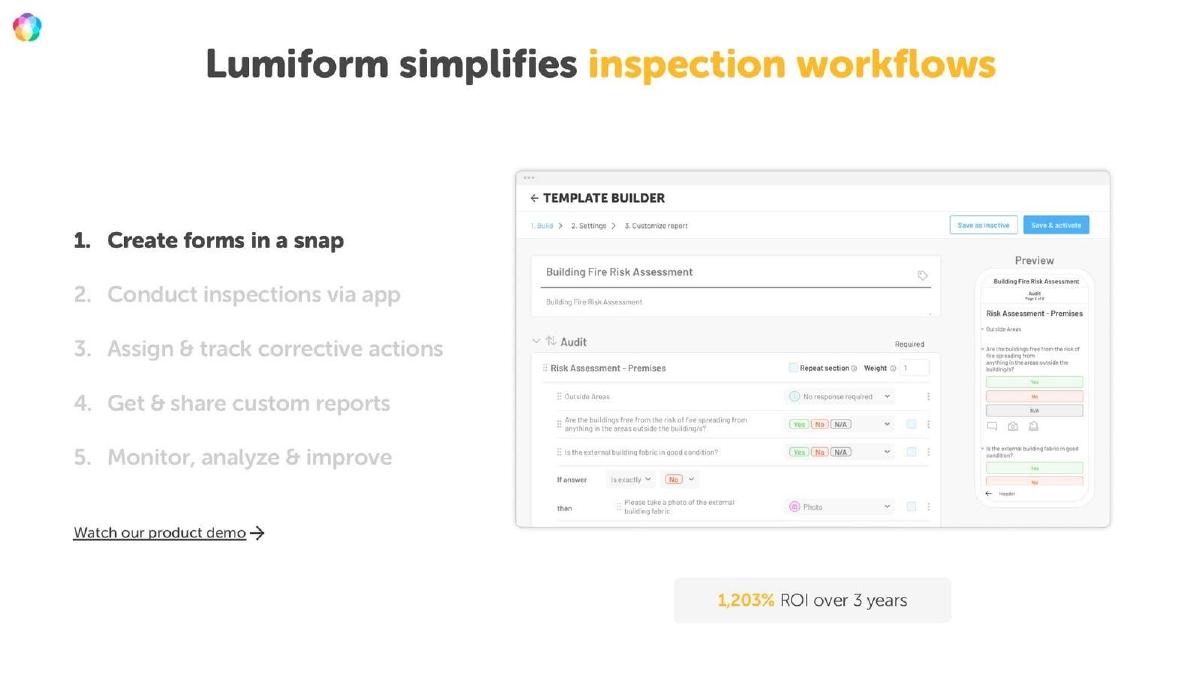
Slides 4 through 8 follow a consistent format, walking through the five steps of the Lumiform workflow. Slide 4 focuses on step one: Create forms in a snap . It features a screenshot of the 'Template Builder' interface, showing a 'Building Fire Risk Assessment.' A key metric is highlighted in a small box at the bottom: 1,203% ROI over 3 years . This is a bold claim that quantifies the value of moving from Word/Excel to a dedicated builder.
Slide 5: Solution Part 2 – Mobile App
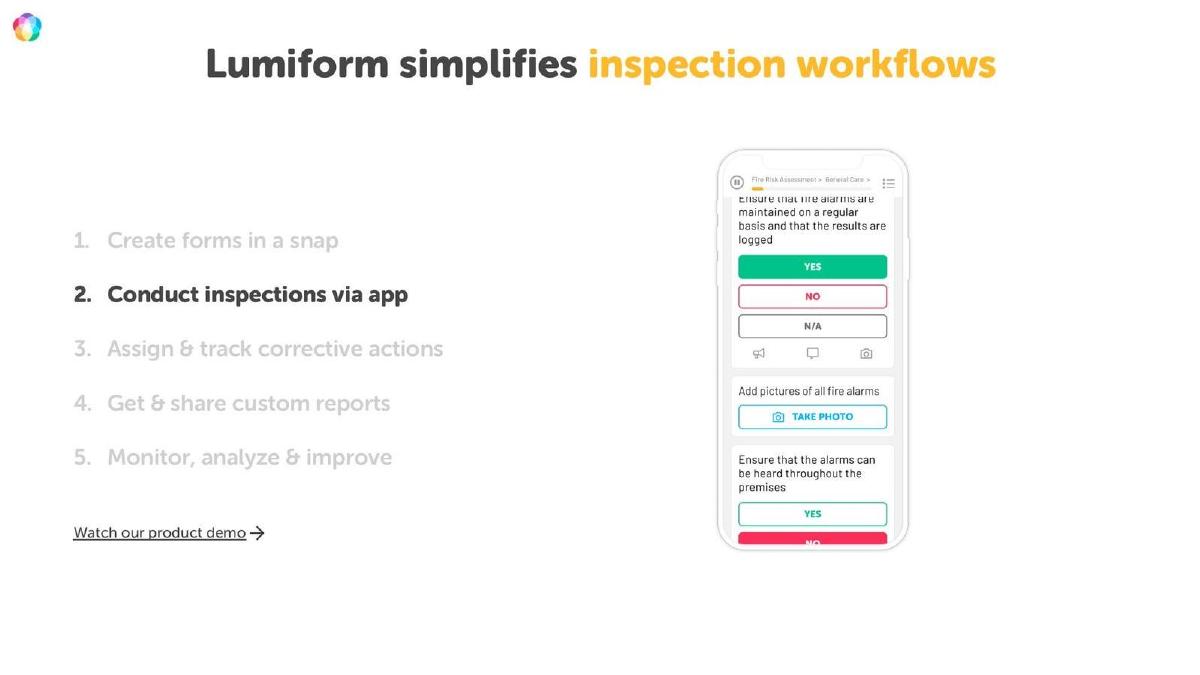
Slide 5 highlights step two: Conduct inspections via app . The visual is a mobile mockup showing a fire alarm inspection. The interface is clean, with large 'YES' and 'NO' buttons and a 'TAKE PHOTO' prompt. This reinforces the ease of use for workers in the field, which is critical for adoption in industries like construction and gastronomy.
Slide 6: Solution Part 3 – Corrective Actions
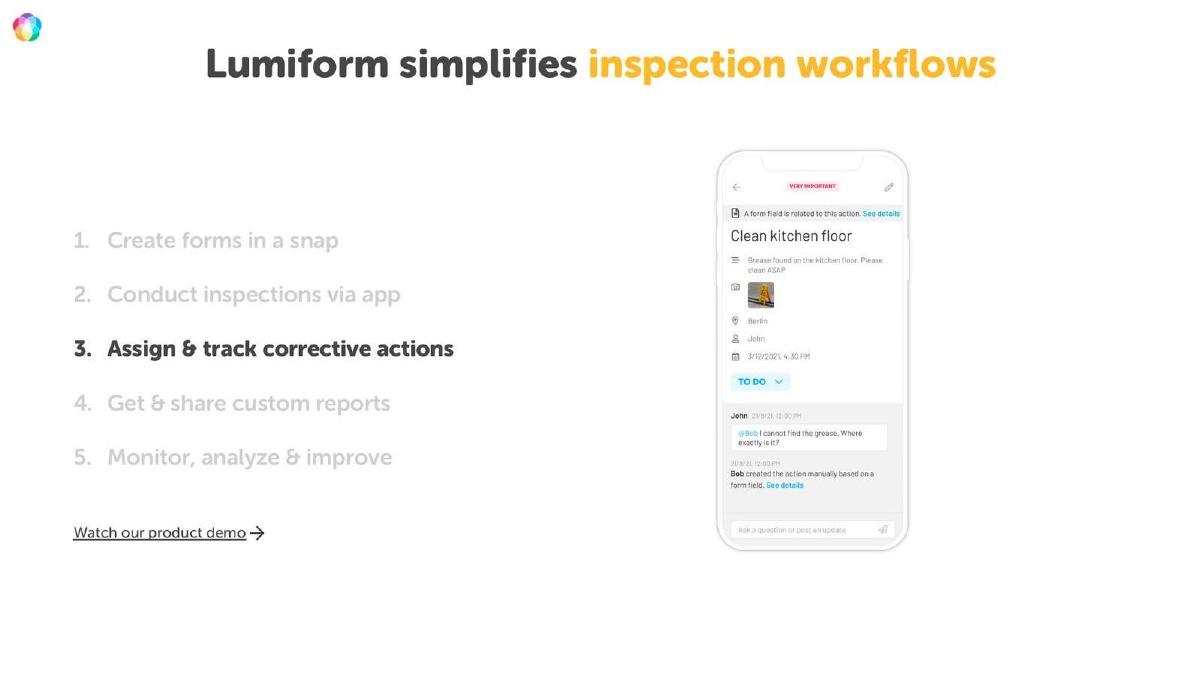
Step three is Assign & track corrective actions . The slide shows how a failed inspection item (e.g., 'Clean kitchen floor') automatically generates a task. The mockup includes details like location (Berlin), assigned user (John), and a chat log between team members. This demonstrates how Lumiform moves beyond simple data collection into active workflow management.
Slide 7: Solution Part 4 – Custom Reports
Step four is Get & share custom reports . The visual shows an 'ISO 9001 Internal Inspection' report on a tablet. It displays a 'Total result' of 75%, marked as 'NOT ACCEPTABLE,' and breaks down scores by topic (Audit, Planning). This slide appeals to management by showing how the raw data from the field is converted into professional, actionable compliance documents.
Slide 8: Solution Part 5 – Analytics Overview
The final step in the product walkthrough is Monitor, analyze & improve . This slide shows a desktop dashboard with high-level metrics: 849 Inspections, 60 Negative responses, and 707 Overdue inspections. It also lists specific items with the most negative responses. This is the 'command center' view that justifies the enterprise software spend for C-suite executives.
Slide 9: Product Philosophy
Slide 9 summarizes the core value proposition: We use workflow automation wherever we can . It uses a flow diagram to show how a 'NO' answer on a safety check automatically triggers an 'Improve visibility' action. The goal, as stated, is to standardize processes and save time . This slide bridges the gap between 'what the product does' and 'why it matters' for organizational efficiency.
Slide 10: Business Model & GTM
The final slide details the go-to-market strategy. Lumiform uses a self-serve approach , noting that 80% of our customers converted by no-touch / low-touch sales . This is a critical metric for a Series A investor, as it indicates a highly scalable, efficient sales engine. The pricing is shown as a Free plan (0€) for limited usage and a Professional plan (20€ per user/month) for unlimited usage. This transparent pricing model supports their high-volume, self-serve acquisition strategy.
What Works in the Lumiform Deck
The most impressive aspect of this deck is its unwavering focus on the product experience . By dedicating 50% of the slides to a step-by-step walkthrough, Lumiform proves that their solution is not just a theoretical improvement but a functional, ready-to-scale tool. The transition from the 'Paper & Pen' timeline on Slide 3 to the automated workflow on Slide 9 creates a compelling narrative arc of efficiency.
Furthermore, the quantification of value is handled well. The 1,203% ROI figure on Slide 4 is a 'hook' that demands attention, and the 80% no-touch conversion rate on Slide 10 provides the evidence of market pull. For a Series A round, these metrics suggest that the company has moved past the experimentation phase and is ready to pour capital into a proven acquisition model.
What is Missing from the Lumiform Deck
Despite its success, the deck has several glaring omissions that would typically be required in a Series A presentation. Most notably, there is no team slide . In venture capital, the 'who' is often as important as the 'what,' especially when disrupting traditional industries. Investors want to know if the founders have deep domain expertise in compliance or a track record in scaling SaaS.
Additionally, there is no competitive landscape . The deck assumes the only competition is 'Paper & Pen,' but the EHS (Environment, Health, and Safety) software market is crowded with players like SafetyCulture (iAuditor). Failing to acknowledge these competitors can make a startup look naive or overly optimistic. Finally, there is no financial roadmap or 'ask' slide . While we know from publisher reports that they raised $6.5M, the deck itself does not specify how much they were seeking or how they intended to spend the capital.
What Founders Should Copy
Founders should emulate Lumiform’s problem visualization . Slide 3 is a masterclass in identifying the 'villain' of the story (manual processes) and breaking down exactly why it is broken. By mapping out the eight steps of a manual inspection, they make the pain point visceral for the investor.
Another takeaway is the transparency of the business model . Many founders hide their pricing or GTM strategy in the appendix, but Lumiform puts it front and center. Showing a 20€/month price point alongside a high self-serve conversion rate tells a story of a 'velocity' business that can grow rapidly without a massive, expensive sales force. If your product has high organic adoption, make that the centerpiece of your pitch.
Conclusion
Lumiform’s deck is a lean, efficient document that mirrors the efficiency of the product it describes. While it breaks several 'rules' of pitch deck construction—most notably by omitting the team and competition—it succeeds by leaning heavily into a massive market and a product that clearly solves a universal pain point. For startups in the enterprise SaaS space, this deck serves as a reminder that a great product and clear traction metrics can often speak louder than a 20-slide deck full of fluff.
Frequently asked questions
- Why does the deck focus so heavily on the product walkthrough?
- For a product-led growth (PLG) company like Lumiform, the software's ease of use is the primary differentiator. By showing the 'Template Builder' and 'Analytics Overview,' they demonstrate how they replace complex manual tasks with a simple digital interface, validating their claim of a 1,203% ROI.
- Is a 10-slide deck sufficient for a Series A round?
- While short, this deck focuses on the 'Big Three' for SaaS: market size, problem/solution fit, and go-to-market efficiency. The 80% no-touch conversion rate is a powerful metric that suggests the product sells itself, reducing the need for extensive operational slides.
- What is the significance of the 'hidden' market mentioned on Slide 2?
- By calling the €178 billion market 'hidden,' Lumiform suggests that while inspections (safety, hygiene, maintenance) are ubiquitous, they are often overlooked as a unified software category. This framing allows them to claim a first-mover advantage in digitizing these fragmented processes.
- How does Lumiform justify its pricing model?
- Slide 10 shows a 0€ Free plan and a 20€ Professional plan. This low-friction entry point supports their 80% self-serve conversion metric, proving that the cost of customer acquisition (CAC) is likely low relative to the lifetime value (LTV) of a professional user.
- What are the biggest risks in a deck that omits a team slide?
- Omitting the team is unusual for Series A, where investors bet on execution capability. However, if the traction metrics and product quality are high enough, investors may focus more on the 'machine' the founders built rather than their individual resumes.