Luko’s 20-slide Series B deck from September 2020 successfully secured $61M by reframing insurance as a preventative service rather than a reactive one. The presentation is divided into two distinct phases: proving the success of their 'Step 1' (becoming the fastest-growing EU home insurer) and outlining 'Step 2' (building a comprehensive homecare ecosystem). The deck highlights impressive growth metrics, such as a 6x increase in MRR over 12 months, despite COVID-19 lockdowns. It also leans heavily into its B Corp status and social mission, featuring a 30% flat fee model where excess premiums…
Key takeaways
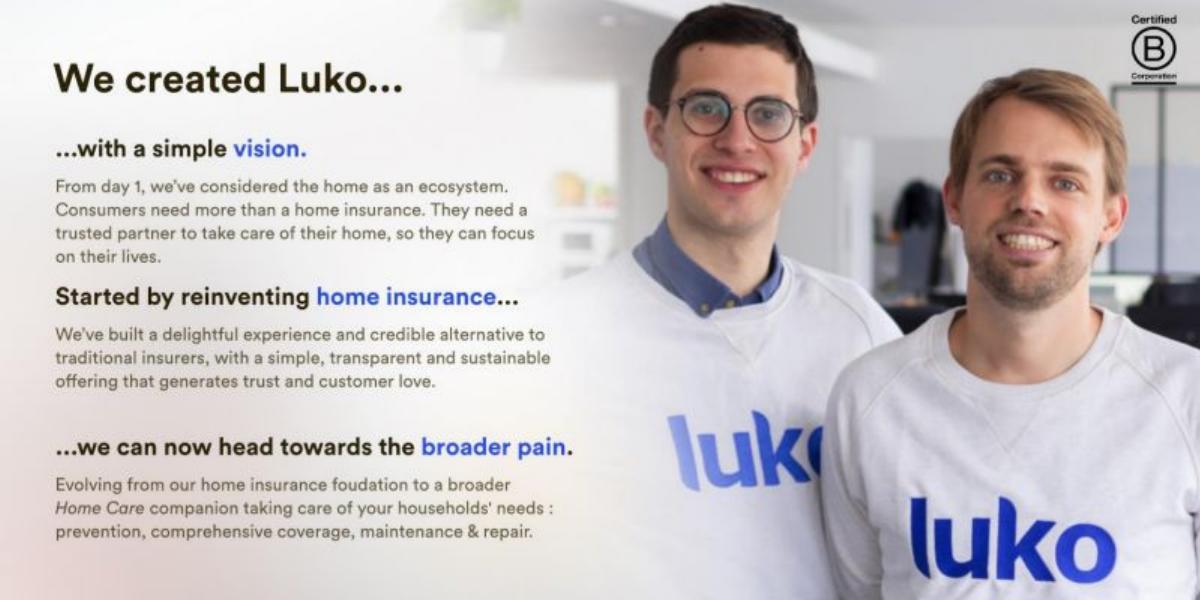
- The company positions itself as a 'Home Care companion' rather than just an insurer, focusing on prevention, coverage, and repair (Slide 3).
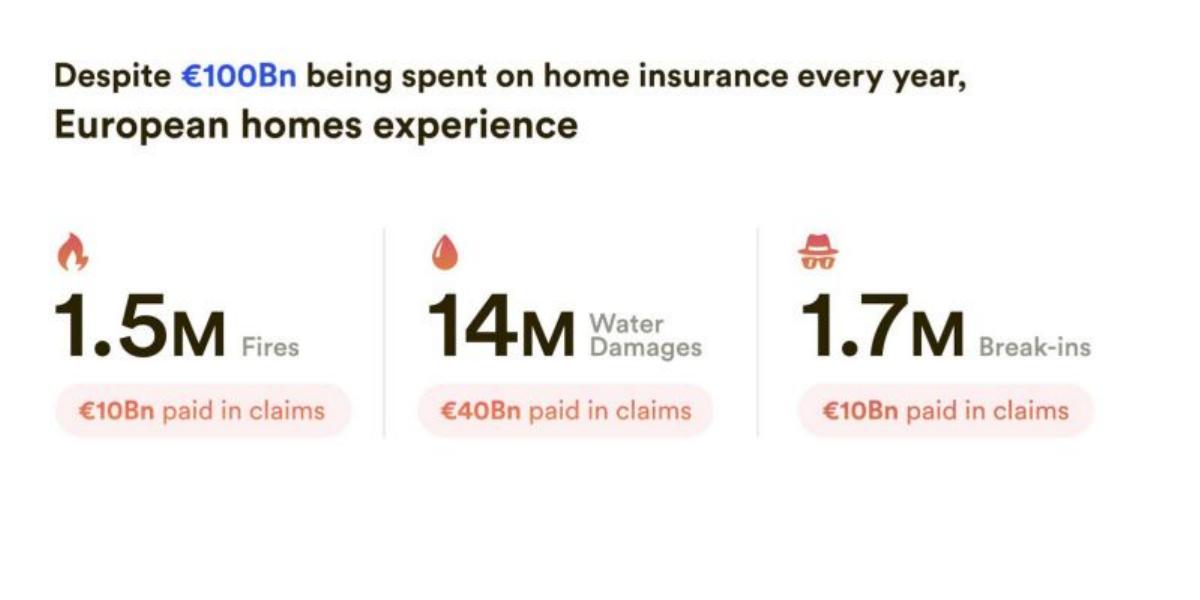
- Luko identifies a massive market opportunity with €100Bn spent annually on European home insurance, yet plagued by 14M water damage incidents and 1.7M break-ins (Slide 4).
- The product offers a significant UX improvement, claiming users can be 'Insured in 2min' and receive a 'solution in 2 hours' for claims (Slides 9 and 10).
- Luko utilizes a transparent business model with a 30% flat fee, donating remaining funds to charity to align interests with customers (Slide 11).
- Growth is a central theme, with the deck reporting 100k homes protected by the end of 2020 and MRR growing 6x since their Series A (Slide 12).
- The roadmap includes a transition from a Managing General Agent (MGA) to a 'Full stack insurer' by 2022-2023 (Slide 14).
- The 'Delight Flywheel' strategy aims to lower costs through accident prevention and data gathering while increasing LTV through cross-selling (Slide 16).
- The team slide showcases deep expertise across growth, insurance, and tech, with 81 total employees across four departments (Slide 18).
Executive Summary and Vision
Slide 1-3: The Mission to Invent Homecare
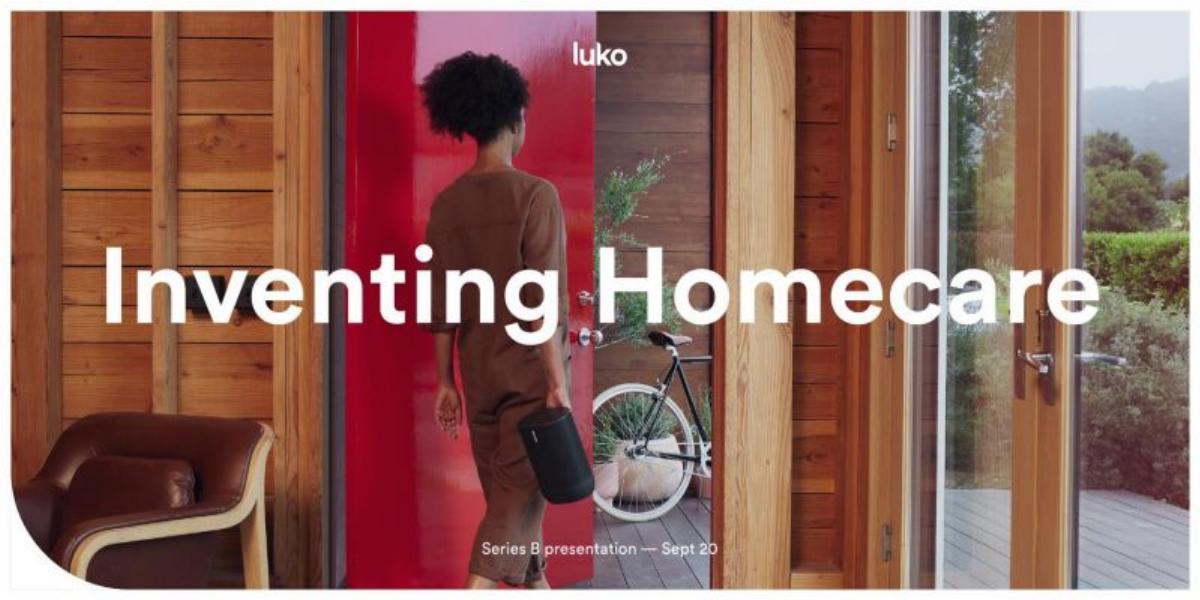
The deck opens with a high-resolution lifestyle image and the bold headline "Inventing Homecare" . This immediately signals that Luko is not positioning itself as a standard fintech or insurtech company, but as a new category of service. Slide 2 introduces the founders, Raphael Vullierme and Benoit Bourdel, and establishes the company's B Corp credentials. The vision is clearly articulated on Slide 3: moving from a foundation in home insurance to a "broader Home Care companion" . They define this ecosystem as encompassing prevention, comprehensive coverage, and maintenance/repair. By framing the problem as a "broader pain" rather than just a lack of insurance, they expand their Total Addressable Market (TAM) from the outset.
The Problem: A Broken Industry
Slide 4-7: The 'Journey to Hell'
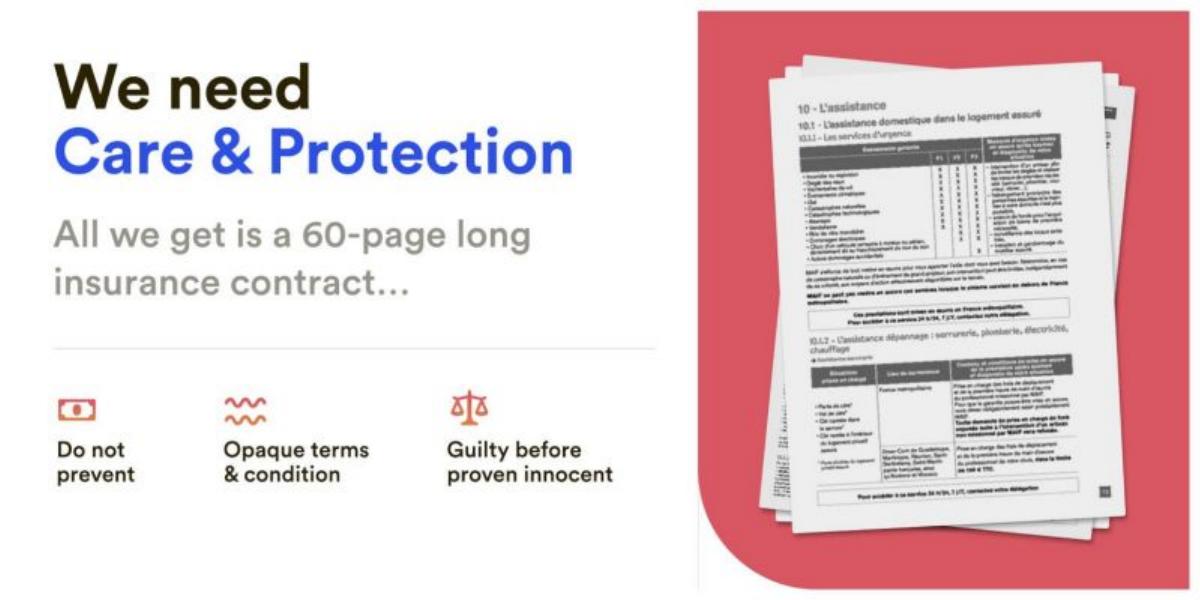
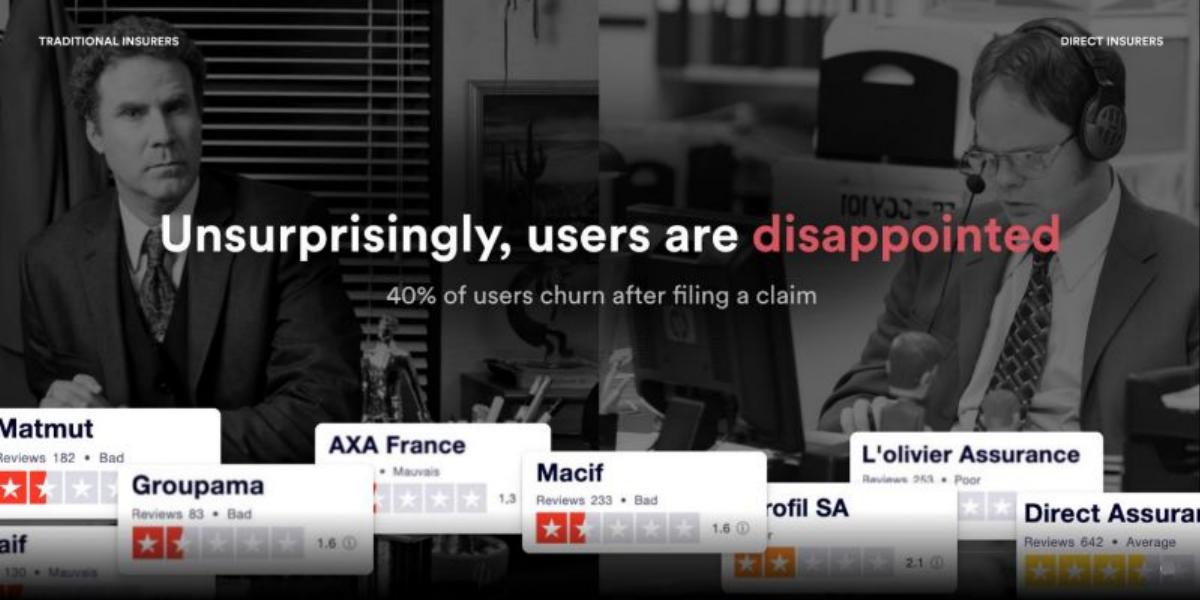
Luko uses Slide 4 to quantify the scale of the problem in Europe. They cite €100Bn spent annually on home insurance, contrasted with the physical reality of 1.5M fires, 14M water damage incidents, and 1.7M break-ins. This slide effectively highlights that despite massive spending, the underlying issues (the damages themselves) remain prevalent. Slide 5 and 6 attack the incumbents. They characterize traditional insurance as a "60-page long insurance contract" that is opaque and reactive. Slide 6 uses pop-culture imagery (Will Ferrell and Rainn Wilson) to mock traditional and direct insurers, noting that 40% of users churn after filing a claim . Slide 7 maps out the "Today's Insurance Journey... to hell," a timeline showing incentivized sales reps, a lack of prevention, and long wait times (30 minutes on the phone) only to potentially be denied a payout. This section is highly emotional and designed to make the investor feel the frustration of the current consumer experience.
Step 1: Proving the Insurance Model
Slide 8-12: Traction and Product-Market Fit
Slide 8 acts as a transition, stating their first goal was to build the "fastest growing EU home insurer." Slides 9 and 10 focus on the technological solution. They claim a user can be "Insured in 2min" by using external datasets for underwriting instead of forms. More impressively, they claim to provide a "solution in 2 hours" for claims using AI, 3D scans, and Face ID for authentication. Slide 11 introduces the "Giveback" model: a 30% flat fee for Luko, with the remainder for claims and charity. This is a critical trust-building slide, showing an NPS of 75 compared to an industry average of 20. Slide 12 provides the hard data: MRR has grown 6x since the Series A (a 12-month period), and they expected to protect 100k homes by the end of 2020. Notably, the chart shows a dip during the "COVID Lockdown" in Q2 2020, followed by a massive recovery in Q3, demonstrating resilience.
Step 2: The Future of Home Care
Slide 13-16: Scaling the Ecosystem
The second half of the deck shifts to the future. Slide 14 outlines the roadmap from being a Managing General Agent (MGA) in France to becoming a "Full stack insurer" across Europe by 2022-2023. This is a significant regulatory and capital-intensive shift. Slide 15 visualizes the "Home Care companion" app, which includes features like monitoring front door locks, power usage, and water leaks (Protect), managing multiple coverages (Cover), and booking plumbers or locksmiths (Care). Slide 16 introduces the "Luko Delight flywheel." The logic is that by preventing accidents and reducing fraud through data, they improve underwriting and economics. This allows them to cross-sell higher LTV products and acquire high-value customers through word-of-mouth, which in turn gathers more data to further prevent accidents. It is a classic virtuous cycle slide intended to show how the business becomes more defensible as it scales.
The Team and Ambition
Slide 17-20: The €10Bn Goal
Slide 17 sets the ultimate target: "Towards a €10Bn+ company." This is a standard "venture scale" claim for a Series B. Slide 18 is a comprehensive team slide. It lists the two founders and then breaks down the rest of the 81-person team into four categories: Ops & Admin (25), Tech & Product (34), Growth (12), and Insurance (6) . The slide highlights impressive pedigrees, including former employees from Airbnb, Uber, BCG, and AXA. This suggests a balanced mix of high-growth tech experience and deep industry expertise (e.g., a Chief Actuary from Admiral France). The deck concludes on Slide 19 with a repeat of the "Inventing HomeCare" branding, providing a cohesive bookend to the presentation.
What Luko Does Well
The deck is exceptionally strong at narrative arc . It doesn't just present a product; it presents a transformation of an entire category. By splitting the deck into "Step 1" (what we've proven) and "Step 2" (where we are going), they provide investors with both the security of existing traction and the excitement of a massive future vision. The use of the B Corp status and the Giveback model serves as a powerful differentiator in a commoditized industry like insurance, suggesting that Luko has a structural advantage in customer acquisition and retention because their interests are aligned with the user. The visual design is clean, modern, and uses mobile app mockups effectively to make the technology feel tangible.
What is Missing
Despite its success, the deck has several notable omissions. First, there is no explicit 'Ask' slide . While we know from the catalogue that they raised $61M, the deck itself does not state the amount sought or the specific allocation of those funds. Second, unit economics are vague . While they mention "improving economics" and a "30% flat fee," they do not provide specific figures for Customer Acquisition Cost (CAC) or the Lifetime Value (LTV) of their different customer segments (e.g., renters vs. owners). Third, the competitive landscape is treated dismissively. By using memes to represent competitors, they avoid a rigorous comparison with other neo-insurers like Lemonade or Alan, which would have been a primary concern for Series B investors. Finally, there are no detailed financial projections beyond the MRR growth chart, leaving the path to the "€10Bn+" valuation largely to the investor's imagination.
Founder Takeaways
1. Sell the 'Step 2' early: If you are in a crowded market like insurance, don't just pitch a better version of the existing product. Pitch the ecosystem that the product enables. Luko isn't just selling insurance; they are selling a 'Home Care companion.' 2. Use 'Trust' as a feature: In industries with low consumer trust, your business model can be your strongest marketing tool. Luko's 30% flat fee and charity giveback is a brilliant way to 'productize' honesty. 3. Quantify the 'Journey to Hell': Don't just say the current solution is bad. Map out the customer journey, highlight the specific pain points (like 30-minute hold times), and then show exactly how your tech eliminates those steps. 4. Show resilience: If your growth was impacted by external shocks (like COVID-19), show the recovery. Luko's MRR chart (Slide 12) is more impressive because it shows they could grow 6x despite a three-month hard lockdown.
Frequently asked questions
- What is Luko's business model?
- Luko operates on a transparent 'Giveback' model. As stated on slide 11, they take a 30% flat fee to cover operations. The remaining 70% is used to pay claims quickly. Any funds left over at the end of the year are donated to a charity chosen by the customer. This model is designed to remove the conflict of interest where traditional insurers profit by denying claims.
- How does Luko use technology to differentiate its insurance product?
- Luko leverages external datasets to eliminate lengthy forms, allowing for a 2-minute sign-up process (Slide 9). For claims, they use AI, 3D home scans via smartphone cameras, and GPS sensors to verify damage and process payouts in as little as two hours (Slide 10). They also integrate IoT devices for real-time home monitoring to prevent accidents before they happen.
- What were Luko's key growth metrics at the time of the Series B?
- According to slide 12, Luko achieved 6x MRR growth in the 12 months following their Series A. They projected protecting 100,000 homes by the end of 2020. They also boast a Net Promoter Score (NPS) of 75, which is significantly higher than the European insurance industry average of 20 (Slide 11).
- What is the 'Home Care' vision mentioned in the deck?
- The 'Home Care' vision (Slide 15) moves beyond insurance into three pillars: Protect (IoT monitoring to prevent accidents), Cover (centralized household insurance), and Care (access to vetted experts for maintenance and repairs). This transforms Luko from a financial service into a proactive utility for homeowners and renters.
- What is missing from the Luko pitch deck?
- The deck lacks a specific 'Ask' slide detailing exactly how the $61M will be allocated. It also omits a detailed competitor matrix, choosing instead to show generic 'Traditional Insurer' archetypes. Furthermore, while it mentions 'improving economics,' it does not provide specific CAC (Customer Acquisition Cost) or LTV (Lifetime Value) figures, nor does it show a path to profitability.