Lumanu’s Series A deck is a study in brevity, using just nine slides to secure $12M in funding. The presentation avoids the common pitfall of over-explaining technology, instead centering the narrative on three core creator problems: getting paid, managing cash flow, and business growth. With a mission-driven approach and a heavy emphasis on social proof—citing 30,000 creators and 200 brands—the deck proves that high-growth startups don't need 30 slides to communicate value. While it lacks traditional financial projections or a detailed team slide, the existing traction data and clear product…
Key takeaways
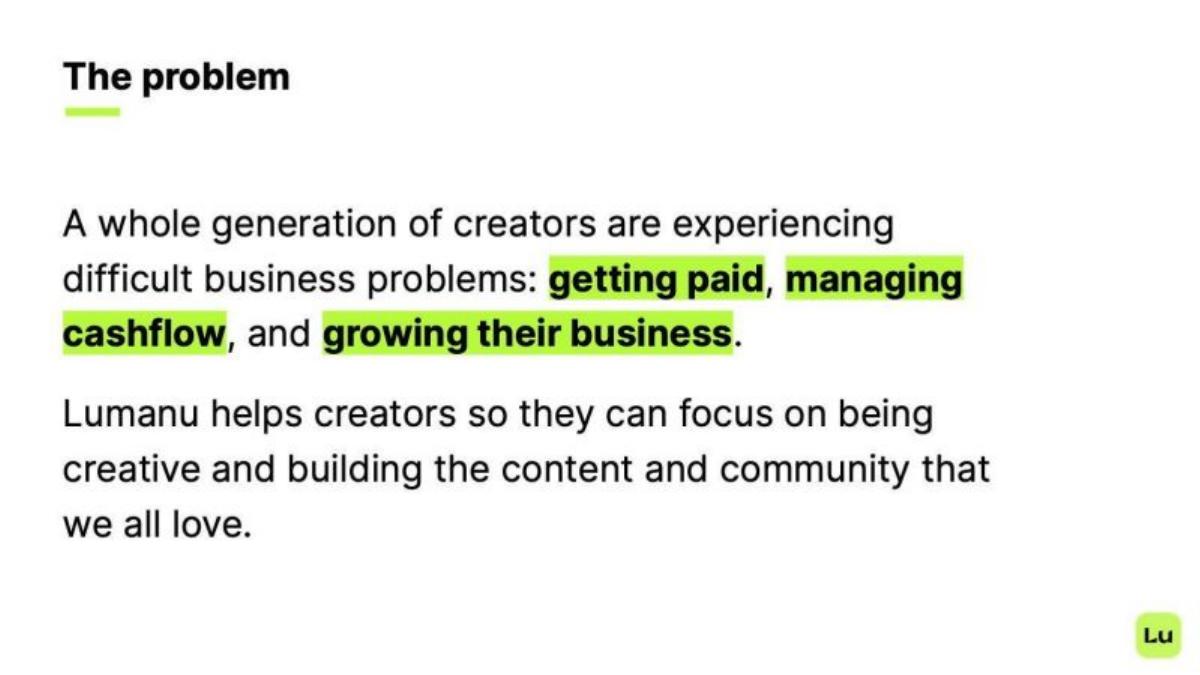
- The deck identifies three specific business problems for creators: getting paid, managing cash flow, and growing their business (Slide 4).
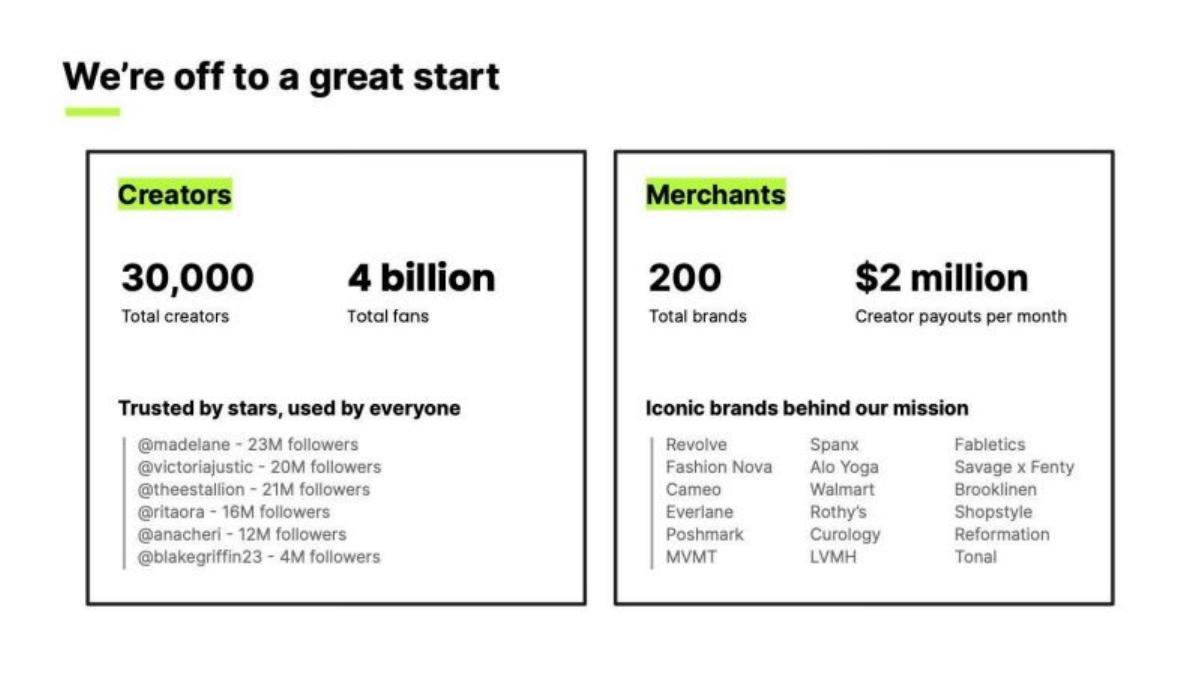
- Lumanu reports having 30,000 total creators with a combined reach of 4 billion fans (Slide 6).
- The platform processes $2 million in creator payouts per month as of the 2021 deck (Slide 6).
- The merchant side of the marketplace includes 200 total brands, featuring names like LVMH, Walmart, and Poshmark (Slide 6).
- Product features are categorized into three pillars: frictionless payments, cash flow management, and community networking (Slide 5).
- The 'Why Now' slide uses a logo cloud of 18 companies including Netflix, TikTok, and Substack to illustrate the diversification of creator income (Slide 7).
- The deck omits a dedicated team slide, detailed financial forecasts, and a specific 'Ask' for the round amount.
- EarlyPay is highlighted as a key feature for providing instant payouts to creators (Slide 5).
The 9-Slide Series A: Less is More
Lumanu’s 2021 Series A deck is an exercise in restraint. In an era where founders often feel compelled to include 20+ slides covering everything from granular unit economics to 5-year hiring plans, Lumanu secured $12M using a narrative that fits on a single hand's worth of fingers. The deck is built on a foundation of 'Creator-First' philosophy, moving quickly from a mission statement to hard traction data.
Slide 1: Title and Branding
The deck opens with a minimalist black slide featuring the Lumanu logo and the subtitle 'FOR CREATORS.' The phrase 'Brief overview' dominates the center in a high-contrast lime green. This sets the aesthetic tone for the rest of the presentation: clean, modern, and focused on the creator persona rather than corporate enterprise aesthetics.
Slides 2 & 3: The Mission-Driven Narrative
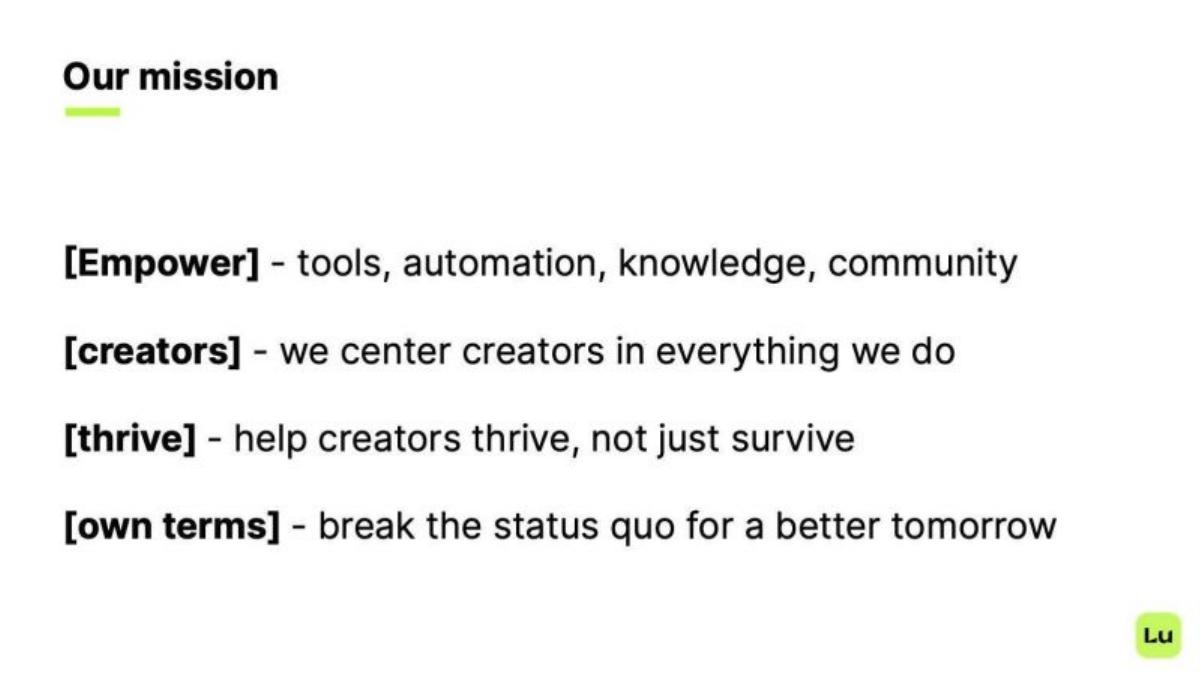
Slide 2 introduces the mission: 'Empower creators to thrive on their own terms.' This is a classic 'North Star' slide designed to align investors with the company's long-term vision. Slide 3 goes a step further by deconstructing the mission statement word-by-word. It defines 'Empower' as providing tools, automation, knowledge, and community. It emphasizes that Lumanu 'centers creators in everything we do' and aims to help them 'thrive, not just survive.' This level of philosophical detail suggests that Lumanu is positioning itself as a partner to the creator, not just a utility provider.
Slide 4: Defining the Problem
The problem slide is refreshingly direct. It identifies that a 'whole generation of creators' is struggling with getting paid, managing cashflow, and growing their business. By highlighting these three specific pain points, Lumanu moves the conversation away from 'content creation' (which is crowded) and toward 'business operations' (which is a massive, underserved fintech opportunity). The slide concludes by stating that Lumanu handles these burdens so creators can focus on their actual work.
Slide 5: The Three-Pronged Solution
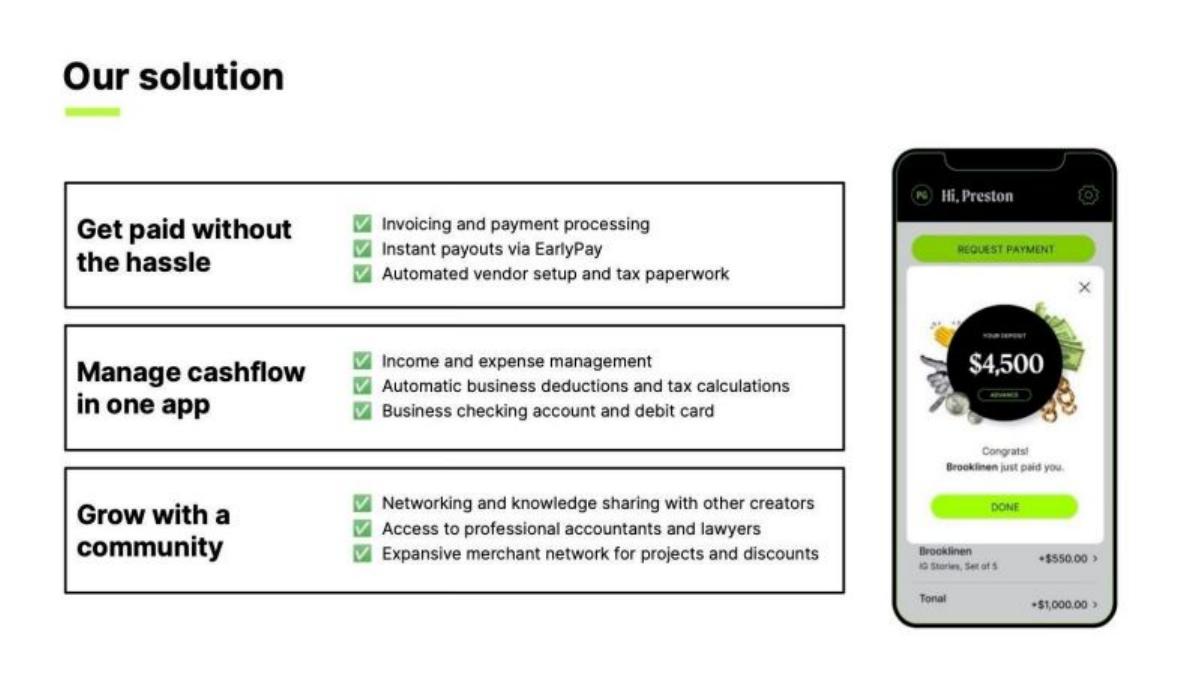
Slide 5 maps the solution directly to the problems identified on the previous slide. It breaks the product into three categories:
Get paid without the hassle: Invoicing, payment processing, and 'EarlyPay' for instant payouts. · Manage cashflow in one app: Income/expense management, tax calculations, and a business checking account/debit card. · Grow with a community: Networking, access to professional services (accountants/lawyers), and a merchant network.
A mobile mockup on the right side of the slide shows a notification: 'Congrats! Brooklinen just paid you,' with a large '$4,500' deposit figure. This visualizes the 'EarlyPay' value proposition—turning a pending invoice into immediate liquidity.
Slide 6: The Traction Powerhouse
This is arguably the most important slide in the deck. It provides the 'proof of life' that justifies a Series A valuation. Lumanu splits its traction into two boxes: Creators and Merchants . On the creator side, they claim 30,000 total creators with 4 billion total fans. They list high-profile users like @madelane (23M followers) and @theestallion (21M followers). On the merchant side, they cite 200 total brands and $2 million in creator payouts per month. The brand list is a 'who's who' of retail and luxury, including LVMH, Walmart, Spanx, and Fenty. This slide effectively communicates that Lumanu has already achieved significant scale and is trusted by both the talent and the capital in the creator economy.
Slide 7: The 'Why Now' and Market Context
Slide 7 addresses the market timing. The headline states: 'More creators are making more money in more ways than ever before.' Below this is a cloud of logos representing the fragmented income streams of a modern creator. Logos include Spotify, Patreon, TikTok, Substack, Medium, YouTube, and Netflix. Interspersed are bubbles for 'Coaching,' 'Sponsorships,' 'Licensing,' and 'Fan support.' This slide argues that as the creator economy becomes more complex and fragmented, the need for a centralized financial 'hub' like Lumanu becomes a necessity rather than a luxury.
Slides 8 & 9: Closing and Call to Action
Slide 8 is a simple 'Thank you!' with a link to the website. Slide 9 is a promotional slide for the source of the deck and not part of the Lumanu presentation. Notably, the deck ends without a team slide, a competition slide, or a financial projection slide. This suggests that the traction on Slide 6 was so compelling that it served as the primary driver for investor interest.
What Lumanu Does Well
The strength of this deck lies in its clarity of purpose. It does not try to be everything to everyone. It identifies as a fintech platform for creators and sticks to that narrative. By framing the problem as 'getting paid' rather than 'managing social media,' Lumanu positions itself in the lucrative payments and banking sector rather than the volatile ad-tech sector. The use of social proof is also exceptional; listing 200 brands and specific high-follower creators provides immediate credibility that a standard 'market size' slide cannot match.
What is Missing from the Deck
For a Series A deck, there are several glaring omissions that founders should be aware of:
Team Slide: There is no mention of the founders' backgrounds or the expertise of the engineering/fintech team. · Unit Economics: The deck mentions $2M in monthly payouts but does not explain how Lumanu makes money (e.g., take rate, SaaS fees, or interest on deposits). · Competition: There is no mention of other creator-focused fintech tools or traditional platforms like PayPal or Stripe. · The Ask: The deck does not specify how much capital is being raised or how it will be deployed (e.g., hiring, marketing, R&D). · Financial Projections: There is no forward-looking data regarding revenue targets or user growth.
It is highly likely that these details were included in a secondary, more data-heavy 'due diligence' deck or discussed extensively in person.
What Other Founders Should Copy
Founders should emulate Lumanu’s problem-solution mapping. Slide 5 is a perfect example of how to present features as direct answers to user pain points. Additionally, the dual-sided traction slide (Slide 6) is a gold standard for marketplace businesses. Instead of just showing total users, Lumanu shows the health of both sides of the ecosystem (creators and brands) and the volume of money flowing between them ($2M/month). Finally, the visual simplicity —using a consistent color palette and minimal text—ensures that the investor stays focused on the key metrics rather than getting lost in the weeds of the product UI.
Frequently asked questions
- How much did Lumanu raise with this deck?
- According to the catalogue facts, Lumanu raised $12M in a Series A round in 2021. The deck itself does not state the amount being raised, which is common in decks shared publicly after a round closes.
- What is the core problem Lumanu solves?
- As stated on Slide 4, Lumanu addresses the 'difficult business problems' faced by creators, specifically focusing on the friction of getting paid, the volatility of managing cash flow, and the complexities of scaling a creative business into a professional enterprise.
- Who are Lumanu's primary customers?
- Lumanu operates a two-sided marketplace. On one side are creators (30,000 users), and on the other are 'Merchants' or brands (200 total). Slide 6 lists high-profile creators like Madelane and Victoria Justice, alongside brands like Revolve, Fashion Nova, and Walmart.
- What financial tools does the platform offer?
- Slide 5 outlines several fintech features: invoicing and payment processing, instant payouts via 'EarlyPay,' automated tax paperwork, income/expense management, and a business checking account with a debit card.
- Is there a team slide in the Lumanu pitch deck?
- No. This 9-slide version of the deck excludes a team slide. While the founders likely presented their backgrounds in the live pitch, the deck focuses entirely on mission, problem, solution, and traction.