Lunar's 14-slide investor deck argues that the Nordics is the world's most profitable and most defensive retail banking market, and that an EU banking licence, clearing access and cloud approval make Lunar the only challenger positioned to take it. The argument is unusually well built — every slide is evidence for one thesis. But the deck carries no revenue, no ARPU, no CAC, no retention, no competitors beyond incumbents, and it ends on a logo with no ask and no contact details.
Key takeaways
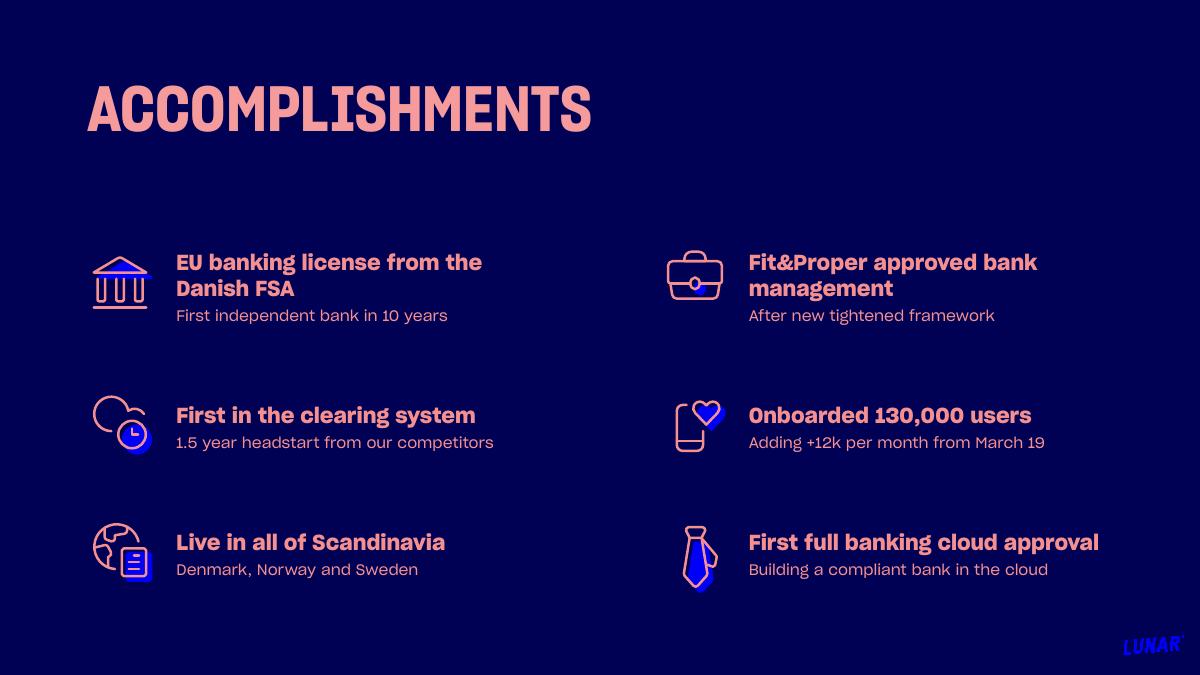
- Lunar's 2020 investor deck runs 14 slides and treats regulatory milestones — an EU banking licence from the Danish FSA, clearing-system access, Fit and Proper approval and full banking cloud approval — as its primary traction.
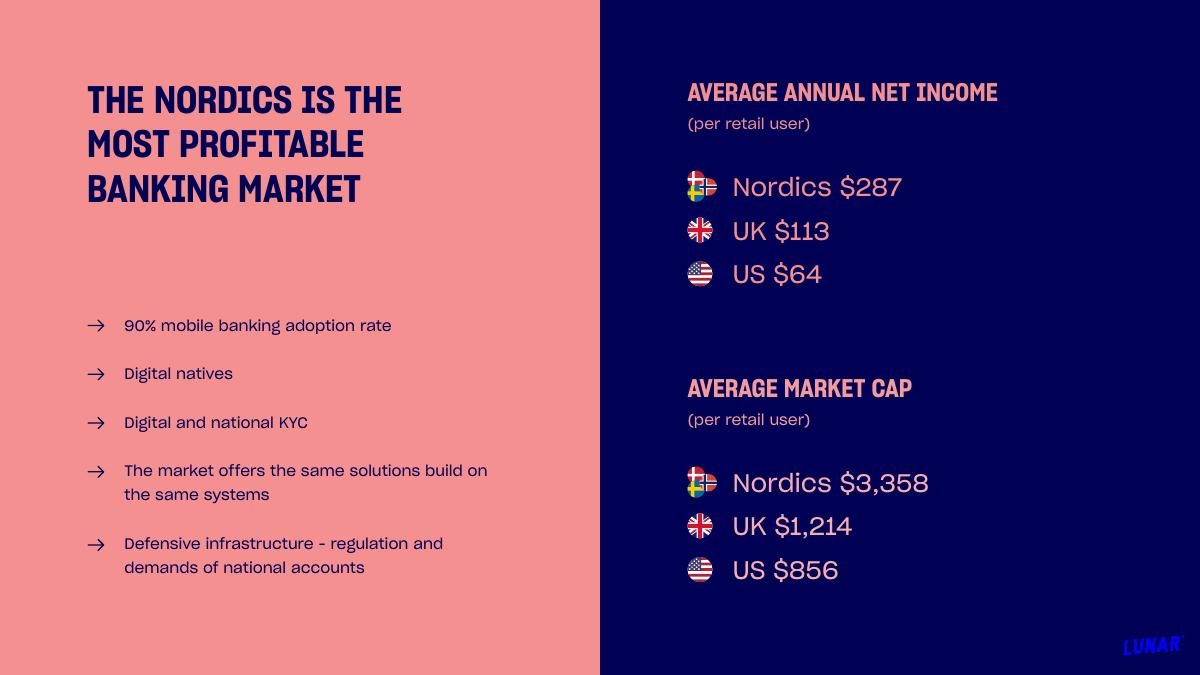
- The deck's core market claim is that Nordic banks earn $287 of average annual net income per retail user versus $113 in the UK and $64 in the US, but no source or year is given for the figures.
- Lunar reported 130,000 onboarded users adding roughly 12,000 per month from March 2019, without distinguishing registered users from funded or primary accounts.
- The revenue model slide projects a mix of 65% premium subscriptions, 15% interchange, 10% business banking and 10% partnerships, with no absolute revenue, ARPU or subscriber count attached.
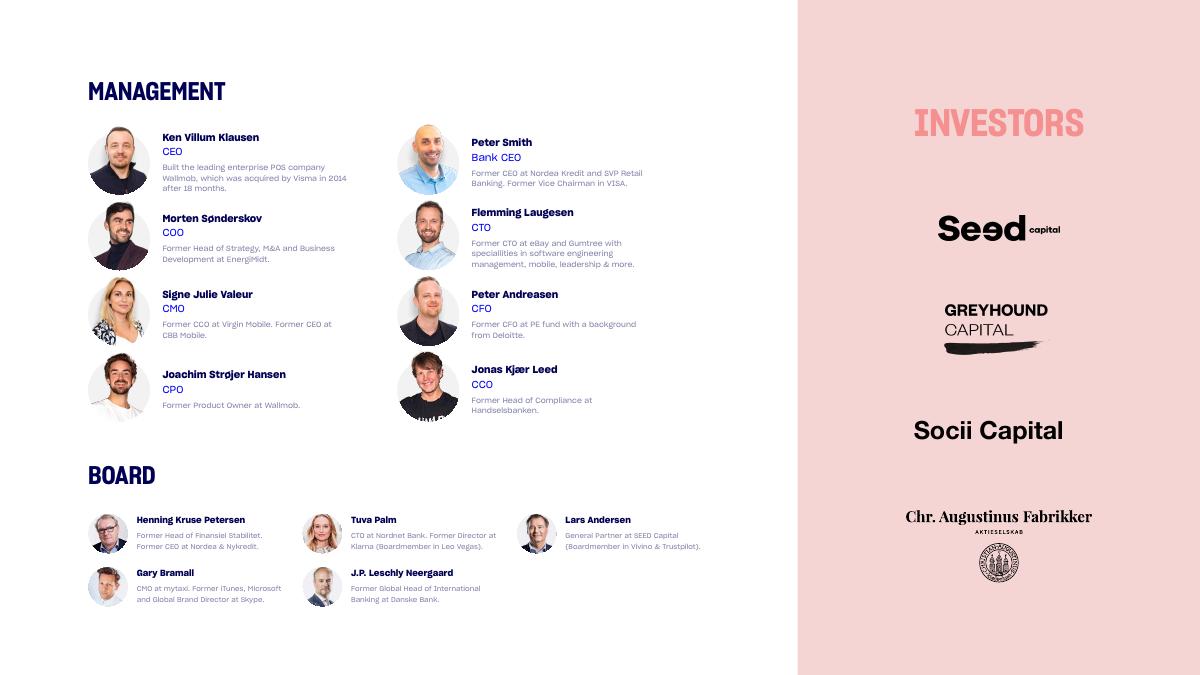
- Separating the founder CEO from a licence-credible 'Bank CEO' with Nordea Kredit and VISA experience is the deck's smartest structural move, because it answers regulator risk before an investor raises it.
- The competition slide lists incumbents holding 11M, 9.5M, 5M, 4.4M and 2.3M customers but omits Revolut, N26 and the domestic Nordic payment apps entirely.
- The strongest go-to-market mechanism — one-click migration of a full bank account using Nordic national infrastructure — is listed last on the growth slide instead of first.
- The deck closes on two brand slides with no ask, no use of funds and no contact details, which makes it unusable as a standalone cold-send document.
What this deck actually is
This is a 14-slide investor deck from Lunar, the Danish neobank founded by Ken Villum Klausen that started life as Lunar Way. The file is dated April 2020, and the content lines up with the fundraising story Lunar was telling around its Series C: an EU banking licence from the Danish FSA, 130,000 users, live in Denmark, Norway and Sweden, and a stated ambition to become "the first financial super app" and a "pan-Nordic dominator within the next three years."
Classify it honestly before you copy anything from it. This is not a seed deck and it is not a data room. It is a narrative-led growth-stage deck: 14 slides, almost no charts, no cap table, no cohort curves, no burn, no ask. It is built to make a single argument — the Nordics is the most profitable retail banking market on earth and it is structurally closed to outsiders, so the company that builds a licensed, cloud-native, pan-Nordic challenger first wins a market nobody else can enter cheaply. Everything else on the page is evidence for that one sentence.
That is a legitimate deck type at growth stage when the investor conversation is happening alongside a data room. It is a dangerous template to copy at seed, because the deck deliberately withholds almost every number an early-stage investor would use to underwrite the story.
Slide-by-slide walkthrough
Slide 1 — Cover
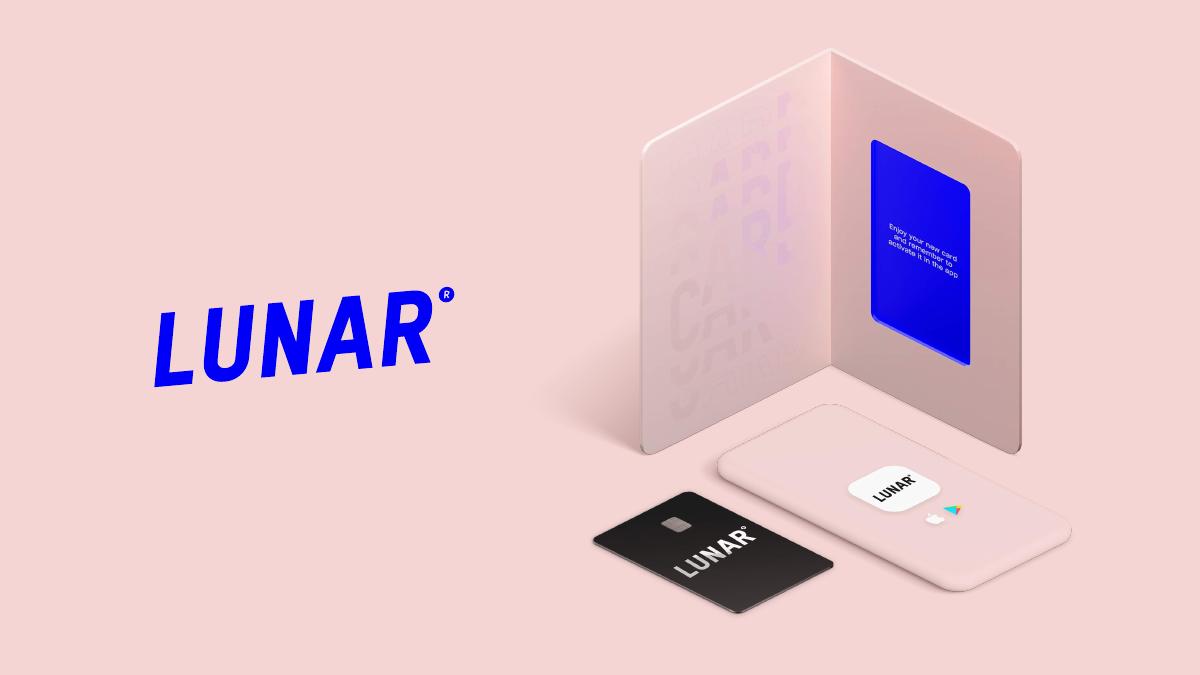
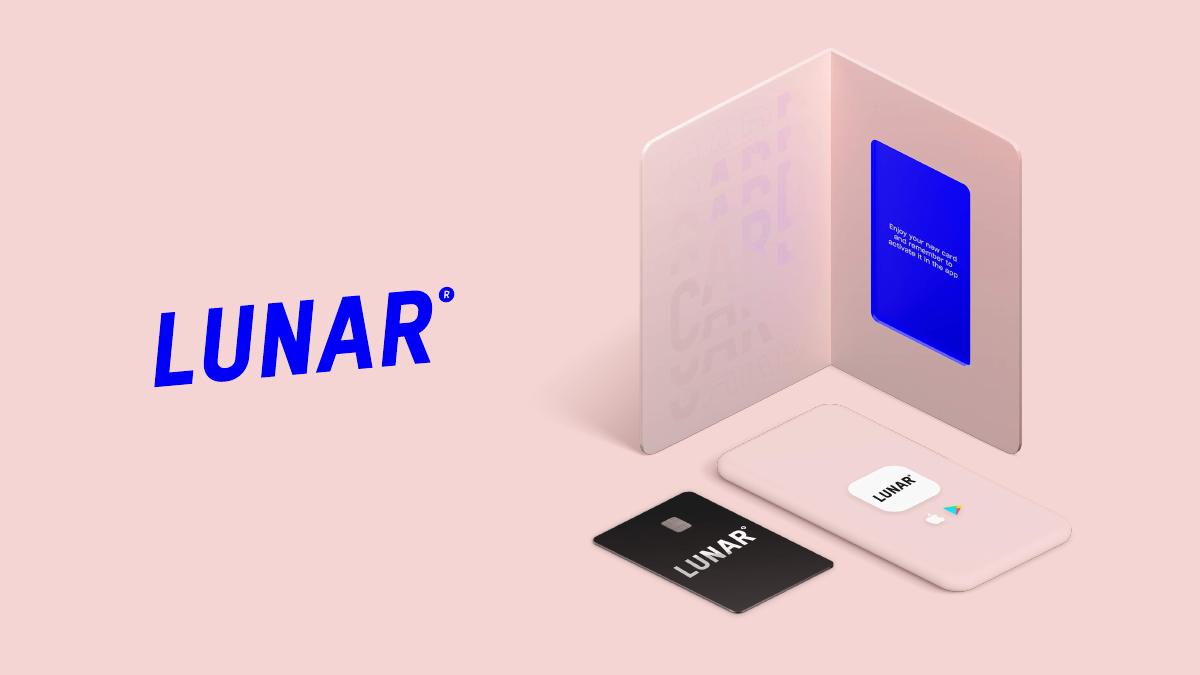
Pale pink field, the wordmark "LUNAR" set in a slanted italic blue, and a product still: a black metal card, a welcome wallet, and a phone showing the app icon with the App Store and Play badges. No tagline, no date, no "confidential" bar, no round name.
This is a brand cover, not an information cover, and for a consumer fintech at growth stage it mostly works — the physical card is the product, and the card looks expensive. What it costs you is orientation. An investor who opens this file cold does not learn what Lunar is, where it operates, or what is being raised until slide 3. If you copy this aesthetic, keep the art and add one line of subtitle: company, category, geography, stage.
Slide 2 — Vision
A single sentence: "We are building the first financial super app to shape the future of banking."
Two thirds of that sentence is doing no work. "Shape the future of banking" is the kind of line that survives in a deck because nobody wants to be the person who deletes it. "Financial super app" is the load-bearing part, and it is the honest description of Lunar's actual strategy — bundle accounts, cards, insurance, investing, loans and business banking into one app and charge a subscription. The vision slide would be stronger as the strategy slide: name the bundle, name the geography, and let the ambition be implied by the size of what you are bundling.
Slide 3 — Why the Nordics?
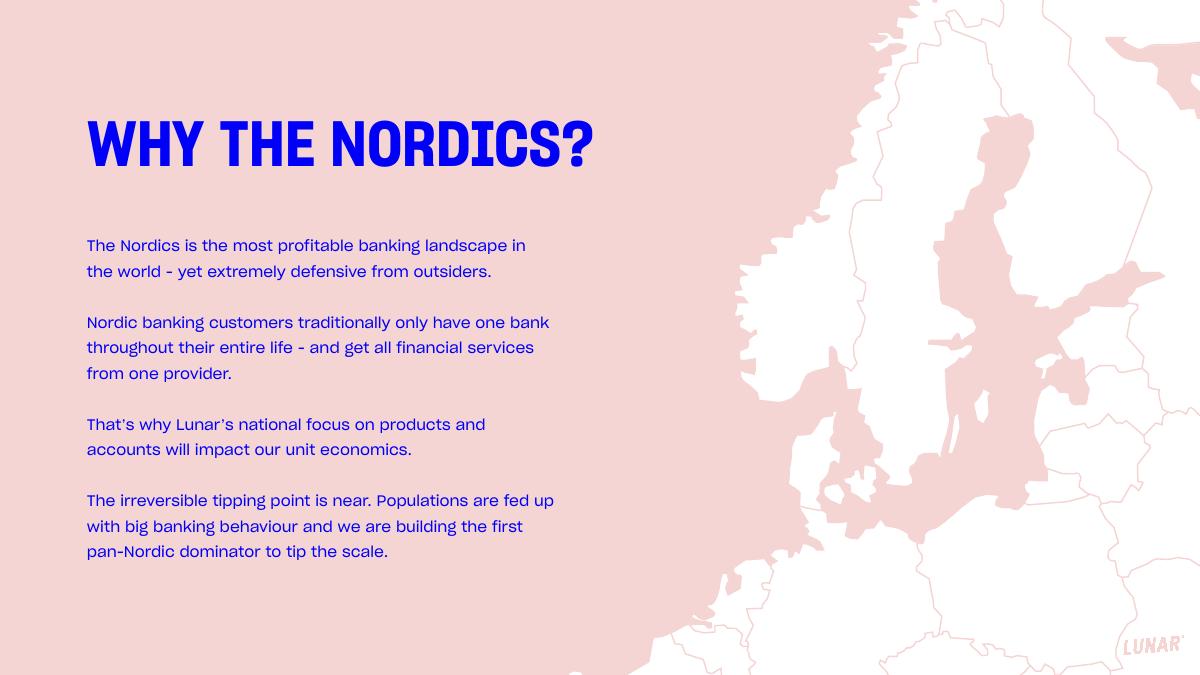
This is the best slide in the deck and it comes third, which is correct. Four short paragraphs make the market argument: the Nordics is the most profitable banking landscape in the world yet extremely defensive from outsiders; Nordic customers traditionally hold one bank for life and buy all financial services from that provider; national focus on products and accounts will therefore impact unit economics; and "the irreversible tipping point is near" because populations are fed up with big-bank behaviour.
Notice the structure. It is a why-now built out of a why-not — the same market characteristic that makes the Nordics attractive (single-bank loyalty, national account infrastructure, regulation) is also the moat that keeps Revolut and N26 from taking it with a marketing budget. That is a genuinely sophisticated argument and it is written in plain sentences with no chart. The weakness is the last paragraph: "the irreversible tipping point is near" is an assertion with nothing behind it. Everything else on this slide could be sourced; that line could not, and it is the line the deck leans on hardest.
Slide 4 — Accomplishments
Six tiles, and this is where the deck earns the right to its ambition. An EU banking licence from the Danish FSA, described as the first independent bank in ten years. Fit and Proper approved bank management under the new tightened framework. First in the clearing system, with a claimed 1.5-year headstart on competitors. 130,000 users onboarded, "adding +12k per month from March 19." Live in all of Scandinavia — Denmark, Norway and Sweden. First full banking cloud approval.
Four of those six are regulatory or infrastructure milestones, and that is the point: in a market whose defensibility is regulatory, the licence is the traction. This is the slide most founders get wrong in the opposite direction — they list product launches and press mentions as accomplishments. Lunar lists things a competitor would need years and a regulator's permission to replicate.
The gap is the one growth number on the slide. 130,000 users and +12k per month tells you nothing about whether those users are funded accounts, primary accounts, or app installs, and nothing about retention. In a market whose entire thesis is that customers keep one bank for life, "did the customer move their salary to you?" is the only user number that matters, and it is not here.
Slide 5 — Management, board and investors
Eight operators, five board members and a logo row of investors on one slide. Ken Villum Klausen, CEO, who built the enterprise POS company Wallmob and sold it to Visma in 2014 after 18 months. Morten Sønderskov, COO, former Head of Strategy, M&A and Business Development at EnergiMidt. Flemming Laugesen, CTO, former CTO at eBay and Gumtree. Signe Julie Valeur, CMO, former CCO at Virgin Mobile and CEO at CBB Mobile. Peter Andreasen, CFO, ex-Deloitte and a PE fund. Joachim Strøjer Hansen, CPO, former Product Owner at Wallmob. Jonas Kjær Leed, CCO, former Head of Compliance at Handelsbanken. And, separately labelled, Peter Smith as Bank CEO — former CEO at Nordea Kredit, SVP Retail Banking, and former Vice Chairman at VISA.
The board is deliberately heavier than the team: Henning Kruse Petersen, former head of Finansiel Stabilitet and former CEO at Nordea and Nykredit; Tuva Palm, CTO at Nordnet Bank and former Klarna director; Gary Bramall, CMO at mytaxi with iTunes, Microsoft and Skype behind him; J.P. Leschly Neergaard, former Global Head of International Banking at Danske Bank; and Lars Andersen, General Partner at SEED Capital. Investor logos include SEED Capital, Greyhound Capital, Socii Capital and Chr. Augustinus Fabrikker.
The single smartest structural choice in the whole deck is splitting "CEO" from "Bank CEO." A regulated bank needs a licence-holder the FSA trusts and a founder the market trusts, and putting both on the slide answers the regulator-risk question before an investor asks it. The cost of the slide is density — twelve faces at this size means nobody reads past the three names they already recognise.
Slide 6 — The Nordics is the most profitable banking market
The proof slide behind slide 3, and the only quantified market slide in the deck. Average annual net income per retail user: Nordics $287, UK $113, US $64. Average market cap per retail user: Nordics $3,358, UK $1,214, US $856. Alongside it, five bullets: 90% mobile banking adoption, digital natives, digital and national KYC, a market where everyone offers the same solutions built on the same systems, and defensive infrastructure driven by regulation and the demands of national accounts.
Per-user net income of $287 versus $64 in the US is the number the whole deck rests on, and it does real work: it explains why a smaller population is not a smaller opportunity. What is missing is a source line. Two derived metrics, six figures, no footnote, no year, no methodology. At growth stage with a data room open that is survivable; in a cold-send deck, an unsourced 4.5x claim is the first thing a partner asks an analyst to check, and you never get to hear the answer.
Slide 7 — Massive incumbents rule the market
A ranked list of incumbent customer bases — 11M, 9.5M, 5M, 4.4M, 2.3M customers — beside the line "All Nordic banking apps look the same. Built by the same, look like the same."
This is competition framed as opportunity, and the framing is fair: if five banks control tens of millions of customers using apps built on shared vendor infrastructure, sameness is the wedge. But the slide has no challenger on it. Revolut, N26, and the domestic mobile-payment behemoths (MobilePay in Denmark, Swish in Sweden, Vipps in Norway) are absent, and any Nordic-literate investor will supply those names themselves within ten seconds. Leaving your real competitor off the competition slide does not remove the competitor; it removes your chance to explain why you beat them.
Slide 8 — Product
A 16-tile grid: Cards, Accounts, Travel Insurance, Budget, Transfers, Loans, Invest, Topup, Business, Insurance, Integrations, Support, Payments, PFM, Receipts, International Transfers. A "Best Design 2019 Runner-up" badge sits in the corner.
Sixteen tiles is the "super app" claim from slide 2 rendered as evidence, and it is the right way to prove a bundle claim — one glance, no reading. The risk is that a grid flattens everything to equal weight. A card and a mortgage-adjacent lending product are not the same business, and nothing here tells you which tiles are live, which are partner-supplied, and which are roadmap. One state marker per tile — live, partner, coming — would have turned a nice graphic into an underwriting document.
Slide 9 — We are building a bank from scratch
Three paragraphs on the technology position: unlike almost all Nordic banks, Lunar built its own stack, which lets it react to changing expectations and ship "hundreds of releases every week"; it is the first Nordic bank with a regulatory-approved cloud solution, with an open API for third-party integration; and the microservice architecture makes it easy to amend functionality, apply new compliance rules and integrate partners, which positions it to be "the most compliant bank in the Nordics" and scale quickly.
The tell here is that the tech slide is written as a compliance slide. "Regulatory approved cloud" and "apply new compliance rules" are not engineering brags, they are moat claims, and in banking that is the correct instinct — anyone can build microservices, almost nobody can get a Nordic regulator to approve them. "Hundreds of releases every week" is the one line that invites scrutiny and adds nothing; nobody underwrites a bank on deployment frequency, and the number is large enough to sound rounded up.
Slide 10 — How we will catch a million users
Five growth tactics: free trial ("you can try us out for free — that's not seen before in the Nordics"); openness (link your other bank rather than break up with it); channel experimentation, described as being recognised "best-in-class" and specifically rated best-in-class by Snap Inc.; influencer and thought-leadership distribution; and one-click full account migration enabled by Nordic infrastructure. On the right, app ratings: Trustpilot 4.3/5.0, Facebook 4.3/5.0, App Store 4.5/5.0, Google Play 4.3/5.0.
The fifth tactic is the strongest thing on the slide and it is listed last. If national account infrastructure lets a user move their entire banking relationship in one click, that is the single mechanism that breaks the one-bank-for-life behaviour described on slide 3 — the thesis and the go-to-market finally touch. Burying it under an influencer bullet is a sequencing mistake.
The slide is also titled with a target — one million users — and then never costs it. Four ratings between 4.3 and 4.5 are respectable but they are satisfaction, not acquisition. Nothing on the slide gives CAC, payback, channel mix, or the conversion rate from free trial to funded account, which means the "how" in the title is answered with tactics rather than with arithmetic.
Slide 11 — Revenue model
A pie split four ways: 65% Premium subscriptions, 15% Interchange fee, 10% Lunar Business, 10% Partnerships and financial products. Beside it, the strategy in prose: rethinking the business model of banking in the world's most profitable banking market by bundling the best of the best, introducing a subscription-based model, and building its own straightforward financial products. Below, a product ladder — Invest, Consumer Loans, Business Loans, Insurance and Mortgage (marked with a question mark) — mapped to Premium, Benefits, Billy, e-conomic and Dinero.
Two things stand out. First, 65% subscription is an aggressive and honest strategic bet: Lunar is saying it will not be an interchange business, which is exactly the trap most 2016–2019 neobanks fell into. Second, the pie has no denominator. There is no revenue figure, no ARPU, no subscriber count, no time period — the slide tells you the shape of the revenue but never its size or whether the shape is today's actual mix or the target mix at scale. That ambiguity is the deck's biggest single omission, because a 65% subscription mix is either the most impressive fact in the file or an aspiration, and the reader cannot tell which.
The question mark on Mortgage is, in contrast, a small piece of intellectual honesty worth copying. It signals a known unknown instead of pretending the roadmap is settled.
Slide 12 — The three-year statement
One sentence, full bleed: "We're building the first dedicated pan-Nordic challenger and becoming a dominator within the next three years."
As a closing argument it is clear and it is falsifiable, which is more than most vision statements manage. What is missing is the bridge: a three-year dominance claim with no milestone ladder underneath it — users, markets, revenue, licence expansions by year — is a promise rather than a plan. One slide of three-year targets here would have converted the whole narrative into an underwriting case.
Slides 13–14 — Closing brand slides
Two full-bleed brand slides in Lunar's navy and electric blue, wordmark only. No contact details, no round size, no use of funds, no email address.
This is the most common and most expensive omission in modern decks. Fourteen slides of argument end with a logo. There is no ask, no valuation context, no next step, and no named person to reply to. If this file gets forwarded — and a deck this well designed will get forwarded — the recipient has no path to a conversation that does not go through the sender.
What this deck does better than most startup pitch decks
The market slide is an argument, not a number. Slide 3 explains why the Nordics is both the most valuable and the most defensible market, and slide 6 pays it off with per-user profitability. Most decks give you a TAM circle; this one gives you a reason the TAM is hard to take. · Regulatory milestones are treated as traction. A banking licence, clearing-system access, Fit and Proper approval and cloud approval are ranked ahead of user growth — correct in a category where permission is the moat. · Splitting CEO from Bank CEO. Naming a separate, licence-credible bank CEO with Nordea and VISA history pre-empts the regulator-risk objection before it is raised. · Board built to cover the founder's gaps. A former Nordea/Nykredit CEO, a Nordnet CTO, a Danske Bank international head and a consumer CMO — every board seat answers a specific doubt about a POS founder running a bank. · A revenue model with a strategic point of view. Choosing subscription over interchange as the majority of revenue is a real decision, stated plainly, in one chart. · Restraint. Fourteen slides, one idea per slide, no wall of text, no animation. The design does not fight the argument.
Where this deck would fail in an investor meeting
No ask, no use of funds, no contact. The deck ends on a logo. Nothing tells the reader what is being raised, at what stage, or who to reply to. · No financials of any kind. No revenue, no ARPU, no burn, no runway, no gross margin. The revenue pie has percentages but no denominator. · User numbers with no quality attached. 130,000 users and +12k/month, with no split between registered, funded, active or primary accounts — in a market whose thesis is single-bank loyalty, primary-account share is the metric and it is absent. · No retention or cohort data. A subscription-led model lives on churn, and churn appears nowhere. · No CAC or payback on a slide literally titled "How we will catch a million users." · Competitors omitted. Incumbents are listed; Revolut, N26 and the domestic payment apps are not, which leaves the sharpest objection unanswered. · Unsourced market statistics. $287 vs $113 vs $64 and $3,358 vs $1,214 vs $856 carry no source, year or methodology. · Unfalsifiable claims doing structural work. "The irreversible tipping point is near," "hundreds of releases every week," "the most compliant bank in the Nordics." · Product grid with no state. Sixteen tiles with no marker for live, partner-supplied or roadmap invites an awkward line-by-line interrogation.
Growth-stage narrative deck vs. a full investor deck
Element Lunar's 14-slide deck What a full investor deck carries
Market Why-now argument plus per-user profitability Same, with sources and dates
Traction Licence, clearing, 130k users, +12k/month Funded accounts, primary-account share, cohort retention
Revenue Mix as percentages only Absolute revenue, ARPU, growth rate, margin
Unit economics Absent CAC, payback period, LTV, contribution margin
Competition Incumbents only Incumbents plus challengers plus substitutes
How you would rebuild this deck today
Put one number on the cover. Keep the pink and the card, add a subtitle: what you are, where you operate, and the single metric you are proudest of. · Merge slides 2 and 3. Lead with the Nordics argument and let "financial super app" be the answer to it, not a standalone vision slide. · Source every market statistic. A one-line footnote under the $287/$113/$64 comparison removes the only real reason to doubt slide 6. · Requalify the user number. Replace "130,000 users" with funded accounts, primary accounts and monthly actives, and show the growth as a curve rather than a monthly average. · Add one retention slide. For a subscription bank, a cohort chart of paying-subscriber retention is worth more than four of the existing slides. · Give the revenue pie a denominator. Annualised revenue, ARPU, paying subscribers, and whether the mix is current or target. · Cost the million users. Blended CAC, payback, and the free-trial-to-funded-account conversion rate belong on slide 10. · Put the challengers on the competition slide. Name Revolut, N26 and the domestic payment apps, then use national account infrastructure and the licence to explain why they struggle here. · Mark every product tile. Live, partner, or roadmap. · Replace the second logo slide with an ask. Amount, instrument, use of funds, the milestones the money buys, and a name with an email address.
The transferable lesson
Lunar's deck is a masterclass in one thing and a cautionary tale in another. The masterclass: it identified the single non-obvious fact about its market — that the Nordics is simultaneously the most profitable and the most closed retail banking market in the world — and built every other slide as evidence for that fact. Nothing is decorative. The licence slide, the board slide, the cloud slide and the one-click migration bullet all point at the same claim.
The cautionary tale: a deck can be beautifully argued and still be unfundable on its own, because it never tells you how the business is performing or what it wants from you. Fourteen slides, zero financials, no ask, no contact. That only works when the deck is a companion to a live process. Sent cold, the argument arrives and the transaction never does.
Most founders have the opposite problem — numbers with no argument. The test that matters for your own deck is whether a reader can state your thesis in one sentence after slide 3, and whether they can state what you want by the last slide. If either answer is no, the design is not the issue.
Frequently asked questions
- Is the Lunar deck a real pitch deck for investors?
- Yes. It is a 14-slide investor deck from Lunar, the Danish neobank founded by Ken Villum Klausen, dated April 2020. It presents the company's market thesis, regulatory accomplishments, team, product bundle, growth tactics and revenue model. It is a narrative-led growth-stage deck designed to accompany a live fundraising process rather than a self-contained data room.
- What is Lunar?
- Lunar, formerly Lunar Way, is a Danish digital bank founded in 2015 that holds an EU banking licence from the Danish FSA. It operates across Denmark, Norway and Sweden, offering accounts, cards, budgeting, investing, loans, insurance and business banking through a single app, and monetises primarily through paid subscription tiers rather than interchange.
- How many slides is the Lunar pitch deck?
- Fourteen. Slide 1 is a brand cover, slides 2 to 12 carry the argument — vision, why the Nordics, accomplishments, team and board, market profitability, incumbents, product, technology, growth tactics, revenue model and the three-year ambition — and slides 13 and 14 are full-bleed brand closing slides with no contact details or ask.
- What is the strongest slide in the Lunar deck?
- Slide 3, 'Why the Nordics?'. It argues that the Nordics is the most profitable banking market in the world and simultaneously the most defensive against outsiders, because customers keep one bank for life and national account infrastructure plus regulation raises the cost of entry. It frames the market's difficulty as the moat rather than as an obstacle.
- What is missing from the Lunar pitch deck?
- Financials of every kind. There is no revenue figure, ARPU, burn, runway or gross margin; the revenue mix is shown only as percentages with no denominator. There is also no CAC or payback despite a slide titled 'How we will catch a million users', no retention or cohort data, no challenger competitors, and no ask, use of funds or contact details.
- Which slides should founders copy from the Lunar deck?
- Three. The why-now market slide that turns a market's difficulty into a moat; the accomplishments slide that ranks regulatory permissions above vanity product launches in a regulated category; and the team slide that splits the founder CEO from a separately named, licence-credible bank CEO to neutralise regulator risk before an investor asks about it.