Lunchclub’s 14-slide deck from 2019 is a lean, high-signal presentation that prioritizes founder pedigree and user sentiment over dense financial modeling. At the time of this Series A, the company focused on the 'offline' nature of professional networking, citing that 84% of people prefer in-person meetings. The deck successfully navigates the transition from a manual 'concierge' service to an AI-driven platform by highlighting a world-class technical team with backgrounds at Quora and hedge funds. While the version available to the public contains several redacted metrics regarding growth a…
Key takeaways
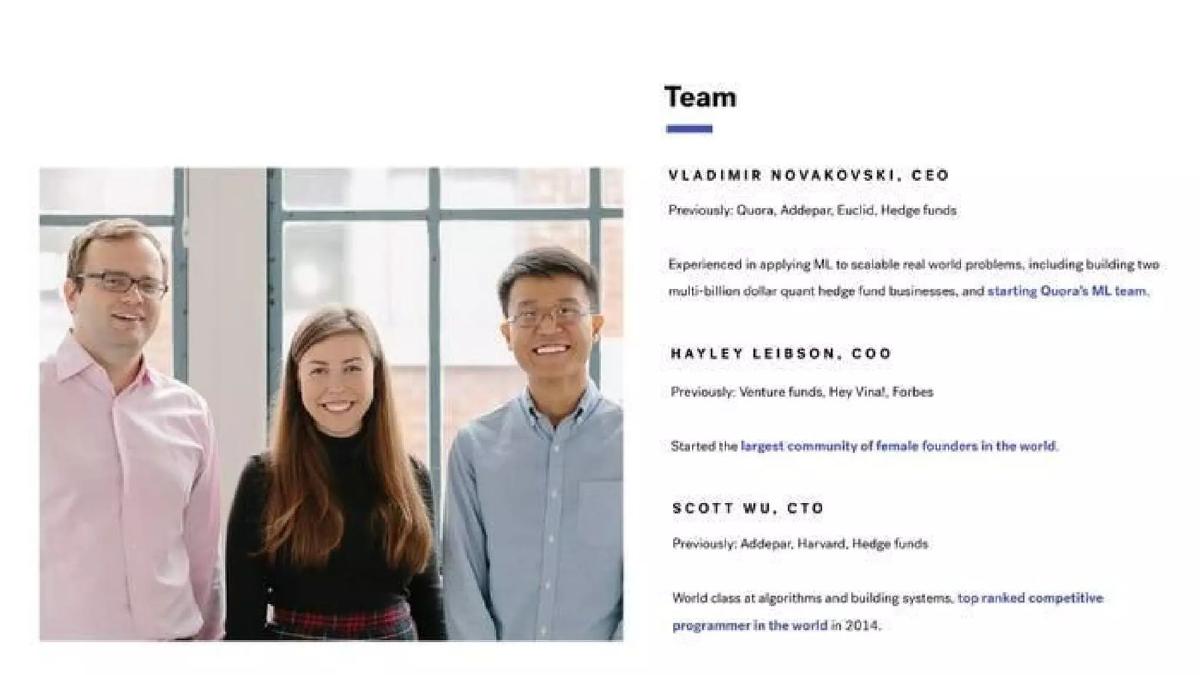
- The team slide (Slide 2) emphasizes deep technical expertise in machine learning and competitive programming to justify the 'AI' label.
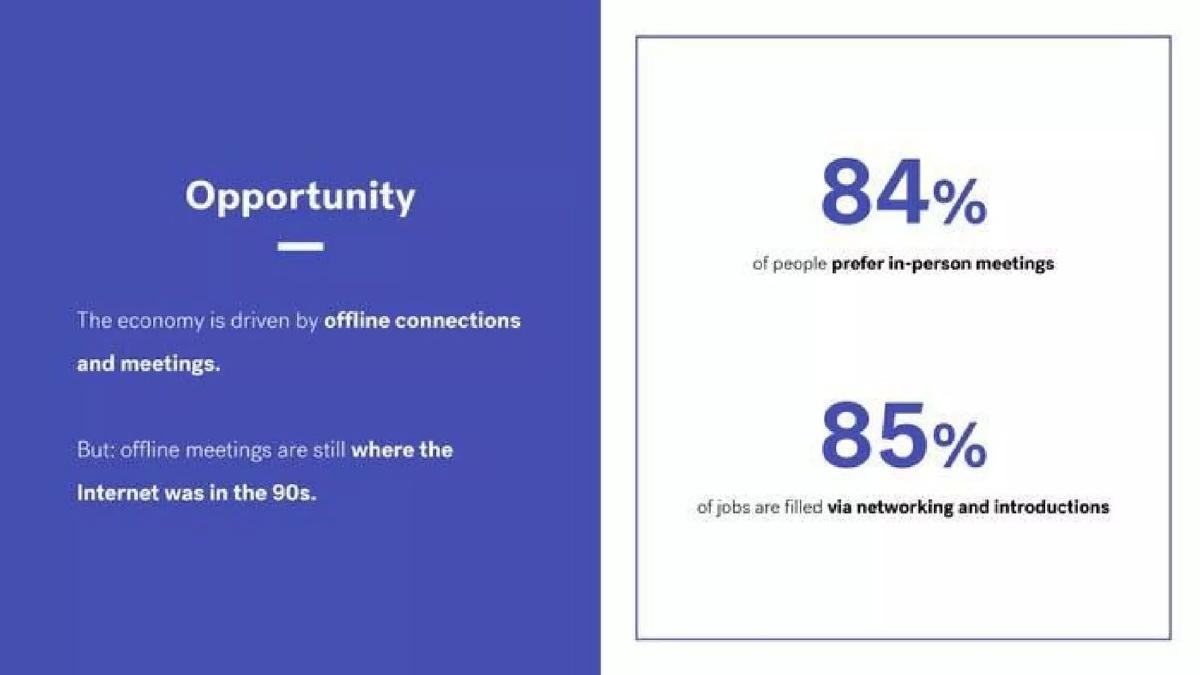
- Market opportunity is framed by the fact that 85% of jobs are filled via networking and introductions (Slide 3).
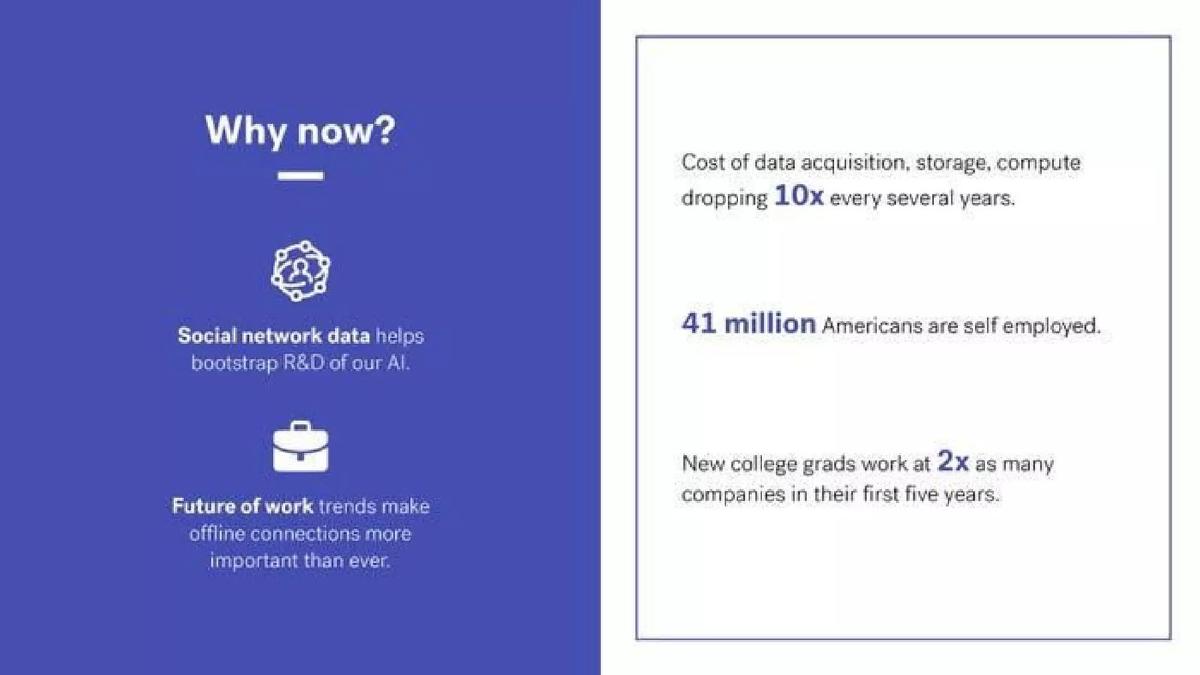
- The 'Why Now' slide (Slide 5) cites a 10x drop in data costs and the rise of 41 million self-employed Americans as tailwinds.
- Lunchclub claims a 'long-term moat' by measuring the complete funnel from digital introduction to time spent in person (Slide 7).
- Network effects are evidenced by the stat that 19% of users were invited by someone in another city (Slide 8).
- Engagement is high, with the average user taking 10 meetings per year, which the deck claims is an order of magnitude higher than competitors (Slide 9).
- The deck uses a 'Product-Market Fit' metric, stating 42% of users would be 'very disappointed' if the service disappeared (Slide 9).
- Success is humanized through specific case studies of a YC founder funding a project and two users becoming co-founders (Slides 10 and 11).
Introduction
Lunchclub’s 2019 Series A deck is a quintessential example of a 'vision and team' play. At 14 slides, it is concise and avoids the clutter of many early-stage decks. The company, which describes itself as an AI super-connector, used this presentation to bridge the gap between a high-touch networking service and a scalable technology platform. By the time this deck was circulated, Lunchclub had already gained significant traction in tech hubs, allowing them to lean heavily on social proof and engagement metrics rather than speculative financial projections.
The Foundation: Team and Vision (Slides 1-2)
Slide 1: Title The deck opens with a simple blue background featuring the Lunchclub logo and the tagline: "Meaningful offline professional connections." This immediately establishes the company's focus on the 'real world' rather than just another digital social network.
Slide 2: Team Lunchclub places its team slide second, a move typically reserved for founders with exceptional pedigrees. Vladimir Novakovski (CEO) is highlighted for building Quora’s ML team and two multi-billion dollar hedge fund businesses. Hayley Leibson (COO) is credited with starting the "largest community of female founders in the world." Scott Wu (CTO) is described as a "world class" programmer and was the "top ranked competitive programmer in the world in 2014." This slide is designed to signal that the 'AI' in their pitch is backed by legitimate technical authority.
The Market Thesis (Slides 3-5)
Slide 3: Opportunity The deck frames the problem as a gap between the importance of offline meetings and the lack of technology supporting them. It cites two key statistics: 84% of people prefer in-person meetings, and 85% of jobs are filled via networking and introductions. The slide concludes with a provocative statement: "offline meetings are still where the Internet was in the 90s."
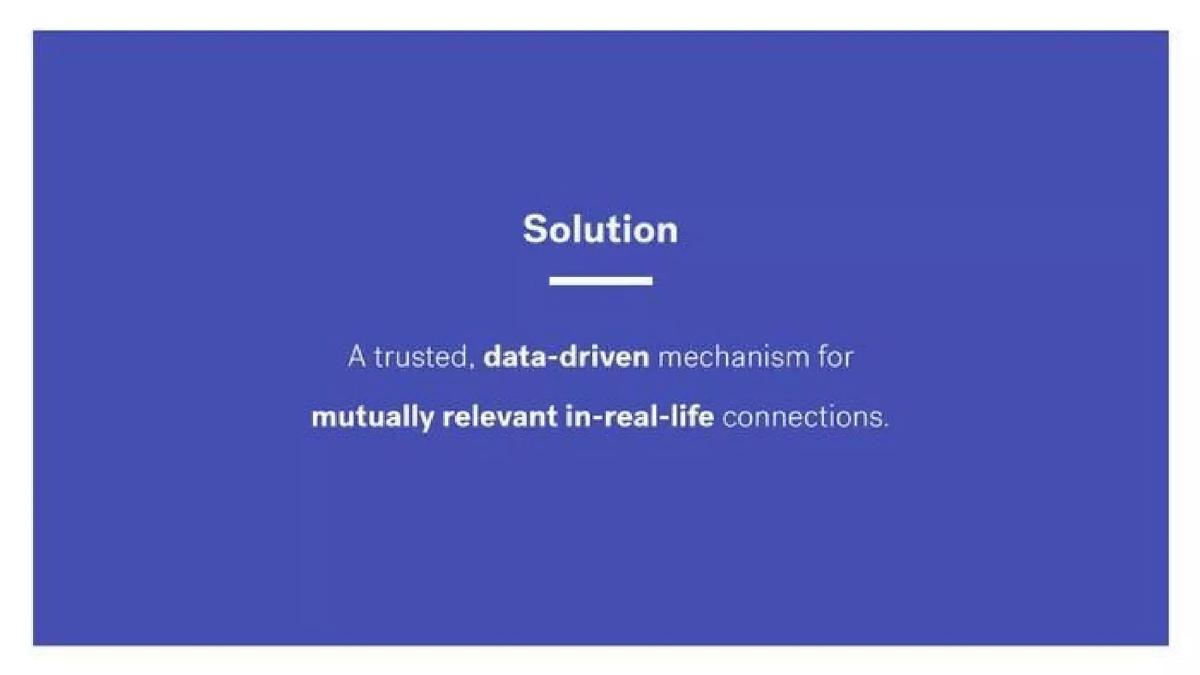
Slide 4: Solution The solution is defined as a "trusted, data-driven mechanism for mutually relevant in-real-life connections." This slide is minimalist, focusing on the phrase "mutually relevant," which is the core promise of their matching algorithm.
Slide 5: Why now? Lunchclub attributes its timing to three factors: the 10x drop in data and compute costs, the rise of 41 million self-employed Americans, and a trend where new college grads work at 2x as many companies in their first five years compared to previous generations. This suggests a more fluid, fragmented workforce that requires constant networking.
Product and Defensibility (Slides 6-7)
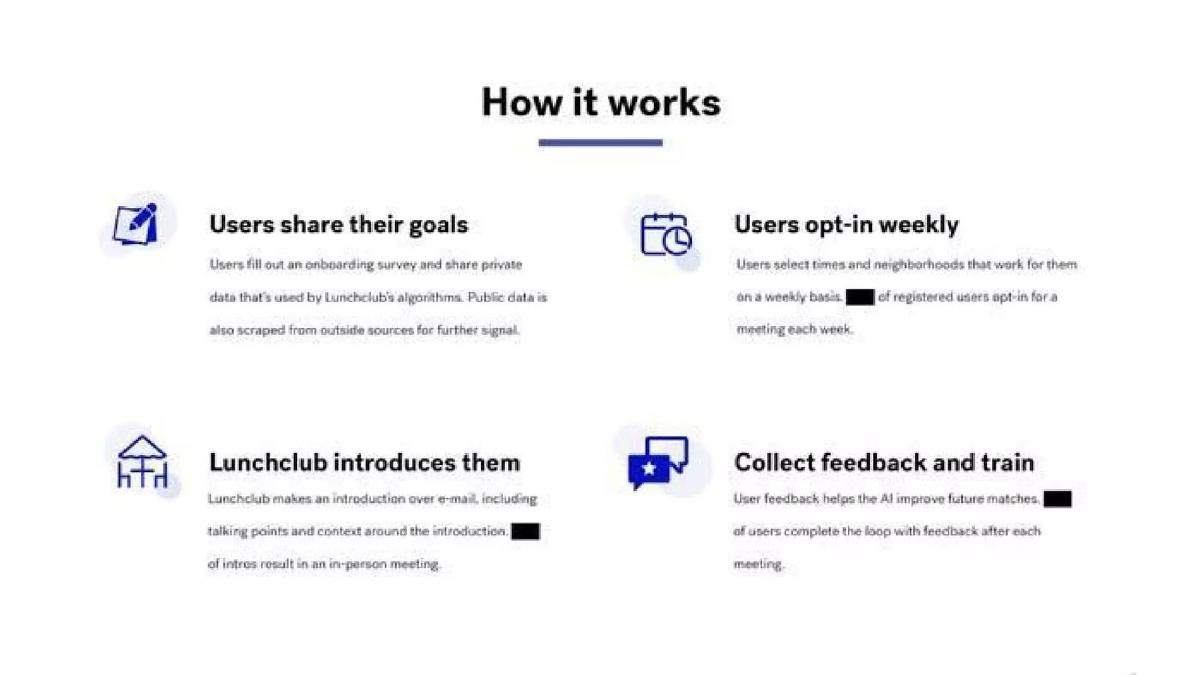
Slide 6: How it works The product flow is broken into four steps: 1) Users share goals via onboarding surveys and private data. 2) Users opt-in weekly by selecting times and neighborhoods. 3) Lunchclub introduces them via email with talking points. 4) Feedback is collected to train the AI. Note that several percentage figures on this slide regarding opt-in rates and meeting success are redacted in the public version.
Slide 7: Defensibility The company claims a moat based on its proprietary data set. Specifically, they note they "measure the complete funnel from introduction to time spent in person." This is a critical distinction from LinkedIn, which generally loses visibility once two users decide to meet offline.
Growth and Engagement (Slides 8-9)
Slide 8: Virality and network effects This slide features a redacted graphic, but the text remains: "19% (and growing) of users were invited by someone in another city." This is used to prove that the network is not just a local utility but has 'natural global network effects.'
Slide 9: Engagement and retention This is a high-impact slide. It states the average user takes 10 meetings a year , which they claim is an "order of magnitude higher than 'swiping' networking apps." They also include a 'Product-Market Fit' score: 42% of users would be "very disappointed" if Lunchclub went away. This is a direct reference to the Sean Ellis test for PMF.
Social Proof and Case Studies (Slides 10-12)
Slides 10 & 11: Case Studies Lunchclub uses two specific stories to humanize their data. Slide 10 describes how a YC founder named Kong funded an animated series for a user named Natalie after a Lunchclub intro. Slide 11 describes how two users, Samuel and Annie, met through the platform and became co-founders of a startup called Lexi. These anecdotes serve as proof that the 'mutual relevance' algorithm works for high-stakes professional outcomes.
Slide 12: Long-term vision The vision is bold: "Most professional introductions in the world will happen on Lunchclub." This positions the company not as a niche tool for techies, but as the future infrastructure for all professional networking.
The Roadmap and Conclusion (Slides 13-14)
Slide 13: Roadmap This slide is heavily redacted. It lists categories for "Finance and hiring" and "Series A milestones," including targets for "weekly actives" and being "Active in [redacted] cities." While the numbers are hidden, the structure shows investors exactly what the Series A capital was intended to achieve.
Slide 14: Closing The deck ends with the logo and the hashtag #stayhungry , a play on the company name and a nod to the ambitious nature of its user base.
What Works
Pedigree-First Approach: By placing the team slide second, Lunchclub immediately answers the 'why you' question. For an AI-driven product, the founders' backgrounds at Quora and in competitive programming are highly relevant. · Quantified Sentiment: Using the '42% very disappointed' metric (Slide 9) is a clever way to show product-market fit when revenue metrics are absent. · Humanized Success: The case studies (Slides 10-11) are powerful. They move the conversation from 'we make intros' to 'we facilitate company formation and funding.' · Clear Market Gap: The comparison of offline networking to the '90s internet' (Slide 3) creates a sense of inevitability about the solution.
What is Missing
Business Model: There is zero mention of how Lunchclub intends to make money. While common in 2019-era Silicon Valley Series A decks, it remains a glaring omission for a SaaS-categorized business. · Competitive Landscape: While they dismiss 'swiping' apps and LinkedIn, there is no detailed analysis of how they coexist with or replace existing professional tools. · The Ask: The deck does not state how much they are raising or the terms of the round. While this is often removed for public versions, its absence in a fundraising teardown is notable. · Unit Economics: There is no mention of Customer Acquisition Cost (CAC) or Lifetime Value (LTV), likely because the company was focusing on organic growth and network effects at this stage.
What a Founder Should Copy
The 'Why Now' Slide: Slide 5 is excellent. It connects macro-economic trends (self-employment) with technical trends (lower compute costs) to create urgency. · Focus on 'The Funnel': Claiming a moat by measuring the 'offline' part of the funnel (Slide 7) is a great way to differentiate a digital product from incumbents. · Minimalist Design: The deck uses a consistent color palette and very little text. It is designed to be spoken over, not read like a book. · Network Effect Proof: If you are building a marketplace or network, the stat about cross-city invites (Slide 8) is a sophisticated way to show that your growth isn't just a local fluke.
Frequently asked questions
- What is Lunchclub's core value proposition according to the deck?
- Lunchclub positions itself as a 'trusted, data-driven mechanism for mutually relevant in-real-life connections' (Slide 4). It aims to modernize professional networking, which it describes as being stuck 'where the Internet was in the 90s' (Slide 3), by using AI to facilitate offline meetings that lead to high-value outcomes like hiring or investment.
- How does Lunchclub define its competitive advantage or 'moat'?
- The deck identifies three pillars of defensibility on Slide 7: a proprietary combination of public, user-generated, and private data; the ability to measure the 'complete funnel' from intro to in-person meeting; and a 'world-class team' capable of building algorithms that understand 'mutual relevance.'
- What specific metrics did Lunchclub use to prove engagement?
- Beyond the redacted growth figures, the deck highlights that the average user takes 10 meetings per year (Slide 9). They also use the 'Sean Ellis' PMF survey metric, noting that 42% of users would be 'very disappointed' if Lunchclub no longer existed, which is a common benchmark for product-market fit.
- Who are the founders and what is their background?
- The team consists of Vladimir Novakovski (CEO), who built ML teams at Quora and multi-billion dollar hedge funds; Hayley Leibson (COO), who started the world's largest community of female founders; and Scott Wu (CTO), a top-ranked competitive programmer with a background at Harvard and Addepar (Slide 2).
- What is missing from this pitch deck?
- The deck notably lacks any mention of monetization, revenue, or business models. There is also no 'Ask' slide detailing the specific amount being raised or the valuation, though catalogue facts indicate the round was $4M. Additionally, a formal competitor analysis slide is absent, replaced by a brief mention of 'swiping' apps and LinkedIn.