LumApps provides an enterprise social collaborative platform designed to break down communication barriers within large organizations. Their Series C pitch deck is a lean, 10-slide presentation that prioritizes social proof and product architecture over granular financial metrics. Founded in 2012, the company successfully raised $70M in 2020 by showcasing a global footprint across seven offices and a roster of 250+ prestigious customers, including Google and Capital One. The deck effectively positions LumApps as the unifying layer for a fragmented software landscape, moving beyond simple intr…
Key takeaways
- The company boasts over 250 blue-chip customers and 2.5 million users worldwide as of the 2020 filing (Slide 3, Slide 8).
- LumApps identifies the core problem as 'information and technology overload' leading to disengaged workforces (Slide 5).
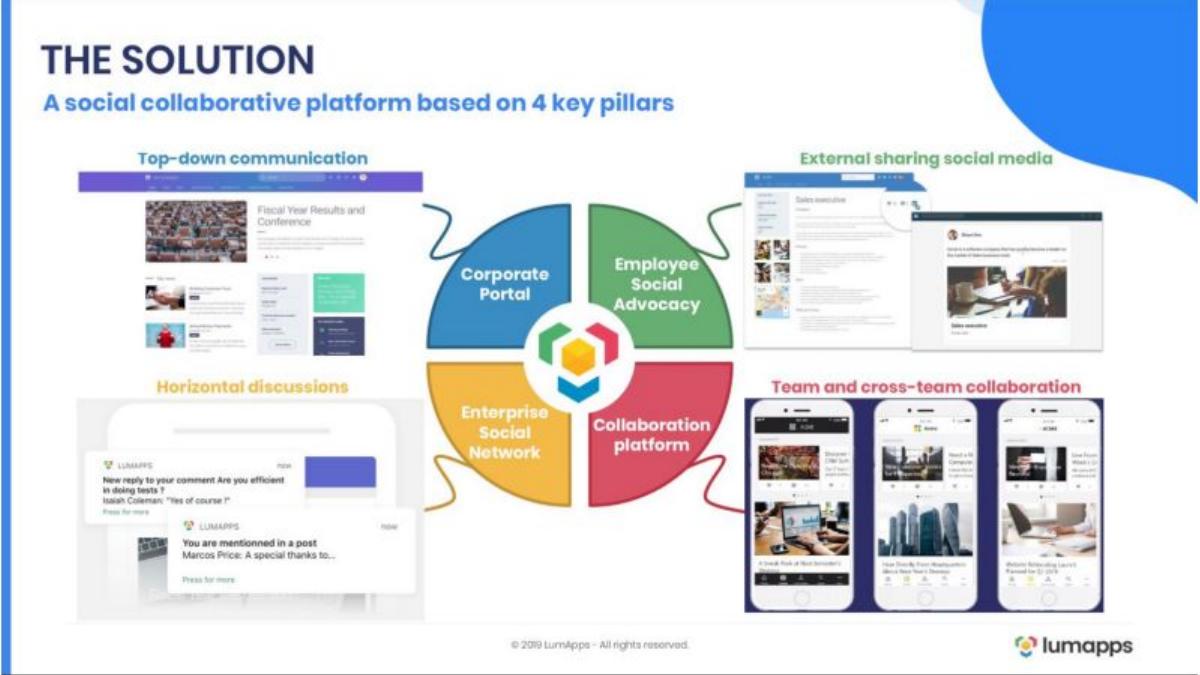
- The solution is built on four pillars: Corporate Portal, Employee Social Advocacy, Enterprise Social Network, and Collaboration Platform (Slide 6).
- The platform utilizes a three-step technical workflow: Capture, Organize, and Broadcast (Slide 7).
- LumApps maintains a significant global presence with 180+ employees across offices in New York, Austin, San Francisco, Paris, Lyon, London, and Tokyo (Slide 3).
- The founding team consists of four key executives: Sébastien Ricard (CEO), Lionel Grivel (COO), Elie Mélois (CTO), and Olivier Chanoux (CMO) (Slide 4).
- Existing investors prior to the round included Goldman Sachs, IDInvest, Bpifrance, and Iris Capital (Slide 3).
- The deck positions the product as a bridge between disparate tools like G Suite, Slack, Workday, and Salesforce (Slide 5, Slide 7).
The 10-Slide Strategy for a $70M Series C
The LumApps Series C pitch deck is a study in restraint. In an era where late-stage decks often balloon to 30 or 40 slides filled with cohort analyses and complex financial modeling, LumApps secured $70M using a concise 10-slide narrative. The deck relies heavily on the company's established maturity, emphasizing a global team and a massive list of blue-chip clients to signal that the 'startup' phase is long over and the 'scaling' phase is in full swing.
Slide 1: The Vision Statement
The cover slide introduces the brand with the tagline "Connect Your Digital Workplace." The imagery is a stylized illustration of diverse workers collaborating on a digital interface, which immediately sets the tone for a B2B SaaS product focused on human resources and internal communications. It is clean, professional, and avoids technical jargon from the outset.
Slide 2: The Mission
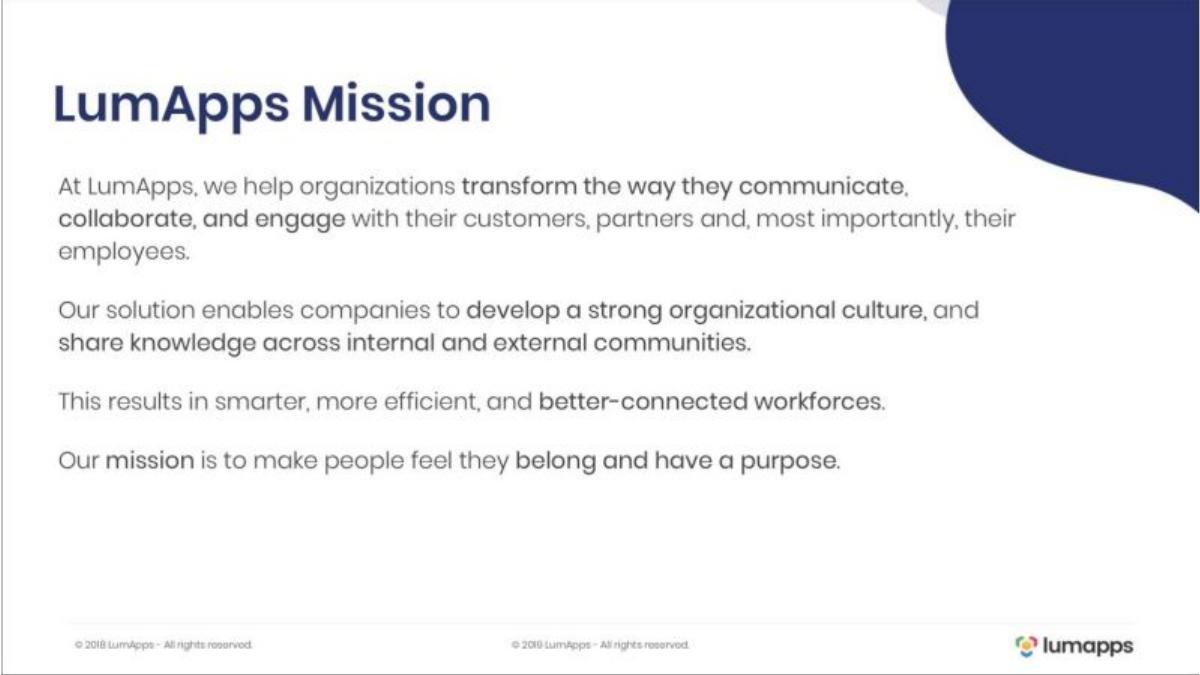
Slide 2 defines the LumApps Mission . It uses four distinct paragraphs to explain that they help organizations "transform the way they communicate, collaborate, and engage." Crucially, it highlights that the most important audience is the employees . The slide concludes with a purpose-driven statement: "Our mission is to make people feel they belong and have a purpose." This framing moves the product from a utility (an intranet) to a cultural necessity.
Slide 3: LumApps at a Glance
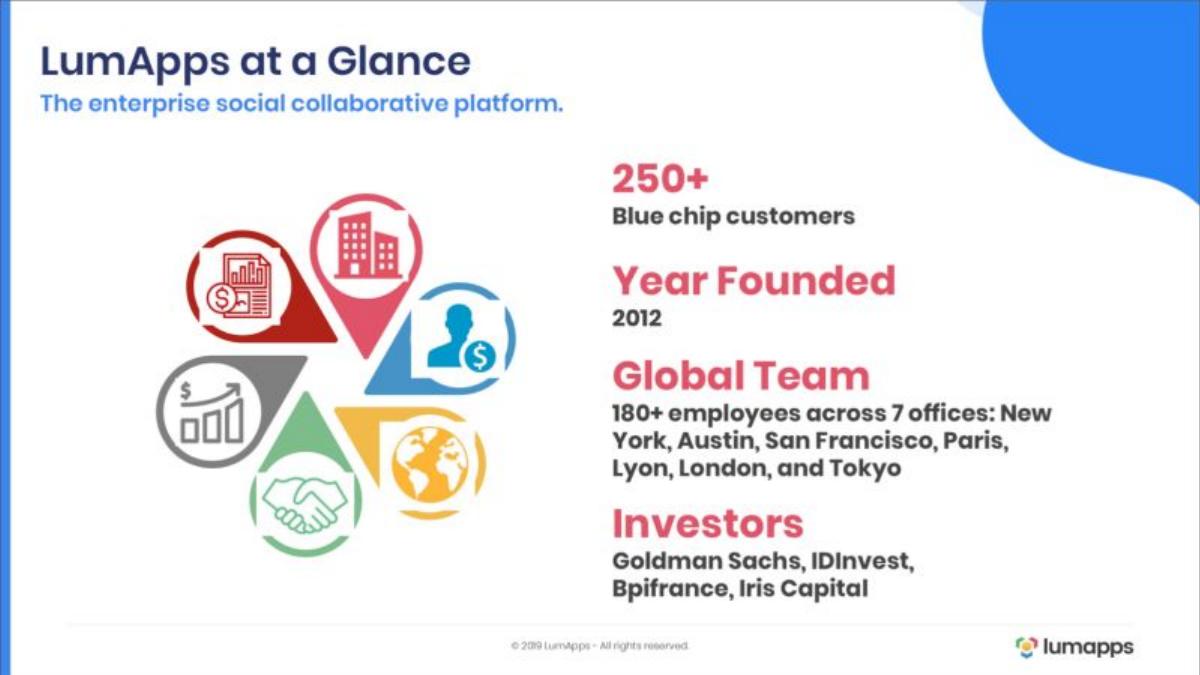
This is the most data-dense slide in the deck, serving as a credibility anchor. It lists four key metrics:
250+ Blue chip customers: Establishing market trust. · Year Founded 2012: Showing longevity and stability. · Global Team: 180+ employees across 7 international offices (New York, Austin, San Francisco, Paris, Lyon, London, and Tokyo). · Investors: Listing heavyweights like Goldman Sachs and Bpifrance.
By placing this slide third, LumApps ensures that the investor views the subsequent problem/solution slides through the lens of a proven, global entity.
Slide 4: The Founding Team
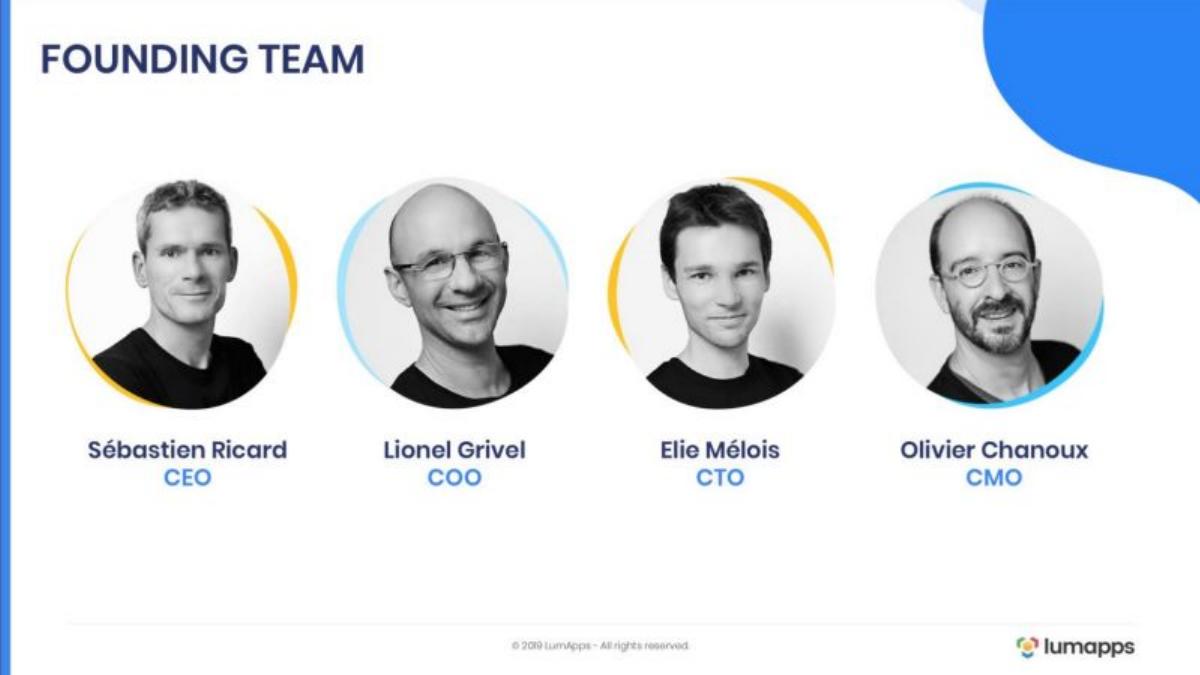
The deck introduces the four founders: Sébastien Ricard (CEO), Lionel Grivel (COO), Elie Mélois (CTO), and Olivier Chanoux (CMO) . The slide is simple, featuring professional black-and-white headshots. Notably, there are no bios or past company logos on this slide. In a Series C deck, the assumption is often that the team's pedigree has already been vetted, or that the company's current success speaks for itself.
Slide 5: The Problem of Fragmentation
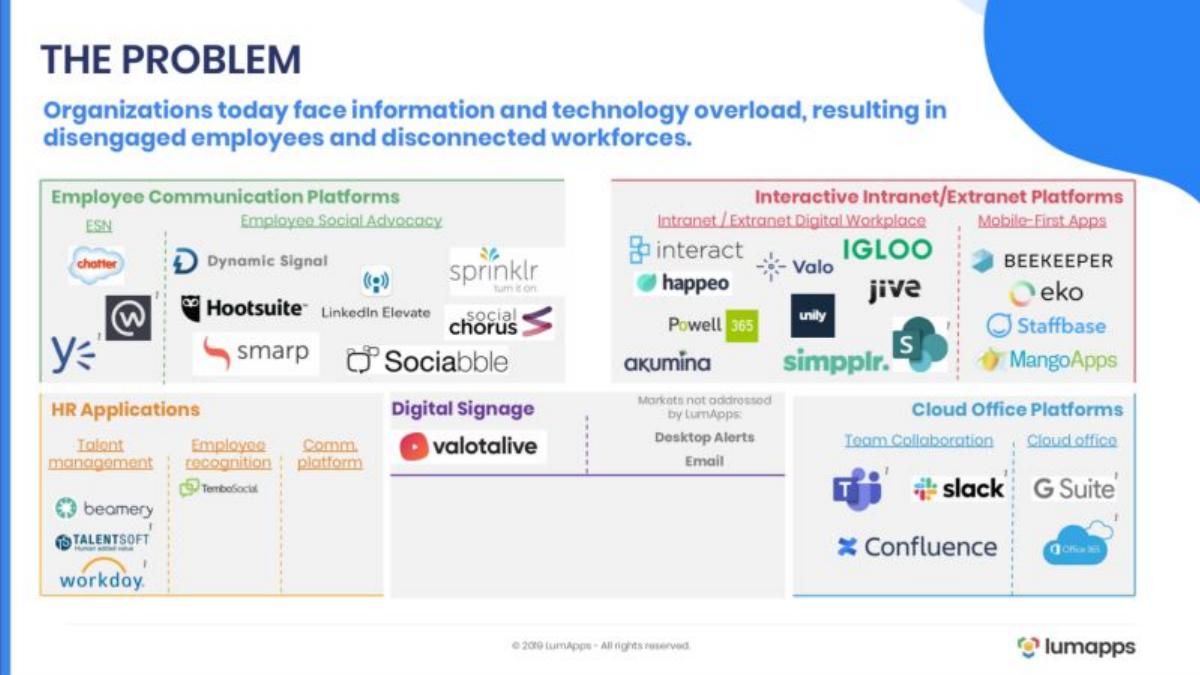
Slide 5, titled "THE PROBLEM," uses a landscape map to illustrate "information and technology overload." It visualizes the crowded ecosystem of Employee Communication Platforms (Chatter, Hootsuite), HR Applications (Workday, Talentsoft), and Cloud Office Platforms (Slack, G Suite, Teams). The slide argues that these tools, while useful, result in "disengaged employees and disconnected workforces" because they are siloed. This sets up LumApps not as another tool to add to the pile, but as the solution to the pile itself.
Slide 6: The Four Pillars of the Solution
The solution is presented as a "social collaborative platform based on 4 key pillars." These are:
Corporate Portal: For top-down communication. · Employee Social Advocacy: For external sharing on social media. · Enterprise Social Network: For horizontal discussions. · Collaboration Platform: For team and cross-team collaboration.
The slide uses UI mockups to show the product in action across desktop and mobile devices, proving the platform's versatility.
Slide 7: Technical Workflow
Slide 7 explains how the platform actually functions using a "Capture, Organize, Broadcast" framework. It highlights "Smart connectors" for tools like Workday and G Suite, a "headless CMS" for organization, and "Omnichannel communications" for broadcasting. This slide is critical for technical due diligence, as it shows how LumApps integrates with an enterprise's existing tech stack rather than requiring a total replacement.
Slide 8: The Logo Wall
Titled "A large portfolio of blue-chip companies," this slide is a pure validation play. It features logos from Google, Capital One, National Geographic, and Motorola , among others. The central text confirms 2.5m users and 250+ customers worldwide . For a Series C investor, this slide represents the de-risking of the investment; the product is already being used at the highest levels of global business.
Slide 9 & 10: Closing and Branding
Slide 9 is a simple branding slide with the LumApps logo, and Slide 10 is a placeholder for the BestPitchDeck catalogue. The deck ends without a formal "Ask" slide or a "Financials" slide in this public version. This is common in late-stage decks where the specific terms of the round are often handled in a separate data room or private memorandum.
What LumApps Does Well
The primary strength of this deck is its clarity of positioning . In Slide 5, they successfully turn their competitors into a justification for their own existence. By mapping out the "overload" of other tools, they position LumApps as the essential glue that holds the digital workplace together. Furthermore, the geographic diversity mentioned on Slide 3 (offices in Tokyo, Paris, and New York) signals to investors that the company has already solved the challenges of international scaling, which is a major hurdle for European-founded startups moving into the US market.
What is Missing from the Deck
As a teardown analyst, the most glaring omissions are the unit economics and growth rates . While we see the number of customers (250+), we do not see the Annual Recurring Revenue (ARR), the Net Revenue Retention (NRR), or the Customer Acquisition Cost (CAC). For a Series C round, these are usually the most important numbers. Additionally, there is no Competitive Matrix beyond the general problem slide. While they show where they fit in the ecosystem, they don't explicitly state why a customer would choose LumApps over a native solution like Microsoft SharePoint, which is their most direct competitor in the enterprise space.
Founder's Summary: What to Copy
Founders should emulate the "Pillar" approach used on Slide 6. Instead of listing fifty features, LumApps grouped their entire product value into four digestible categories. This makes it much easier for an investor to remember what the company does. Additionally, the "Capture, Organize, Broadcast" flow on Slide 7 is an excellent way to explain a complex SaaS backend in a way that feels logical and linear. Finally, if you have enterprise traction, do not hide your logos . LumApps dedicated an entire slide to their best customers, and it is arguably the most persuasive slide in the entire deck.
Frequently asked questions
- What is the primary value proposition of LumApps according to the deck?
- LumApps positions itself as an 'enterprise social collaborative platform' that transforms how organizations communicate and engage with employees. According to Slide 2, the mission is to make people feel they belong and have a purpose by developing a strong organizational culture and sharing knowledge across internal and external communities.
- How does LumApps differentiate itself from competitors like Slack or Microsoft Teams?
- Slide 5 categorizes competitors into silos like 'Employee Communication Platforms,' 'HR Applications,' and 'Cloud Office Platforms' (where Slack and Teams reside). LumApps differentiates by acting as the unifying 'Interactive Intranet/Extranet' layer that integrates these tools into a single corporate portal, rather than competing directly as a chat-only or file-storage-only tool.
- What specific enterprise customers are mentioned in the deck?
- Slide 8 lists a high-profile portfolio including Motorola Solutions, Finish Line, Capital One, Japan Airlines (JAL), Etam, TIBCO, Red Energy, Merieux NutriSciences, Google, Norauto, TMX, National Geographic, Global Payments, and John Lewis & Partners.
- What technical capabilities does the platform highlight?
- Slide 7 details a 'unique, complete, and flexible solution' featuring smart connectors for communication tools, a headless CMS structure, AI-powered search, a universal smart notification center, and omnichannel broadcasting capabilities for mobile apps and social advocacy.
- Is there a specific funding ask or financial projection in this deck?
- No. The 10-slide deck provided does not include a slide dedicated to the specific dollar amount requested, the valuation, or future revenue projections. It focuses entirely on the mission, team, problem/solution, and existing market traction.