Apteo's 12-slide pitch deck is a textbook example of a Seed-stage narrative that prioritizes problem-solution fit over raw traction metrics. Raised in 2019, the $1.1M round was built on the premise that financial firms were drowning in 'alternative data'—information outside of traditional SEC filings and price feeds—but lacked the data science resources to process it. The deck uses a clean, three-column layout across most slides to contrast the 'Before' (weeks of manual work) with the 'Now' (minutes of automated analysis). While the deck lacks specific revenue figures or a detailed cap table,…
Key takeaways
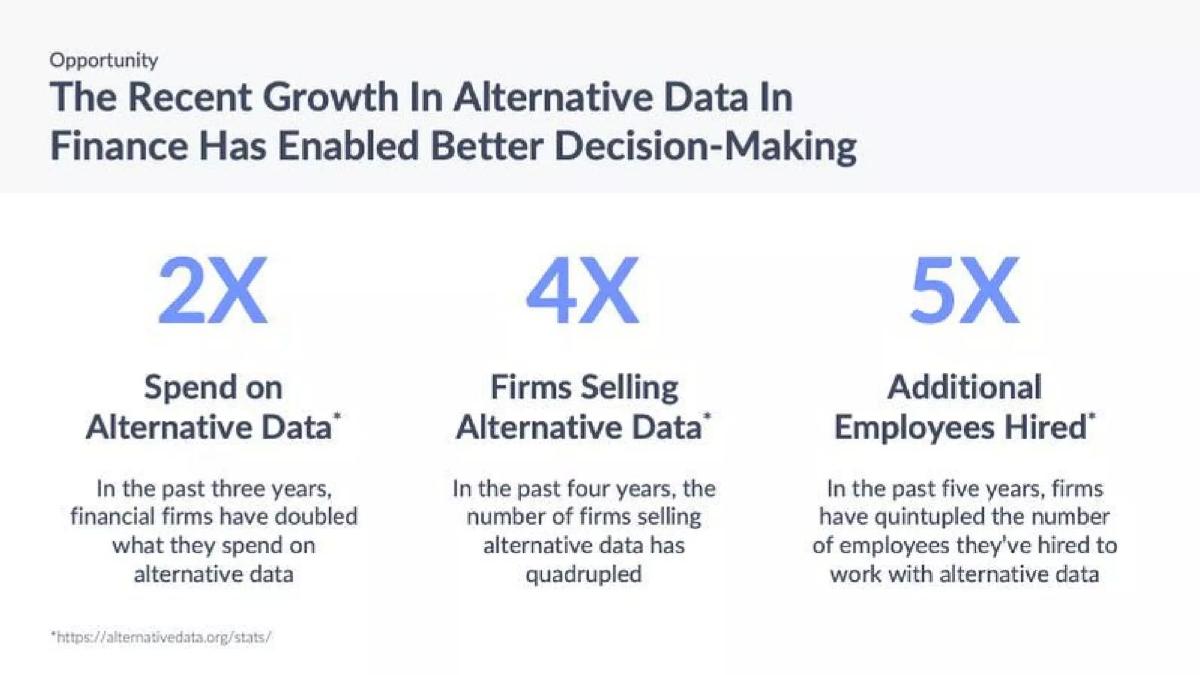
- The deck identifies a specific market shift: a 5x increase in employees hired to work with alternative data over five years (Slide 2).
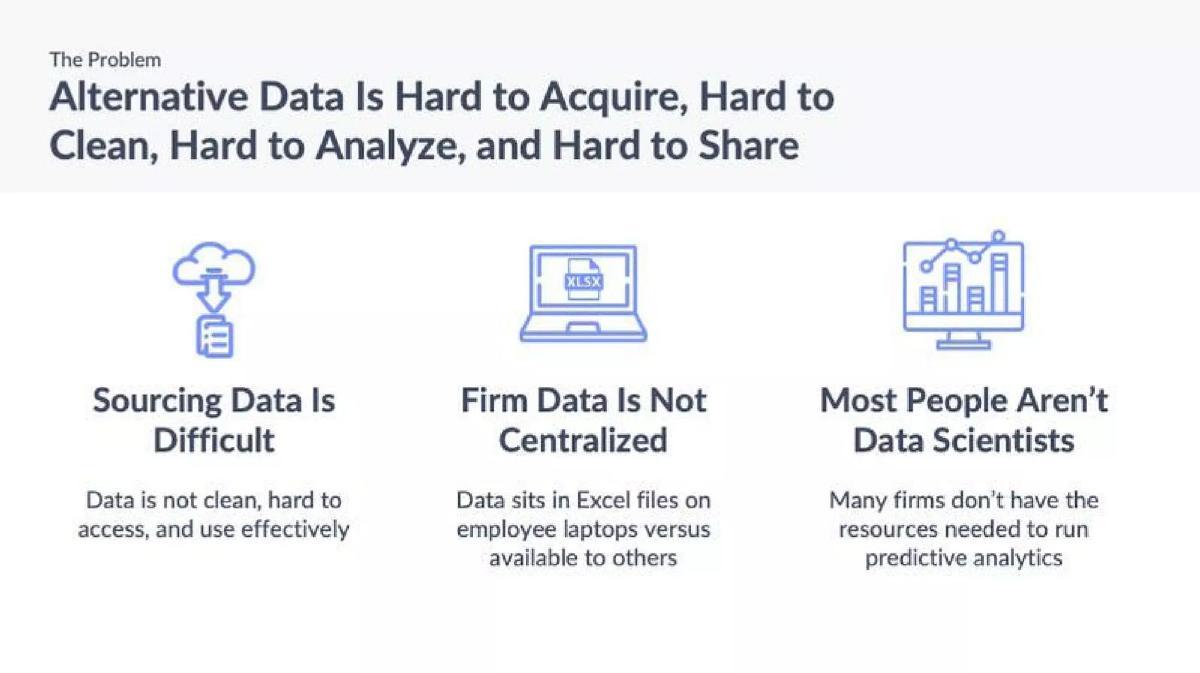
- The core problem is defined as data being 'hard to acquire, clean, analyze, and share' due to lack of centralization (Slide 3).
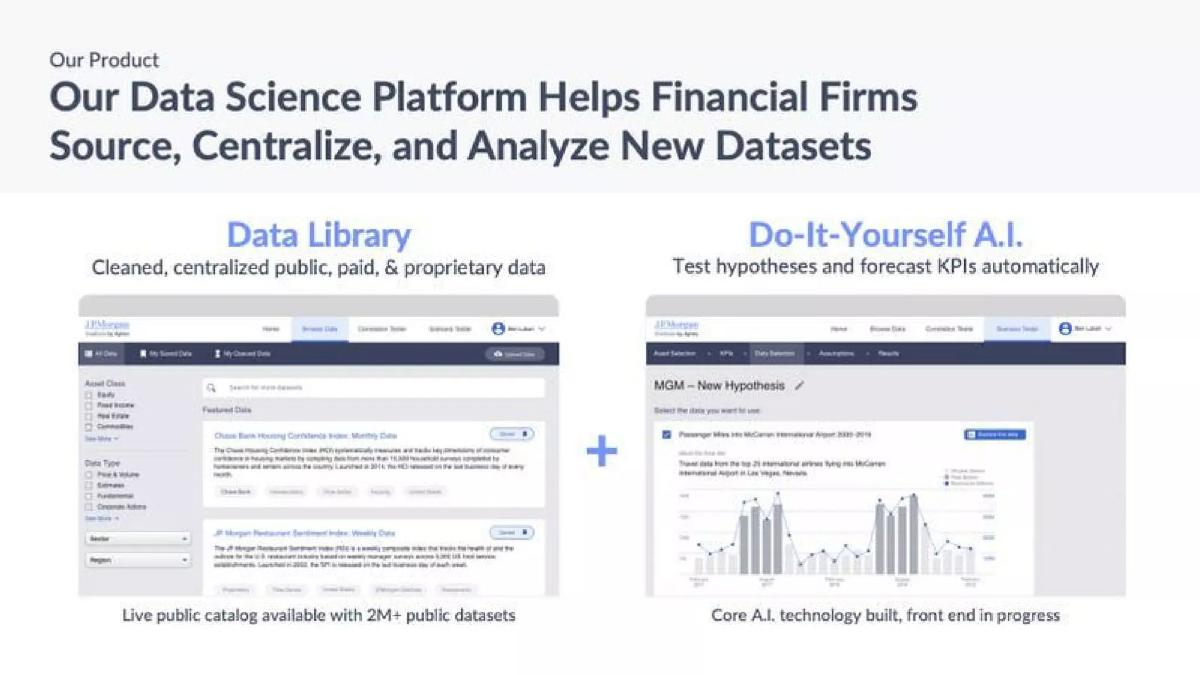
- Apteo positions its product as a dual offering: a 'Data Library' with 2M+ public datasets and a 'Do-It-Yourself A.I.' engine (Slide 4).
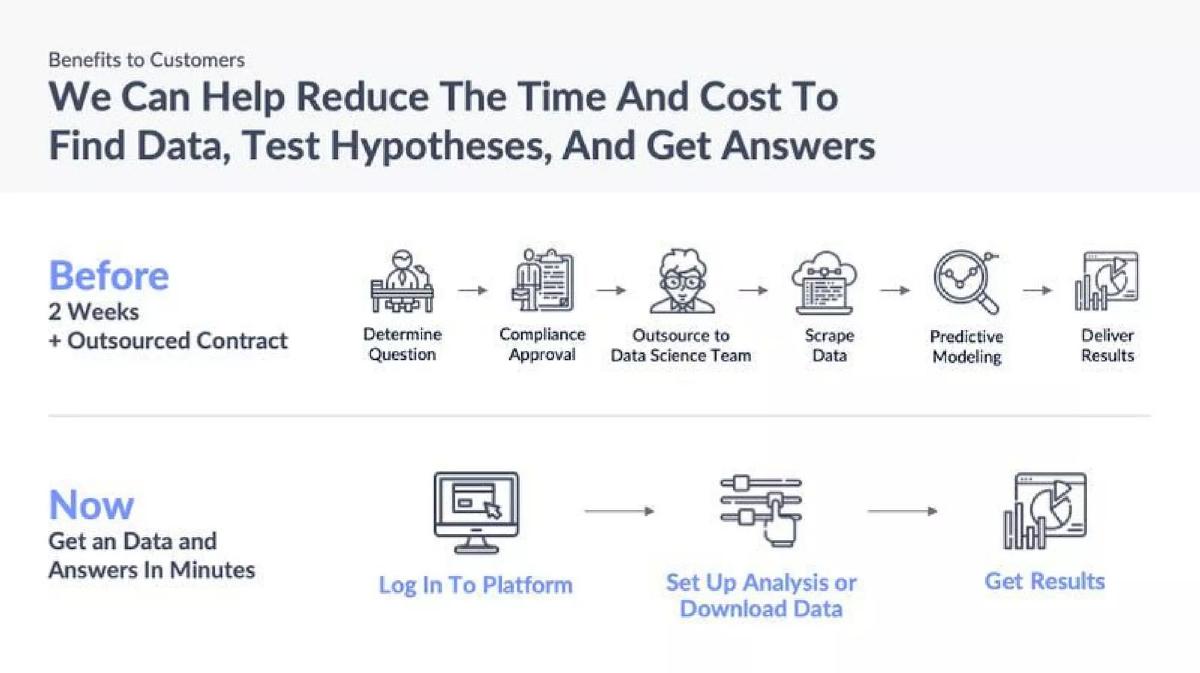
- The value proposition is framed as a time reduction from '2 Weeks + Outsourced Contract' to 'Answers In Minutes' (Slide 5).
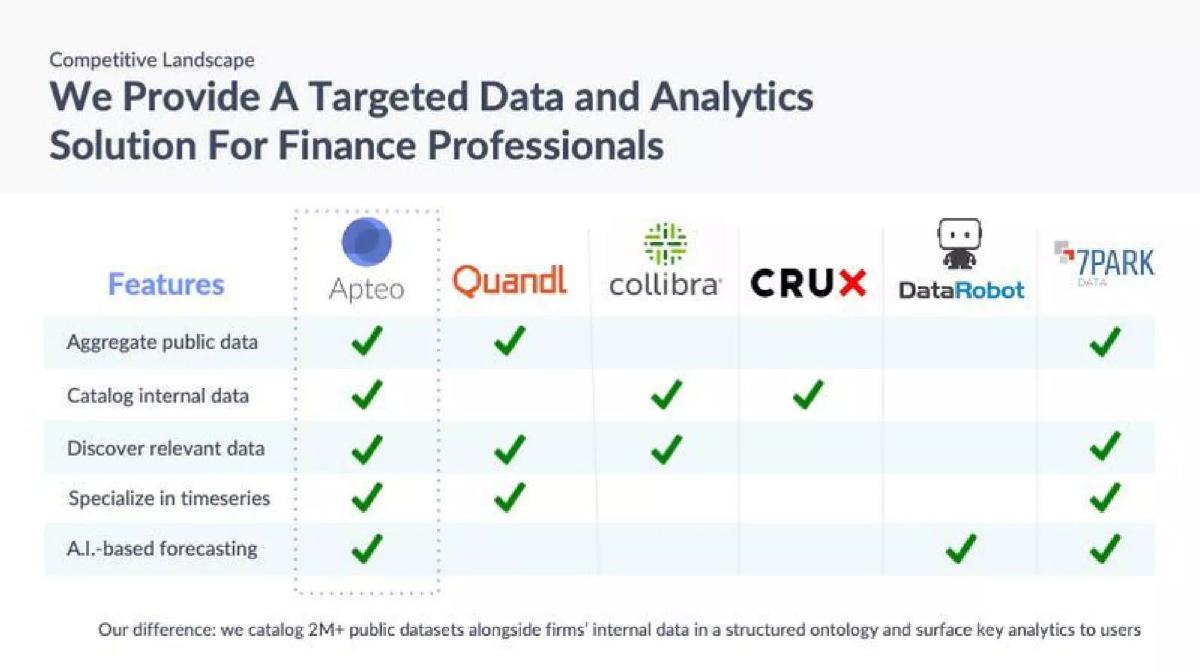
- A feature-by-feature comparison table pits Apteo against six competitors, including Quandl and DataRobot (Slide 6).
- The market size is segmented into a $440 Billion total US market and a $28 Billion addressable market for market data (Slide 7).
- The business model includes a '6-figure contract' integration fee for large institutions plus monthly per-user fees (Slide 9).
- The team slide highlights significant domain expertise, including a CEO from Twitter and a COO from Point72 (Slide 10).
The Narrative: Simplifying the Complex
Apteo’s pitch deck is a study in clarity. In the high-stakes world of financial technology, founders often fall into the trap of over-explaining their algorithms. Apteo avoids this by focusing on the workflow friction. The deck is structured to move the investor from a macro trend (the explosion of alternative data) to a micro solution (a platform that replaces weeks of manual labor with minutes of automated analysis).
Slides 1-3: The Macro Opportunity and The Friction
Slide 1: Title Slide The deck opens with a simple, clean aesthetic. The tagline, "Helping finance professionals make smarter decisions with data and analytics," is broad but establishes the target audience immediately. It includes contact information for the founders, which is a standard but necessary inclusion.
Slide 2: Opportunity This slide uses three large metrics to validate the market's momentum. It cites a 2X increase in spend on alternative data over three years, a 4X increase in firms selling that data over four years, and a 5X increase in employees hired to manage it over five years. By citing alternativedata.org , the founders ground their claims in industry-standard research. This slide successfully argues that the market is not just large, but rapidly accelerating.
Slide 3: The Problem The problem is broken down into three pillars: sourcing, centralization, and talent. The slide explicitly states that "Data sits in Excel files on employee laptops versus available to others" and that "Most people aren't data scientists." This identifies a clear gap: firms are buying data but lack the infrastructure to use it effectively. The phrasing "Hard to Acquire, Hard to Clean, Hard to Analyze, and Hard to Share" creates a checklist of pain points that the next slide promises to solve.
Slides 4-6: The Solution and Competitive Positioning
Slide 4: Our Product Apteo introduces its "Data Science Platform" as a two-part solution. On the left is the "Data Library," which they claim contains 2M+ public datasets. On the right is the "Do-It-Yourself A.I." The slide includes a screenshot of the interface, which is crucial for a Seed-stage deck to prove the product isn't just vaporware. However, a small caption notes that the "front end is in progress," a transparent admission that the product is still in development.
Slide 5: Benefits to Customers This is the "money slide" of the deck. It uses a linear process map to compare the "Before" and "Now." The "Before" state involves six steps—from compliance approval to outsourcing to a data science team—taking "2 Weeks + Outsourced Contract." The "Now" state reduces this to three steps: Log In, Set Up, and Get Results, taking only "Minutes." This visualizes the ROI in terms of time, which is the most valuable currency in finance.
Slide 6: Competitive Landscape The competition slide uses a standard feature matrix. It lists Quandl, Collibra, Crux, DataRobot, and 7Park Data. Apteo claims a unique position by checking every box, particularly the ability to both "Catalog internal data" and provide "A.I.-based forecasting." While these matrices are often biased, this one serves to show that Apteo understands its neighbors in the fintech ecosystem.
Slides 7-9: Market Size and Business Strategy
Slide 7: Market Opportunity Apteo uses a "bubble" visualization to show market tiers. They cite a $440 Billion total US market for financial services IT spending (via IDC, 2018) and a $28 Billion addressable market for financial market data and news (via Burton-Taylor, 2017). By providing specific sources and dates for these figures, they add a layer of professional rigor that investors expect in the finance sector.
Slide 8: Go-to-market The strategy is a three-step expansion: 1) Close initial design partners, 2) Expand within the vertical (large banks and mid-sized organizations), and 3) Expand across verticals (Private Equity and VC). The slide notes they are "currently in talks to close design partners," which signals that they are in the pre-revenue or very early pilot stage.
Slide 9: Business Model The revenue model is diversified. It includes a "6-figure contract" for large institutions (Integration Fee), a "Per-user monthly fee" (Recurring Fee), and "Additional sales from premium data" (Premium Data). This shows a sophisticated understanding of how enterprise software is sold in finance, where security and compliance integrations often command high one-time fees.
Slides 10-12: Team and The Ask
Slide 10: Our Team For a Seed round, the team slide is often the most important. Apteo’s founders have strong pedigrees. CEO Shanif Dhanani was a Data Scientist at Twitter and a Lead Engineer at TapCommerce (acquired by Twitter). COO Manan Shah has a deep finance background with stints at Point72, Coatue, and Morgan Stanley. CTO Mo Syed was a Machine Learning Engineer at Twitter. This combination of "Big Tech" engineering and "Big Finance" operations is a compelling narrative for a fintech startup.
Slide 11: Use of Funds The deck concludes with a clear plan for the capital. They intend to hire 2-3 additional full-stack engineers, operate the technical infrastructure, and hire a head of sales. This is a standard Seed-stage allocation, focusing on product completion and the transition to a repeatable sales process.
Slide 12: Contact A simple closing slide with a background image of the New York City skyline, reinforcing their focus on the financial capital. It provides a website and an investor-specific email address.
What Works
The "Before and After" Visualization: Slide 5 is exceptionally effective. It translates technical features into a business outcome (time savings) that any investor can understand. · Founder-Market Fit: The team slide (Slide 10) perfectly balances technical expertise (Twitter) with domain expertise (Point72). In fintech, having a COO who speaks the language of the customer is as important as having a CEO who can build the product. · Specific Market Sourcing: Rather than pulling "trillion-dollar" numbers out of thin air, the deck cites IDC and Burton-Taylor. This builds trust. · Clean Design: The consistent use of three-column layouts and a limited color palette makes the deck easy to digest in a quick flip-through.
What is Missing
Traction Metrics: While the deck mentions being "in talks" for pilots, there are no hard numbers on user engagement, waitlist size, or letter-of-intent (LOI) values. · Unit Economics: The business model slide (Slide 9) mentions "6-figure contracts," but it doesn't provide data on the cost of customer acquisition (CAC) or the expected lifetime value (LTV). · Case Studies: Even with a product in progress, a slide showing a specific use case—such as "How a hedge fund used Apteo to track retail foot traffic"—would have made the A.I. capabilities feel more concrete. · The Ask Amount: The deck states what they will do with the funds (Slide 11) but never explicitly states the dollar amount they are raising. While common in some decks to allow for flexibility, it leaves a key question unanswered.
What a Founder Should Copy
The Problem Breakdown: Copy the way Slide 3 categorizes the problem. By breaking a complex issue into "Sourcing," "Centralization," and "Talent," you make it easier for an investor to agree with your premise. · The Feature Matrix: Slide 6 is a great template for competitive analysis. It focuses on functional capabilities rather than just listing logos. · The Three-Step GTM: Slide 8 provides a realistic roadmap. Starting with "Design Partners" before moving to "High-touch enterprise sales" shows a mature understanding of the sales cycle. · The Use of Funds Icons: Slide 11 uses simple icons and bullet points to explain where the money goes. This is much better than a complex spreadsheet or a vague paragraph.
Frequently asked questions
- How much did Apteo raise with this deck?
- According to the catalogue facts, Apteo raised $1.1M in 2019. The deck itself does not specify the dollar amount being sought, only that the funds would be used for product development, technical infrastructure, and hiring initial sales personnel to launch paid pilots.
- What is the primary product Apteo is selling?
- Apteo describes its product as a Data Science Platform for financial firms. It consists of a live public catalog with over 2 million datasets and a 'Do-It-Yourself A.I.' tool that allows users to test hypotheses and forecast KPIs automatically without needing a dedicated data science team.
- Who are the competitors mentioned in the deck?
- Slide 6 lists six competitors: Quandl, Collibra, Crux, DataRobot, and 7Park Data. Apteo differentiates itself by being the only one (according to their chart) that aggregates public data, catalogs internal data, discovers relevant data, specializes in timeseries, and offers A.I.-based forecasting simultaneously.
- What is the business model described in the deck?
- The business model is a three-tiered approach. Large institutions pay a 6-figure annual integration fee for security and compliance. All customers pay a monthly per-user recurring fee for platform access. Finally, the company generates additional revenue through the sale of premium data on the platform.
- What stage of development was the product in during this raise?
- Slide 4 notes that the 'Core A.I. technology' was built, but the 'front end' was still in progress at the time of the deck. Slide 8 further clarifies that they were in the process of finalizing paid pilots with initial design partners among banks and asset managers.