Arbol’s 13-slide pitch deck, used for their $60M Series B in 2024, prioritizes institutional authority over granular product walkthroughs. The deck leans heavily on a 'Paradigm Shift' narrative, citing regulatory pressures like the SEC and EU's CSRD to justify the urgency of climate risk management. Rather than showing software screenshots, Arbol highlights a leadership team with pedigrees from Citadel, AIG, and BlackRock, signaling to investors that they possess the sophisticated financial engineering required for parametric insurance. While the deck lacks specific revenue figures or a detai…
Key takeaways
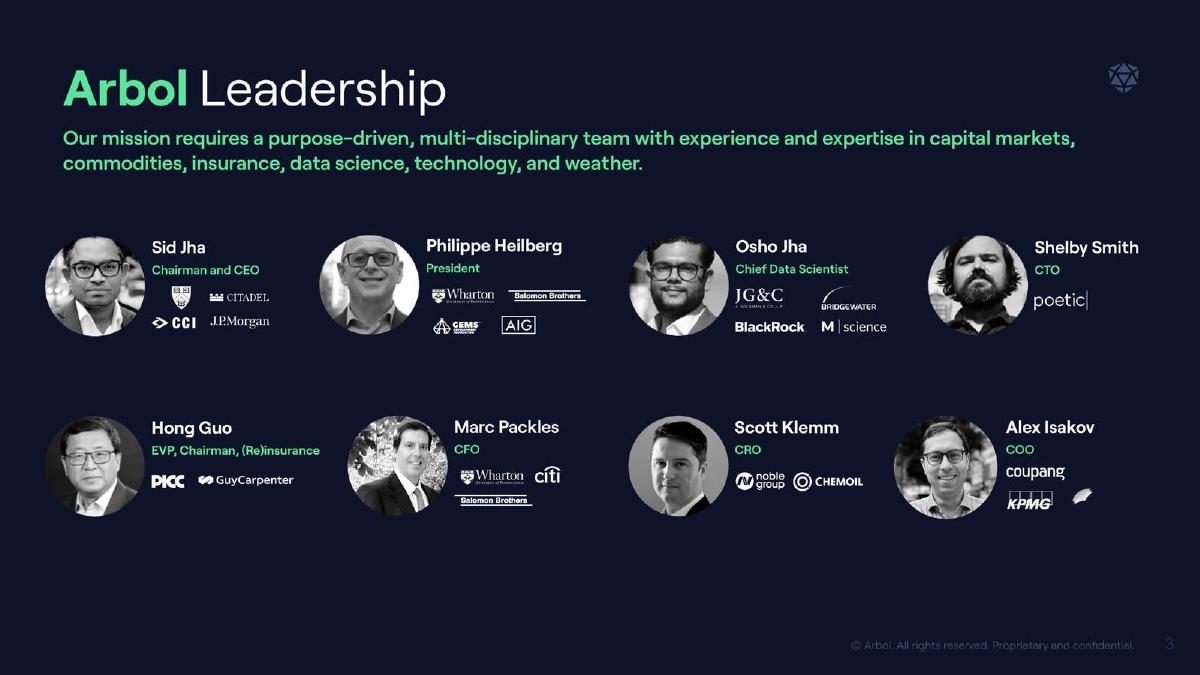
- The leadership slide (Slide 3) is the deck's strongest asset, featuring logos from Citadel, JPMorgan, BlackRock, and AIG to establish immediate institutional trust.
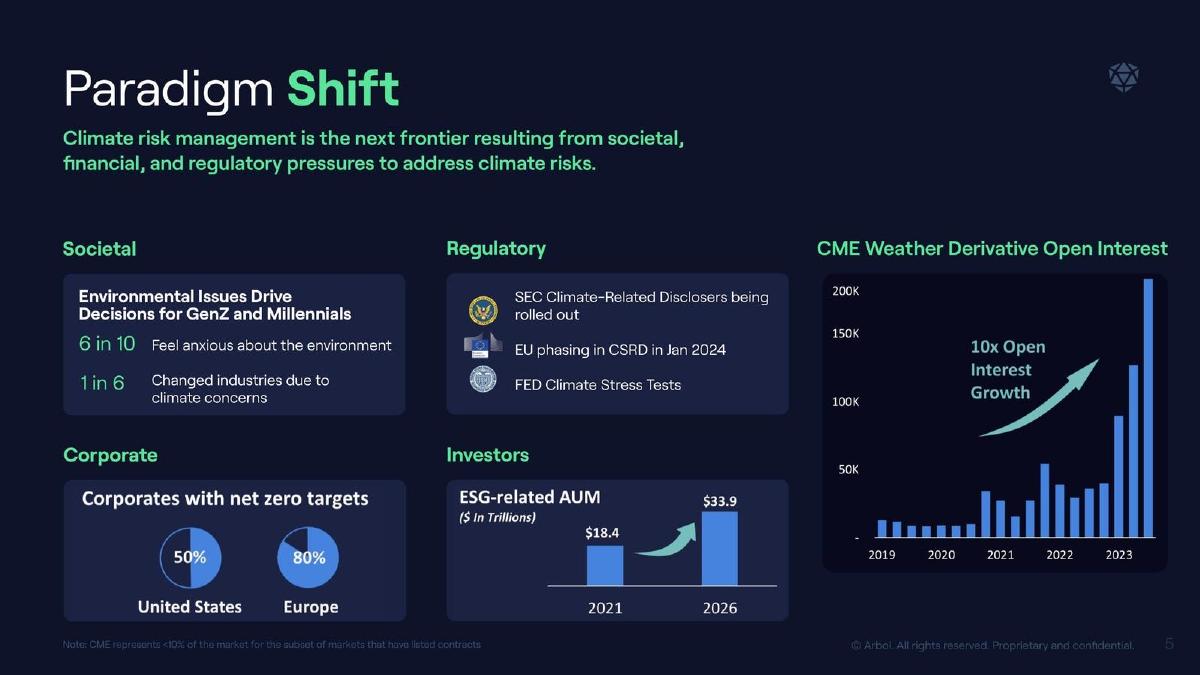
- Market timing is validated on Slide 5 by showing a 10x growth in CME Weather Derivative Open Interest between 2019 and 2023.
- The deck identifies four key drivers for their 'Paradigm Shift': Societal, Regulatory, Corporate, and Investors (Slide 5).
- Product versatility is demonstrated on Slide 7, covering eight distinct climate risks including solar farm hail damage and ski resort snowfall shortfalls.
- Arbol positions itself as a creator of a 'new climate asset class' rather than just an insurance broker (Slide 11).
- The platform handles a wide range of premium sizes, from $500 to over $10M, indicating a broad market reach across agriculture and energy (Slide 7).
- Regulatory tailwinds are specifically cited, including the SEC's climate disclosures and the FED's climate stress tests (Slide 5).
- The deck utilizes a 'Growth Flywheel' (Slide 11) to explain how increasing data trains AI models, which in turn attracts more capital and traders to their market.
The Institutional Approach to Climate Risk
Arbol’s Series B deck is a masterclass in positioning a startup as an inevitable market leader. In the world of fintech and insurtech, especially when dealing with complex instruments like parametric insurance, the 'who' is often more important than the 'how.' Arbol leans into this heavily, spending significant real estate on the pedigree of its team and the macro-economic shifts making their solution necessary. Reported by Business Insider to have raised $60M in 2024, this deck reflects a company that is no longer proving a concept, but rather claiming a territory.
Slide 1-2: Branding and Vision
The deck opens with a minimalist title slide. The tagline, "The Future of Climate Risk Management," is broad but authoritative. It avoids the 'Uber for X' tropes, instead positioning Arbol as a category definer. The use of a dark, professional color palette with a geometric logo suggests stability and technical sophistication—key traits for a company asking to manage millions in risk.
Slide 3: Arbol Leadership
This is arguably the most important slide in the deck. For a Series B company, investors are looking for a team that can handle institutional-grade capital. Arbol lists eight key leaders, each accompanied by logos of prestigious former employers. Sid Jha (Chairman and CEO) brings experience from Citadel and JPMorgan . Philippe Heilberg (President) comes from AIG and Salomon Brothers . Osho Jha (Chief Data Scientist) carries the BlackRock and Bridgewater pedigree. By front-loading these names, Arbol preemptively answers questions about their ability to navigate complex capital markets and regulatory environments. The slide explicitly states their mission requires a team with expertise in "capital markets, commodities, insurance, data science, technology, and weather."
Slide 5: Paradigm Shift
Slide 5 moves from the 'who' to the 'why now.' It breaks down the market opportunity into four distinct categories: Societal, Regulatory, Corporate, and Investors. The data points are specific and compelling. Under Societal, they note that 6 in 10 people feel anxious about the environment. Under Regulatory, they cite the SEC Climate-Related Disclosures and the EU phasing in CSRD in Jan 2024 . The most striking visual on this slide is the CME Weather Derivative Open Interest chart, which shows a 10x growth in open interest from 2019 to 2023. This isn't just a 'market is big' slide; it's a 'market is moving right now' slide. They also project ESG-related AUM to hit $33.9 Trillion by 2026 , up from $18.4 Trillion in 2021.
Slide 7: Our Products
This slide provides the first look at the breadth of Arbol's platform. It notes that the platform handles premium sizes ranging from "$500 to over $10M." This range is significant because it shows scalability from small-scale agriculture to massive energy infrastructure. The slide lists eight specific product applications:
Temperature: Utility covering warm winters. · Rainfall: Farmer covering drought risk. · Wind: Wind farm insuring production shortfall. · Crop Yield: Agribusiness insuring supply chain disruption. · Storm: Florida insurer purchasing hurricane reinsurance. · Solar: Solar farm insuring production shortfall. · Snowfall: Ski resort insuring low snowfall. · Hail: Solar farm insuring against hail damage.
This list demonstrates that Arbol has moved beyond a single-use case and has built a horizontal platform for climate risk.
Slide 9: Three Critical Elements
Slide 9 simplifies the business model into a three-part equation: Technology + Partnerships + Capital. This is a standard strategic framework, but in the context of parametric insurance, it highlights the three barriers to entry. You need the Technology to process climate data, the Partnerships to reach the customers, and the Capital to back the risk. By presenting these as the 'critical elements,' Arbol is telling investors exactly where their $60M will be deployed: strengthening these three pillars.
Slide 11: Our Growth Flywheel
The 'Flywheel' slide is a staple of modern pitch decks, and Arbol uses it to explain their network effects. The cycle starts with "Increase data and trains AI models," which leads to "Illustrate value proposition, grow customers and market," then "Expand partnerships and become more embedded," and finally "Attract traders, capital, and others to the market." The core message here is that Arbol isn't just selling insurance policies; they are "building a new climate asset class." This is a much higher-valuation narrative than being a simple MGA (Managing General Agent).
Slide 13: Disclaimer
The final slide is a standard legal disclaimer. While often ignored in teardowns, its presence in a 13-slide deck reinforces the institutional nature of the raise. It signals that the company is operating with the legal rigor expected of a Series B fintech firm.
What Arbol Does Exceptionally Well
Arbol excels at Institutional Positioning . Many climate-tech startups lead with 'saving the planet' imagery. Arbol leads with 'managing financial risk.' By focusing on regulatory mandates (SEC, FED, EU) and market liquidity (CME derivatives), they speak the language of Series B investors who are looking for de-risked, macro-aligned opportunities. The team slide is a masterclass in 'Logo Dropping'—it doesn't just list names; it builds a wall of credibility that makes it difficult for an investor to doubt their technical or financial execution capability.
Furthermore, the Product Versatility shown on Slide 7 is crucial. It proves that Arbol isn't a 'one-trick pony' dependent on a single weather event or industry. By showing they can cover everything from ski resorts to solar farms, they demonstrate a massive Total Addressable Market (TAM) without having to include a generic, often-inflated TAM slide.
What is Missing from the Deck
The most glaring omission is Internal Traction Metrics . There are no slides showing Arbol's year-over-year revenue growth, number of active policies, total insured value (TIV), or loss ratios. While the CME chart shows the market is growing, it doesn't explicitly show that Arbol is capturing that growth. For a $60M Series B, these numbers were undoubtedly in the data room, but their absence from the primary deck suggests this was a 'teaser' deck meant to secure the first meeting rather than the final investment committee deck.
Additionally, there is no Competitive Landscape slide. The deck assumes a vacuum or that Arbol's 'new asset class' positioning makes competition irrelevant. In a crowded insurtech market, investors usually want to see how a company differentiates itself from incumbents (like Swiss Re or Munich Re) and other startups (like Descartes Underwriting). Finally, the lack of an Ask Slide is a missed opportunity to define the narrative of the round's purpose, though in high-profile Series B rounds, the 'Ask' is often negotiated rather than dictated.
Founder's Playbook: Lessons to Copy
1. Use Macro Proxies for Traction: If your specific industry is emerging, use established market data (like Arbol's use of CME Weather Derivatives) to prove that the 'pipes' for your business are already being laid. It provides a sense of inevitability.
2. The 'Logo Wall' Team Slide: If your team has a high-pedigree background, don't just list their titles. Use the logos of the institutions they came from. It creates a psychological shortcut for investors to trust your expertise.
3. Categorize Your Tailwinds: Don't just say 'the market is growing.' Break it down like Slide 5 did: Societal, Regulatory, Corporate, and Investors. This shows a multi-dimensional understanding of your business environment and makes the 'Why Now' argument much harder to refute.
4. Simplify Complex Models: Parametric insurance involves complex data science and financial hedging. Arbol avoided the weeds, instead using a simple 'Flywheel' and a 'Three Elements' slide to make their business model digestible in seconds.
Frequently asked questions
- What is Arbol's core business model according to the deck?
- Arbol operates a climate risk management platform that utilizes technology, partnerships, and capital to address financial risks. As shown on Slide 7, they offer parametric insurance products for sectors like agriculture and energy, covering risks such as rainfall, wind, and solar production. Their model relies on objective data markers to trigger payouts, aiming to build a new climate asset class.
- How does Arbol justify the market need for their product?
- Arbol uses Slide 5 to illustrate a 'Paradigm Shift' driven by four pillars: Societal (Gen Z/Millennial anxiety), Regulatory (SEC and EU mandates), Corporate (Net Zero targets), and Investors (ESG-related AUM projected to reach $33.9 trillion by 2026). They specifically point to the 10x growth in weather derivative trading as proof of increasing market liquidity and demand.
- Who are the key people behind Arbol?
- The leadership team, detailed on Slide 3, includes Chairman and CEO Sid Jha (formerly of Citadel and JPMorgan), President Philippe Heilberg (AIG and Salomon Brothers), and Chief Data Scientist Osho Jha (BlackRock and Bridgewater). The team combines expertise in capital markets, data science, and insurance, which is critical for a high-stakes fintech company.
- What specific industries does Arbol target?
- According to Slide 7, Arbol focuses on the agriculture, energy, and reinsurance sectors. Their products are tailored for specific use cases like utilities covering warm winters, farmers insuring against drought, wind farms managing production shortfalls, and ski resorts protecting against low snowfall.
- What is missing from the Arbol pitch deck?
- The deck is notably light on internal financial metrics. It does not list current ARR, loss ratios, or specific customer names. Furthermore, there is no 'Ask' slide detailing the $60M round terms or a 'Use of Funds' slide. This suggests the deck was likely a high-level teaser or part of a process where financials were shared in a separate data room.